Single review
Thames & Kosmos Mechanical Engineering Review
Reviewed from Thames & Kosmos's published specifications. We have not built it. Every other kit in this line publishes a floor; this one publishes a band, and that turns out to be the most useful thing on the box.
By Sawyer V. · Published
The short answer
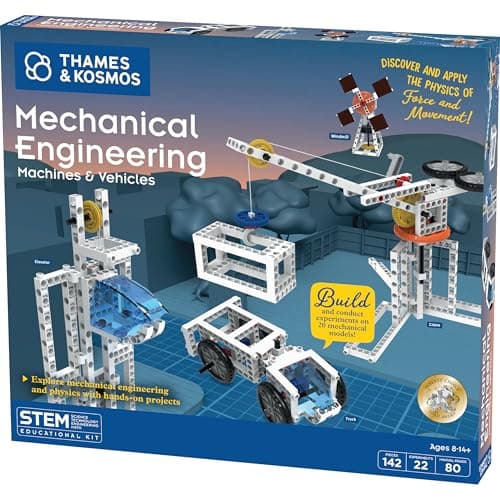
Thames & Kosmos Mechanical Engineering: Machines & Vehicles is the kit to buy when the child wants to build machines they have actually seen. The maker publishes 20 building projects and 22 supplemental experiments with an 80-page full-color manual, on a “durable, reusable building system” — and the named models are a tightrope walker, an elevator, a crane, a windmill and an all-wheel drive ATV. It is published for “kids ages 8-14+”, the only band rather than a floor in this line.
Block & Beaker earns a commission when you buy through our links, at no cost to you. It never changes a ranking, and we say so plainly when the right answer is the cheaper set, or nothing at all. Full disclosure · How we pick.
At a glance
The picks, ranked
Tap any row to jump to the full reasoning. Prices come live from Amazon where we have them and read “check price” where we don’t — never a number we cannot stand behind today.
| # | Product | Best for | Price |
|---|---|---|---|
| 1 | The product Thames & Kosmos Mechanical Engineering: Machines & Vehicles 20 projects and 22 experiments building a crane, an elevator, a windmill and an ATV. | Eight to fourteen, for a child who points at cranes | |
| 2 | 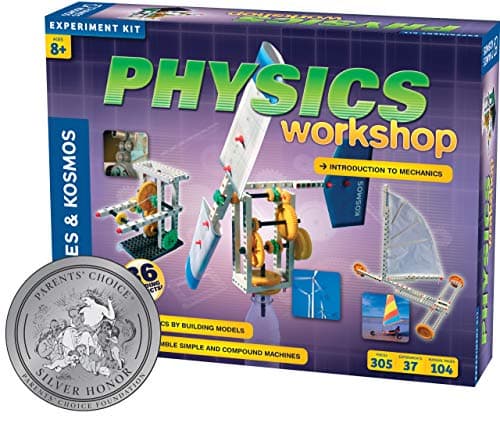 The sibling with the theory Thames & Kosmos Physics Workshop 38 models and 37 experiments from 305 pieces, with a 104-page manual. | Eight and up, for a child who wants the equation as well as the machine | |
| 3 | 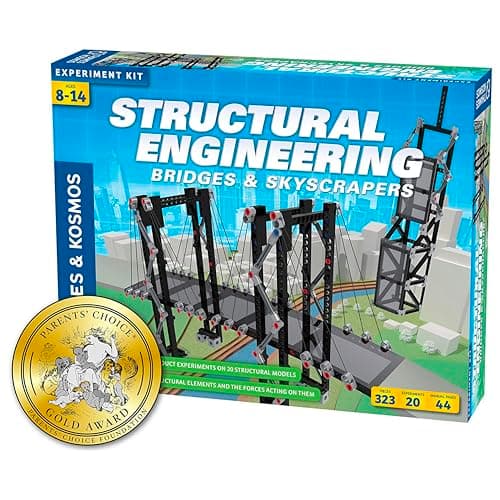 The other branch — things that hold still Thames & Kosmos Structural Engineering: Bridges & Skyscrapers 20 models from 285+ interchangeable pieces, on force, load, compression and tension. | Eight and up, for a child drawn to bridges and towers | |
| 4 | 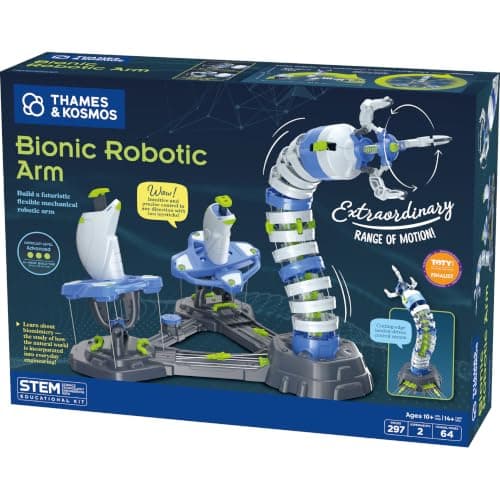 The step up, and the one with no motor in it Thames & Kosmos Bionic Robotic Arm Nearly 300 pieces, two joysticks, and a network of nylon cables doing all the work. | Ten and up with help, fourteen and up alone — the maker's own words | |
| — | 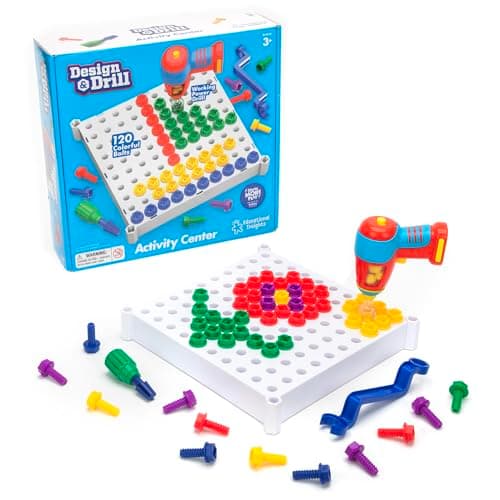 Five published years early Design & Drill Activity Center A working kid-sized power drill, 120 bolts, an activity board and 10 double-sided cards. | Three to five, where it is genuinely one of the best things on the shelf |
5 picks, including 1 we tell you to skip. Ages shown are the manufacturer’s own rating, not ours.
What we can tell you, and what we cannot
We have not built it. No lab, no samples, no test children, and no star rating on this page or in its structured data. Everything below is Thames & Kosmos’s own published information plus arithmetic.
Three limits. The maker publishes no piece count for this kit at all, so we cannot tell you how much is in the box — and we are not going to infer it from the shipping weight. It publishes “physics in the solar system” among the topics and never explains what that means in a kit about cranes and elevators, so neither will we. And thamesandkosmos.com has refused every request from this machine across three runs, so these figures come from the manufacturer’s published listing copy rather than its product page — which is why there are no NGSS correlations here.
The specification that decides it
The arithmetic
T&K Mechanical Engineering: Machines & Vehicles (625419), published
| Building projects | 20 |
|---|---|
| Supplemental experiments | 22 |
| Piece count | Not published — no total and no breakdown |
| Manual | 80 pages, full color, step-by-step illustrated |
| Models named | “a tightrope walker, elevator, crane, windmill, all-wheel drive ATV, and more” |
| Topics | “forces, gravity, weight, simple machines, storing and converting energy, momentum and gears, physics in the solar system” |
| Real-world framing | “construction sites, … rollercoaster rides, … automotive engineering” |
| System | “Durable, reusable building system” — combine and reconfigure |
| Stated age | “Kids ages 8-14+” — a band, not a floor |
| Power | None published as required |
| Box | 13 x 11.5 x 1.8 in; 0.93 lb |
| Consumables | None |
Why a band beats a floor
Almost every kit this site covers publishes an age floor: 8+, 10+, 5 and up. A floor answers one question — is my child old enough — and says nothing about the one parents of older children actually ask, which is whether it will still be interesting.
Thames & Kosmos publishes “kids ages 8-14+” here, and the sibling Bionic Robotic Arm goes further with “ages 10+ with help or 14+ for independent play” — the most precise age statement anywhere in this catalog, because it separates the age a child can do it with an adult from the age they can do it alone. Those are different numbers for every kit ever made and almost nobody prints both.
Read the band as the maker’s own estimate of the useful window, and it does real buying work. At eight this is a guided build with an adult nearby; at eleven it is independent; at fourteen the published claim is “still worth it”, which for a 20-project kit is optimistic but not absurd given the components are published as reconfigurable.
The arithmetic
Published ages across the same maker's engineering and physics line
| Mechanical Engineering | “Kids ages 8-14+” — the only band |
|---|---|
| Physics Workshop | Ages 8 and up |
| Structural Engineering | Ages 8+, skill level “Intermediate” |
| Electricity & Magnetism | Ages 8+, “Skill Level: Intermediate” |
| Catapult Engineering | Ages 8+ |
| Bionic Robotic Arm | “10+ with help or 14+ for independent play” |
Say the unwelcome thing
Do not treat the top of the band as a promise
Apparatus or machinery: the question underneath
The Thames & Kosmos physics and engineering kits all cost roughly the same, publish roughly the same age and sit on the same shelf. The thing that actually separates them is what the finished model is.
Apparatus demonstrates a principle. A centrifuge, a pendulum, a magnetic field box. It exists to make something invisible visible, and when the experiment is over it has no other job. The Physics Workshop is mostly this, and its 104-page manual with equations is the correct support for it.
Machinery does a job. A crane lifts, an elevator raises, a windmill turns something. It can be pointed at out of a car window, which means the kit is explaining something the child has already noticed and wondered about. That is a different and often stronger motivation, and it needs less explaining — which is why 80 pages sits between the structures kit’s 36 and the physics kit’s 104.
And structures just stand there, usefully. A bridge proves itself by not falling. See the Structural Engineering review for why that one needs the shortest manual of the three.
The practical version: ask which the child has pointed at. If it is diggers and cranes, this kit. If it is “how does that work” about something with no moving parts, the structures kit. If it is “but why”, the Physics Workshop.
Who should skip it
Anyone who wants the physics explained properly. Eighty pages of step-by-step assembly with “digestible” explanations is not the same as 104 pages containing equations. The maker is clear about which kit is which.
A child under eight. The published band starts at eight. Below that, engineering toys for preschoolers is the right page, and the Design & Drill set above is one of its best entries.
Anyone who needs to know what is in the box. No piece count is published. If an exact component list matters — for a classroom, or for comparing against a set you already own — the structures kit publishes “over 285” and the Physics Workshop publishes 305.
A household that already owns a big mechanics system. With LEGO Technic or a large K’NEX box already in the house, the new thing here is the 80-page manual and the named models rather than the mechanisms. See LEGO Technic by age.
Worth knowing before you buy
Where it sits
This kit belongs on mechanical toys for kids, which covers the same question across brands, and in the engineering category at engineering toys for kids. Its two siblings are reviewed at Physics Workshop and Structural Engineering, and the wider shelf is at physics kits for kids. For the age above this band, see engineering toys for teens.
In full
Every pick, and what is wrong with it
Published specifications only, each linked back to the page it came from. Where a manufacturer publishes nothing, the row says so — we do not fill blanks in.
1. The product
Thames & Kosmos Mechanical Engineering: Machines & Vehicles
Thames & Kosmos · 625419 · maker rates it 8-14+
20 projects and 22 experiments building a crane, an elevator, a windmill and an ATV.
- Building projects
- 20
- Supplemental experiments
- 22
- Models named
- “a tightrope walker, elevator, crane, windmill, all-wheel drive ATV, and more”
- Topics covered
- “forces, gravity, weight, simple machines, storing and converting energy, momentum and gears, physics in the solar system”
Thames & Kosmos publishes “20 hands-on building projects and 22 supplemental experiments” for “kids ages 8-14+”, on a “durable, reusable building system” whose components “combine and reconfigure”. Named models: “a tightrope walker, elevator, crane, windmill, all-wheel drive ATV, and more”. The 80-page full-color experiment manual “guides the assembly of models through step-by-step, illustrated instructions and provides digestible, easy-to-understand explanations”. Model 625419, 13 x 11.5 x 1.8 inches at 0.93 lb, no batteries published as required.
The named models are the product. A crane, an elevator and a windmill are machines a child has stood underneath and watched working, and building a small one closes a loop that no apparatus can. Compare the Physics Workshop, whose models demonstrate centrifugal force and gear ratios — real physics, and nothing a child has ever pointed at from a car window.
The published topic list is broad and mostly sensible: “forces, gravity, weight, simple machines, storing and converting energy, momentum and gears”. The maker also names the real-world payoff explicitly — construction sites, rollercoaster rides, automotive engineering — which is the same loop stated from the other end.
Honest drawbacks, and there are three. No piece count is published anywhere — the sibling kits publish 305 and “over 285”, and this one publishes neither a total nor a breakdown, which on a construction system is the figure a buyer most wants. Twenty projects is also fewer than the Physics Workshop’s 38. And the topic list ends with “physics in the solar system”, which the maker does not elaborate anywhere and which does not obviously belong in a kit about cranes.
Replay signal
- Open-ended or one-shot
- 20 published projects, then a reconfigurable system
- Does anything run out
- Nothing runs out
- Room to grow
- Published as combining and reconfiguring into further models
Why we say so: Thames & Kosmos publishes 20 building projects plus 22 supplemental experiments with an 80-page manual, aimed at 8-14+. The named models are the tell: a crane, an elevator, a windmill and an all-wheel-drive ATV are machines a child has seen working in the world, which is a different proposition from a physics kit built around abstractions.
What’s wrong with it
No piece count published at all, and 20 projects against the Physics Workshop's 38.
| Building projects | 20 |
|---|---|
| Supplemental experiments | 22 |
| Models named | “a tightrope walker, elevator, crane, windmill, all-wheel drive ATV, and more” |
| Topics covered | “forces, gravity, weight, simple machines, storing and converting energy, momentum and gears, physics in the solar system” |
| Manual | “80-page, full-color experiment manual” |
| System | “Durable, reusable building system” — components combine and reconfigure |
| Stated age | “Kids ages 8-14+” |
| Batteries | None published as required |
| Consumables | None |
Every figure above is from Thames & Kosmos, Mechanical Eng: Machines & Vehicles (625419) — published listing copy. Blanks are shown as “not published” rather than filled in.
2. The sibling with the theory
Thames & Kosmos Physics Workshop
Thames & Kosmos · 625412 · maker rates it 8+
38 models and 37 experiments from 305 pieces, with a 104-page manual.
- Models
- 38
- Experiments
- 37
- Piece count
- 305
- Manual
- “104-page full-color manual” written by Dr. Uwe Wandrey, with “keyword definitions, real-world examples, data charts, and fundamental physics equations”
Thames & Kosmos publishes 38 models and 37 experiments from 305 pieces across five sequenced chapters, in a “104-page full-color manual” by Dr. Uwe Wandrey containing “fundamental physics equations”. Parents’ Choice Silver Award, rated 8+.
Nearly twice the models and a manual a quarter longer again, for a similar price. On paper it is the better kit, and for a child who asks why it is.
What it does not have is a crane. The distinction worth holding onto is apparatus versus machinery: a centrifuge proves a principle, an elevator does a job. Children who want the second are not persuaded by more of the first. See the Physics Workshop review.
Replay signal
- Open-ended or one-shot
- 38 models, then 305 reusable parts — the system builds things the manual does not show
- Does anything run out
- Nothing runs out; no batteries and no consumables
- Room to grow
- Five published chapters that build on each other, ending at a working pendulum clock
Why we say so: Thames & Kosmos publishes 38 models and 37 experiments from 305 pieces, structured into five chapters that progress from gravity to centrifugal force, documented in a 104-page manual containing actual physics equations. The manual is the product here: it is the only one in this catalog with equations in it, and at 104 pages it is longer than any other kit's by a wide margin.
What’s wrong with it
104 pages is a reading commitment, and its models are apparatus rather than machines.
| Models | 38 |
|---|---|
| Experiments | 37 |
| Piece count | 305 |
| Manual | “104-page full-color manual” written by Dr. Uwe Wandrey, with “keyword definitions, real-world examples, data charts, and fundamental physics equations” |
| Chapters | 5 — “gravity and inertia through simple machines, gears and energy transfer, forces at work, and centrifugal force”, each building on the last |
| Concepts covered | “gravity, mass, levers, pulleys, inclined planes, gears, sprockets, chain drives, pendulums, centrifuges” |
| Published end point | “from first experiment to working pendulum clock” |
| Standards | Published as “aligned with Next Generation Science Standards”; the listing does not state which correlations |
| Award published | Parents' Choice Silver Award |
| Batteries | None published as required |
| Stated age | Ages 8 and up |
| Consumables | None |
Every figure above is from Thames & Kosmos, Physics Workshop (625412) — published listing copy. Blanks are shown as “not published” rather than filled in.
3. The other branch — things that hold still
Thames & Kosmos Structural Engineering: Bridges & Skyscrapers
Thames & Kosmos · 625414 · maker rates it 8+
20 models from 285+ interchangeable pieces, on force, load, compression and tension.
- Models
- “20 different models that each teach about force, load, compression, tension and more”
- Piece count
- “Over 285 interchangeable building pieces”
- Manual
- “36-page, illustrated experiment manual and Assembly guide”
- Skill level
- Published as “Intermediate”
Thames & Kosmos publishes 20 models “that each teach about force, load, compression, tension and more” from “over 285 interchangeable building pieces”, with a 36-page illustrated manual plus a separate assembly guide. Skill level Intermediate, rated 8+.
Same brand, same price band, same published floor, and the exact complement: structures resist motion, machines produce it. Twenty models each, and the choice is simply buildings or machinery.
The crane is the interesting overlap — a machine that is also a structure, and it sits in this review’s kit rather than that one. See the Structural Engineering review.
Replay signal
- Open-ended or one-shot
- 20 models, then 285+ interchangeable pieces that build structures the manual does not
- Does anything run out
- Nothing runs out
- Room to grow
- The published interchangeability is the growth — the parts are a system, not a model
Why we say so: Thames & Kosmos publishes 20 models from over 285 interchangeable pieces, each teaching force, load, compression and tension, in a 36-page manual. Note the ratio against the Physics Workshop: a similar piece count and a manual a third the length, because a bridge that stands is its own proof and needs less explaining than a centrifuge.
What’s wrong with it
Nothing in it moves. If the interest is machinery, this is the wrong half.
| Models | “20 different models that each teach about force, load, compression, tension and more” |
|---|---|
| Piece count | “Over 285 interchangeable building pieces” |
| Manual | “36-page, illustrated experiment manual and Assembly guide” |
| Skill level | Published as “Intermediate” |
| Stated age | Ages 8+ |
| Batteries | None published as required |
| Consumables | None |
Every figure above is from Thames & Kosmos, Structural Eng: Bridges & Skyscrapers (625414) — published listing copy. Blanks are shown as “not published” rather than filled in.
4. The step up, and the one with no motor in it
Thames & Kosmos Bionic Robotic Arm
Thames & Kosmos · 620506 · maker rates it 10+ with help, 14+ independently
Nearly 300 pieces, two joysticks, and a network of nylon cables doing all the work.
- Pieces
- “nearly 300 pieces”
- Power
- “No motors or electricity required!” — the arm is entirely mechanical
- Control
- “a pair of joysticks that pull and release a network of nylon cables to enable intuitive and precise movements”
- Claw
- Buttons on the joysticks “open, close, and rotate the arm and the claw that attaches to the end of it”
Thames & Kosmos publishes “nearly 300 pieces”, “no motors or electricity required”, and control by “a pair of joysticks that pull and release a network of nylon cables”, with buttons that open, close and rotate the claw. The manual covers assembly plus “robotic arms in the real-world, biomimicry, and mechanical engineering”. Published for “ages 10+ with help or 14+ for independent play”.
The no-motor line is why it belongs here rather than in the robotics hub. Every input is a cable being pulled, so the entire mechanism from joystick to claw is visible and traceable — which is precisely what a servo-driven arm hides inside a case.
It is also the natural next purchase: this review’s kit teaches what a linkage does across 20 small models, and the arm spends 300 pieces on one linkage done properly. See robot kits for kids for the powered alternatives.
Replay signal
- Open-ended or one-shot
- One assembled arm, then an open-ended grabbing challenge — the maker publishes “challenge yourself or friends”
- Does anything run out
- Nothing runs out, and there are no batteries to run down
- Room to grow
- The published age spans 10 to 14+, which is a four-year window on one object
Why we say so: Thames & Kosmos publishes nearly 300 pieces, a cable-and-joystick control system and explicitly no motors or electricity. The no-power line is the specification that matters: every input the child gives is a cable being pulled, so the mechanism that moves the claw is visible and traceable end to end, which a servo-driven arm hides inside a case.
What’s wrong with it
One model. When the arm is built, the building is over.
| Pieces | “nearly 300 pieces” |
|---|---|
| Power | “No motors or electricity required!” — the arm is entirely mechanical |
| Control | “a pair of joysticks that pull and release a network of nylon cables to enable intuitive and precise movements” |
| Claw | Buttons on the joysticks “open, close, and rotate the arm and the claw that attaches to the end of it” |
| Manual | “A full-color, step-by-step manual” covering assembly, experimentation, and “robotic arms in the real-world, biomimicry, and mechanical engineering” |
| Stated age | “kids ages 10+ with help or 14+ for independent play” — the most precise age statement in this catalog |
| Product dimensions | 15.7 x 11.4 x 4.1 in; 2.9 lb |
| Consumables | None — no batteries at all |
Every figure above is from Thames & Kosmos, Bionic Robotic Arm (620506) — published listing copy. Blanks are shown as “not published” rather than filled in.
Skip this one
Design & Drill Activity Center
Educational Insights · EI-4112 · maker rates it 3+
A working kid-sized power drill, 120 bolts, an activity board and 10 double-sided cards.
- Pieces
- 146
- Contents
- Kid-friendly power drill, activity board, colored bolts, design and activity cards
- Stated age
- Ages 3+
- Batteries
- Required for the drill (not included)
Educational Insights publishes a toy power drill with three bits, a hand-powered screwdriver, a combination wrench, 120 bolts, an activity board and 10 double-sided cards, requiring two AA batteries. The current listing publishes it for “Toddlers 3-5”.
It is the skip here purely on arithmetic, and it is worth being clear that this is a very good toy — this site recommends it on mechanical toys for kids and engineering toys for preschoolers, where it belongs.
Three-to-five against eight-to-fourteen is a five-year gap at the bottom and nine at the top. It gets bought for the wrong child because “drill” and “tools” read as older than they are, and because a real working drill is the most impressive thing in any toy aisle. Driving a bolt into a board is a fine-motor activity; building a working crane is mechanical engineering.
Replay signal
- Open-ended or one-shot
- Both: the activity cards give a ladder, and the board can be filled freely once they are done
- Does anything run out
- Nothing runs out
- Room to grow
- Little beyond about five — this is squarely a preschool toy
- Adult required
- For the first go, then not. The drill is designed for a three-year-old to hold
Why we say so: Educational Insights publishes the 146-piece contents including the child-sized drill and pattern cards. A real trigger-operated tool at a 3+ rating is unusual, and it is the whole appeal: the child is using a tool rather than a representation of one.
What’s wrong with it
Published for “Toddlers 3-5”. For an eight-to-fourteen band it is the wrong shelf entirely.
| Pieces | 146 |
|---|---|
| Contents | Kid-friendly power drill, activity board, colored bolts, design and activity cards |
| Stated age | Ages 3+ |
| Batteries | Required for the drill (not included) |
| Consumables | None |
Every figure above is from Educational Insights, Design & Drill Activity Center. Blanks are shown as “not published” rather than filled in.
We are not putting a buy button on this one. It is easy enough to find if you want it anyway — but we would rather send you to something that gets played with twice.
Questions people actually ask
Frequently asked
Is the Thames & Kosmos Mechanical Engineering kit worth it?
Yes, for a child who wants to build machines they have actually seen. The maker publishes 20 building projects and 22 supplemental experiments with an 80-page full-color manual, and names a tightrope walker, elevator, crane, windmill and all-wheel drive ATV among the models. It is published for ages 8-14+, the only age band rather than a floor in this line.
What can you build with it?
Thames & Kosmos names five models - "a tightrope walker, elevator, crane, windmill, all-wheel drive ATV, and more" - across 20 building projects, on a system published as durable and reusable so the components combine and reconfigure. The published topics are forces, gravity, weight, simple machines, storing and converting energy, and momentum and gears.
How many pieces are in it?
Not published. Thames & Kosmos states no piece total and no breakdown for this kit, which is a real gap on a construction system - the sibling kits publish 305 pieces (Physics Workshop) and "over 285" (Structural Engineering). We will not estimate it from the shipping weight.
What age is it for?
"Kids ages 8-14+", published by Thames & Kosmos - and the band is the point. Every other kit in this line publishes only a floor. A floor tells you whether a child is old enough; a band is the maker's own estimate of how long it stays interesting. Buying above the age rating.
Should I buy this or the Physics Workshop?
Ask what the child has pointed at. This kit builds machinery - a crane lifts, an elevator raises - and has an 80-page assembly manual. The Physics Workshop builds apparatus that demonstrates principles, publishes 38 models from 305 pieces, and has a 104-page manual containing real equations. Machines or theory; that is the whole decision. Physics Workshop review.
What is the Thames & Kosmos robotic arm, and is it the same thing?
No, it is a separate product - the Bionic Robotic Arm. The maker publishes nearly 300 pieces, no motors or electricity, and control by two joysticks pulling a network of nylon cables, for "ages 10+ with help or 14+ for independent play". It is the natural step up: this kit teaches what a linkage does across 20 small models, and the arm spends 300 pieces on one linkage done properly.
Does it need batteries?
No. Thames & Kosmos publishes no battery requirement and no powered function - the crane, elevator and windmill are all driven by hand. Nothing in the kit can stop working. Battery guide for STEM toys.
Sources
Where these figures came from
Every specification on this page traces to one of these. If a manufacturer publishes nothing on a point, the page says so rather than filling the gap.
- Thames & Kosmos, Mechanical Eng: Machines & Vehicles (625419) — published listing copy
- Thames & Kosmos, Bionic Robotic Arm (620506) — published listing copy
- Thames & Kosmos, Physics Workshop (625412) — published listing copy
- Thames & Kosmos, Structural Eng: Bridges & Skyscrapers (625414) — published listing copy
- Educational Insights, Design & Drill Activity Center (EI-4112)
Read next
Where to go from here
Back to Reviews, or read how we pick.