The picks
Rock and Geology Kits for Kids
This is the most consumable corner of the whole category. Count the results before you buy.
By Sawyer V. · Published
The short answer
Geology kits are mostly consumable, and the number of results is the whole purchase. Ten geodes is ten moments. Three bags of compound is seven slow crystals. A rock tumbler is a machine that keeps working after the supplied grit is gone — which is the only one here that does.
Block & Beaker earns a commission when you buy through our links, at no cost to you. It never changes a ranking, and we say so plainly when the right answer is the cheaper set, or nothing at all. Full disclosure · How we pick.
At a glance
The picks, ranked
Tap any row to jump to the full reasoning. Prices come live from Amazon where we have them and read “check price” where we don’t — never a number we cannot stand behind today.
| # | Product | Best for | Price |
|---|---|---|---|
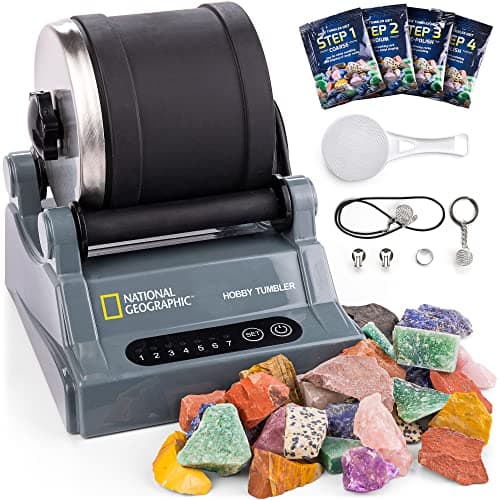
| 1 | Best overall NATIONAL GEOGRAPHIC Hobby Rock Tumbler Kit The only geology purchase here where the machine outlives the supplies — after the grit, anything from a beach goes in. | Eight and up, and a child with patience or a collection | |
| 2 | 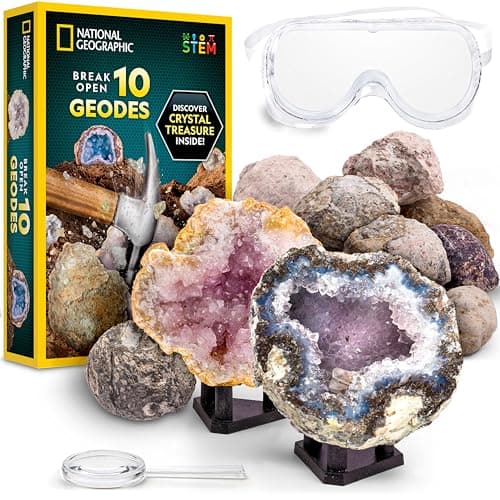 Best single experience NATIONAL GEOGRAPHIC Break Open 10 Premium Geodes Ten real geodes and ten genuinely memorable moments, and then it is a bowl of pretty rocks. | Eight and up, priced as an afternoon rather than a toy | |
| 3 | 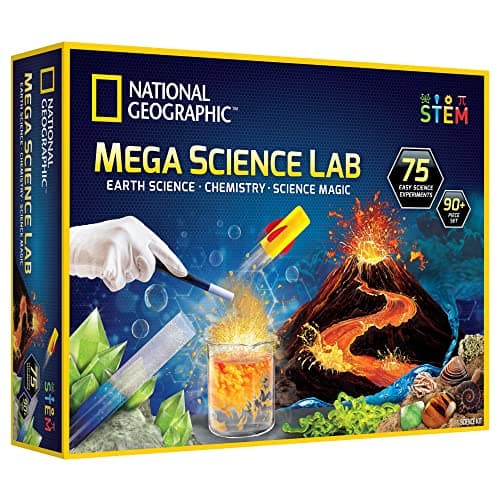 Best value if geology is one interest of several NATIONAL GEOGRAPHIC Mega Science Lab Earth science as one third of a kit, with 85 household experiments that outlive the supplies. | Eight and up, where the child likes science broadly | |
| 4 | Best for looking at what you found My First Lab Duo-Scope Microscope Top lighting is what lets a microscope look at a rock at all — and the specimens are free forever. | Nine and up, and a child who already collects rocks | Sold direct by My First Lab → Not stocked on Amazon. This link goes to the maker and we earn nothing on it. |
| — | 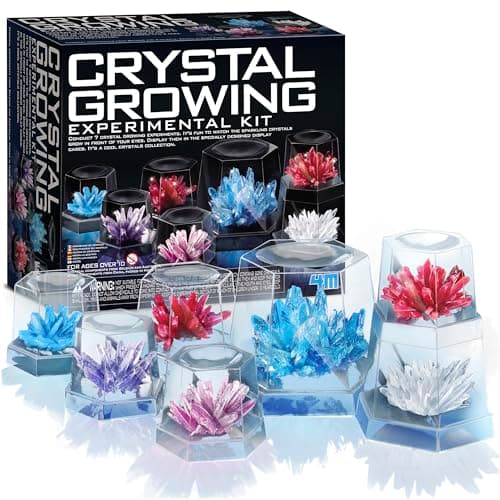 The one to skip 4M Crystal Growing Experiment Kit Seven results from three bags of compound, each arriving days after the child does anything. | A child who has specifically asked to grow crystals |
5 picks, including 1 we tell you to skip. Ages shown are the manufacturer’s own rating, not ours.
Count the results before you buy
The arithmetic
How many outcomes are in the box
| Break Open 10 Geodes — results | 10, single use |
|---|---|
| 4M Crystal Growing — results | 7, from 3 bags of compound |
| Mega Science Lab — kit experiments | 45 |
| Mega Science Lab — household experiments | 85+ |
| Rock tumbler — batches from the supplied grit | Four-stage cycles, then refillable |
| Microscope — specimens available | Unlimited |
The three kinds of geology purchase
Experiences. Geodes, crystal kits. A fixed number of results, then finished. Excellent value judged as an afternoon out; poor value judged as a toy. Buy them deliberately and say so on the card.
Machines. A rock tumbler. The equipment is permanent and the consumable is separable — refill grit is inexpensive and rough stone can be picked up on a beach. This is the only shape in the category that improves with time.
Instruments. A microscope with top lighting. Not a geology kit at all, and often the best geology purchase, because it turns every rock the child already owns into something to look at.
What tumbling actually involves
Worth setting expectations, because this is the pick we lead with and it is not an afternoon activity.
A four-stage grit sequence runs coarse, medium, fine, then polish. Each stage runs continuously for days before the barrel is opened, rinsed and reloaded. Start to finish is measured in weeks, not hours.
That is the honest case for and against it. Against: a child expecting a result on the day will be disappointed. For: a child who checks on something every evening for three weeks and then holds a polished stone they made has had an experience that no single-afternoon kit delivers.
Worth knowing before you buy
The geode kit is rated 8+ specifically because it involves hitting rocks with a hammer. The supplied safety goggles are there to be worn rather than admired, and the striking should happen on a hard floor outside rather than a kitchen table.
Tumbler grit is a fine abrasive powder. Rinse barrels outdoors or into a bucket rather than a sink — grit settles in a trap and sets. Keep the compounds away from younger children between stages, since the barrel sits out for days at a time.
Say the unwelcome thing
Do not buy a crystal kit expecting a science experiment
Crystallization is real chemistry, but the experience is unlike an experiment in the way that matters to a child: there is no reaction to watch and no immediate cause and effect. You mix a solution and then you wait until next weekend.
If the child has specifically asked for crystals, buy it — it does what it says. As a general geology present, a geode kit delivers on the day and a tumbler delivers for years.
What to buy
- Patient child, or one who collects: the rock tumbler.
- A memorable afternoon: the geode kit, framed honestly as an event.
- Likes science generally: the Mega Science Lab, for the household bonus guide.
- Already has a rock collection: a microscope with top lighting.
See also experiment kits, outdoor and nature kits and STEM toys for 9 year olds.
In full
Every pick, and what is wrong with it
Published specifications only, each linked back to the page it came from. Where a manufacturer publishes nothing, the row says so — we do not fill blanks in.
1. Best overall
NATIONAL GEOGRAPHIC Hobby Rock Tumbler Kit
National Geographic · Hobby Rock Tumbler · maker rates it 8+
The only geology purchase here where the machine outlives the supplies — after the grit, anything from a beach goes in.
- Includes
- Tumbler, four polishing grits, sifter, learning guide
- Rough gemstones
- Nine types
- Barrel
- Noise-reducing, leak-proof, stainless steel lid
- Controls
- One-touch settings with an automatic shutoff timer
National Geographic publishes a tumbler with four polishing grits, a sifter, a learning guide and nine types of rough gemstone, in a noise-reducing leak-proof barrel with a stainless steel lid, one-touch settings and an automatic shutoff timer, plus jewelry fastenings, rated 8+.
The four-stage grit sequence is the actual lesson. Coarse to fine over successive weeks is how real lapidary work is done, and a child who runs the full cycle has learned something about process rather than about rocks.
The reason it heads this page is structural: it is the one item where the consumable is separable from the equipment. Refill grit is cheap, and the input can be free.
Replay signal
- Open-ended or one-shot
- Semi-open: the machine is permanent, the grit is not, and rocks from a beach are free
- Does anything run out
- The grits and the supplied gemstones run out; refill grit is sold separately
- Room to grow
- Once the supplied rough is gone, the tumbler works on anything the child collects
- Adult required
- For loading and for the timer; the tumbling itself is unattended
Why we say so: National Geographic publishes four polishing grits, nine gemstone types and an automatic shutoff timer. The machine outliving the grit is what makes this different from a one-shot geology kit — but it runs for days per batch, so it is a patience purchase, not an afternoon one.
What’s wrong with it
Runs for days per batch and is audible through a wall. This is a garage or utility-room object.
| Includes | Tumbler, four polishing grits, sifter, learning guide |
|---|---|
| Rough gemstones | Nine types |
| Barrel | Noise-reducing, leak-proof, stainless steel lid |
| Controls | One-touch settings with an automatic shutoff timer |
| Extras | Jewelry fastenings for the polished stones |
| Stated age | 8+ |
| Consumables | Yes — the four grits and the supplied rough are used up |
Every figure above is from National Geographic toys, Hobby Rock Tumbler Kit. Blanks are shown as “not published” rather than filled in.
2. Best single experience
NATIONAL GEOGRAPHIC Break Open 10 Premium Geodes
National Geographic · NGGEO10 · maker rates it 8+
Ten real geodes and ten genuinely memorable moments, and then it is a bowl of pretty rocks.
- Geodes
- 10, hand-selected, 1.25 to 2.25 inches across
- Includes
- Safety goggles, magnifying glass, display stands, full-color learning guide
- Stated age
- Manufacturer's minimum age 8 years
- Safety note
- Contains small parts; not for children under 3
National Geographic publishes ten hand-selected natural geodes, 1.25 to 2.25 inches across, with safety goggles, a magnifying glass, display stands and a full-color learning guide, rated 8+, with an explicit small-parts warning for under-threes.
We recommend it and tell you it ends, because both are true. Cracking a rock open and finding crystals inside is a real moment, and these are genuine geological specimens rather than a manufactured novelty.
The display stands matter more than they sound. They are what turns the results into something that stays on a shelf rather than something that goes in a drawer.
Replay signal
- Open-ended or one-shot
- One-shot by design. Ten geodes, ten moments, then it is a bowl of pretty rocks
- Does anything run out
- Yes, definitively — the clearest example on this site of a kit that ends
Why we say so: National Geographic publishes the count as ten natural geodes. Ten single-use items is a finite number, and we would rather say so than let a gift-buyer find out on Christmas afternoon.
What’s wrong with it
Ten single-use items. An enthusiastic child can be through all of them before lunch on the day it arrives.
| Geodes | 10, hand-selected, 1.25 to 2.25 inches across |
|---|---|
| Includes | Safety goggles, magnifying glass, display stands, full-color learning guide |
| Stated age | Manufacturer's minimum age 8 years |
| Safety note | Contains small parts; not for children under 3 |
| Consumables | Yes — ten geodes, and each one only cracks open once |
Every figure above is from National Geographic toys, Break Open Geodes. Blanks are shown as “not published” rather than filled in.
3. Best value if geology is one interest of several
NATIONAL GEOGRAPHIC Mega Science Lab
National Geographic · Mega Science Lab · maker rates it 8+
Earth science as one third of a kit, with 85 household experiments that outlive the supplies.
- Experiments in the kit
- 45, across chemistry, earth science and science magic
- Bonus guide
- 85+ further experiments using household items, for 130+ in total
- Includes
- Volcano build, glow-in-the-dark crystal growth, and the tools for both
- Stated age
- 8+
National Geographic publishes 45 experiments across chemistry, earth science and science magic, plus a bonus guide of more than 85 experiments using household items — over 130 in total — including building and erupting a volcano and growing a glow-in-the-dark crystal, rated 8+.
If "likes rocks" is really "likes science", this delivers more per pound than any dedicated geology kit on the page.
The bonus guide is why. Roughly two thirds of the published content needs nothing but a kitchen, which is the opposite of how this category usually works.
Replay signal
- Open-ended or one-shot
- Guided, and the 45 in-kit experiments end. The 85 household ones do not
- Does anything run out
- The supplied materials run out; the household half of the book never does
- Room to grow
- The bonus guide is the genuinely durable part, and it costs the manufacturer almost nothing to include
- Adult required
- Supervision for the chemistry third; the earth science and household experiments are largely self-run
Why we say so: National Geographic publishes 45 in-kit experiments plus a bonus guide of 85+ using household items. That second number is why this kit outlasts most of its price band: roughly two-thirds of the published content needs nothing but a kitchen.
What’s wrong with it
The geology section is shallower than a dedicated kit. This is breadth rather than depth.
| Experiments in the kit | 45, across chemistry, earth science and science magic |
|---|---|
| Bonus guide | 85+ further experiments using household items, for 130+ in total |
| Includes | Volcano build, glow-in-the-dark crystal growth, and the tools for both |
| Stated age | 8+ |
| Consumables | Yes — the supplied chemicals and crystal compounds are used up |
Every figure above is from National Geographic toys, Mega Science Lab. Blanks are shown as “not published” rather than filled in.
4. Best for looking at what you found
My First Lab Duo-Scope Microscope
My First Lab · MFL-06 · maker rates it 9+
Top lighting is what lets a microscope look at a rock at all — and the specimens are free forever.
- Magnifications
- 40x, 100x and 400x, from a 10x eyepiece with 4x, 10x and 40x objectives
- Optics
- Real optical glass lenses
- Lighting
- Dual LED, above and below the stage
- Slides included
- 5 blank, 1 concavity (well), 4 prepared
My First Lab publishes 40x, 100x and 400x from a 10x eyepiece with 4x, 10x and 40x objectives, real optical glass, dual LED lighting above and below the stage, and five blank slides plus one concavity and four prepared, rated 9 and older.
Light from above is the specification that matters for rocks. A standard compound microscope only lights from below, which works on thin transparent slides and not at all on a lump of quartz.
For a child who already picks up interesting stones, this converts the collection into an ongoing activity rather than a windowsill.
Replay signal
- Open-ended or one-shot
- Genuinely open-ended, unusually so for a science purchase — the world is the consumable
- Does anything run out
- The four prepared slides run out; the five blanks and everything in the garden do not
- Room to grow
- Light from above as well as below means it works on rocks, leaves and insects, not only on slides
Why we say so: The manufacturer publishes the dual-LED lighting, the blank-slide count and the real-glass optics. Blank slides plus top lighting is what turns a microscope from four pictures into a thing you point at whatever you found outside.
What’s wrong with it
Rated 9 and older, and it is not a geology kit. It is the instrument you use on geology.
| Magnifications | 40x, 100x and 400x, from a 10x eyepiece with 4x, 10x and 40x objectives |
|---|---|
| Optics | Real optical glass lenses |
| Lighting | Dual LED, above and below the stage |
| Slides included | 5 blank, 1 concavity (well), 4 prepared |
| Stated age | Ages 9 and older |
| Batteries | 3 x AA (not included) |
| Weight | 1.95 lb |
Every figure above is from My First Lab, Duo-Scope MFL-06. Blanks are shown as “not published” rather than filled in.
Not stocked on Amazon. This link goes to the maker and we earn nothing on it.
Skip this one
4M Crystal Growing Experiment Kit
4M · 5557 · maker rates it 10+
Seven results from three bags of compound, each arriving days after the child does anything.
- Experiments
- 7 crystal-growing experiments
- Contents
- 3 bags of crystal compound, 3 bags of seeding mixture, stirring bowl and spoon, 7 display bases, 7 display covers, 7 ring templates
- Stated age
- 10 years and up
- Consumables
- Yes — the compound is the whole product
4M publishes seven crystal-growing experiments from three bags of crystal compound and three of seeding mixture, with a stirring bowl and spoon and seven display bases, covers and ring templates, rated 10 years and up.
The problem is visible in the published contents: seven experiments, three bags of compound. The consumable is smaller than the experiment count implies.
The bigger issue is time. Crystals grow over days, so the gap between doing something and seeing a result is measured in sleeps. For most children under about eleven that is a waiting exercise rather than an experiment.
Replay signal
- Open-ended or one-shot
- One-shot, seven times over
- Does anything run out
- Definitively. Three bags of compound, and when they are gone the kit is a set of display cases
Why we say so: 4M publishes three bags of crystal compound across seven experiments. That is the arithmetic that decides this purchase: it is seven results, spread over weeks because crystals take days to grow, and then it is finished. Excellent as an event; poor as the main present.
What’s wrong with it
Days between action and result, a 10+ rating that surprises people, and three bags of compound that are the entire product.
| Experiments | 7 crystal-growing experiments |
|---|---|
| Contents | 3 bags of crystal compound, 3 bags of seeding mixture, stirring bowl and spoon, 7 display bases, 7 display covers, 7 ring templates |
| Stated age | 10 years and up |
| Consumables | Yes — the compound is the whole product |
| Time per experiment | Days, not minutes — crystals grow on their own schedule |
Every figure above is from 4M, Crystal Growing Experiment Kit. Blanks are shown as “not published” rather than filled in.
We are not putting a buy button on this one. It is easy enough to find if you want it anyway — but we would rather send you to something that gets played with twice.
Questions people actually ask
Frequently asked
Are geode kits worth buying?
As an experience, yes. As a toy, no. National Geographic publishes ten natural geodes in its Break Open kit, and an enthusiastic child can be through all ten before lunch. Price it against a trip out rather than against a toy and it is good value.
Is a rock tumbler a good present for a child?
For a patient eight-year-old or older, it is the best purchase in this category — the machine outlives the supplied grit, so anything picked up on a beach goes in afterwards. Be aware it runs for days per batch, is audible through a wall, and the full four-stage cycle takes weeks.
How long does rock tumbling take?
Weeks, not hours. A four-stage grit sequence runs coarse, medium, fine then polish, and each stage runs continuously for days before the barrel is opened, rinsed and reloaded. A child expecting a result on the day will be disappointed.
Why are crystal growing kits disappointing?
Because the result arrives days after the child does anything. Crystallization is real chemistry, but there is no reaction to watch and no immediate cause and effect — you mix a solution and wait until next weekend. 4M also publishes only three bags of compound across seven experiments.
Sources
Where these figures came from
Every specification on this page traces to one of these. If a manufacturer publishes nothing on a point, the page says so rather than filling the gap.
Read next
Where to go from here
Back to Science Kits, or read how we pick.