The picks
Physics Kits for Kids
Nearly everything sold as a physics kit is a magnetism kit. That is not a complaint — magnets are the one force a child can hold — but it does mean the shelf is narrower than it looks.
By Sawyer V. · Published
The short answer
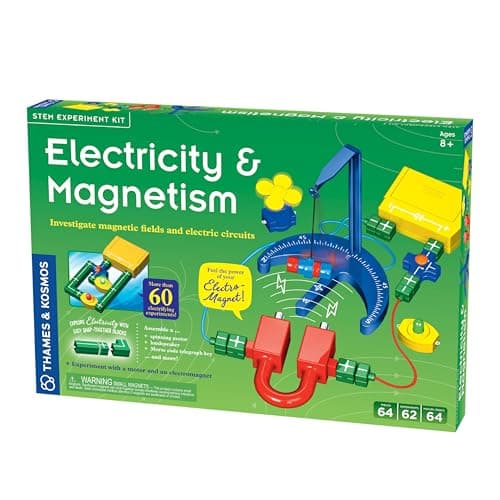
Buy the kit that covers electricity and magnetism, because they are one subject and most kits only sell you half of it. Thames & Kosmos Electricity & Magnetism publishes 62 experiments from 64 pieces with a 64-page manual, ending in a working loudspeaker and relay. Motors & Generators publishes 25 experiments from just 12 pieces. Magnetic Science publishes 33 activities and needs no batteries at all. All three are rated 8+.
Block & Beaker earns a commission when you buy through our links, at no cost to you. It never changes a ranking, and we say so plainly when the right answer is the cheaper set, or nothing at all. Full disclosure · How we pick.
At a glance
The picks, ranked
Tap any row to jump to the full reasoning. Prices come live from Amazon where we have them and read “check price” where we don’t — never a number we cannot stand behind today.
| # | Product | Best for | Price |
|---|---|---|---|
| 1 | Best overall — the only kit that treats the subject as one thing Thames & Kosmos Electricity & Magnetism 62 experiments from 64 snap-together pieces, ending in a loudspeaker and a relay. | Eight and up, as the single physics purchase if there is only one | |
| 2 | 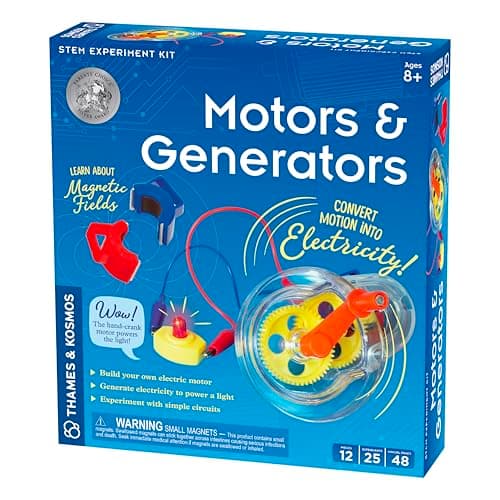 Most experiments per piece — 25 from 12 Thames & Kosmos Motors & Generators A transparent motor that runs forward on batteries and backward as a hand crank. | Eight and up, for the child who asks how the thing actually works | |
| 3 | 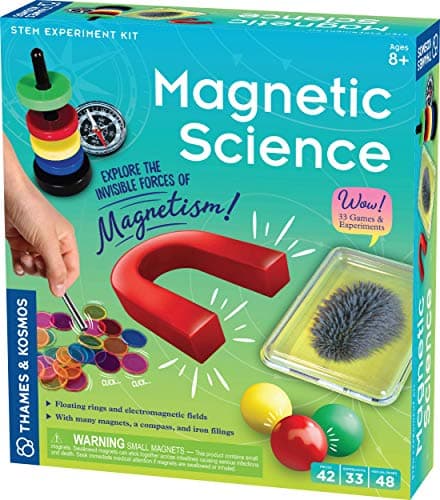 Best magnetism-only kit, and the only one with no batteries Thames & Kosmos Magnetic Science 33 activities from 42 pieces, with the iron filings sealed in a transparent box. | Eight and up, where the kit has to work with nothing bought and nothing charged | |
| 4 | 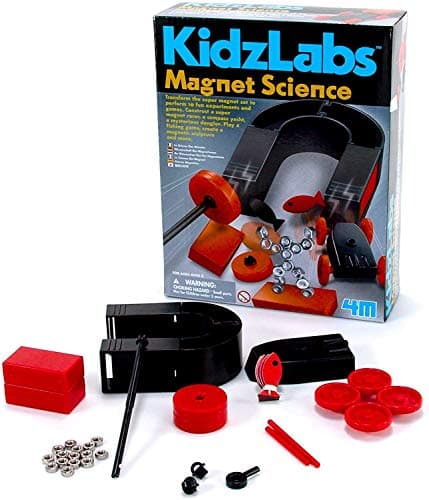 Lowest price band — the right first magnet kit 4M Magnet Science 10 experiments and games built around a horseshoe magnet and a wand. | Eight and up, as a small gift or a test of whether the interest is real | |
| 5 | 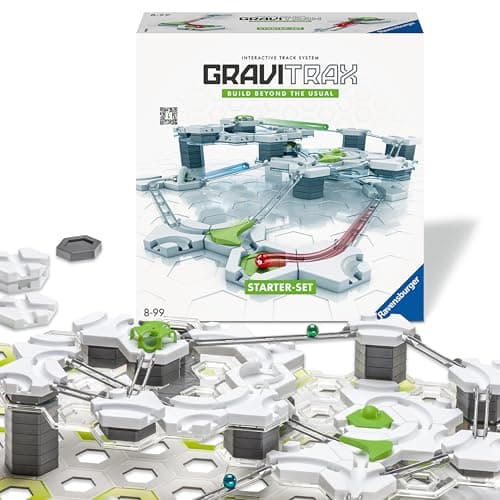 The physics kit that is not sold as one GraviTrax Starter Set 122 pieces across 18 element types, including a vortex and a magnetic cannon. | Eight and up, for mechanics rather than electromagnetism | |
| — | 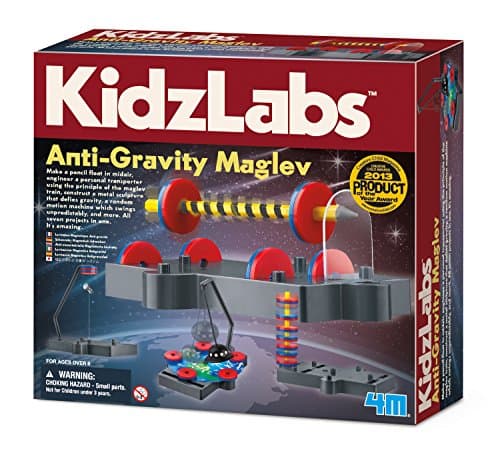 Seven projects, one idea 4M Anti Gravity Magnetic Levitation A floating pencil, a maglev transporter, a gravity-defying sculpture and a motion machine. | Eight and up, as a second magnet kit for a child already interested |
6 picks, including 1 we tell you to skip. Ages shown are the manufacturer’s own rating, not ours.
Most of this shelf is magnets, and the makers do not hide it
The arithmetic
Physics kits: published experiments, pieces and subject
| T&K Electricity & Magnetism | 62 experiments · 64 pieces · 64-page manual · both halves · 2 x AA · 8+ |
|---|---|
| T&K Magnetic Science | 33 activities · 42 pieces · 48-page manual · magnetism · no batteries · 8+ |
| T&K Motors & Generators | 25 experiments · 12 pieces · 48-page manual · motors both ways · 2 x AA · 8+ |
| 4M Magnet Science | 10 experiments · piece count not published · magnetism · no batteries · 8+ |
| 4M Anti Gravity Magnetic Levitation | 7 projects · piece count not published · levitation only · no batteries · 8+ |
| GraviTrax Starter Set | No experiment count · 122 pieces, 18 element types · mechanics · no batteries · 8+ |
| Everything published below age 8 | Nothing. Every kit on this shelf publishes 8 and up |
Why electricity and magnetism belong in the same box
This is the whole buying argument, so it is worth a paragraph. Electricity and magnetism are not two subjects that happen to sit near each other on a syllabus. A current creates a magnetic field; a moving magnet creates a current. That single fact is what a motor is, what a generator is, what a loudspeaker is, and what a relay is.
A kit that sells only the magnetism half can show a child that magnets attract iron and point north. Useful, and finished in an afternoon. A kit that includes the electromagnet, the motor and the loudspeaker shows them why — and a child who has wound an electromagnet and then built a speaker out of it has met the idea that most of the machines in the house are the same trick in different cases.
Thames & Kosmos publishes exactly this arc for the Electricity & Magnetism kit, which is why it leads this page despite being the largest and most expensive box here. The Magnetic Science kit includes one electromagnet as a nod to the join; Motors & Generators covers the join and nothing else. Between them the three kits are a sequence rather than three competing purchases.
What to buy on, when every box says 8+
The subject, first. Decide whether you are buying magnetism, electricity, or mechanics. The experiment count is meaningless across those three, and the box fronts all say “physics”.
Whether a manual comes with it. Physics is the one shelf where the explanation is the product. All three Thames & Kosmos kits publish a page count — 64, 48, 48 — and the 4M kits publish a downloadable manual in seven languages but no page count. A kit with no written explanation teaches a child that magnets are fun, which they already knew.
Experiments per piece, not experiments. Motors & Generators publishes 25 experiments from 12 pieces; 4M Magnet Science publishes 10 from an unstated number. A high ratio means the kit is explaining rather than assembling, which on this shelf is what you want.
Whether it needs batteries. Two of the six do, and both publish 2 x AA. This sounds trivial until a kit arrives on a Saturday with no cells in the house — see the battery guide for STEM toys.
Not the photograph on the front. Levitation photographs better than circuits and sells accordingly. The published project count is the corrective.
What a physics kit can and cannot do at eight
It can make an invisible thing visible. This is the genuine superpower of the subject and the reason iron filings keep appearing in these boxes. A magnetic field is an abstraction until filings arrange themselves into it on a sheet of paper, and then it is an object.
It can give a reversible demonstration. Crank the generator and the bulb lights; connect the battery and the same device spins. Reversibility is rare in children’s science — most experiments run one way and then they are done.
It cannot do the mathematics, and should not try. Nothing on this shelf publishes a formula, and that is correct for eight. The arithmetic of physics arrives in school; what a kit provides is the thing the arithmetic later describes.
And it will not survive a child who wanted to build. Twelve pieces, 42 pieces, 64 pieces: these are explanation kits, not construction sets. A child who wants to make things is better served by circuit kits or a mechanical building set, both of which teach physics as a side effect of building something.
Where physics goes after a kit
The ceiling on this shelf is low, and it is worth knowing before buying. Nothing in the category publishes an age above about twelve, and the Thames & Kosmos kits are the top of it. A thirteen-year-old who finished the 62 experiments has three honest directions.
Circuits with more components. Snap Circuits publishes 300 to 750 projects depending on the set, which is breadth rather than depth but a great deal of it.
A programmable board. Arduino kits put a motor and a sensor under code, which is where electricity stops being a demonstration and becomes a tool. Arduino publishes 11+ for its Student Kit.
Instruments rather than kits. A telescope is applied optics and a microscope is applied optics, and neither has an upper age. See science kits for teens, which is the page for the age this shelf stops serving.
Worth knowing before you buy
So which one
One kit, and it should cover the whole subject: Electricity & Magnetism — 62 experiments, ending in a loudspeaker and a relay.
They want to know where electricity comes from: Motors & Generators, 25 experiments from 12 pieces, forwards and backwards.
Nothing can need batteries: Magnetic Science — 33 activities, sealed iron filings, published as N/A for power.
A small gift, or you are testing the interest: 4M Magnet Science, 10 experiments in the lowest price band here.
They want physics they can feel rather than read: GraviTrax — 122 pieces, 18 element types, and a magnetic cannon.
Say the unwelcome thing
Do not buy the levitation kit first
4M publishes seven projects for the Anti Gravity Magnetic Levitation set, every one of them levitation, and publishes ten experiments across several phenomena for its Magnet Science kit in a lower price band. Same maker, same KidzLabs range, same published 8+. The levitation box photographs better and that is the entire difference. If a child has already done the compass and the fishing game and wants the spectacular version, buy it second — it is a good kit in the wrong position.
Where to go next
Science experiment kits covers the general-science shelf this one sits beside, circuit kits for kids covers the electricity half as a building activity, science kits by age sorts the whole hub on published ratings, and mechanical toys covers forces you can watch rather than read about.
In full
Every pick, and what is wrong with it
Published specifications only, each linked back to the page it came from. Where a manufacturer publishes nothing, the row says so — we do not fill blanks in.
1. Best overall — the only kit that treats the subject as one thing
Thames & Kosmos Electricity & Magnetism
Thames & Kosmos · 620417 · maker rates it 8+
62 experiments from 64 snap-together pieces, ending in a loudspeaker and a relay.
- Experiments
- 62
- Piece count
- 64
- Manual
- 64 pages, full color
- Circuits covered
- “Build series and parallel circuits to light up a light bulb”; push buttons and on-off switches; “circuits that include a spinning motor, two switches, and up to three light bulbs”
Thames & Kosmos publishes 62 experiments from a 64-piece kit with a 64-page full-color manual, rated ages 8+, on 2 AA batteries, at 16.8 x 11.5 x 2.1 inches and 2.4 lb. The published content runs from series and parallel circuits lighting a bulb, through push buttons and on-off switches, to “circuits that include a spinning motor, two switches, and up to three light bulbs”. The magnetism half covers which materials are magnetic, poles, magnetizing a metal, iron filings to “make invisible magnetic fields visible”, a magnetic pendulum, and a compass against Earth’s magnetic field.
The reason this leads is the ending, which the maker publishes outright: after a series of experiments with a sturdy electromagnet, the child builds a loudspeaker and an electromagnetic relay. Those two devices are the entire point of the subject — they are where electricity becomes magnetism and magnetism becomes motion and sound. Every other kit on this page stops before that join.
Sixty-two experiments against 64 pieces is also an unusually honest ratio. It means roughly one new experiment per component, which is what you get when a kit is built around explaining a subject rather than around a parts count. Compare that against the Snap Circuits line, where 300 or 500 projects come from 60 or 75 parts — a different and equally valid design, optimized for building rather than for understanding.
Published 2012, which matters less than it looks: the physics has not changed and neither has the kit. The honest cons are size and price. This is the biggest box here and the only one that needs a clear table rather than a lap. See what else a science kit needs.
Replay signal
- Open-ended or one-shot
- 62 experiments, then a box of snap-together circuit blocks that still make circuits
- Does anything run out
- Nothing runs out except the two AA cells
- Room to grow
- The published arc runs from one bulb to a working loudspeaker and relay, which is a genuine ladder rather than 62 variations
Why we say so: Thames & Kosmos publishes 62 experiments from 64 pieces with a 64-page manual, and publishes the end point: a loudspeaker and an electromagnetic relay built from the same blocks that started with a single bulb. It is the only kit in this catalog that covers electricity and magnetism as one subject rather than two, which is the point the maker's own title makes.
What’s wrong with it
The largest box and the highest price band here. Two AA cells are required and not included.
| Experiments | 62 |
|---|---|
| Piece count | 64 |
| Manual | 64 pages, full color |
| Circuits covered | “Build series and parallel circuits to light up a light bulb”; push buttons and on-off switches; “circuits that include a spinning motor, two switches, and up to three light bulbs” |
| Magnetism covered | Which materials are magnetic, magnetic poles, magnetizing a metal, iron filings to “make invisible magnetic fields visible”, a magnetic pendulum, a compass and Earth's magnetic field |
| Final builds | A loudspeaker and an electromagnetic relay, after “a series of experiments with a sturdy electromagnet” |
| Assembly | “colorful snap-together blocks” — no soldering |
| Batteries | 2 x AA, published as required |
| Product dimensions | 16.8 x 11.5 x 2.1 in; 2.4 lb |
| Stated age | Ages 8+; the listing adds “Skill Level: Intermediate” |
| Year released | 2012 |
| Consumables | None beyond batteries |
Every figure above is from Thames & Kosmos, Electricity & Magnetism (620417). Blanks are shown as “not published” rather than filled in.
2. Most experiments per piece — 25 from 12
Thames & Kosmos Motors & Generators
Thames & Kosmos · 665036 · maker rates it 8+
A transparent motor that runs forward on batteries and backward as a hand crank.
- Experiments
- 25
- Piece count
- 12 — the lowest in this catalog
- Manual
- 48 pages, published by the maker; the Amazon listing says 48 in its title and “60-page” in a bullet, so we use the maker's figure
- The motor
- “made of transparent plastic to show how the inside components work”; runs on battery power, then “reconfigure the device to work in reverse as a hand-crank electric generator”
Thames & Kosmos publishes 25 experiments from 12 pieces with a 48-page manual, rated 8+, on 2 AA batteries, at 10 x 11 x 2.5 inches and 1 lb. The motor is published as “made of transparent plastic to show how the inside components work”. The kit runs it on battery power first, then has the child “reconfigure the device to work in reverse as a hand-crank electric generator”.
Twenty-five experiments from twelve pieces is the highest ratio in this entire catalog, and it is worth understanding why rather than treating it as a bargain. This kit is not trying to build 25 things. It is trying to explain one thing 25 ways: a motor converts electricity into motion, a generator converts motion into electricity, and they are the same machine pointed in opposite directions.
That reversal is the best single idea available on this shelf, and the transparent casing is what makes it land. A child who has turned a crank and watched a bulb light has seen where electricity comes from, which is a question no amount of circuit building answers. It pairs naturally with solar and energy kits, where the same question gets a different answer.
The cons are real. Twelve pieces is twelve pieces, there is nothing to construct, and a child who wanted a building set will be disappointed inside an hour. It is also the cheapest kit here, which makes it a sensible second purchase rather than a first one.
Replay signal
- Open-ended or one-shot
- One device, 25 published configurations of it. Not open-ended, and not meant to be
- Does anything run out
- Nothing runs out except the two AA cells
- Room to grow
- The hand-crank reconfiguration is the growth: the same 12 pieces run forwards as a motor and backwards as a generator
Why we say so: Thames & Kosmos publishes 25 experiments from 12 pieces — the highest experiment-to-piece ratio in this catalog by a wide margin — around a single transparent motor that also works in reverse. Twelve pieces sounds like nothing until you notice the kit is not trying to build 25 things; it is trying to explain one thing 25 ways.
What’s wrong with it
Twelve pieces and one device. If the child wants to build things, this builds one thing.
| Experiments | 25 |
|---|---|
| Piece count | 12 — the lowest in this catalog |
| Manual | 48 pages, published by the maker; the Amazon listing says 48 in its title and “60-page” in a bullet, so we use the maker's figure |
| The motor | “made of transparent plastic to show how the inside components work”; runs on battery power, then “reconfigure the device to work in reverse as a hand-crank electric generator” |
| Covered | How a motor converts electricity into motion and a generator converts motion into electricity; the force of magnetism; “how magnetic fields relate to electric current” |
| Circuits | “simple circuits consisting of the motor or generator, wires, and a light bulb” |
| Batteries | 2 x AA, published as required |
| Product dimensions | 10 x 11 x 2.5 in; 1 lb |
| Stated age | Ages 8+; the listing adds “Grades 3-6” |
| Year released | 2012 |
| Consumables | None beyond batteries |
Every figure above is from Thames & Kosmos, Motors & Generators (665036). Blanks are shown as “not published” rather than filled in.
3. Best magnetism-only kit, and the only one with no batteries
Thames & Kosmos Magnetic Science
Thames & Kosmos · 665050 · maker rates it 8+
33 activities from 42 pieces, with the iron filings sealed in a transparent box.
- Activities
- 33 — the maker's word is “experiments and games”
- Piece count
- 42
- Manual
- 48 pages, published by the maker; the Amazon listing says “60-page”, so we use the maker's figure
- Covered
- Which materials are magnetic, magnetic poles and fields, “how Earth behaves like one giant magnet”, compasses and finding north
Thames & Kosmos publishes 33 activities — its own phrase is “experiments and games” — from 42 pieces with a 48-page manual, rated 8+, batteries published as “N/A”, at 10 x 11 x 2.5 inches and 1.4 lbs. The published coverage is which materials are magnetic, poles and fields, “how Earth behaves like one giant magnet”, compasses, and building an electromagnet “to learn how electricity relates to magnetism”.
The specification worth paying for is a detail most buyers would skip: the iron filings come “in an enclosed transparent box”. Loose iron filings are the component every magnetism kit loses in week one — they stick to everything, they cannot be swept up, and once they are gone the best demonstration in the box is gone with them. Sealing them is the difference between a kit that still works in March and one that does not.
No batteries at all is the second quiet advantage. It is the only kit on this page that works the moment it is opened, which matters more on a birthday morning than any experiment count. See gifts that work straight out of the box.
The honest limit is scope. Thirty-three activities on one force, with a single electromagnet as the bridge to the other half of the subject. If the budget allows only one kit, the Electricity & Magnetism set above contains this one’s territory and then keeps going.
Replay signal
- Open-ended or one-shot
- 33 activities and then the magnets are still magnets — a permanent toolkit
- Does anything run out
- Nothing runs out, and no batteries are required at all
- Room to grow
- Limited by subject: this is magnetism only, with one electromagnet as the bridge
Why we say so: Thames & Kosmos publishes 33 activities from 42 pieces with no batteries required, and publishes the iron filings as sealed in a transparent box. That last detail is the one worth paying for — loose iron filings are the component every magnetism kit loses in the first week, and sealing them is the difference between a demonstration that works in March and one that does not.
What’s wrong with it
Magnetism only. One electromagnet is the whole of the electricity content.
| Activities | 33 — the maker's word is “experiments and games” |
|---|---|
| Piece count | 42 |
| Manual | 48 pages, published by the maker; the Amazon listing says “60-page”, so we use the maker's figure |
| Covered | Which materials are magnetic, magnetic poles and fields, “how Earth behaves like one giant magnet”, compasses and finding north |
| Iron filings | Supplied “in an enclosed transparent box” rather than loose |
| Electromagnet | Published as included — “Build an electromagnet to learn how electricity relates to magnetism” |
| Batteries | Published as “N/A” — none required |
| Product dimensions | 10 x 11 x 2.5 in; 1.4 lbs |
| Stated age | Ages 8+ |
| Year released | 2016 |
| Consumables | None |
Every figure above is from Thames & Kosmos, Magnetic Science (665050). Blanks are shown as “not published” rather than filled in.
4. Lowest price band — the right first magnet kit
4M Magnet Science
4M · 00-03291 · maker rates it 8+
10 experiments and games built around a horseshoe magnet and a wand.
- Experiments
- 10 — published as “10 fun experiments and games”
- Pieces
- Over 25, per the listing; 4M publishes no piece count
- Named builds
- “a super magnet racer, a compass yacht, a mysterious dangler”, a fishing game and “a magnetic sculpture”
- Range
- KidzLabs, item 00-03291
4M publishes 10 experiments and games in its KidzLabs Magnet Science set, item 00-03291, at an item size of 17 x 22 x 6 cm, rated ages 8 years and up, with no batteries required. It names the builds: “a super magnet racer, a compass yacht, a mysterious dangler”, a fishing game and a magnetic sculpture. The listing adds “over 25 pieces”; 4M itself publishes no piece count.
Ten is a small number and the page is not going to pretend otherwise. What it buys is the lowest price band on this page by a comfortable margin, which makes this the honest answer to a specific question: the child mentioned magnets once and you do not yet know whether it was a passing remark.
The named builds are also better than the count suggests. A fishing game and a magnetic sculpture are open-ended in a way a numbered experiment is not — nothing in the box says when the sculpture is finished. 4M publishes three awards for it, including a Parents’ Choice Recommended, which is the maker’s claim rather than ours.
Treat it as a stocking-sized purchase rather than a main gift. See small STEM gifts that travel and STEM gifts under $20.
Replay signal
- Open-ended or one-shot
- Ten experiments, then a super magnet and a wand that keep working
- Does anything run out
- Nothing runs out
- Room to grow
- None published — this is an introduction, not a system
Why we say so: 4M publishes 10 experiments and games built around a horseshoe magnet and a wand, and names the five that matter: racer, compass yacht, dangler, fishing game, sculpture. Ten is a small number and the price band is the lowest on this page, which makes it the right first magnet kit and the wrong only one.
What’s wrong with it
Ten experiments, and 4M publishes no piece count. This is an introduction, not a kit that lasts.
| Experiments | 10 — published as “10 fun experiments and games” |
|---|---|
| Pieces | Over 25, per the listing; 4M publishes no piece count |
| Named builds | “a super magnet racer, a compass yacht, a mysterious dangler”, a fishing game and “a magnetic sculpture” |
| Range | KidzLabs, item 00-03291 |
| Item size | 17 x 22 x 6 cm, published by 4M |
| Batteries | None published as required |
| Stated age | Ages 8 years and up |
| Awards published | Hong Kong Awards for Industries Consumer Product Design 2015; Good Toy Guide 2013; Parents' Choice Recommended 2011 |
| Consumables | None |
Every figure above is from 4M, Magnet Science (KidzLabs 00-03291). Blanks are shown as “not published” rather than filled in.
5. The physics kit that is not sold as one
GraviTrax Starter Set
Ravensburger · 27597 · maker rates it 8+
122 pieces across 18 element types, including a vortex and a magnetic cannon.
- Pieces
- 122
- Construction elements
- 18 types, including base plates, height tiles, curves, junctions, switches, tracks, a vortex, a launch pad and a magnetic cannon
- Marbles
- 6
- Stated age
- 8 and up
Ravensburger publishes 122 pieces across 18 construction element types — base plates, height tiles, curves, junctions, switches, tracks, a vortex, a launch pad and a magnetic cannon among them — with 6 marbles and 9 included track designs, rated 8 and up.
It is on a physics page deliberately, because the electromagnetism kits above leave out half of school physics. Gravity, potential and kinetic energy, momentum, acceleration and the conversion of stored energy into motion are all mechanics, and no kit in this catalog teaches them with a manual. A marble run teaches them by consequence: build the drop too shallow and the marble stops.
The magnetic cannon is the genuine crossover. It stores energy in a magnetic field and releases it as speed, which is the same conversion the maglev kit demonstrates and the same one the loudspeaker in the Thames & Kosmos kit relies on — three very different boxes, one idea.
The honest con is that none of this is labeled. There is no manual explaining potential energy and no experiment numbered 14. If you want physics explained, buy a physics kit; if you want physics felt, this is the better object. See the GraviTrax review and mechanical toys for kids.
Replay signal
- Open-ended or one-shot
- Open-ended once the nine included designs are done — the system is a construction kit, not a puzzle with an answer
- Does anything run out
- Nothing runs out
- Room to grow
- Ravensburger publishes a large expansion range built to enlarge the same system
Why we say so: Ravensburger publishes the 122-piece count, the 18 construction-element types, the nine included track designs and an expansion range designed to extend the same track system.
What’s wrong with it
No manual, no experiments, no explanations. The physics is implicit and nobody names it.
| Pieces | 122 |
|---|---|
| Construction elements | 18 types, including base plates, height tiles, curves, junctions, switches, tracks, a vortex, a launch pad and a magnetic cannon |
| Marbles | 6 |
| Stated age | 8 and up |
| Track designs included | 9 |
| Consumables | None |
Every figure above is from Ravensburger, GraviTrax Starter Set. Blanks are shown as “not published” rather than filled in.
Skip this one
4M Anti Gravity Magnetic Levitation
4M · 00-03299 · maker rates it 8+
A floating pencil, a maglev transporter, a gravity-defying sculpture and a motion machine.
- Projects
- 7 — “All seven projects in one!”
- Named projects
- “Make a pencil float in midair, engineer a personal transporter using the principle of the maglev train, construct a metal sculpture that defies gravity, A random motion machine which swings unpredictably”
- Subject
- Magnetic levitation only — one phenomenon
- Range
- KidzLabs, item 00-03299
4M publishes “all seven projects in one” for its KidzLabs Anti Gravity Magnetic Levitation set, item 00-03299, at an item size of 24 x 22 x 6 cm, recommended for ages 8 years and up. The named projects are making a pencil float in midair, engineering a personal transporter on the maglev train principle, constructing a metal sculpture that defies gravity, and a random motion machine “which swings unpredictably”. 4M publishes no piece count.
It is the skip on this page and the reason is arithmetic rather than quality. Seven projects, all of them the same phenomenon, in a higher price band than 4M’s own Magnet Science kit, which publishes ten experiments across several phenomena. Same maker, same KidzLabs range, same published age — fewer ideas for more money.
It is also the kit most likely to be bought on a photograph. Levitation is the most photogenic thing magnetism does, and a floating pencil on a box front sells better than a compass. That is precisely why it is worth doing the comparison before clicking.
Where it genuinely earns its place: as a second magnet kit for a child who already did the fishing game and the compass and wants the spectacular version. Bought in that order it is a good purchase. Bought first it is seven projects and a shelf.
Replay signal
- Open-ended or one-shot
- Seven projects on one idea. The floating pencil does not become anything else
- Does anything run out
- Nothing runs out
- Room to grow
- None published
Why we say so: 4M publishes seven projects, all of them levitation: a floating pencil, a maglev transporter, a gravity-defying sculpture, a random motion machine. It is the most photogenic kit on this page and the narrowest. The arithmetic to do before buying is against 4M's own Magnet Science — ten experiments in a lower price band, from the same maker and the same range.
What’s wrong with it
Seven published projects, all levitation, in a higher price band than a 10-experiment kit from the same maker.
| Projects | 7 — “All seven projects in one!” |
|---|---|
| Named projects | “Make a pencil float in midair, engineer a personal transporter using the principle of the maglev train, construct a metal sculpture that defies gravity, A random motion machine which swings unpredictably” |
| Subject | Magnetic levitation only — one phenomenon |
| Range | KidzLabs, item 00-03299 |
| Item size | 24 x 22 x 6 cm, published by 4M |
| Piece count | Not published |
| Batteries | None published as required |
| Stated age | Recommended for ages 8 years and up |
| Awards published | Hong Kong Awards for Industries Consumer Product Design 2015; Creative Child Kids Product of the Year 2013 |
| Consumables | None |
Every figure above is from 4M, Anti Gravity Magnetic Levitation (KidzLabs 00-03299). Blanks are shown as “not published” rather than filled in.
We are not putting a buy button on this one. It is easy enough to find if you want it anyway — but we would rather send you to something that gets played with twice.
Questions people actually ask
Frequently asked
What is the best physics kit for kids?
Thames & Kosmos Electricity & Magnetism, on published content: 62 experiments from 64 snap-together pieces with a 64-page manual, rated 8+. It is the only kit on this shelf that covers both halves of the subject, and the published arc ends with the child building a working loudspeaker and an electromagnetic relay.
Are most physics kits just magnet kits?
Largely, yes. Of the six products on this page, four are magnetism or levitation only, one adds electricity, and one is a mechanics set not sold as physics at all. Magnets dominate because magnetism is the one force a child can hold in their hand, but it means the shelf is narrower than the word "physics" suggests.
What age are physics kits for?
Eight and up, across the board. Every kit on this page publishes 8+ - the two Thames & Kosmos magnetism kits, Motors & Generators, both 4M kits and GraviTrax. Nothing in the category publishes an age below eight, largely because of small, strong magnets. Science kits by age.
Do physics kits need batteries?
Two of the six here do, and both publish 2 x AA, not included: Electricity & Magnetism and Motors & Generators. Thames & Kosmos publishes "N/A" for batteries on Magnetic Science, and neither 4M kit nor GraviTrax requires power. Battery guide for STEM toys.
What is the difference between Electricity & Magnetism and Magnetic Science?
Scope and price band. Thames & Kosmos publishes 62 experiments from 64 pieces for Electricity & Magnetism, covering circuits, motors, an electromagnet, a loudspeaker and a relay. Magnetic Science publishes 33 activities from 42 pieces on magnetism alone, with one electromagnet as the only electricity content - and no batteries required.
Is a magnetic levitation kit a good first physics kit?
No. 4M publishes seven projects for its Anti Gravity Magnetic Levitation set, all of them levitation, in a higher price band than its own Magnet Science kit, which publishes ten experiments across several phenomena at the same published age of 8+. Buy the levitation set second, for a child already interested.
What should a teenager who has outgrown physics kits buy?
Something without a ceiling. Snap Circuits publishes 300 to 750 projects depending on the set; Arduino publishes 11+ for its Student Kit with nine 90-minute lessons, which puts a motor and a sensor under code; and a telescope or microscope is applied optics with no upper age at all. Arduino kits for kids.
Sources
Where these figures came from
Every specification on this page traces to one of these. If a manufacturer publishes nothing on a point, the page says so rather than filling the gap.
Read next
Where to go from here
Back to Science Kits, or read how we pick.