The picks
Science Experiment Kits for Kids
Ranked on the question nobody else asks: how many afternoons is this, really?
By Sawyer V. · Published
The short answer
Most experiment kits are consumable, so the useful comparison is not how many experiments are printed on the box but how many survive the supplies running out. National Geographic’s Mega Science Lab publishes 45 in-kit experiments plus 85 more using household items — roughly two thirds of the content needs nothing but a kitchen.
Block & Beaker earns a commission when you buy through our links, at no cost to you. It never changes a ranking, and we say so plainly when the right answer is the cheaper set, or nothing at all. Full disclosure · How we pick.
At a glance
The picks, ranked
Tap any row to jump to the full reasoning. Prices come live from Amazon where we have them and read “check price” where we don’t — never a number we cannot stand behind today.
| # | Product | Best for | Price |
|---|---|---|---|
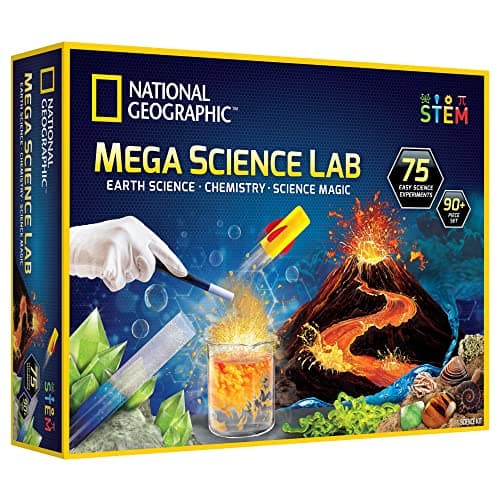
| 1 | Best overall NATIONAL GEOGRAPHIC Mega Science Lab Forty-five kit experiments plus 85 household ones — the second number is why this outlasts its price band. | Eight and up, and a household that will keep going after the supplies run out | |
| 2 | 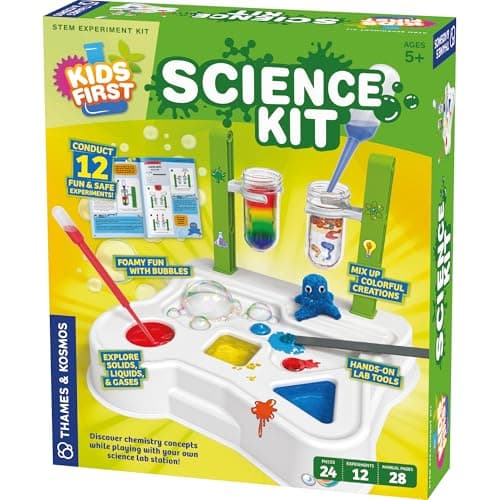 Best for under-sixes Kids First Science Laboratory Twenty-four reusable tools and no chemicals at all — a preschool science kit with nothing in it to use up. | Three to six, where almost every other kit is unavailable | |
| 3 | 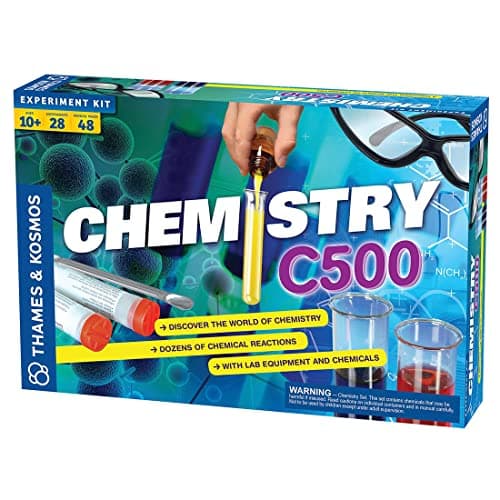 Best for real chemistry Thames & Kosmos Chemistry C500 Twenty-eight experiments, a 48-page manual and five actual chemicals — the step from science kit to chemistry set. | Ten and up, where a child wants the real thing rather than a themed kit | |
| 4 | 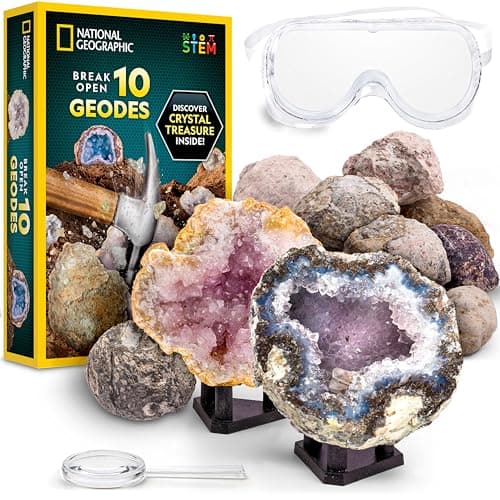 Best single experience NATIONAL GEOGRAPHIC Break Open 10 Premium Geodes Ten geodes, ten genuinely brilliant moments, and then a bowl of pretty rocks. | A stocking filler or a second present, never the main one | |
| — | 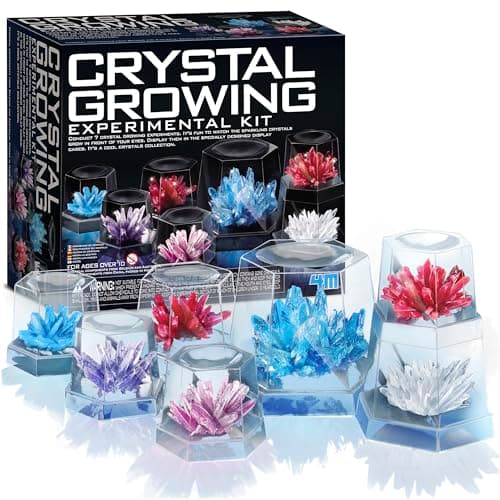 The one to skip 4M Crystal Growing Experiment Kit Seven experiments from three bags of compound, each taking days, with a 10+ rating that surprises people. | Nobody, unless the child has specifically asked for crystals |
5 picks, including 1 we tell you to skip. Ages shown are the manufacturer’s own rating, not ours.
The question this page is built around
Every experiment kit publishes a number of experiments and every review repeats it. That number is close to useless on its own, because there is no standard for what counts as one experiment, and because it says nothing about what happens when the supplied materials run out.
So the ranking above uses two numbers instead. First, the manual page count divided by the experiment count, which is a decent proxy for depth — a page and a half per experiment is enough for a method, a result and an explanation; a quarter of a page is a list of instructions. Second, and more importantly, how much of the published content survives the consumables running out.
The arithmetic
What is left when the supplies are gone
| NatGeo Mega Science Lab — kit experiments | 45 |
|---|---|
| NatGeo Mega Science Lab — household experiments in the bonus guide | 85+ |
| Proportion of content that outlives the box | roughly two thirds |
| Chem C500 — experiments / chemicals | 28 / 5 |
| Chem C500 — manual pages per experiment | about 1.7 |
| 4M Crystal Growing — experiments / bags of compound | 7 / 3 |
| NatGeo Break Open Geodes — single-use items | 10 |
What a good science kit for a child actually does
Three things, and most kits do only the first.
It produces a result the child did not expect. This is the easy part and every kit manages it — a color change, a fizz, a thing that grows. It is also the part that wears off, because surprise is not repeatable.
It explains what happened in language the child can hold. This is where the manual page count matters. A kit that says “add the powder and watch!” has produced a magic trick. A kit that gets a page and a half to say what an acid is and why the indicator changed color has produced a fact.
It leaves the child able to do something else. This is rarest and it is what the bonus-guide model achieves. A child who has learned that red cabbage water is an indicator can go and test everything in the kitchen, and that is a different order of outcome from a child who has used up a sachet.
Worth knowing before you buy
Chemistry kits sold in Europe are made to EN 71-4, the published standard specifically covering chemistry experiment kits, and Thames & Kosmos states compliance with it. US toys are covered by ASTM F963. A manufacturer that names its standard has committed to something checkable; one that says only “safe for children” has not.
Practical points that the standards do not cover: geode kits involve hitting a rock with a hammer, which is why goggles are in the published contents and should be worn. Crystal-growing compounds should not be left where a younger sibling can reach them during the several days they sit out. And at the bottom of a 10+ chemistry rating, sit with the child — not because it is dangerous as directed, but because the first unexpected result is the moment the science lands.
Matching the kit to the child
- Three to six: Kids First Science Laboratory. Reusable tools, no chemicals, works with kitchen materials.
- Six to ten, general interest: Mega Science Lab, for the household bonus guide.
- Ten and up, asked for chemistry specifically: Chem C500, and read the manual online before you buy — Thames & Kosmos publishes them free.
- Any age, as a second present: the geode kit, framed honestly as an afternoon.
If what you actually want is a science purchase that never runs out, this is the wrong page — a microscope is the answer, and it is the only category here that passes the replay test outright. For the monthly model, see subscription boxes, and for real chemistry specifically, the chemistry set roundup.
In full
Every pick, and what is wrong with it
Published specifications only, each linked back to the page it came from. Where a manufacturer publishes nothing, the row says so — we do not fill blanks in.
1. Best overall
NATIONAL GEOGRAPHIC Mega Science Lab
National Geographic · Mega Science Lab · maker rates it 8+
Forty-five kit experiments plus 85 household ones — the second number is why this outlasts its price band.
- Experiments in the kit
- 45, across chemistry, earth science and science magic
- Bonus guide
- 85+ further experiments using household items, for 130+ in total
- Includes
- Volcano build, glow-in-the-dark crystal growth, and the tools for both
- Stated age
- 8+
The published structure is the reason this wins. Forty-five experiments using the supplied materials, spread across chemistry, earth science and science magic, plus a bonus guide of more than 85 further experiments using household items — 130-plus in total.
That second number is unusual and it changes the arithmetic completely. Every other kit on this page hits a wall when the supplies run out. This one hands the child a book that works with vinegar, food coloring and a kitchen. It costs the manufacturer almost nothing and it roughly triples the life of the purchase.
The published headline activities — building and erupting a volcano, growing a glow-in-the-dark crystal — are the ones a child will actually ask for. The 8+ rating is right: the chemistry third needs an adult nearby, the rest largely does not.
Replay signal
- Open-ended or one-shot
- Guided, and the 45 in-kit experiments end. The 85 household ones do not
- Does anything run out
- The supplied materials run out; the household half of the book never does
- Room to grow
- The bonus guide is the genuinely durable part, and it costs the manufacturer almost nothing to include
- Adult required
- Supervision for the chemistry third; the earth science and household experiments are largely self-run
Why we say so: National Geographic publishes 45 in-kit experiments plus a bonus guide of 85+ using household items. That second number is why this kit outlasts most of its price band: roughly two-thirds of the published content needs nothing but a kitchen.
What’s wrong with it
It is three kits in a trench coat. Chemistry, earth science and science magic in one box means less depth in each than a dedicated set of the same price would give.
| Experiments in the kit | 45, across chemistry, earth science and science magic |
|---|---|
| Bonus guide | 85+ further experiments using household items, for 130+ in total |
| Includes | Volcano build, glow-in-the-dark crystal growth, and the tools for both |
| Stated age | 8+ |
| Consumables | Yes — the supplied chemicals and crystal compounds are used up |
Every figure above is from National Geographic toys, Mega Science Lab. Blanks are shown as “not published” rather than filled in.
2. Best for under-sixes
Kids First Science Laboratory
Thames & Kosmos · Kids First Science Laboratory · maker rates it 3-6+
Twenty-four reusable tools and no chemicals at all — a preschool science kit with nothing in it to use up.
- Contents
- 24 large plastic scientific tools, described as durable, reusable and easy to handle
- Experiment cards
- 10, double-sided
- Stated age
- 3 to 6+
- Chemicals included
- None — experiments use household materials
Thames & Kosmos publishes 24 large plastic scientific tools — described as durable, reusable and easy to handle — and 10 double-sided experiment cards, for ages 3 to 6 and up.
The absence of chemicals is the specification, not an omission. A preschool science kit whose experiments use household materials has no consumable at all, which means it is still a science kit in March. Compare that to almost everything else at this age, which is a one-afternoon craft in a box.
The tools themselves are the durable asset. Beakers, pipettes, a funnel and a magnifier sized for small hands carry into any household-materials experiment for years, long after the ten cards have been worked through.
Replay signal
- Open-ended or one-shot
- The 20 card sides are a starting ladder; the tools then work on anything in the kitchen
- Does anything run out
- Nothing in the box runs out, because nothing in the box is consumed
- Room to grow
- The same tools carry into any household-materials experiment for years
- Adult required
- Yes at three, less so at five. The cards are picture-led but the setup is not
Why we say so: Thames & Kosmos publishes 24 reusable tools and no chemicals. A preschool science kit with no consumables in it is unusual, and it is the reason this one survives past its first fortnight when kit-of-the-week alternatives do not.
What’s wrong with it
Ten experiment cards is not many, and once they are done the value depends entirely on an adult inventing the next thing to pour.
| Contents | 24 large plastic scientific tools, described as durable, reusable and easy to handle |
|---|---|
| Experiment cards | 10, double-sided |
| Stated age | 3 to 6+ |
| Chemicals included | None — experiments use household materials |
| Consumables | None in the box |
Every figure above is from Thames & Kosmos, Kids First range. Blanks are shown as “not published” rather than filled in.
3. Best for real chemistry
Thames & Kosmos Chemistry C500
Thames & Kosmos · 665012 · maker rates it 10+
Twenty-eight experiments, a 48-page manual and five actual chemicals — the step from science kit to chemistry set.
- Experiments
- 28
- Manual
- 48 pages
- Chemicals included
- 5
- Equipment
- Safety glasses, test tubes, dropper pipettes, double-headed measuring spoon
Thames & Kosmos publishes 28 experiments, a 48-page manual, five chemicals, safety glasses, test tubes, dropper pipettes and a double-headed measuring spoon, rated 10 and up.
Forty-eight pages across 28 experiments is roughly a page and a half each, which is enough for a method, a result and an explanation. That ratio is the honest measure of a science kit’s depth, and it is far more useful than the raw experiment count.
The equipment carries forward. When the chemicals are gone, the glassware, the spatula and the safety glasses are still there and work with the larger C1000 and C2000 sets. Bought as the first rung of a ladder, it is good value; bought as a standalone toy, it ends.
Replay signal
- Open-ended or one-shot
- Guided, not open-ended: 28 experiments, then the manual is finished
- Does anything run out
- Yes — the chemicals are consumed, and Thames & Kosmos sells replacements
- Room to grow
- Steps up to the larger C1000, C2000 and C3000 sets in the same line
- Adult required
- The maker rates it 10+ and it involves real chemicals
Why we say so: Thames & Kosmos publishes 28 experiments, a 48-page manual and five chemicals. Five finite chemicals across 28 experiments is arithmetic, not opinion — this set has an end, and it is better to know that before Boxing Day than after.
What’s wrong with it
The chemicals are consumed and the set has a numbered last experiment. Bought expecting a permanent toy, it disappoints inside a month.
| Experiments | 28 |
|---|---|
| Manual | 48 pages |
| Chemicals included | 5 |
| Equipment | Safety glasses, test tubes, dropper pipettes, double-headed measuring spoon |
| Stated age | 10 years and up |
| Batteries | 1 x 9V (not included) |
| Consumables | Yes — the five chemicals are used up |
Every figure above is from Thames & Kosmos, Chemistry C500. Blanks are shown as “not published” rather than filled in.
4. Best single experience
NATIONAL GEOGRAPHIC Break Open 10 Premium Geodes
National Geographic · NGGEO10 · maker rates it 8+
Ten geodes, ten genuinely brilliant moments, and then a bowl of pretty rocks.
- Geodes
- 10, hand-selected, 1.25 to 2.25 inches across
- Includes
- Safety goggles, magnifying glass, display stands, full-color learning guide
- Stated age
- Manufacturer's minimum age 8 years
- Safety note
- Contains small parts; not for children under 3
National Geographic publishes ten hand-selected natural geodes, 1.25 to 2.25 inches across, with safety goggles, a magnifying glass, display stands and a full-color learning guide, rated 8+.
We are recommending this and telling you it ends, because both are true. Cracking open a rock and finding crystals inside is a genuinely memorable thing, the specimens are real geological samples rather than a manufactured novelty, and the display stands mean the results stay on a shelf afterward.
But ten is ten. If a child is given this on Christmas morning, there is a real chance all ten are open by lunchtime. Buy it as an event, price it against an afternoon out rather than against a toy, and it is excellent value on those terms.
Replay signal
- Open-ended or one-shot
- One-shot by design. Ten geodes, ten moments, then it is a bowl of pretty rocks
- Does anything run out
- Yes, definitively — the clearest example on this site of a kit that ends
Why we say so: National Geographic publishes the count as ten natural geodes. Ten single-use items is a finite number, and we would rather say so than let a gift-buyer find out on Christmas afternoon.
What’s wrong with it
It is finite in a way nothing else here is: ten single-use items, and every one is used up the first afternoon if the child is enthusiastic.
| Geodes | 10, hand-selected, 1.25 to 2.25 inches across |
|---|---|
| Includes | Safety goggles, magnifying glass, display stands, full-color learning guide |
| Stated age | Manufacturer's minimum age 8 years |
| Safety note | Contains small parts; not for children under 3 |
| Consumables | Yes — ten geodes, and each one only cracks open once |
Every figure above is from National Geographic toys, Break Open Geodes. Blanks are shown as “not published” rather than filled in.
Skip this one
4M Crystal Growing Experiment Kit
4M · 5557 · maker rates it 10+
Seven experiments from three bags of compound, each taking days, with a 10+ rating that surprises people.
- Experiments
- 7 crystal-growing experiments
- Contents
- 3 bags of crystal compound, 3 bags of seeding mixture, stirring bowl and spoon, 7 display bases, 7 display covers, 7 ring templates
- Stated age
- 10 years and up
- Consumables
- Yes — the compound is the whole product
The published contents make the problem visible: seven crystal-growing experiments, but three bags of crystal compound and three bags of seeding mixture, plus seven display bases, covers and ring templates. The consumable is smaller than the experiment count suggests.
The bigger issue is time. Crystals grow over days, which means the gap between doing the thing and seeing the result is measured in sleeps. For most children under about eleven that is not a science experiment, it is a waiting exercise, and the 10+ rating reflects it.
If a child has specifically asked for crystal growing, buy it — it does what it says. If you are choosing a science kit for a child who likes science generally, almost everything else on this page delivers more per pound and delivers it the same day.
Replay signal
- Open-ended or one-shot
- One-shot, seven times over
- Does anything run out
- Definitively. Three bags of compound, and when they are gone the kit is a set of display cases
Why we say so: 4M publishes three bags of crystal compound across seven experiments. That is the arithmetic that decides this purchase: it is seven results, spread over weeks because crystals take days to grow, and then it is finished. Excellent as an event; poor as the main present.
What’s wrong with it
Days of waiting per result, a hard 10+ age rating, and when three bags of compound are gone the kit is seven empty display cases.
| Experiments | 7 crystal-growing experiments |
|---|---|
| Contents | 3 bags of crystal compound, 3 bags of seeding mixture, stirring bowl and spoon, 7 display bases, 7 display covers, 7 ring templates |
| Stated age | 10 years and up |
| Consumables | Yes — the compound is the whole product |
| Time per experiment | Days, not minutes — crystals grow on their own schedule |
Every figure above is from 4M, Crystal Growing Experiment Kit. Blanks are shown as “not published” rather than filled in.
We are not putting a buy button on this one. It is easy enough to find if you want it anyway — but we would rather send you to something that gets played with twice.
Questions people actually ask
Frequently asked
How many experiments does a science kit really have?
Fewer than the box says, in the sense that the count includes experiments limited by consumable supplies. The more useful figures are manual pages per experiment — around 1.7 for the Chem C500 — and how much of the content works with household materials once the kit supplies are gone.
What is the best science kit for a 5-year-old?
Thames & Kosmos Kids First Science Laboratory, rated 3 to 6+. It publishes 24 reusable tools and 10 double-sided cards, and contains no chemicals at all, so nothing in it can run out.
Are geode kits worth buying?
As an event, yes. As the main present, no. National Geographic publishes ten natural geodes, and ten single-use items can easily be gone in an afternoon. Price it against a trip out rather than against a toy and it is good value.
What science kit lasts the longest?
The one with the most content that does not depend on supplied materials. National Geographic's Mega Science Lab publishes 45 kit experiments plus a bonus guide of 85+ using household items, so roughly two thirds of the content outlives the box.
Are children's chemistry sets safe?
Sets sold in Europe are made to EN 71-4, the standard covering chemistry experiment kits, and Thames & Kosmos states compliance. Supervision is still the right call at the bottom of a 10+ rating, mainly because the first unexpected result is the moment worth being present for.
Sources
Where these figures came from
Every specification on this page traces to one of these. If a manufacturer publishes nothing on a point, the page says so rather than filling the gap.
Read next
Where to go from here
Back to Science Kits, or read how we pick.