The picks
First Science Kits for Ages 3 to 6
Almost every science kit is rated eight and up. Here is what actually works for a four-year-old.
By Sawyer V. · Published
The short answer
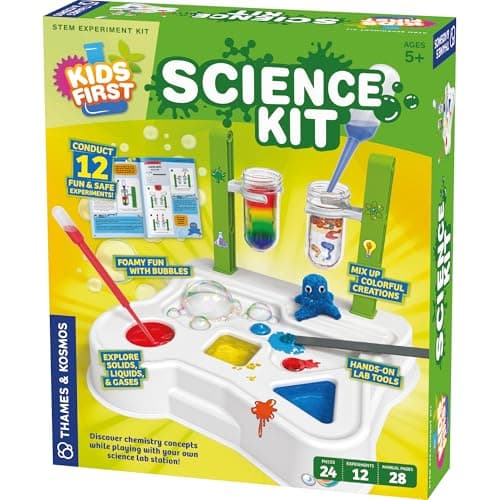
Under six, buy tools rather than kits. Thames & Kosmos’s Kids First Science Laboratory publishes 24 reusable tools, no chemicals and 10 double-sided cards for ages 3 to 6+ — nothing in it runs out, and the experiments use household materials. Almost every other science kit on the shelf is rated 8+.
Block & Beaker earns a commission when you buy through our links, at no cost to you. It never changes a ranking, and we say so plainly when the right answer is the cheaper set, or nothing at all. Full disclosure · How we pick.
At a glance
The picks, ranked
Tap any row to jump to the full reasoning. Prices come live from Amazon where we have them and read “check price” where we don’t — never a number we cannot stand behind today.
| # | Product | Best for | Price |
|---|---|---|---|
| 1 | Best first science kit Kids First Science Laboratory Twenty-four reusable tools, zero chemicals, and experiments that run on things already in the kitchen. | Three to six, as an actual science kit rather than a craft | |
| 2 | 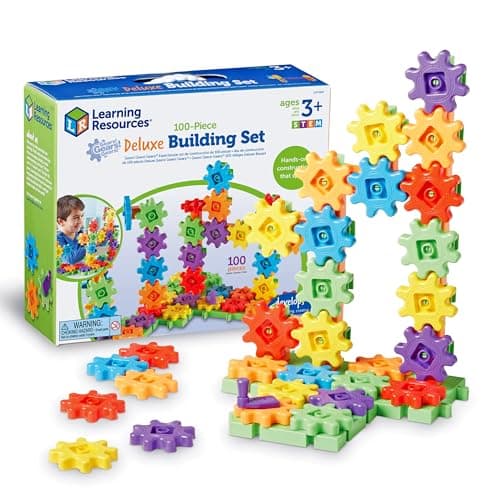 Best cause and effect Gears! Gears! Gears! 100-Piece Deluxe Building Set A hundred pieces that build a machine, and a crank handle that makes the whole thing move at once. | Three and up, and a child who wants to see why something moved | |
| 3 | 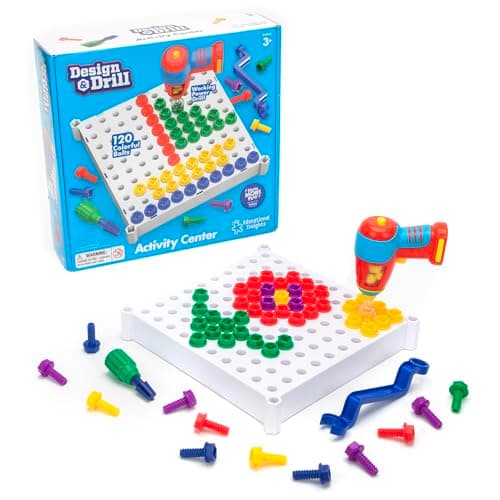 Best real tool Design & Drill Activity Center A working child-sized power drill in a 146-piece set, at a 3+ rating. | Three and up, and a child fascinated by whatever an adult is doing with tools | |
| 4 | 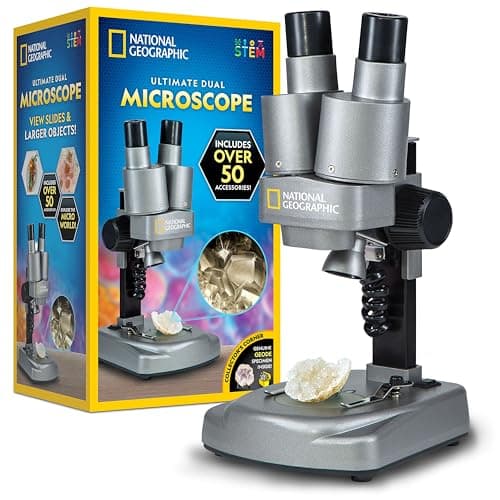 Best to grow into NATIONAL GEOGRAPHIC Dual LED Student Microscope Low magnification and top lighting, which is exactly the right first microscope. | Six and up, or five with an adult doing the focusing | |
| — | 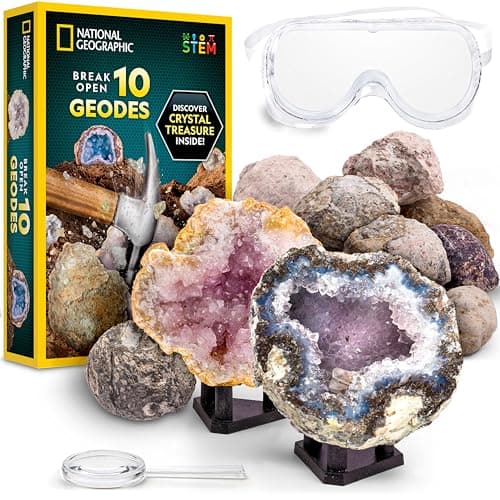 The one to skip at this age NATIONAL GEOGRAPHIC Break Open 10 Premium Geodes Rated 8+, involves a hammer, and is over in an afternoon — three separate reasons it is wrong here. | Eight and up, not this page |
5 picks, including 1 we tell you to skip. Ages shown are the manufacturer’s own rating, not ours.
Why this page exists
Walk the science aisle looking for a four-year-old and almost everything is rated 8+. That is not marketing caution — it reflects real constraints: small parts, reagents, reading, and fine motor control that has not arrived yet.
What fills the gap is mostly craft dressed as science. Kits that grow one thing, or make one slime, and are finished. Those are fine as activities and poor as presents, and they are the reason so many parents conclude that science kits are a waste of money at this age.
The answer is to change what you are buying. Under six, buy tools and mechanisms rather than kits: equipment a child can operate, that does something visible, and that does not get used up.
What actually works before six
Things that respond immediately. A crank that makes twenty gears turn. A drill that spins. A pipette that moves water. The gap between action and result has to be zero, which is why crystal growing and anything requiring days is wrong at this age.
Things with no reading. Picture cards, symbols and demonstration. Any kit whose instructions are prose is an adult-operated kit, and adult-operated kits get used when an adult is free.
Things that survive being wrong. A four-year-old will put the gear on the wrong peg and the drill bit in the wrong hole. Equipment that tolerates that keeps being picked up; equipment that breaks or produces a failed experiment does not.
Things with nothing to use up. This is the one that separates the recommendations above from most of the aisle. Every pick here except the geode kit has no consumable at all.
The best science kit at this age might not be a kit
Worth saying plainly: a set of magnetic tiles teaches more physics to a four-year-old than most science kits rated for eight. Balance, structure, magnetism, symmetry — all of it, open-ended, with nothing to run out.
The same goes for a marble run: gravity, momentum and iterative problem-solving, delivered as play rather than as an activity someone has to organize.
We would rather say that than sell a kit. If you are buying a science present for a four-year-old and the child does not already have a good open-ended construction set, buy that first and come back to kits at six.
Worth knowing before you buy
Age ratings at this end of the range are usually small-parts safety floors rather than difficulty estimates, and they should be treated as floors. A 3+ rating means the pieces have passed testing for a child who might still mouth them; an 8+ rating on a science kit usually means the opposite is true.
The specific things to avoid before six: anything with loose magnets, anything requiring a hammer, anything with reagents, and anything where the result arrives days later and the materials sit out in the meantime.
What to buy
- Three to four: Gears, or Design & Drill. Immediate cause and effect, no reading, nothing to use up.
- Four to six: Kids First Science Laboratory, for real tools and household-materials experiments.
- Five to six, with an adult: the National Geographic Dual LED microscope, which is the only purchase here that lasts past seven.
- No construction set in the house yet: buy tiles instead and come back to this page in two years.
For age-by-age picks across every category, see four-year-olds and five-year-olds. For what to buy once they are past this stage, experiment kits.
In full
Every pick, and what is wrong with it
Published specifications only, each linked back to the page it came from. Where a manufacturer publishes nothing, the row says so — we do not fill blanks in.
1. Best first science kit
Kids First Science Laboratory
Thames & Kosmos · Kids First Science Laboratory · maker rates it 3-6+
Twenty-four reusable tools, zero chemicals, and experiments that run on things already in the kitchen.
- Contents
- 24 large plastic scientific tools, described as durable, reusable and easy to handle
- Experiment cards
- 10, double-sided
- Stated age
- 3 to 6+
- Chemicals included
- None — experiments use household materials
Thames & Kosmos publishes 24 large plastic scientific tools — durable, reusable and easy to handle — with 10 double-sided experiment cards, for ages 3 to 6 and up.
No chemicals is the whole design. A three-year-old does not need reagents; they need a beaker they can hold, a pipette that works with a weak grip, and permission to pour water from one container into another while an adult says what is happening.
That also makes it the rare science purchase at this age with no consumable. The tools are still tools in a year, and they work with any household-materials experiment an adult finds online, which extends the ten cards indefinitely if anyone is willing.
Replay signal
- Open-ended or one-shot
- The 20 card sides are a starting ladder; the tools then work on anything in the kitchen
- Does anything run out
- Nothing in the box runs out, because nothing in the box is consumed
- Room to grow
- The same tools carry into any household-materials experiment for years
- Adult required
- Yes at three, less so at five. The cards are picture-led but the setup is not
Why we say so: Thames & Kosmos publishes 24 reusable tools and no chemicals. A preschool science kit with no consumables in it is unusual, and it is the reason this one survives past its first fortnight when kit-of-the-week alternatives do not.
What’s wrong with it
Ten cards is a short ladder. After those, the value depends on an adult being willing to invent the next thing to measure or pour.
| Contents | 24 large plastic scientific tools, described as durable, reusable and easy to handle |
|---|---|
| Experiment cards | 10, double-sided |
| Stated age | 3 to 6+ |
| Chemicals included | None — experiments use household materials |
| Consumables | None in the box |
Every figure above is from Thames & Kosmos, Kids First range. Blanks are shown as “not published” rather than filled in.
2. Best cause and effect
Gears! Gears! Gears! 100-Piece Deluxe Building Set
Learning Resources · LER9162 · maker rates it 3+
A hundred pieces that build a machine, and a crank handle that makes the whole thing move at once.
- Pieces
- 100
- Contents
- 46 gears, 26 square pillars, 21 six-way axles, 6 interlocking bases, 1 crank handle, activity guide
- Stated age
- 3+
- Batteries
- None — hand-cranked
Learning Resources publishes 46 gears, 26 square pillars, 21 six-way axles, 6 interlocking bases, a crank handle and an activity guide, rated 3+.
The crank is what makes this science rather than construction. A three-year-old builds something, turns a handle, and every part of it moves — including the parts they did not touch. That is the first experience of a mechanism, and it lands years before any kit could explain it.
No batteries appear in the published contents. This is a toy that works forever, in the car, on holiday, and after every other present has gone flat.
Replay signal
- Open-ended or one-shot
- Open-ended, with immediate cause and effect: turn the handle, the whole thing moves
- Does anything run out
- Nothing runs out
- Room to grow
- Sets from the same line interlock, so a second box doubles the machine
Why we say so: Learning Resources publishes the full 100-piece contents list, the ages 3+ rating and the hand crank. No batteries appear in the published contents, which is why this one still works when everything else in the toy box is flat.
What’s wrong with it
The core idea — gears turn other gears — is understood quickly. After that it is arrangement rather than discovery.
| Pieces | 100 |
|---|---|
| Contents | 46 gears, 26 square pillars, 21 six-way axles, 6 interlocking bases, 1 crank handle, activity guide |
| Stated age | 3+ |
| Batteries | None — hand-cranked |
| Consumables | None |
Every figure above is from Learning Resources, Gears! Gears! Gears! Deluxe Building Set. Blanks are shown as “not published” rather than filled in.
3. Best real tool
Design & Drill Activity Center
Educational Insights · EI-4112 · maker rates it 3+
A working child-sized power drill in a 146-piece set, at a 3+ rating.
- Pieces
- 146
- Contents
- Kid-friendly power drill, activity board, colored bolts, design and activity cards
- Stated age
- Ages 3+
- Batteries
- Required for the drill (not included)
Educational Insights publishes 146 pieces including a kid-friendly power drill, an activity board, colored bolts and pattern cards, rated 3+.
A trigger-operated drill at a 3+ rating is unusual and it is the entire appeal. The child is using a tool rather than a representation of one, and the difference in how seriously a three-year-old takes it is immediately obvious.
The pattern cards give it structure — match the card, place the bolts — and the board works freely afterward. Buy batteries at the same time; a drill that does not spin is the wrong present entirely.
Replay signal
- Open-ended or one-shot
- Both: the activity cards give a ladder, and the board can be filled freely once they are done
- Does anything run out
- Nothing runs out
- Room to grow
- Little beyond about five — this is squarely a preschool toy
- Adult required
- For the first go, then not. The drill is designed for a three-year-old to hold
Why we say so: Educational Insights publishes the 146-piece contents including the child-sized drill and pattern cards. A real trigger-operated tool at a 3+ rating is unusual, and it is the whole appeal: the child is using a tool rather than a representation of one.
What’s wrong with it
It is a preschool toy with a short runway — most children are done with it by five — and the drill needs batteries that are not included.
| Pieces | 146 |
|---|---|
| Contents | Kid-friendly power drill, activity board, colored bolts, design and activity cards |
| Stated age | Ages 3+ |
| Batteries | Required for the drill (not included) |
| Consumables | None |
Every figure above is from Educational Insights, Design & Drill Activity Center. Blanks are shown as “not published” rather than filled in.
4. Best to grow into
NATIONAL GEOGRAPHIC Dual LED Student Microscope
National Geographic · Dual LED Student Microscope · maker rates it 8+
Low magnification and top lighting, which is exactly the right first microscope.
- Magnifications
- 20x and 50x, from two sets of optical glass lenses
- Lighting
- Upper and lower LED
- Accessories
- 50+ pieces, including 10 prepared slides, blank slides and covers, tweezers, eye-dropper and a mini geode
- Weight
- 2.6 lb
National Geographic publishes 20x and 50x with upper and lower LED lighting and 50-plus accessories including 10 prepared slides, blank slides, tweezers, an eye-dropper and a mini geode, rated 8+.
We are including it below its rating deliberately, with a condition: at five or six this is something an adult focuses and a child looks through, and on those terms it is spectacular. Twenty times magnification on a leaf or a beetle is the single most reliably astonishing thing in this entire roundup.
It is also the one purchase here that a child does not outgrow. The others are done by five or six; this one is still being used at eleven.
Replay signal
- Open-ended or one-shot
- Open-ended, and the low magnification is the reason — 20x is where insects and leaves look extraordinary
- Does anything run out
- The 10 prepared slides run out; blank slides and the garden do not
- Room to grow
- Limited on magnification, generous on subject matter
Why we say so: National Geographic publishes 20x and 50x with upper and lower LED lighting. Low magnification plus top lighting is a deliberate design for looking at whole objects rather than slides, which for a child under about ten is a far better first microscope than a 1000x compound scope they cannot focus.
What’s wrong with it
Rated 8+, and focusing genuinely is beyond most five-year-olds — this is a shared activity at that age, not a solo one.
| Magnifications | 20x and 50x, from two sets of optical glass lenses |
|---|---|
| Lighting | Upper and lower LED |
| Accessories | 50+ pieces, including 10 prepared slides, blank slides and covers, tweezers, eye-dropper and a mini geode |
| Weight | 2.6 lb |
| Stated age | 8+ |
Every figure above is from National Geographic toys, Dual LED Student Microscope. Blanks are shown as “not published” rather than filled in.
Skip this one
NATIONAL GEOGRAPHIC Break Open 10 Premium Geodes
National Geographic · NGGEO10 · maker rates it 8+
Rated 8+, involves a hammer, and is over in an afternoon — three separate reasons it is wrong here.
- Geodes
- 10, hand-selected, 1.25 to 2.25 inches across
- Includes
- Safety goggles, magnifying glass, display stands, full-color learning guide
- Stated age
- Manufacturer's minimum age 8 years
- Safety note
- Contains small parts; not for children under 3
National Geographic publishes this at a minimum age of 8 with an explicit warning that it contains small parts and is not for children under 3. It shows up constantly in gift lists for younger children and it does not belong there.
Cracking geodes involves hitting rocks with a hammer while wearing goggles. That is a fine activity for an eight-year-old and an unsuitable one for a four-year-old, and no amount of supervision changes what the child is actually able to do.
It is a good kit. It is on the experiment kits page for the age it suits.
Replay signal
- Open-ended or one-shot
- One-shot by design. Ten geodes, ten moments, then it is a bowl of pretty rocks
- Does anything run out
- Yes, definitively — the clearest example on this site of a kit that ends
Why we say so: National Geographic publishes the count as ten natural geodes. Ten single-use items is a finite number, and we would rather say so than let a gift-buyer find out on Christmas afternoon.
What’s wrong with it
Small parts, an explicit not-for-under-threes warning, hammering, and ten single-use items.
| Geodes | 10, hand-selected, 1.25 to 2.25 inches across |
|---|---|
| Includes | Safety goggles, magnifying glass, display stands, full-color learning guide |
| Stated age | Manufacturer's minimum age 8 years |
| Safety note | Contains small parts; not for children under 3 |
| Consumables | Yes — ten geodes, and each one only cracks open once |
Every figure above is from National Geographic toys, Break Open Geodes. Blanks are shown as “not published” rather than filled in.
We are not putting a buy button on this one. It is easy enough to find if you want it anyway — but we would rather send you to something that gets played with twice.
Questions people actually ask
Frequently asked
What is the best science kit for a 4-year-old?
Thames & Kosmos Kids First Science Laboratory, rated 3 to 6+. It publishes 24 reusable tools and 10 double-sided cards with no chemicals, so the experiments use household materials and nothing in the box runs out.
Why are most science kits rated 8 and up?
Because of small parts, reagents, reading and fine motor control. Those are real constraints rather than marketing caution, which is why the kits that work below six are tool sets and mechanisms rather than experiment kits.
Is a microscope too advanced for a 5-year-old?
To use alone, yes — National Geographic rates its student scope 8+ and focusing genuinely is beyond most five-year-olds. As a shared activity where an adult focuses and the child looks, 20x magnification on a leaf is the most reliably astonishing thing at this age.
Should I buy a science kit or a construction set for a 4-year-old?
A construction set, if there isn't one in the house. Magnetic tiles teach a four-year-old more physics — balance, structure, magnetism, symmetry — than most science kits rated for eight, open-ended and with nothing to run out. The magnetic tile picks.
Sources
Where these figures came from
Every specification on this page traces to one of these. If a manufacturer publishes nothing on a point, the page says so rather than filling the gap.
Read next
Where to go from here
Back to Science Kits, or read how we pick.