The picks
STEM Toys for 8 Year Olds
Eight is when the equipment stops pretending. Real circuits, real optics, real project counts.
By Sawyer V. · Published
The short answer
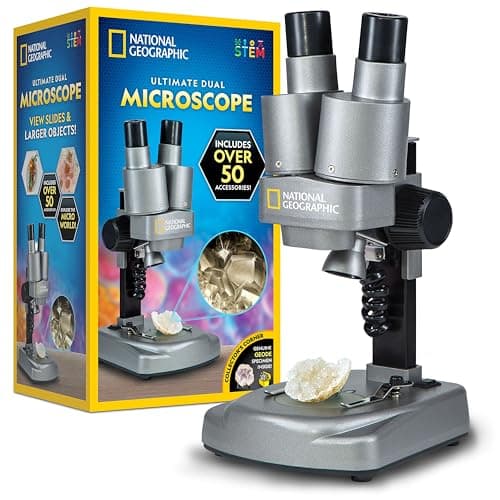
Eight is when almost everything unlocks. The best single purchase is a microscope: it is the only thing here that never runs out, because the specimens are whatever the child finds. National Geographic publishes 20x and 50x with upper and lower LED lighting, which is the right first scope.
Block & Beaker earns a commission when you buy through our links, at no cost to you. It never changes a ranking, and we say so plainly when the right answer is the cheaper set, or nothing at all. Full disclosure · How we pick.
At a glance
The picks, ranked
Tap any row to jump to the full reasoning. Prices come live from Amazon where we have them and read “check price” where we don’t — never a number we cannot stand behind today.
| # | Product | Best for | Price |
|---|---|---|---|
| 1 | Best overall NATIONAL GEOGRAPHIC Dual LED Student Microscope Low magnification and top lighting, which is exactly the right combination for a first microscope. | Eight, and the one purchase here with no end | |
| 2 | 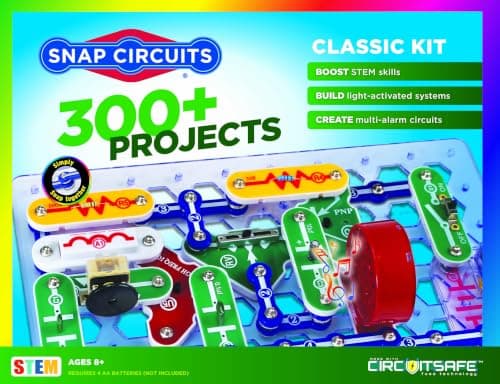 Best system Snap Circuits Classic Three hundred and five projects from 60-plus parts, at the exact rated age. | Eight, as the deepest published ladder at this price | |
| 3 | 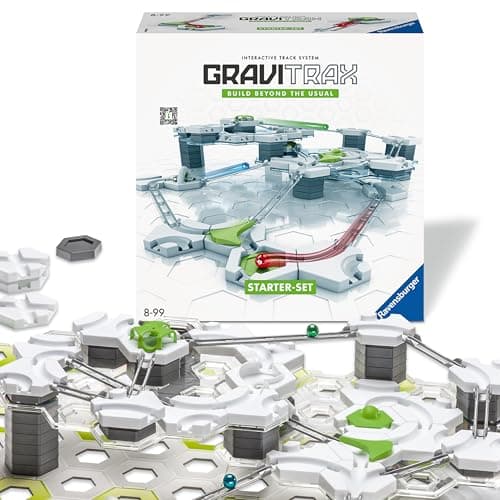 Best construction GraviTrax Starter Set One hundred and twenty-two pieces across 18 element types, with genuine physics in the action pieces. | Eight, at the age the height-tile system finally clicks | |
| 4 | 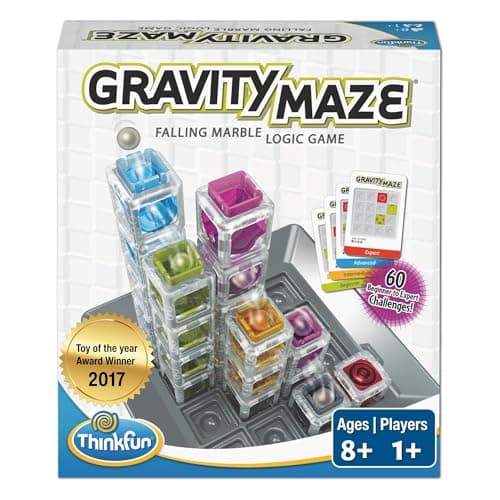 Best logic game ThinkFun Gravity Maze Sixty challenges where a marble verifies the answer instead of an adult. | Eight, as a second present alongside something open-ended | |
| — | 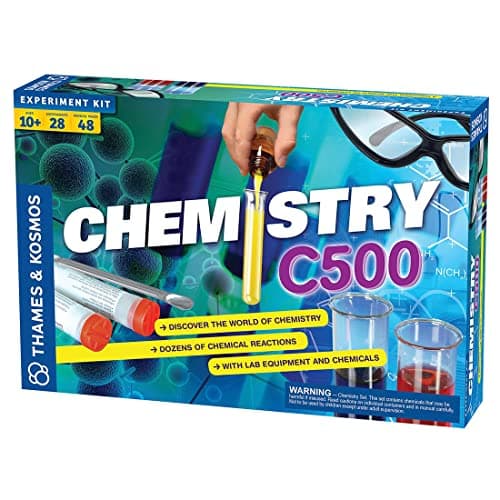 The one to skip Thames & Kosmos Chemistry C500 A good chemistry set with a published 10+ rating that is about the contents, not the difficulty. | Ten and up, not eight |
5 picks, including 1 we tell you to skip. Ages shown are the manufacturer’s own rating, not ours.
What changes at eight
Eight is the age at which the equipment stops pretending. Real optics, real circuit components, real project ladders — almost everything in this category is rated 8+, and at eight the child is finally inside the range rather than being bridged into it.
Two capacities arrive that matter for buying. Sustained iteration: an eight-year-old will attempt something, fail, adjust, and attempt it again several times before giving up — which is what a marble run and a circuit both require. And independent reading of instructions, which finally makes long manuals usable without an adult in the room.
The one thing that never runs out
Run the Replay Signal across everything on this page and one purchase scores differently from the rest.
The arithmetic
What ends, and what does not
| Microscope — specimens available | Unlimited, free, outside |
|---|---|
| Snap Circuits Classic — published projects | 305 |
| GraviTrax — included track designs | 9, then open-ended |
| Gravity Maze — published challenges | 60 |
| Chemistry C500 — experiments / chemicals | 28 / 5 |
It is also why a microscope is our standing answer for a gift when you do not know what a child already owns: unlikely to be a duplicate, impossible to exhaust.
Which age ratings can be stretched, and which cannot
This distinction matters more at eight than at any other age, because eight-year-olds sit right at the boundary of the 10+ tier.
Ratings about reading and abstraction can flex. Snap Circuits at 8+, GraviTrax at 8+ — an adult alongside for the first few sessions bridges a year comfortably in either direction.
Ratings about contents cannot. A chemistry set at 10+ is rated for the reagents. A geode kit at 8+ involves hitting a rock with a hammer. Those numbers describe what is in the box rather than what the child can understand.
The practical test: ask what would go wrong if the child were a year young for it. If the answer is “they would find it hard”, that is a judgment you can make. If the answer involves a substance, a tool or a hazard, it is not.
Say the unwelcome thing
Do not buy the biggest version of a system
Eight is the age at which the flagship set becomes tempting — the 750-project circuit kit, the largest marble run, the biggest chemistry box.
The published numbers usually argue against it. Between Snap Circuits Pro and Extreme, parts rise from over 75 to over 80 while projects rise from 500 to 750; almost all of the difference is manual. And a 750-project manual handed to a beginner is intimidating rather than generous.
Buy the middle rung and spend the difference on a second category. A circuit kit plus a microscope beats the biggest circuit kit, by a wide margin.
Worth knowing before you buy
Snap Circuits Classic publishes a four-AA requirement, not included. The National Geographic microscope publishes an accessory kit with blank slides and covers — glass, and worth a word before first use.
If a geode kit is also being bought, it is rated 8+ specifically because it involves a hammer, and the supplied goggles should be worn rather than admired.
What to buy
- One present, no idea what they own: the microscope.
- A system to work through: Snap Circuits Classic.
- Construction with real physics: GraviTrax.
- Second, smaller present: Gravity Maze.
For the full science category see microscopes and experiment kits. For electronics, the Snap Circuits line comparison.
In full
Every pick, and what is wrong with it
Published specifications only, each linked back to the page it came from. Where a manufacturer publishes nothing, the row says so — we do not fill blanks in.
1. Best overall
NATIONAL GEOGRAPHIC Dual LED Student Microscope
National Geographic · Dual LED Student Microscope · maker rates it 8+
Low magnification and top lighting, which is exactly the right combination for a first microscope.
- Magnifications
- 20x and 50x, from two sets of optical glass lenses
- Lighting
- Upper and lower LED
- Accessories
- 50+ pieces, including 10 prepared slides, blank slides and covers, tweezers, eye-dropper and a mini geode
- Weight
- 2.6 lb
National Geographic publishes 20x and 50x from two sets of optical glass lenses, with upper and lower LED lighting and over 50 accessories including 10 prepared slides, blank slides and covers, tweezers, an eye-dropper and a mini geode, rated 8+.
Low magnification is the right call and it is counter-intuitive. At 20x an insect looks like an insect — recognizable, three-dimensional and astonishing. At 400x it is an unidentifiable field of texture that has to be explained.
The top lighting is what makes the supply of specimens infinite. Light from above works on leaves, rocks, fabric and coins; light from below only works on things thin enough to see through.
Replay signal
- Open-ended or one-shot
- Open-ended, and the low magnification is the reason — 20x is where insects and leaves look extraordinary
- Does anything run out
- The 10 prepared slides run out; blank slides and the garden do not
- Room to grow
- Limited on magnification, generous on subject matter
Why we say so: National Geographic publishes 20x and 50x with upper and lower LED lighting. Low magnification plus top lighting is a deliberate design for looking at whole objects rather than slides, which for a child under about ten is a far better first microscope than a 1000x compound scope they cannot focus.
What’s wrong with it
Fifty times is a real ceiling — cells and pond microorganisms are out of reach, and a keen ten-year-old will meet it.
| Magnifications | 20x and 50x, from two sets of optical glass lenses |
|---|---|
| Lighting | Upper and lower LED |
| Accessories | 50+ pieces, including 10 prepared slides, blank slides and covers, tweezers, eye-dropper and a mini geode |
| Weight | 2.6 lb |
| Stated age | 8+ |
Every figure above is from National Geographic toys, Dual LED Student Microscope. Blanks are shown as “not published” rather than filled in.
2. Best system
Snap Circuits Classic
Elenco · SC-300 · maker rates it 8+
Three hundred and five projects from 60-plus parts, at the exact rated age.
- Projects
- “Build over 300 exciting projects” — manual covers projects 1-305
- Parts
- “Contains over 60 Snap-Together parts”
- Projects per part
- 5.1 — the highest ratio in the line
- Stated age
- “Ages 8+” and “Not for Children under 3 yrs.”
Elenco publishes over 300 projects with a manual covering 1-305, from over 60 snap-together parts, rated 8+, requiring four AA batteries.
Five projects per part is the highest genuine ratio in the Snap Circuits line. Above this set, parts stop growing while project counts double — from the Pro to the Extreme, parts rise by about five and projects by 250 — so you are buying manual rather than components.
At eight this is squarely in its rated range and the child can work it alone. Three hundred and five projects at one a week is years.
Replay signal
- Open-ended or one-shot
- The sweet spot of the line — enough parts to invent with, cheap enough not to be an event
- Does anything run out
- Nothing runs out
- Room to grow
- 305 published projects is years of Sunday afternoons at one a week
Why we say so: Elenco publishes 305 numbered projects against 60+ parts. Five projects per part is the highest ratio anywhere in the Snap Circuits line, which is the arithmetic reason this is the set to buy rather than the cheap one or the big one.
What’s wrong with it
Four AA batteries not included, and the component tray is the thing that goes missing first.
| Projects | “Build over 300 exciting projects” — manual covers projects 1-305 |
|---|---|
| Parts | “Contains over 60 Snap-Together parts” |
| Projects per part | 5.1 — the highest ratio in the line |
| Stated age | “Ages 8+” and “Not for Children under 3 yrs.” |
| Batteries | “Requires 4 ‘AA’ batteries (not included)” |
| Relationship to SC-100 | Manual includes all SC-100 projects plus 200 new ones |
Every figure above is from Elenco, Snap Circuits Classic. Blanks are shown as “not published” rather than filled in.
3. Best construction
GraviTrax Starter Set
Ravensburger · 27597 · maker rates it 8+
One hundred and twenty-two pieces across 18 element types, with genuine physics in the action pieces.
- Pieces
- 122
- Construction elements
- 18 types, including base plates, height tiles, curves, junctions, switches, tracks, a vortex, a launch pad and a magnetic cannon
- Marbles
- 6
- Stated age
- 8 and up
Ravensburger publishes 122 pieces across 18 construction element types, four base plates, 52 height tiles, six marbles, nine included track designs, and named action pieces — a vortex, a launch pad and a magnetic cannon — rated 8 and up.
The magnetic cannon is the piece that makes this genuinely about physics rather than gravity alone: it accelerates the marble, which means a run can go up as well as down.
Eight is where the height-tile idea lands properly. Raising the ground rather than building upward is an abstraction, and it is the reason the same set frustrates a six-year-old and absorbs an eight-year-old.
Replay signal
- Open-ended or one-shot
- Open-ended once the nine included designs are done — the system is a construction kit, not a puzzle with an answer
- Does anything run out
- Nothing runs out
- Room to grow
- Ravensburger publishes a large expansion range built to enlarge the same system
Why we say so: Ravensburger publishes the 122-piece count, the 18 construction-element types, the nine included track designs and an expansion range designed to extend the same track system.
What’s wrong with it
Expandable to the point of being expensive — the published expansion range is where the real money goes.
| Pieces | 122 |
|---|---|
| Construction elements | 18 types, including base plates, height tiles, curves, junctions, switches, tracks, a vortex, a launch pad and a magnetic cannon |
| Marbles | 6 |
| Stated age | 8 and up |
| Track designs included | 9 |
| Consumables | None |
Every figure above is from Ravensburger, GraviTrax Starter Set. Blanks are shown as “not published” rather than filled in.
4. Best logic game
ThinkFun Gravity Maze
ThinkFun · 44001006 · maker rates it 8+
Sixty challenges where a marble verifies the answer instead of an adult.
- Challenges
- 60, beginner to expert
- Contents
- Game grid, 9 towers, 1 target piece, 3 marbles, 60 challenge cards
- Players
- 1
- Batteries
- None
ThinkFun publishes 60 challenges from beginner to expert with a game grid, nine towers, one target piece, three marbles and 60 challenge cards, single-player, no batteries, rated 8+.
The self-verifying solution is the appeal. The child places towers, drops the marble, and it either reaches the target or it does not — no adult adjudicates and no answer card is checked.
Sixty challenges is a few weeks for a determined eight-year-old, so buy it alongside something with no end rather than as the main present.
Replay signal
- Open-ended or one-shot
- Finite by design — 60 challenges, and a determined child will finish them
- Does anything run out
- Nothing physically runs out, but the challenge cards do end
- Room to grow
- The towers can be used freely once the cards are done, though nothing in the box prompts that
Why we say so: ThinkFun publishes 60 challenges and a fixed component list. Sixty is a real number with a real end, and single-player puzzle games are the category where that matters most — better to know before you buy it as the main present.
What’s wrong with it
Sixty challenges and then nothing in the box prompts further play, though the towers work freely.
| Challenges | 60, beginner to expert |
|---|---|
| Contents | Game grid, 9 towers, 1 target piece, 3 marbles, 60 challenge cards |
| Players | 1 |
| Batteries | None |
| Stated age | Ages 8+ |
| Consumables | None |
Every figure above is from ThinkFun, Gravity Maze. Blanks are shown as “not published” rather than filled in.
Skip this one
Thames & Kosmos Chemistry C500
Thames & Kosmos · 665012 · maker rates it 10+
A good chemistry set with a published 10+ rating that is about the contents, not the difficulty.
- Experiments
- 28
- Manual
- 48 pages
- Chemicals included
- 5
- Equipment
- Safety glasses, test tubes, dropper pipettes, double-headed measuring spoon
Thames & Kosmos publishes 28 experiments, a 48-page manual, five chemicals, safety glasses, test tubes, dropper pipettes and a measuring spoon, rated 10 years and up.
Elsewhere on this page we recommend two products at or slightly below their rating, because those ratings are about reading and abstraction. This one is different: a 10+ rating on a set with real reagents is about what is in the bottles.
For an eight-year-old who wants chemistry, the honest route is a broader science kit with a chemistry section — the National Geographic Mega Science Lab is rated 8+ and does exactly that. The real set is worth waiting for, and it is on the chemistry sets page for when the time comes.
Replay signal
- Open-ended or one-shot
- Guided, not open-ended: 28 experiments, then the manual is finished
- Does anything run out
- Yes — the chemicals are consumed, and Thames & Kosmos sells replacements
- Room to grow
- Steps up to the larger C1000, C2000 and C3000 sets in the same line
- Adult required
- The maker rates it 10+ and it involves real chemicals
Why we say so: Thames & Kosmos publishes 28 experiments, a 48-page manual and five chemicals. Five finite chemicals across 28 experiments is arithmetic, not opinion — this set has an end, and it is better to know that before Boxing Day than after.
What’s wrong with it
Real chemicals two years below the manufacturer's rating. That is the one kind of age rating that should not be stretched.
| Experiments | 28 |
|---|---|
| Manual | 48 pages |
| Chemicals included | 5 |
| Equipment | Safety glasses, test tubes, dropper pipettes, double-headed measuring spoon |
| Stated age | 10 years and up |
| Batteries | 1 x 9V (not included) |
| Consumables | Yes — the five chemicals are used up |
Every figure above is from Thames & Kosmos, Chemistry C500. Blanks are shown as “not published” rather than filled in.
We are not putting a buy button on this one. It is easy enough to find if you want it anyway — but we would rather send you to something that gets played with twice.
Questions people actually ask
Frequently asked
What is the best STEM toy for an 8-year-old?
A microscope, if you want the one purchase that never runs out — the specimens are whatever the child finds outside. National Geographic publishes 20x and 50x with upper and lower LED lighting, rated 8+, which is the right combination for a first scope.
Can an 8-year-old have a chemistry set?
Thames & Kosmos rates its C-series 10+, and that rating is about what is in the bottles rather than about difficulty. For an eight-year-old who wants chemistry, a broader science kit rated 8+ with a chemistry section is the honest route, and the real set is worth waiting for. Chemistry sets, by age.
Which age ratings can I stretch and which can't I?
Ask what would go wrong if the child were a year young. If the answer is that they would find it hard — Snap Circuits at 8+, GraviTrax at 8+ — that is a judgment you can make with an adult alongside. If the answer involves a substance, a tool or a hazard, it is not.
Should I buy the biggest set in a range at eight?
Usually not. Elenco publishes parts rising from over 75 to over 80 between the Snap Circuits Pro and Extreme while projects rise from 500 to 750 — almost all of the difference is manual. Buy the middle rung and spend the difference on a second category.
Sources
Where these figures came from
Every specification on this page traces to one of these. If a manufacturer publishes nothing on a point, the page says so rather than filling the gap.
Read next
Where to go from here
Back to Shop by Age, or read how we pick.