Head to head
Snap Circuits Compared: Jr, Classic, Pro and Extreme
Six sets, one ladder, and one division nobody does: projects divided by parts.
By Sawyer V. · Published
The short answer
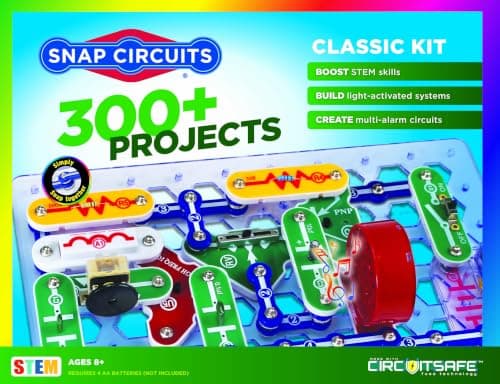
Buy the Classic SC-300. Elenco publishes 305 projects from over 60 parts — about five projects per part, the highest genuine ratio in the line. Above it, part counts barely move while project counts double, so you are paying for more manual rather than more components.
Block & Beaker earns a commission when you buy through our links, at no cost to you. It never changes a ranking, and we say so plainly when the right answer is the cheaper set, or nothing at all. Full disclosure · How we pick.
At a glance
The picks, ranked
Tap any row to jump to the full reasoning. Prices come live from Amazon where we have them and read “check price” where we don’t — never a number we cannot stand behind today.
| # | Product | Best for | Price |
|---|---|---|---|
| 1 | Best for almost everyone Snap Circuits Classic Three hundred and five published projects from 60-plus parts — the point where the set stops being a demonstration. | Eight and up, as the one Snap Circuits set to own | |
| 2 | 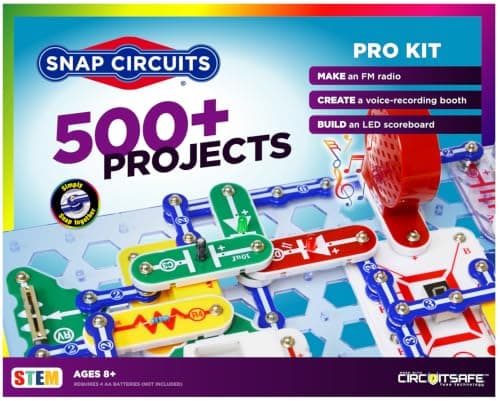 Best for a persistent child Snap Circuits Pro The 73 published computer-interfaced experiments are the only real reason to pay the difference. | A child who finished the Classic manual and wants more | |
| 3 | 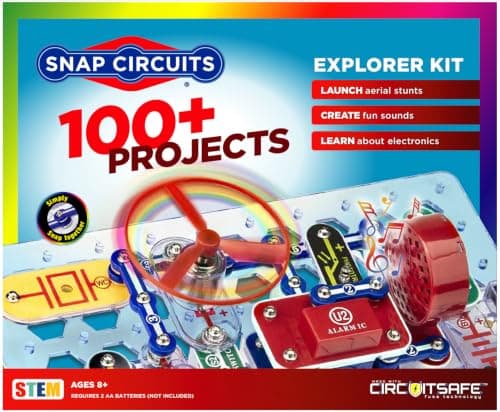 Best budget entry Snap Circuits Jr. Thirty parts and over 100 published projects, all of which reappear in the Classic manual later. | Eight, on a tighter budget, or an unsure first purchase | |
| 4 | 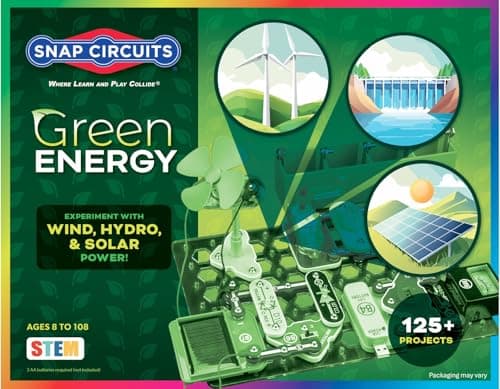 A theme, not a step up Snap Circuits Green One hundred and twenty-five projects from 45-plus parts, focused on alternative energy. | A child already interested in energy specifically | |
| — | 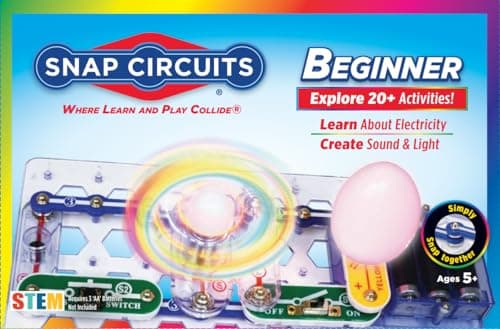 The one to skip Snap Circuits Beginner Twenty-one projects from 14 parts — about a fifth of the Classic's content for a third of the price. | Five to seven, and even then reluctantly | |
| 5 | 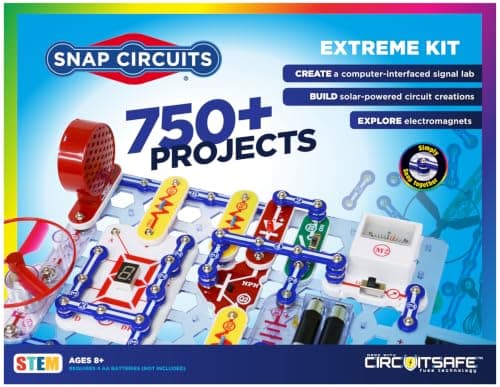 More manual, not more kit Snap Circuits Extreme Seven hundred and fifty projects from 80-plus parts, with solar and electromagnetism added. | A household that has genuinely exhausted the Pro |
6 picks, including 1 we tell you to skip. Ages shown are the manufacturer’s own rating, not ours.
The whole line, in one table
| Set | Model | Parts | Projects | Projects per part | Stated age |
|---|---|---|---|---|---|
| Beginner | SCB-20 | 14 | 21 | 1.5 | 5-8 |
| Green | SCG-125 | 45+ | 125+ | 2.8 | 8+ |
| Jr. | SC-100 | 30 | 100+ | 3.3 | 8+ |
| Classic | SC-300 | 60+ | 305 | 5.1 | 8+ |
| Pro | SC-500 | 75+ | 500+ | 6.7 | 8+ |
| Extreme | SC-750 | 80+ | 750+ | 9.4 | 8+ |
Every parts and projects figure above is published by Elenco. The final column is ours, and it is simple division you can check.
How to read that ratio, because it is counter-intuitive
A higher projects-per-part number is not straightforwardly better. What it measures is how much the manual gets out of the components — and past a certain point, a rising ratio means the components have stopped growing while the manual keeps going.
The arithmetic
Where the parts actually increase
| Beginner to Jr. | +16 parts, +80 projects |
|---|---|
| Jr. to Classic | +30 parts, +205 projects |
| Classic to Pro | +15 parts, +195 projects |
| Pro to Extreme | +5 parts, +250 projects |
This is the whole argument for the Classic. It sits at the top of the part-count growth and the bottom of the price stretch, and everything above it is buying manual pages.
Why the range overlaps, and why that is good
Elenco publishes that the SC-300 manual contains all of the SC-100 projects plus 200 more. The line is designed as a nested set rather than as six competing products, and two useful consequences follow.
First, upgrading loses nothing. A child who moves from the Jr set to the Classic still has every project they knew, plus 200 they did not.
Second, buying up front is efficient. Because the smaller set’s content is entirely contained in the bigger one, the only cost of skipping a rung is that you skipped it — there is no gap in what the child will have covered.
What the age rating means here
Elenco rates almost the whole line 8+, and the Beginner set 5-8. Those are not safety ratings in any meaningful sense: the sets run on AA batteries, nothing gets hot, and the snap-together design is specifically engineered so a wrong connection cannot be made.
They are reading and patience ratings. The manuals are diagram-led but assume a child can follow a numbered sequence and notice when their build does not match the picture. A six or seven-year-old can absolutely use the Classic with an adult sitting alongside, and will get years more out of it than from being bought the Beginner set now.
Worth knowing before you buy
Buy the batteries. Elenco publishes that the Classic and the Pro each require four AA cells, not included. A circuit kit that cannot be switched on is the most disappointing object in a pile of presents, and it is entirely avoidable.
On safety more broadly, the snap-together design is the safety feature: Elenco states the parts “require no tools and ensure correct connections.” There is no soldering, no mains electricity and no exposed wiring in any set in this line.
Say the unwelcome thing
Do not buy the Extreme as a gift for a beginner
A 750-project manual handed to a child who has never built a circuit is intimidating rather than generous, and the 80-plus parts arrive in a tray that means nothing to them yet.
The Classic looks less impressive under a tree and is a substantially better present. If you want to spend the difference, spend it on a circuit logic puzzle to go alongside it, or on the component kit that comes after Snap Circuits.
What to buy, in one line
- Five to seven: Beginner, or wait a year and buy the Classic.
- Eight and up, one set: Classic SC-300. This is the answer for almost everyone.
- Finished the Classic: Pro, if the 73 computer-interfaced experiments will be used. Green, if the interest is energy.
- Genuinely exhausted the Pro: Extreme, for solar and electromagnetism.
For what comes after Snap Circuits, see electronics starter kits. For the same logic in a no-batteries puzzle format, circuit logic games. And for picks by age, eight-year-olds.
In full
Every pick, and what is wrong with it
Published specifications only, each linked back to the page it came from. Where a manufacturer publishes nothing, the row says so — we do not fill blanks in.
1. Best for almost everyone
Snap Circuits Classic
Elenco · SC-300 · maker rates it 8+
Three hundred and five published projects from 60-plus parts — the point where the set stops being a demonstration.
- Projects
- “Build over 300 exciting projects” — manual covers projects 1-305
- Parts
- “Contains over 60 Snap-Together parts”
- Projects per part
- 5.1 — the highest ratio in the line
- Stated age
- “Ages 8+” and “Not for Children under 3 yrs.”
Elenco publishes “build over 300 exciting projects” with a manual covering projects 1-305, from “over 60 Snap-Together parts,” rated 8+ and requiring four AA batteries.
Sixty parts is the threshold where a child can go off-manual. Below that there are not enough spare components to hold an idea — every build consumes most of the box. Above it, a child can look at project forty, wonder what happens if they add a second motor, and try it.
Elenco also publishes the fact that the SC-300 manual contains all of the SC-100 projects plus 200 more. That means buying this instead of the Jr set loses nothing at all — the smaller set’s entire content is included.
Replay signal
- Open-ended or one-shot
- The sweet spot of the line — enough parts to invent with, cheap enough not to be an event
- Does anything run out
- Nothing runs out
- Room to grow
- 305 published projects is years of Sunday afternoons at one a week
Why we say so: Elenco publishes 305 numbered projects against 60+ parts. Five projects per part is the highest ratio anywhere in the Snap Circuits line, which is the arithmetic reason this is the set to buy rather than the cheap one or the big one.
What’s wrong with it
Requires four AA batteries that are not included, and at 60-plus parts the storage tray is already the thing that goes missing.
| Projects | “Build over 300 exciting projects” — manual covers projects 1-305 |
|---|---|
| Parts | “Contains over 60 Snap-Together parts” |
| Projects per part | 5.1 — the highest ratio in the line |
| Stated age | “Ages 8+” and “Not for Children under 3 yrs.” |
| Batteries | “Requires 4 ‘AA’ batteries (not included)” |
| Relationship to SC-100 | Manual includes all SC-100 projects plus 200 new ones |
Every figure above is from Elenco, Snap Circuits Classic. Blanks are shown as “not published” rather than filled in.
2. Best for a persistent child
Snap Circuits Pro
Elenco · SC-500 · maker rates it 8+
The 73 published computer-interfaced experiments are the only real reason to pay the difference.
- Projects
- “Build over 500 exciting projects”
- Parts
- “Contains over 75 snap-together parts”
- Computer-interfaced experiments
- “Includes 73 computer interfaced experiments”
- Projects per part
- 6.7
Elenco publishes “build over 500 exciting projects” from “over 75 snap-together parts,” including 73 computer interfaced experiments, rated 8+ and requiring four AA batteries.
That third number is the one to buy on. Seventy-three computer-interfaced experiments is a genuinely different activity from the rest of the line — the circuit talks to a computer, which is the bridge from electronics into programming.
If nobody is going to use that, the honest arithmetic is that you are paying a substantial premium for fifteen extra components. The Classic set plus a programmable robot is usually a better use of the same money.
Replay signal
- Open-ended or one-shot
- Open-ended, and the computer-interfaced projects give it somewhere to go after the manual
- Does anything run out
- Nothing runs out
- Room to grow
- 73 published computer-interfaced experiments is a second product hiding inside the first
Why we say so: Elenco publishes 500+ projects from 75+ parts and specifically 73 computer-interfaced experiments. That last number is the only thing separating the Pro from the Classic, and it is the only reason to pay the difference.
What’s wrong with it
Fifteen more parts than the Classic for 200 more projects, most of which are variations. Without a computer to interface with, the upgrade is thin.
| Projects | “Build over 500 exciting projects” |
|---|---|
| Parts | “Contains over 75 snap-together parts” |
| Computer-interfaced experiments | “Includes 73 computer interfaced experiments” |
| Projects per part | 6.7 |
| Stated age | “Ages 8+” |
| Batteries | “Requires 4 ‘AA’ batteries (not included)” |
Every figure above is from Elenco, Snap Circuits Pro. Blanks are shown as “not published” rather than filled in.
3. Best budget entry
Snap Circuits Jr.
Elenco · SC-100 · maker rates it 8+
Thirty parts and over 100 published projects, all of which reappear in the Classic manual later.
- Projects
- Over 100
- Parts
- 30
- Projects per part
- 3.3
- Stated age
- Ages 8+
Elenco publishes over 100 projects from 30 parts, rated 8+, with projects including an FM radio, an AM radio, a digital voice recorder, a burglar alarm and a doorbell, and states that the snap-together parts “require no tools and ensure correct connections.”
Those named projects are the reason this set works despite the low part count. A child who builds a working radio out of snap-together components has built a real thing, and that lands regardless of how many parts were involved.
Buy this if you are unsure the interest is real. Buy the Classic if you are fairly sure — the overlap means the upgrade path works but costs you the price of the first box.
Replay signal
- Open-ended or one-shot
- Semi-open. The manual is a ladder, but 30 parts is enough vocabulary to go off-book
- Does anything run out
- Nothing runs out
- Room to grow
- Every SC-100 project is reprinted in the SC-300 manual, so the step up loses nothing
Why we say so: Elenco publishes over 100 projects from 30 parts, and publishes that the SC-300 manual contains all of the SC-100 projects plus 200 more. That overlap is what makes the upgrade path a genuine upgrade rather than a re-buy.
What’s wrong with it
Thirty parts runs out fast for a curious child, and the upgrade to the Classic duplicates most of what is in the box.
| Projects | Over 100 |
|---|---|
| Parts | 30 |
| Projects per part | 3.3 |
| Stated age | Ages 8+ |
| Projects include | FM radio, AM radio, digital voice recorder, burglar alarm, doorbell |
| Tools needed | None — snap-together parts “require no tools and ensure correct connections” |
| Consumables | None |
Every figure above is from Elenco, Snap Circuits Jr. 100 Experiments. Blanks are shown as “not published” rather than filled in.
4. A theme, not a step up
Snap Circuits Green
Elenco · SCG-125 · maker rates it 8+
One hundred and twenty-five projects from 45-plus parts, focused on alternative energy.
- Projects
- Over 125
- Parts
- 45+
- Projects per part
- 2.8
- Stated age
- Ages 8 and up
Elenco publishes over 125 projects from 45-plus parts for the Green set, rated 8 and up, focused on alternative energy.
Held against the Classic — 305 projects from 60-plus parts — the Green set is a narrower product at a similar price band. That is fine, provided you are buying the theme deliberately.
The parts are cross-compatible with the rest of the line, so a household that already owns the Classic can add this for the solar and energy components without duplication. That is the sensible way to buy it: second, not first.
Replay signal
- Open-ended or one-shot
- Themed rather than general-purpose, which narrows it
- Does anything run out
- Nothing runs out
- Room to grow
- Parts are cross-compatible with the rest of the Snap Circuits line
Why we say so: Elenco publishes 125+ projects from 45+ parts for the Green set. Against the Classic's 305 projects from 60+ parts, the Green set is a theme rather than a step up — worth knowing before you buy it as one.
What’s wrong with it
Priced near the Classic while publishing fewer than half its projects. Bought as an upgrade it is a downgrade.
| Projects | Over 125 |
|---|---|
| Parts | 45+ |
| Projects per part | 2.8 |
| Stated age | Ages 8 and up |
| Focus | Alternative energy |
| Consumables | None |
Every figure above is from Elenco, Snap Circuits Green. Blanks are shown as “not published” rather than filled in.
Skip this one
Snap Circuits Beginner
Elenco · SCB-20 · maker rates it 5-8
Twenty-one projects from 14 parts — about a fifth of the Classic's content for a third of the price.
- Projects
- 21
- Parts
- 14
- Projects per part
- 1.5
- Stated age
- Ages 5-8
Elenco publishes 21 projects from 14 parts, rated 5 to 8. It is the only set in the line rated below eight, and for a five or six-year-old it is a legitimate purchase — nothing else in the range is available to them.
For anyone eight or over it is a poor buy, and the arithmetic is stark. Twenty-one projects against 305. Fourteen parts against sixty. Roughly a third of the price for roughly a fifteenth of the content.
The parts do carry into the larger sets, so it is not wasted money if an upgrade follows. But if the child is eight, skip this rung entirely and start at the Classic.
Replay signal
- Open-ended or one-shot
- Limited. 14 parts is a small vocabulary, and once the 21 projects are built the set goes quiet
- Does anything run out
- Nothing runs out
- Room to grow
- Parts work with the bigger sets, so it is not a dead end — but it is a short road
Why we say so: Elenco publishes 21 projects from 14 parts. That ratio is the whole story: this is the entry rung, and the number to hold it against is the 305 projects the Classic set publishes from 60+ parts.
What’s wrong with it
One and a half projects per part is the worst ratio in the line, and a curious eight-year-old is finished with it in an afternoon.
| Projects | 21 |
|---|---|
| Parts | 14 |
| Projects per part | 1.5 |
| Stated age | Ages 5-8 |
| Tools needed | None — parts snap together |
| Consumables | None |
Every figure above is from Elenco, Snap Circuits Beginner. Blanks are shown as “not published” rather than filled in.
We are not putting a buy button on this one. It is easy enough to find if you want it anyway — but we would rather send you to something that gets played with twice.
5. More manual, not more kit
Snap Circuits Extreme
Elenco · SC-750 · maker rates it 8+
Seven hundred and fifty projects from 80-plus parts, with solar and electromagnetism added.
- Projects
- Over 750
- Parts
- Over 80
- Projects per part
- 9.4
- Adds over the SC-500
- Solar, electromagnetism, vibration switches, and 70 computer-interfaced projects
Elenco publishes over 750 projects from over 80 parts, adding solar, electromagnetism, vibration switches and 70 computer-interfaced projects over the SC-500, rated 8+.
Look at the shape of those two numbers together. Between the Pro and the Extreme, the part count rises by roughly five while the project count rises by 250. Projects per part goes from about 6.7 to about 9.4 — and a rising ratio at the top of a range does not mean better value, it means the manual is being stretched further over components that have stopped growing.
The genuine additions are solar and electromagnetism, and if those are the interest then this is the set. If the interest is “more electronics”, the Classic plus the Green set covers more ground for less.
Replay signal
- Open-ended or one-shot
- As open as the line gets
- Does anything run out
- Nothing runs out
- Room to grow
- Nowhere further to go inside Snap Circuits, which is either the point or the problem
Why we say so: Elenco publishes 750+ projects from 80+ parts and names solar, electromagnetism and vibration switches as the additions over the SC-500. Watch the shape of those numbers: parts rise from 75 to 80 while projects rise from 500 to 750, so most of what you are paying for is more manual, not more components.
What’s wrong with it
Parts rise from 75-plus to 80-plus while projects rise from 500 to 750. Almost all of what you are buying is additional manual.
| Projects | Over 750 |
|---|---|
| Parts | Over 80 |
| Projects per part | 9.4 |
| Adds over the SC-500 | Solar, electromagnetism, vibration switches, and 70 computer-interfaced projects |
| Stated age | Ages 8+ |
| Consumables | None |
Every figure above is from Elenco, Snap Circuits Extreme. Blanks are shown as “not published” rather than filled in.
Questions people actually ask
Frequently asked
Which Snap Circuits set should I buy?
The Classic SC-300 for almost everyone. Elenco publishes 305 projects from over 60 parts — about five per part, the highest genuine ratio in the line. Sixty parts is also the point where a child has enough spare components to build something the manual did not describe.
What is the difference between Snap Circuits Jr and Classic?
Thirty parts and 100-plus projects against 60-plus parts and 305 projects. Elenco publishes that the Classic manual contains every SC-100 project plus 200 more, so upgrading loses nothing — but it does mean buying both duplicates the first set's content.
Is Snap Circuits Extreme worth it?
Rarely. Elenco publishes parts rising from over 75 to over 80 while projects rise from 500 to 750, so almost all of the difference is additional manual rather than additional components. The genuine additions are solar and electromagnetism — buy it if those are the interest.
What age is Snap Circuits for?
Elenco rates most of the line 8+ and the Beginner set 5-8. These are reading and patience ratings rather than safety ones — there is no soldering, no mains power and the parts are designed so a wrong connection cannot be made. A six-year-old can use the Classic with an adult alongside.
Do Snap Circuits need batteries?
Yes. Elenco publishes that the Classic and Pro each require four AA batteries, not included. Buy them at the same time.
Is Snap Circuits Green a good upgrade from the Classic?
It is a theme rather than an upgrade. Elenco publishes 125-plus projects from 45-plus parts for the Green set against 305 from 60-plus for the Classic. The parts are cross-compatible, so it works well as a second set for the solar and energy components — but not as a step up.
Sources
Where these figures came from
Every specification on this page traces to one of these. If a manufacturer publishes nothing on a point, the page says so rather than filling the gap.
Read next
Where to go from here
- What comes after Snap Circuits
- Circuit logic puzzles, no batteries needed
- STEM toys for 8 year olds
- Robot kits: electronics that move
- Snap Circuits alternatives
- Circuit kits for kids
- Snap Circuits Jr. vs Classic
- Snap Circuits Beginner review
- Snap Circuits Extreme review
- Snap Circuits Beginner vs Jr.
- Snap Circuits Green review
Back to Electronics, or read how we pick.