The picks
Marble Runs for Kids
A building toy with a success condition — which is exactly why it gets rebuilt rather than admired.
By Sawyer V. · Published
The short answer
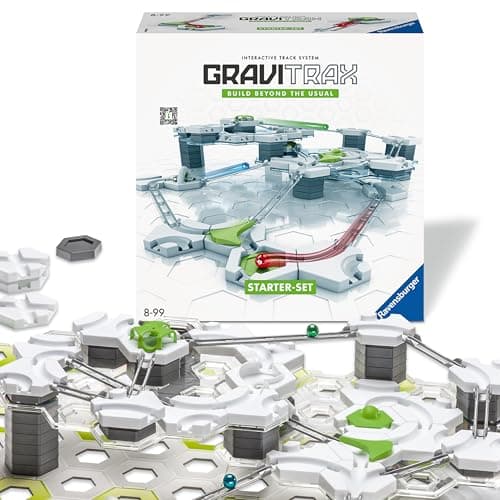
Look at the base count, not the piece count. Bases decide how tall a run can stand before it topples, and a set with plenty of track and too few bases builds low. GraviTrax publishes 122 pieces including four base plates and 52 height tiles; Marble Genius publishes eight bases; Quadrilla’s wooden blocks are heavy enough to need none.
Block & Beaker earns a commission when you buy through our links, at no cost to you. It never changes a ranking, and we say so plainly when the right answer is the cheaper set, or nothing at all. Full disclosure · How we pick.
At a glance
The picks, ranked
Tap any row to jump to the full reasoning. Prices come live from Amazon where we have them and read “check price” where we don’t — never a number we cannot stand behind today.
| # | Product | Best for | Price |
|---|---|---|---|
| 1 | Best overall GraviTrax Starter Set The only set here with a magnetic cannon, a vortex and a launch pad — the physics is the toy. | Eight and up, and a child who wants to engineer rather than assemble | |
| 2 | 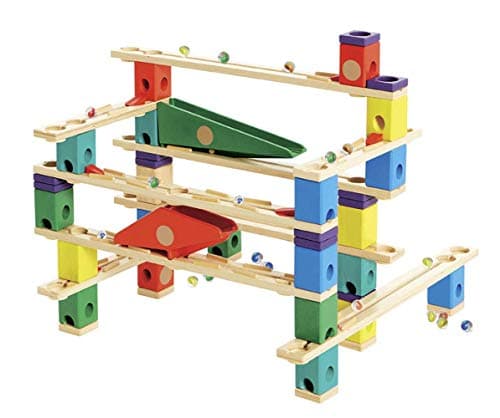 Best wooden set Quadrilla Wooden Marble Run: Vertigo Heavy wooden blocks that need no base plate, and that work as plain blocks when nobody wants a marble run. | Four and up, and a household that wants it left out on show | |
| 3 | 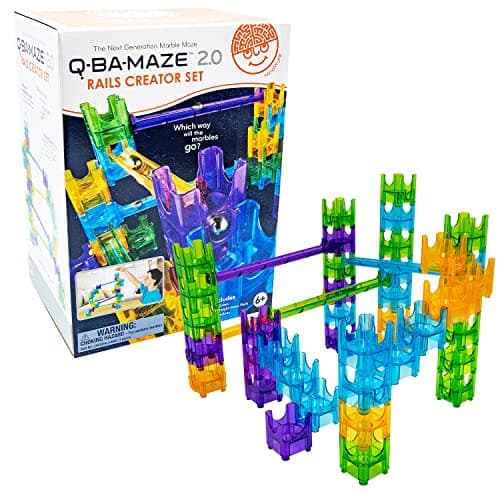 Best for free building Q-BA-MAZE 2.0 Big Box Cubes that interlock in any direction, so the structure branches instead of following a path. | Six and up, and a child who resists being told what to make | |
| 4 | 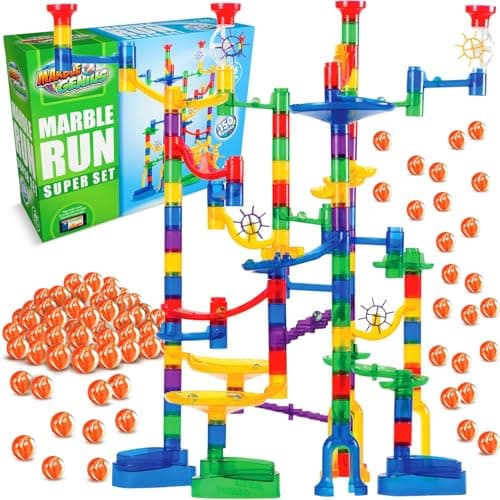 Best starter set Marble Genius Marble Run Super Set Nineteen distinct track styles and eight bases including three large ones — the base count is the tell. | Four to eight, as a first marble run | |
| — | 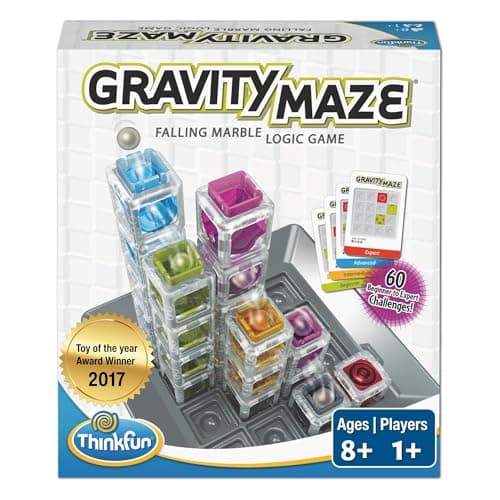 Not a marble run ThinkFun Gravity Maze A genuinely good logic game that is shelved next to marble runs and is not one. | A puzzle-solver, but do not buy it expecting a construction toy |
5 picks, including 1 we tell you to skip. Ages shown are the manufacturer’s own rating, not ours.
Why marble runs replay better than plain building sets
A tower is finished when the child decides it is. A marble run is finished when the marble reaches the bottom, and that is a real difference. The success condition converts building from decoration into a problem, and problems get returned to in a way that decorations do not.
It also produces the most useful failure mode in construction play: the marble stops somewhere, and the child can see exactly where. That is debugging, arriving three or four years before anything with a screen would teach it, and it is why a marble run is a genuinely good precursor to coding toys.
Base count is the specification nobody checks
The arithmetic
Bases, height and why runs topple
| GraviTrax Starter — base plates | 4 |
|---|---|
| GraviTrax Starter — height tiles (large and small) | 52 |
| Marble Genius Super Set — bases (3 large) | 8 |
| Quadrilla Vertigo — base plates required | 0 (wooden blocks self-support) |
| Q-BA-MAZE Big Box — base plates required | 0 (cubes interlock structurally) |
This is the specification to check when comparing two sets with similar piece counts. A hundred pieces of track over two small bases builds a short, wide run. The same track over eight bases builds something worth photographing.
Wood or plastic
Wooden sets are heavier, which means self-supporting structures and no base plates. They are also more expensive per piece, less portable, and gentler-looking — which matters if the run is going to live in the living room rather than a playroom.
Plastic sets do things wood cannot. GraviTrax’s published action pieces — a magnetic cannon that accelerates the marble, a vortex, a launch pad — have no wooden equivalent, and they are the reason the physics in that set is genuinely interesting rather than just gravity.
For a four-year-old, wood. For an eight-year-old who has asked how things work, plastic with action pieces.
Worth knowing before you buy
Every set here contains marbles, and marbles are a choking hazard for children under three regardless of what the box says about the older child it was bought for. Q-BA-MAZE ships 20 steel marbles and Marble Genius ships 65 glass ones; both will find their way under furniture.
If there is a toddler in the house, the practical answer is a set that gets built on a table rather than the floor, and a marble count you can actually audit at tidy-up time. Sixty-five is not that number.
What to buy
- First marble run, child aged 4 to 8: Marble GeniusSuper Set, for the base count and the track variety.
- Child aged 8+ who asks how things work: GraviTrax, for the height-tile system and the action pieces.
- Younger sibling in the house: Quadrilla, because the pieces are wooden blocks when they are not a marble run. Once a Quadrilla run is in the house, the cheapest thing to add to it is the Sonic Playground attachment, which makes the run audible.
- Child who dislikes instructions: Q-BA-MAZE, which has no correct structure at all.
If the child already owns magnetic tiles, a magnetic-tile marble run pack is the cheaper way into this category and makes the existing tiles useful again. And if what you actually want is a puzzle rather than a construction toy, the logic puzzles roundup is the right page.
In full
Every pick, and what is wrong with it
Published specifications only, each linked back to the page it came from. Where a manufacturer publishes nothing, the row says so — we do not fill blanks in.
1. Best overall
GraviTrax Starter Set
Ravensburger · 27597 · maker rates it 8+
The only set here with a magnetic cannon, a vortex and a launch pad — the physics is the toy.
- Pieces
- 122
- Construction elements
- 18 types, including base plates, height tiles, curves, junctions, switches, tracks, a vortex, a launch pad and a magnetic cannon
- Marbles
- 6
- Stated age
- 8 and up
The published contents are the argument: 122 pieces across 18 different construction element types, including four base plates, 40 large and 12 small height tiles, and action pieces named individually — a vortex, a launch pad and a magnetic cannon.
Height tiles are the mechanism that makes this different from a stacked track. Instead of building a tower and hanging track off it, the child raises the ground. That is a more abstract idea and it is the reason for the 8+ rating, but it is also why GraviTrax builds look like machines rather than like slides.
Nine track designs come in the box, which is enough scaffolding to learn the system before inventing. After that the published expansion range means the system genuinely extends rather than being replaced.
Replay signal
- Open-ended or one-shot
- Open-ended once the nine included designs are done — the system is a construction kit, not a puzzle with an answer
- Does anything run out
- Nothing runs out
- Room to grow
- Ravensburger publishes a large expansion range built to enlarge the same system
Why we say so: Ravensburger publishes the 122-piece count, the 18 construction-element types, the nine included track designs and an expansion range designed to extend the same track system.
What’s wrong with it
Rated 8+ and it means it. The height-tile system requires planning two levels ahead, which is genuinely beyond most six-year-olds.
| Pieces | 122 |
|---|---|
| Construction elements | 18 types, including base plates, height tiles, curves, junctions, switches, tracks, a vortex, a launch pad and a magnetic cannon |
| Marbles | 6 |
| Stated age | 8 and up |
| Track designs included | 9 |
| Consumables | None |
Every figure above is from Ravensburger, GraviTrax Starter Set. Blanks are shown as “not published” rather than filled in.
2. Best wooden set
Quadrilla Wooden Marble Run: Vertigo
Hape · E6009 · maker rates it 4+
Heavy wooden blocks that need no base plate, and that work as plain blocks when nobody wants a marble run.
- Total pieces
- 134
- Track and block pieces
- 84
- Marbles
- 50
- Materials
- Birch and rubber wood
Hape publishes 134 pieces: 84 track and block pieces plus 50 marbles, in birch and rubber wood, with straightaway rails, three spiral funnels and a seesaw.
The wood matters for a mechanical reason rather than an aesthetic one. The blocks are heavy enough that a tall run stays standing without a base plate, which removes the single most common failure of plastic sets — a structure that is tall enough to be interesting and light enough to fall over when the marble hits it.
The other advantage is the dual life. When the marble run is over, the pieces are wooden blocks, and a two-year-old sibling can use them for that with nothing needing to be supervised.
Replay signal
- Open-ended or one-shot
- Open-ended, and the wooden blocks work as plain blocks when nobody wants a marble run
- Does anything run out
- Nothing runs out
- Room to grow
- Quadrilla sets combine, and the blocks are the standard the whole system is built on
Why we say so: Hape publishes the 84 track pieces plus 50 marbles, the wood species and the named action pieces. Wood matters here for a specific reason rather than a sentimental one: the blocks are heavy enough that a tall run does not need a base plate to stay standing.
What’s wrong with it
Fifty marbles is a lot to lose, and wooden marble runs are the least portable option here — this is a floor-of-the-lounge toy.
| Total pieces | 134 |
|---|---|
| Track and block pieces | 84 |
| Marbles | 50 |
| Materials | Birch and rubber wood |
| Includes | Straightaway rails, three spiral funnels, a seesaw |
| Stated age | 4 and above |
Every figure above is from Hape, Quadrilla Vertigo. Blanks are shown as “not published” rather than filled in.
3. Best for free building
Q-BA-MAZE 2.0 Big Box
MindWare · 48168W · maker rates it 6+
Cubes that interlock in any direction, so the structure branches instead of following a path.
- Cubes
- 72, in five colors
- Cube mix
- 18 bottom-exit, 36 single-exit, 18 double-exit
- Marbles
- 20 steel
- Stated age
- 6 and up
MindWare publishes 72 cubes in five colors, split precisely: 18 bottom-exit, 36 single-exit and 18 double-exit. That split is the product. Double-exit cubes are what make the marble’s route genuinely uncertain, so the same structure produces different outcomes and a child watches ten marbles rather than one.
Because the cubes interlock in every direction rather than stacking in a stack, structures grow sideways and outward. MindWare describes it as building sculptures, and that is accurate — a finishedQ-BA-MAZE looks less like a track and more like an object.
Replay signal
- Open-ended or one-shot
- Genuinely open-ended — the cubes interlock in any direction, so there is no single correct structure
- Does anything run out
- Nothing runs out
- Room to grow
- MindWare sells stunt and expansion sets that clip into the same cubes
Why we say so: MindWare publishes the 72-cube count, the exact exit-type mix, the 20 marbles and the ages 6+ rating. Three different exit types is what makes a structure branch rather than follow one fixed path.
What’s wrong with it
Twenty steel marbles in a house with a toddler is a supervision commitment, and the cubes take real hand strength to separate.
| Cubes | 72, in five colors |
|---|---|
| Cube mix | 18 bottom-exit, 36 single-exit, 18 double-exit |
| Marbles | 20 steel |
| Stated age | 6 and up |
| Material | Phthalate-free and BPA-free ABS plastic |
| Consumables | None, though marbles are the part that disappears under the sofa |
Every figure above is from MindWare, Q-BA-MAZE 2.0. Blanks are shown as “not published” rather than filled in.
4. Best starter set
Marble Genius Marble Run Super Set
Marble Genius · Super Set · maker rates it 4-8
Nineteen distinct track styles and eight bases including three large ones — the base count is the tell.
- Total pieces
- 150
- Track pieces
- 85 translucent pieces in 19 distinct styles
- Marbles
- 65 glass
- Bases
- 8 solid bases, of which 3 are large
The published breakdown is 150 total pieces: 85 translucent track pieces in 19 distinct styles, 65 glass marbles, and 8 solid bases of which 3 are large.
The base count is the number worth checking on any marble run and it is the reason this one works as a starter. Eight bases with three large ones is enough footprint for a genuinely tall build. Cheaper sets ship a lot of colorful track and two small bases, and the result is a run that has to be built against a wall to stay standing.
Nineteen distinct track styles is real variety at this price. The marble count, honestly, is padding — a run uses five or six at a time.
Replay signal
- Open-ended or one-shot
- Open-ended construction, with the marble supplying an immediate success condition
- Does anything run out
- Nothing runs out
- Room to grow
- Expansion sets in the same system; the base count is what limits height
Why we say so: Marble Genius publishes 85 track pieces across 19 styles and 8 bases including 3 large ones. The base count is the number to watch: bases decide how tall a run can stand before it topples, and a set with plenty of track and too few bases builds low and disappoints.
What’s wrong with it
Sixty-five glass marbles is far more than the run needs, and the excess is mostly a floor hazard rather than a feature.
| Total pieces | 150 |
|---|---|
| Track pieces | 85 translucent pieces in 19 distinct styles |
| Marbles | 65 glass |
| Bases | 8 solid bases, of which 3 are large |
| Stated age | Ages 4-8 |
| Consumables | None, though 65 marbles is a number that only goes down |
Every figure above is from Marble Genius, Marble Run Super Set. Blanks are shown as “not published” rather than filled in.
Skip this one
ThinkFun Gravity Maze
ThinkFun · 44001006 · maker rates it 8+
A genuinely good logic game that is shelved next to marble runs and is not one.
- Challenges
- 60, beginner to expert
- Contents
- Game grid, 9 towers, 1 target piece, 3 marbles, 60 challenge cards
- Players
- 1
- Batteries
- None
Gravity Maze is included here because it is the product most often bought by mistake by someone shopping for a marble run, and the mistake is understandable — it has marbles, towers and a marble that falls.
But ThinkFun publishes 60 challenges, a game grid, nine towers, one target piece and three marbles. That is a fixed-component single-player puzzle game. You are given a starting position and a target, and there is one correct answer. When the 60 cards are done, there is nothing in the box telling the child what to do next.
As a logic game it is excellent, and it appears in our logic puzzles roundup on those terms. As a marble run it is a category error, and buying it as the main construction present will disappoint.
Replay signal
- Open-ended or one-shot
- Finite by design — 60 challenges, and a determined child will finish them
- Does anything run out
- Nothing physically runs out, but the challenge cards do end
- Room to grow
- The towers can be used freely once the cards are done, though nothing in the box prompts that
Why we say so: ThinkFun publishes 60 challenges and a fixed component list. Sixty is a real number with a real end, and single-player puzzle games are the category where that matters most — better to know before you buy it as the main present.
What’s wrong with it
Sixty challenge cards and then it is finished. It is a puzzle book with towers, not a system you keep building with.
| Challenges | 60, beginner to expert |
|---|---|
| Contents | Game grid, 9 towers, 1 target piece, 3 marbles, 60 challenge cards |
| Players | 1 |
| Batteries | None |
| Stated age | Ages 8+ |
| Consumables | None |
Every figure above is from ThinkFun, Gravity Maze. Blanks are shown as “not published” rather than filled in.
We are not putting a buy button on this one. It is easy enough to find if you want it anyway — but we would rather send you to something that gets played with twice.
Questions people actually ask
Frequently asked
What age is a marble run for?
Four for wooden sets like Quadrilla, six for interlocking cube systems, and eight for GraviTrax, which Ravensburger rates 8+ because its height-tile system requires planning two levels ahead. Below four, a child enjoys watching an adult build one.
How many pieces does a good marble run need?
Check the base count rather than the total. Bases set the footprint and therefore the maximum height, so a hundred track pieces over two small bases builds a short wide run. GraviTrax publishes four base plates and 52 height tiles; Marble Genius publishes eight bases including three large.
Is GraviTrax worth it over a cheaper marble run?
If the child is eight or older, yes. The published action pieces — a magnetic cannon, a vortex, a launch pad — have no cheap equivalent, and the height-tile system builds structures that look engineered rather than assembled. Below about seven the same set is frustrating.
Is Gravity Maze a marble run?
No, and it is the most common mix-up in this category. ThinkFun publishes it as a 60-challenge single-player logic game with a fixed component set. It is a very good puzzle and a poor construction toy, and buying it as the main marble-run present will disappoint. Where it does belong.
Sources
Where these figures came from
Every specification on this page traces to one of these. If a manufacturer publishes nothing on a point, the page says so rather than filling the gap.
Read next
Where to go from here
Back to Building Sets, or read how we pick.