The picks
Microscopes for Kids
The only science purchase on this site that never runs out — and the one where the biggest number on the box is the least useful.
By Sawyer V. · Published
The short answer
Buy the one with top lighting and blank slides, not the one with the biggest magnification. A scope that lights specimens from above works on leaves, rocks and insects — which a child can find themselves, infinitely, for free. At 1200x an entry-level objective delivers a large, dim, blurry image that most children cannot focus.
Block & Beaker earns a commission when you buy through our links, at no cost to you. It never changes a ranking, and we say so plainly when the right answer is the cheaper set, or nothing at all. Full disclosure · How we pick.
At a glance
The picks, ranked
Tap any row to jump to the full reasoning. Prices come live from Amazon where we have them and read “check price” where we don’t — never a number we cannot stand behind today.
| # | Product | Best for | Price |
|---|---|---|---|
| 1 | Best overall My First Lab Duo-Scope Microscope A genuine dual-purpose scope: real glass optics, lights above and below, and five blank slides. | Nine and up, and any child who wants to look at what they found outside | Sold direct by My First Lab → Not stocked on Amazon. This link goes to the maker and we earn nothing on it. |
| 2 | 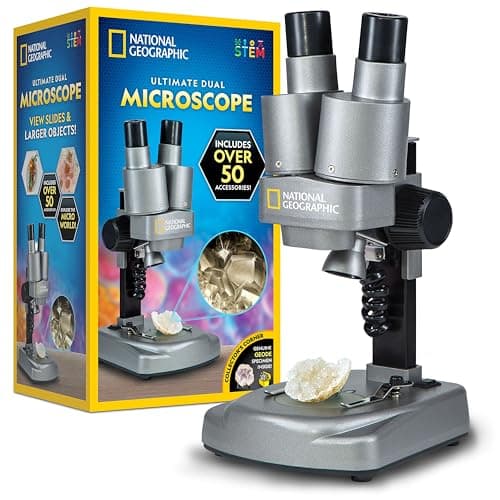 Best for younger children NATIONAL GEOGRAPHIC Dual LED Student Microscope Only 20x and 50x, and that is deliberately the right answer for a younger child. | Eight and up, and a child who wants to look at objects rather than slides | |
| — |  Best build quality AmScope 120X-1200X Beginner Microscope Kit A metal frame and a real stage, with a top magnification you should ignore. | A child who will still want it at fourteen |
3 picks, including 1 we tell you to skip. Ages shown are the manufacturer’s own rating, not ours.
Why the biggest number on the box is the wrong number
Microscope marketing runs on magnification, and magnification is close to the least useful specification for a child’s scope. There are two reasons, and both are physics rather than opinion.
The first is light. Magnification spreads the same amount of light over a larger image, so a 1200x view is dramatically dimmer than a 100x one. On an entry-level instrument with a single LED, the top magnification is often too dark to use at all.
The second is resolution. Magnifying beyond what the objective lens can resolve produces a bigger blur, not more detail — opticians call it empty magnification. An inexpensive 40x objective has a hard ceiling, and multiplying it by a 30x eyepiece to reach 1200x does not move that ceiling.
The practical consequence: on almost every children’s microscope, the useful range is the bottom two settings. A scope whose lowest setting is 120x has thrown away the part a child will actually use.
The specification that actually decides it
The arithmetic
What each scope can look at
| My First Lab Duo-Scope — lighting | Above and below |
|---|---|
| My First Lab Duo-Scope — usable range | 40x to 400x |
| NatGeo Dual LED — lighting | Above and below |
| NatGeo Dual LED — usable range | 20x to 50x |
| AmScope M30 kit — lighting | Below only (LED plus mirror) |
| AmScope M30 kit — usable range | 120x to 1200x |
This is why both scopes we recommend publish dual lighting and the one we do not recommend does not. It is also why the National Geographic scope, with the lowest magnification range here, is a better first microscope than the AmScope with the highest.
Why a microscope is the best value science purchase there is
Run the Replay Signal over it. Is it open-ended? Completely — the specimens are the world. Does anything run out? The prepared slides do; the blank slides and the garden do not. Is there room to grow? A child moves from leaves to onion skin to pond water over years. Does it need an adult? For the first focus, then never again.
Nothing else in the science category scores like that. A chemistry set has a numbered last experiment, a geode kit has ten geodes, and a subscription box arrives once and is built once. A microscope has a supply of subject matter that is literally infinite and costs nothing.
This is also why we route so many gift questions here. If you do not know what a child already owns, a microscope is both unlikely to be a duplicate and impossible to exhaust.
Getting the first session right
More microscopes are abandoned in the first hour than at any later point, almost always for the same reason: the child starts at maximum magnification, sees nothing, and concludes it is broken.
- Start at the lowest magnification, always. Find the specimen, then go up.
- Start with something opaque and top-lit — a leaf, a feather, a bit of fabric. It is easier to focus and more immediately impressive than a prepared slide.
- Use the prepared slides second, not first. They are the reward for knowing how to focus, not the introduction.
- Buy the batteries. The Duo-Scope publishes three AA cells, not included, and an unlit microscope is a paperweight.
Which to buy
Eight to ten, or unsure: the National Geographic Dual LED. Low magnification, top lighting, and a big accessory kit that lets a child prepare their own subjects.
Nine and up, genuinely interested: the My First Lab Duo-Scope. The 40x to 400x range covers everything from a leaf to onion cells, and the blank slides make it open-ended.
Thirteen and up, or a child who has outgrown a first scope: the AmScope, accepting the loss of top lighting for a metal frame and a higher range.
For where this sits against the rest of the category, see experiment kits and chemistry sets. For a younger child, first science kits.
In full
Every pick, and what is wrong with it
Published specifications only, each linked back to the page it came from. Where a manufacturer publishes nothing, the row says so — we do not fill blanks in.
1. Best overall
My First Lab Duo-Scope Microscope
My First Lab · MFL-06 · maker rates it 9+
A genuine dual-purpose scope: real glass optics, lights above and below, and five blank slides.
- Magnifications
- 40x, 100x and 400x, from a 10x eyepiece with 4x, 10x and 40x objectives
- Optics
- Real optical glass lenses
- Lighting
- Dual LED, above and below the stage
- Slides included
- 5 blank, 1 concavity (well), 4 prepared
The published specification is the argument. Magnifications of 40x, 100x and 400x from a 10x eyepiece with 4x, 10x and 40x objectives. Real optical glass lenses. Dual LED lighting, above and below the stage. Five blank slides, one concavity slide and four prepared ones.
The dual lighting is what makes it a Duo-Scope rather than a compound microscope with a name. Light from below is for transparent things on slides; light from above is for opaque things — a leaf, a beetle, a fragment of rock, a hair, the corner of a banknote. The second category is the one a child can supply endlessly.
The five blank slides matter for the same reason. A microscope with only prepared slides is four pictures. A microscope with blanks is a thing you point at whatever is in the garden, which is the difference between an object and a habit.
Replay signal
- Open-ended or one-shot
- Genuinely open-ended, unusually so for a science purchase — the world is the consumable
- Does anything run out
- The four prepared slides run out; the five blanks and everything in the garden do not
- Room to grow
- Light from above as well as below means it works on rocks, leaves and insects, not only on slides
Why we say so: The manufacturer publishes the dual-LED lighting, the blank-slide count and the real-glass optics. Blank slides plus top lighting is what turns a microscope from four pictures into a thing you point at whatever you found outside.
What’s wrong with it
Rated 9 and older, and 400x at the top end needs a steady hand and good light to be worth using.
| Magnifications | 40x, 100x and 400x, from a 10x eyepiece with 4x, 10x and 40x objectives |
|---|---|
| Optics | Real optical glass lenses |
| Lighting | Dual LED, above and below the stage |
| Slides included | 5 blank, 1 concavity (well), 4 prepared |
| Stated age | Ages 9 and older |
| Batteries | 3 x AA (not included) |
| Weight | 1.95 lb |
Every figure above is from My First Lab, Duo-Scope MFL-06. Blanks are shown as “not published” rather than filled in.
Not stocked on Amazon. This link goes to the maker and we earn nothing on it.
2. Best for younger children
NATIONAL GEOGRAPHIC Dual LED Student Microscope
National Geographic · Dual LED Student Microscope · maker rates it 8+
Only 20x and 50x, and that is deliberately the right answer for a younger child.
- Magnifications
- 20x and 50x, from two sets of optical glass lenses
- Lighting
- Upper and lower LED
- Accessories
- 50+ pieces, including 10 prepared slides, blank slides and covers, tweezers, eye-dropper and a mini geode
- Weight
- 2.6 lb
National Geographic publishes 20x and 50x from two sets of optical glass lenses, with upper and lower LED lighting and over 50 accessories including 10 prepared slides, blank slides and covers, tweezers, an eye-dropper and a mini geode.
Low magnification is a design decision rather than a compromise, and for a child under about ten it is the better one. At 20x an insect looks like an insect — recognizable, three-dimensional, astonishing. At 400x an insect is an unidentifiable field of texture that has to be explained.
The wide accessory kit is also better matched to a younger child than it first appears. Tweezers and a dropper are the tools that let a child prepare their own subject, which is most of the fun.
Replay signal
- Open-ended or one-shot
- Open-ended, and the low magnification is the reason — 20x is where insects and leaves look extraordinary
- Does anything run out
- The 10 prepared slides run out; blank slides and the garden do not
- Room to grow
- Limited on magnification, generous on subject matter
Why we say so: National Geographic publishes 20x and 50x with upper and lower LED lighting. Low magnification plus top lighting is a deliberate design for looking at whole objects rather than slides, which for a child under about ten is a far better first microscope than a 1000x compound scope they cannot focus.
What’s wrong with it
Fifty times is genuinely limited — cells and pond microorganisms are out of reach, and a curious ten-year-old will hit that ceiling.
| Magnifications | 20x and 50x, from two sets of optical glass lenses |
|---|---|
| Lighting | Upper and lower LED |
| Accessories | 50+ pieces, including 10 prepared slides, blank slides and covers, tweezers, eye-dropper and a mini geode |
| Weight | 2.6 lb |
| Stated age | 8+ |
Every figure above is from National Geographic toys, Dual LED Student Microscope. Blanks are shown as “not published” rather than filled in.
Skip this one
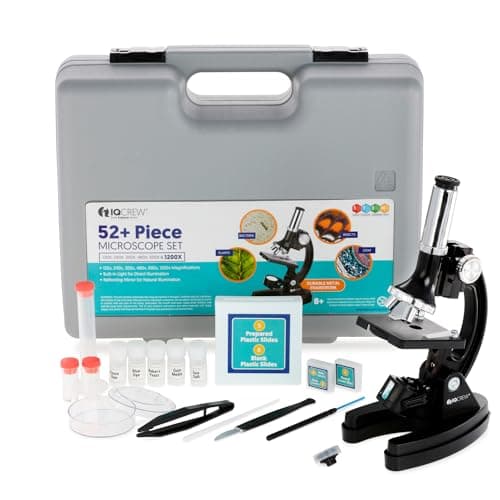
AmScope 120X-1200X Beginner Microscope Kit
AmScope · M30-ABS-KT2 · maker rates it 8+
A metal frame and a real stage, with a top magnification you should ignore.
- Magnifications
- Six levels — 120x, 240x, 300x, 480x, 600x and 1200x
- Frame
- Metal arm, with stage clips
- Lighting
- Built-in LED plus a reflecting mirror
- Extras
- Rotating color filter wheel; 52-piece accessory kit
AmScope publishes six magnification levels — 120x, 240x, 300x, 480x, 600x and 1200x — with a metal arm and stage clips, a built-in LED and a reflecting mirror, a rotating color filter wheel, a 70 x 65 mm stage and a 52-piece accessory kit, published “For ages 8+”.
The metal frame is genuinely better than the plastic bodies above, and if a child is going to keep this into secondary school it is the one that survives. We are marking it as the skip anyway, for two specific reasons.
First, no top lighting. Everything this scope looks at has to be thin, flat and on a slide, which cuts out the entire category of things a child finds outside. Second, the magnification range starts at 120x — three times the lowest setting on the Duo-Scope — so the comfortable, recognizable, low-power view is not available at all.
For a serious teenager with an interest in cells and pond life, this is the better instrument. For a child being given a microscope to see whether they like microscopes, it is the wrong end of the telescope.
Replay signal
- Open-ended or one-shot
- Open-ended — specimens are free and infinite
- Does anything run out
- The prepared slides in the accessory kit run out; blank slides do not
- Room to grow
- 1200x is well past what a child needs and past what the optics comfortably resolve, but the metal frame will outlast the interest
Why we say so: AmScope publishes six magnification levels, a metal arm and a 70 x 65 mm stage. Treat the top magnification with skepticism — at 1200x an entry-level objective delivers a large, dim, blurry image — and buy this for the metal frame and the usable lower range instead.
What’s wrong with it
AmScope publishes 8+, but the 1200x headline is optimistic and there is no top lighting — this is a slides-only instrument.
| Magnifications | Six levels — 120x, 240x, 300x, 480x, 600x and 1200x |
|---|---|
| Frame | Metal arm, with stage clips |
| Lighting | Built-in LED plus a reflecting mirror |
| Extras | Rotating color filter wheel; 52-piece accessory kit |
| Stage | 70 x 65 mm |
| Shipping weight | 6 lb — AmScope publishes no product weight |
| Stated age | “For ages 8+” |
Every figure above is from AmScope, M30-ABS-KT2 microscope. Blanks are shown as “not published” rather than filled in.
We are not putting a buy button on this one. It is easy enough to find if you want it anyway — but we would rather send you to something that gets played with twice.
Questions people actually ask
Frequently asked
What magnification does a child's microscope need?
Less than you think. The useful range on an entry-level scope is the bottom two settings, because magnification beyond what the objective can resolve produces a bigger blur rather than more detail, and dims the image. A scope whose lowest setting is 120x has thrown away the range a child will actually use.
Why does top lighting matter on a kids microscope?
It decides what can go under the scope. Light from below only works on thin transparent specimens on slides. Light from above works on leaves, insects, rocks, fabric and coins — everything a child brings in from outside, which is the supply that never runs out.
What age is a microscope suitable for?
National Geographic rates its Dual LED student scope 8+, and My First Lab rates the Duo-Scope 9 and older. Both are about the fine motor control focusing requires rather than about safety.
Is a microscope a good present if I don't know what they own?
It is one of the best, for two reasons: it is unlikely to be a duplicate, and it cannot be exhausted. The specimens are whatever the child finds, which makes it the only science purchase on this site that passes our replay test outright.
Why is my child's microscope image black?
Almost always because they started at maximum magnification. Start at the lowest setting, find the specimen, then increase. If the scope has top lighting, start with something opaque like a leaf — it is far easier to focus than a prepared slide.
Sources
Where these figures came from
Every specification on this page traces to one of these. If a manufacturer publishes nothing on a point, the page says so rather than filling the gap.
Read next
Where to go from here
Back to Science Kits, or read how we pick.