The picks
Telescopes for Kids
Almost every first telescope is abandoned for the same reason, and it is not the optics. Nobody could find anything.
By Sawyer V. · Published
The short answer
Buy aperture, not magnification. Aperture is how much light the telescope gathers and it sets what can be seen at all; magnification only enlarges whatever the aperture delivered. A 76 mm scope at 15x shows more than a 70 mm scope pushed to 120x.
Block & Beaker earns a commission when you buy through our links, at no cost to you. It never changes a ranking, and we say so plainly when the right answer is the cheaper set, or nothing at all. Full disclosure · How we pick.
At a glance
The picks, ranked
Tap any row to jump to the full reasoning. Prices come live from Amazon where we have them and read “check price” where we don’t — never a number we cannot stand behind today.
| # | Product | Best for | Price |
|---|---|---|---|
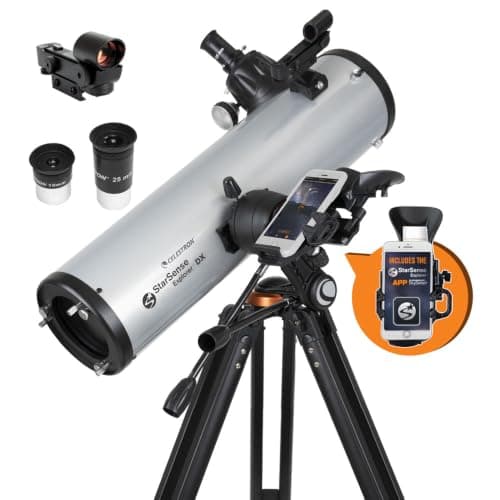
| 1 | Best overall Celestron StarSense Explorer DX 130AZ One hundred and thirty millimetres of aperture, plus a phone app that solves the reason most first telescopes fail. | A family that has owned a telescope before and given up on it | |
| 2 | 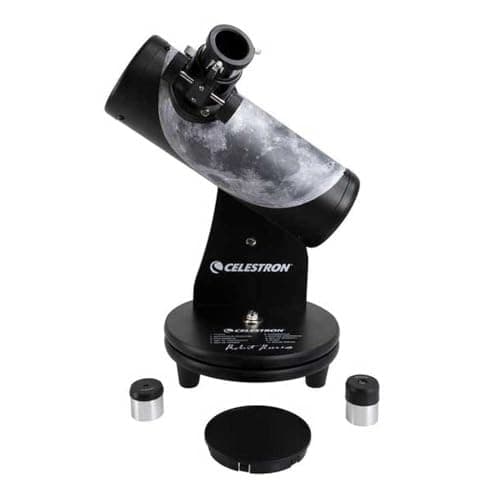 Best entry point Celestron FirstScope Telescope Seventy-six millimetres on a tabletop Dobsonian mount — genuinely child-operable, with no tripod fight. | A first telescope where the budget is the constraint | |
| 3 | 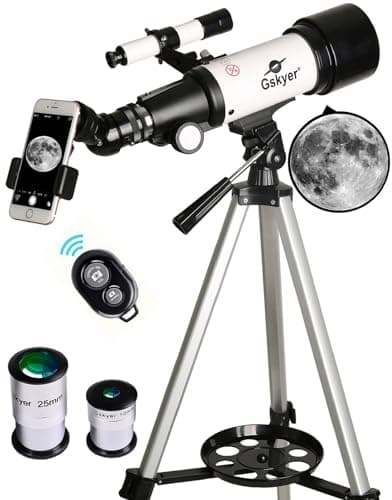 Best portable Gskyer AZ70400 Refractor Telescope Seventy millimetres in a bag, with a phone adapter for photographing the moon. | A household that has to drive somewhere darker | |
| 4 | 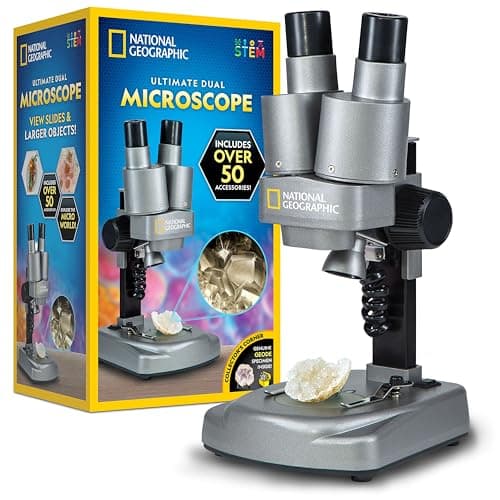 Not a telescope, and often the better buy NATIONAL GEOGRAPHIC Dual LED Student Microscope Works in daylight, indoors, in any weather — none of which is true of a telescope. | A child who said 'space' but actually likes looking at things | |
| — | 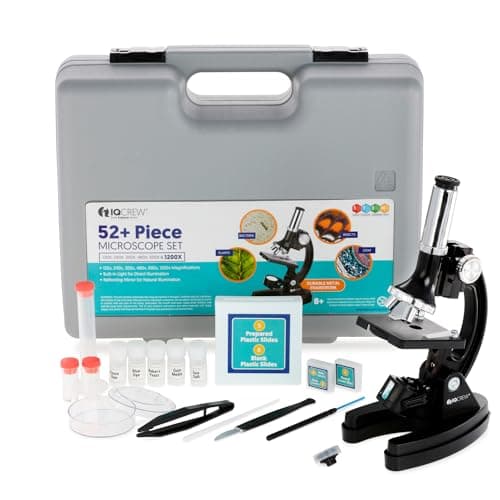 The one to skip here AmScope 120X-1200X Beginner Microscope Kit A serious instrument for a completely different subject, and a common mis-buy for a child who asked about space. | Slide biology, on a different page |
5 picks, including 1 we tell you to skip. Ages shown are the manufacturer’s own rating, not ours.
Aperture is the number that matters
Telescope marketing runs on magnification, and magnification is close to the least useful specification on the box.
The arithmetic
Light gathered, relative to a 70 mm scope
| Gskyer AZ70400 — 70 mm aperture | 1.0x (baseline) |
|---|---|
| Celestron FirstScope — 76 mm aperture | about 1.2x |
| StarSense Explorer DX 130AZ — 130 mm aperture | about 3.4x |
| Magnification's effect on light gathered | None |
The practical rule: a bigger aperture at low power beats a smaller aperture at high power, every time. A 120x view through a 70 mm scope is a large, dim, blurry version of what the 40x view showed sharply.
The finding problem is the real problem
Nearly every abandoned first telescope failed the same way. The family took it outside, could not locate anything except the moon, got cold, and put it in a cupboard.
That is not an optics failure. Pointing a telescope at a specific object is genuinely hard: the field of view is tiny, the sky moves, and a beginner has no reference points.
It is why the StarSense scope earns its premium. A phone that recognizes the star field and tells you which way to nudge removes the single step that defeats beginners. Without that, budget for a planisphere and an adult willing to learn alongside the child.
What a child can realistically see
- The moon. Spectacular in anything, including the cheapest scope here. Craters along the terminator line are the single best first view in astronomy.
- Jupiter and its four large moons. Visible as points in a line in any of these. Seeing them shift over a few nights is the thing that hooks children.
- Saturn's rings. Achievable in all three telescopes here, as a small shape rather than a photograph.
- Deep-sky objects. This is where 130 mm separates from 70 mm. Faint nebulae and galaxies need light-gathering, not magnification.
Manage expectations before the first night. Nothing looks like the Hubble photographs, and a child told otherwise will be disappointed by an objectively remarkable view.
Worth knowing before you buy
One rule and it is absolute: never point a telescope at the sun, and never leave a telescope set up unattended outdoors in daylight where a child could. A few seconds of focused sunlight through any of these apertures causes permanent eye damage.
Solar filters exist and work, but they must be full-aperture filters fitted over the front. The small screw-in "sun filters" that once shipped with cheap telescopes are dangerous and should be discarded if you find one in a second-hand set.
Say the unwelcome thing
Do not buy on the magnification printed on the box
Any telescope claiming 400x or 600x on a small aperture is quoting a number achievable only in the sense that the eyepiece math permits it. The image at that power is dim, shaky and blurred.
Compare apertures instead — 70 mm, 76 mm, 130 mm — and treat quoted maximum magnification as marketing rather than specification.
What to buy
- First telescope, tight budget: the FirstScope, used mostly at 15x.
- Needs to travel: the Gskyer AZ70400, for the bag and the phone adapter.
- Tried before and failed: the StarSense Explorer.
- Interest is "looking closely" not "space": a microscope, which works 365 days a year.
In full
Every pick, and what is wrong with it
Published specifications only, each linked back to the page it came from. Where a manufacturer publishes nothing, the row says so — we do not fill blanks in.
1. Best overall
Celestron StarSense Explorer DX 130AZ
Celestron · 22461 · maker rates it Not published
One hundred and thirty millimetres of aperture, plus a phone app that solves the reason most first telescopes fail.
- Aperture
- 130 mm (5.1 in)
- Focal length
- 650 mm
- Focal ratio
- f/5
- Optical design
- Newtonian reflector
Celestron publishes 130 mm aperture at 650 mm focal length, f/5, as a Newtonian reflector on an altazimuth mount with slow-motion controls, plus a smartphone app that identifies where the telescope is pointing and directs you to targets.
One hundred and thirty millimetres is a genuine jump. Light-gathering scales with the square of aperture, so this collects roughly three times what a 76 mm scope does — the difference between a smudge and a shape with structure in it.
But the app is what earns the recommendation. Optics are rarely why a family gives up; not finding anything is. A phone that says "move it left" removes the step that ends most first nights.
Replay signal
- Open-ended or one-shot
- Open-ended — the sky is the consumable and it restocks itself
- Does anything run out
- Nothing runs out
- Room to grow
- Standard eyepieces; 130 mm gathers enough light for planets and brighter deep-sky objects
- Adult required
- Much less than a normal telescope. The published point of StarSense is that the phone does the finding
Why we say so: Celestron publishes 130 mm of aperture at 650 mm focal length, f/5, with a smartphone app that identifies where the telescope is pointing. The app is the specification that matters for a family: not finding anything is what ends most first telescope nights, and this removes that step.
What’s wrong with it
Considerably more expensive than a starter scope, and the app advantage needs a compatible smartphone to exist at all.
| Aperture | 130 mm (5.1 in) |
|---|---|
| Focal length | 650 mm |
| Focal ratio | f/5 |
| Optical design | Newtonian reflector |
| Finding aid | StarSense smartphone app — the phone identifies the sky and directs you |
| Mount | Altazimuth with slow-motion controls |
| Stated age | Not published |
Every figure above is from Celestron, StarSense Explorer DX 130AZ. Blanks are shown as “not published” rather than filled in.
2. Best entry point
Celestron FirstScope Telescope
Celestron · 21024 · maker rates it Not published
Seventy-six millimetres on a tabletop Dobsonian mount — genuinely child-operable, with no tripod fight.
- Aperture
- “76mm (2.99″)”
- Focal length
- “300mm (12″)”
- Focal ratio
- “f/3.95”
- Eyepiece 1
- 20mm, 15x magnification
Celestron publishes 76 mm aperture, 300 mm focal length, f/3.95, with 20 mm and 4 mm eyepieces giving 15x and 75x, on a Dobsonian-style table-top stand. No age rating is published; Celestron describes it as "an ideal entry level astronomical telescope".
The tabletop Dobsonian mount is why this works for a child. Point it like a cannon and it stays where you left it — no tripod legs to adjust and no fine-thread controls to fight.
Use the 20 mm eyepiece almost all the time. The 15x view of the moon is genuinely spectacular; the 75x view is dim and hard to hold steady.
Replay signal
- Open-ended or one-shot
- Open-ended in the most literal sense: the sky changes every month whether anyone touches it or not
- Does anything run out
- Nothing runs out
- Room to grow
- Standard eyepieces, so it accepts better ones later without replacing the telescope
- Adult required
- Finding the first object usually needs an adult; after that a tabletop Dobsonian is genuinely child-operable
Why we say so: Celestron publishes the 76mm aperture, 300mm focal length, f/3.95 ratio and both eyepiece magnifications. The table-top Dobsonian mount is the published design, and it is why a child can aim this one without a tripod fight.
What’s wrong with it
It needs a table, and the supplied 4 mm eyepiece at 75x is beyond what this aperture comfortably supports.
| Aperture | “76mm (2.99″)” |
|---|---|
| Focal length | “300mm (12″)” |
| Focal ratio | “f/3.95” |
| Eyepiece 1 | 20mm, 15x magnification |
| Eyepiece 2 | 4mm, 75x magnification |
| Mount | “Dobsonian style stand”, table-top |
| Stated age | Not published — Celestron calls it “an ideal entry level astronomical telescope” |
Every figure above is from Celestron, FirstScope Telescope. Blanks are shown as “not published” rather than filled in.
3. Best portable
Gskyer AZ70400 Refractor Telescope
Gskyer · AZ70400 · maker rates it Not published
Seventy millimetres in a bag, with a phone adapter for photographing the moon.
- Aperture
- 70 mm
- Focal length
- 400 mm
- Focal ratio
- f/5.7
- Eyepieces
- Two, giving 16x and 40x
Gskyer publishes 70 mm aperture at 400 mm focal length, f/5.7, with two eyepieces giving 16x and 40x, a stated 120x maximum using the supplied 3x Barlow, a 5x24 finder scope, a smartphone adapter, a wireless shutter remote and a carry bag, on an altazimuth mount.
The carry bag is a real feature rather than a throw-in. Light pollution ruins more observing sessions than bad optics do, and a telescope that fits in a car boot gets taken somewhere darker.
The phone adapter is the other genuine draw for a child. Photographing the moon and showing somebody is a large part of the motivation at this age.
Replay signal
- Open-ended or one-shot
- Open-ended, and the carry bag means it goes where the sky is darker
- Does anything run out
- Nothing runs out
- Room to grow
- 16x and 40x are the useful range; the 120x figure is optimistic on 70 mm of aperture
Why we say so: Gskyer publishes 70 mm at 400 mm focal length with 16x and 40x eyepieces. Treat the 120x maximum with caution — 70 mm of aperture cannot resolve detail at that power, so the two supplied eyepieces are the range you will actually use.
What’s wrong with it
The published 120x maximum is optimistic on 70 mm — the two supplied eyepieces are the range you will actually use.
| Aperture | 70 mm |
|---|---|
| Focal length | 400 mm |
| Focal ratio | f/5.7 |
| Eyepieces | Two, giving 16x and 40x |
| Maximum magnification | 120x, with the supplied 3x Barlow |
| Optical design | Refractor on an altazimuth mount |
| Extras | 5x24 finder scope, smartphone adapter, wireless shutter remote, carry bag |
Every figure above is from Gskyer, 70mm astronomical refractor telescope. Blanks are shown as “not published” rather than filled in.
4. Not a telescope, and often the better buy
NATIONAL GEOGRAPHIC Dual LED Student Microscope
National Geographic · Dual LED Student Microscope · maker rates it 8+
Works in daylight, indoors, in any weather — none of which is true of a telescope.
- Magnifications
- 20x and 50x, from two sets of optical glass lenses
- Lighting
- Upper and lower LED
- Accessories
- 50+ pieces, including 10 prepared slides, blank slides and covers, tweezers, eye-dropper and a mini geode
- Weight
- 2.6 lb
National Geographic publishes 20x and 50x from two sets of optical glass lenses, upper and lower LED lighting and 50-plus accessories including 10 prepared slides, blank slides, tweezers, an eye-dropper and a mini geode, rated 8+.
Worth considering seriously before buying a telescope. A telescope works on clear nights, after dark, outdoors, in the cold — which in practice is perhaps a dozen usable evenings a year in a typical household.
A microscope works every day of the year in a warm room. If the underlying interest is "looking at things closely" rather than astronomy specifically, it is the higher-use purchase by a wide margin.
Replay signal
- Open-ended or one-shot
- Open-ended, and the low magnification is the reason — 20x is where insects and leaves look extraordinary
- Does anything run out
- The 10 prepared slides run out; blank slides and the garden do not
- Room to grow
- Limited on magnification, generous on subject matter
Why we say so: National Geographic publishes 20x and 50x with upper and lower LED lighting. Low magnification plus top lighting is a deliberate design for looking at whole objects rather than slides, which for a child under about ten is a far better first microscope than a 1000x compound scope they cannot focus.
What’s wrong with it
It is a microscope. If the child specifically wants planets, this will not do.
| Magnifications | 20x and 50x, from two sets of optical glass lenses |
|---|---|
| Lighting | Upper and lower LED |
| Accessories | 50+ pieces, including 10 prepared slides, blank slides and covers, tweezers, eye-dropper and a mini geode |
| Weight | 2.6 lb |
| Stated age | 8+ |
Every figure above is from National Geographic toys, Dual LED Student Microscope. Blanks are shown as “not published” rather than filled in.
Skip this one
AmScope 120X-1200X Beginner Microscope Kit
AmScope · M30-ABS-KT2 · maker rates it 8+
A serious instrument for a completely different subject, and a common mis-buy for a child who asked about space.
- Magnifications
- Six levels — 120x, 240x, 300x, 480x, 600x and 1200x
- Frame
- Metal arm, with stage clips
- Lighting
- Built-in LED plus a reflecting mirror
- Extras
- Rotating color filter wheel; 52-piece accessory kit
AmScope publishes six magnification levels from 120x to 1200x with a metal arm, a built-in LED plus reflecting mirror and a 70 x 65 mm stage.
It is here because "high magnification" search results mix microscopes and telescopes constantly, and a 1200x number looks impressive next to a telescope's 75x.
Those numbers are not comparable. A microscope's 1200x is looking at something a millimetre away; a telescope's 75x is looking at something 380,000 kilometres away. Buying the wrong one because the number was bigger is a genuinely common mistake.
Replay signal
- Open-ended or one-shot
- Open-ended — specimens are free and infinite
- Does anything run out
- The prepared slides in the accessory kit run out; blank slides do not
- Room to grow
- 1200x is well past what a child needs and past what the optics comfortably resolve, but the metal frame will outlast the interest
Why we say so: AmScope publishes six magnification levels, a metal arm and a 70 x 65 mm stage. Treat the top magnification with skepticism — at 1200x an entry-level objective delivers a large, dim, blurry image — and buy this for the metal frame and the usable lower range instead.
What’s wrong with it
No top lighting and a 120x minimum — it cannot look at whole objects, and it certainly cannot look at the sky.
| Magnifications | Six levels — 120x, 240x, 300x, 480x, 600x and 1200x |
|---|---|
| Frame | Metal arm, with stage clips |
| Lighting | Built-in LED plus a reflecting mirror |
| Extras | Rotating color filter wheel; 52-piece accessory kit |
| Stage | 70 x 65 mm |
| Shipping weight | 6 lb — AmScope publishes no product weight |
| Stated age | “For ages 8+” |
Every figure above is from AmScope, M30-ABS-KT2 microscope. Blanks are shown as “not published” rather than filled in.
We are not putting a buy button on this one. It is easy enough to find if you want it anyway — but we would rather send you to something that gets played with twice.
Questions people actually ask
Frequently asked
What should I look for in a kids telescope?
Aperture, not magnification. Aperture sets how much light the telescope gathers and therefore what can be seen at all; magnification only enlarges whatever the aperture delivered. A 76mm scope at 15x shows more than a 70mm scope pushed to 120x.
Why do most kids telescopes end up in a cupboard?
Because nobody could find anything. Pointing a telescope at a specific object is genuinely hard — the field of view is tiny and beginners have no reference points. It is a finding problem rather than an optics problem, which is why app-guided scopes like Celestron's StarSense are worth the premium.
What can a child actually see through a beginner telescope?
The moon spectacularly, Jupiter's four large moons as points in a line, and Saturn's rings as a small shape. Deep-sky objects need real aperture. Nothing looks like the Hubble photographs, and it is worth saying so before the first night.
Is a microscope a better buy than a telescope?
Often, yes. A telescope needs a clear night, darkness and cold tolerance — perhaps a dozen usable evenings a year in a typical household. A microscope works every day in a warm room. If the interest is looking at things closely rather than astronomy specifically, it gets far more use. Microscopes compared.
Sources
Where these figures came from
Every specification on this page traces to one of these. If a manufacturer publishes nothing on a point, the page says so rather than filling the gap.
Read next
Where to go from here
Back to Science Kits, or read how we pick.