The picks
STEM Toys for 10 Year Olds
Ten is the age the 10+ ratings stop being a barrier. Almost everything is now on the table.
By Sawyer V. · Published
The short answer
Ten is when the 10+ ratings unlock, and they are the ratings that were genuinely blocking things. Real chemistry with real reagents, telescopes worth aiming, and typed programming languages all become reasonable in the same year.
Block & Beaker earns a commission when you buy through our links, at no cost to you. It never changes a ranking, and we say so plainly when the right answer is the cheaper set, or nothing at all. Full disclosure · How we pick.
At a glance
The picks, ranked
Tap any row to jump to the full reasoning. Prices come live from Amazon where we have them and read “check price” where we don’t — never a number we cannot stand behind today.
| # | Product | Best for | Price |
|---|---|---|---|
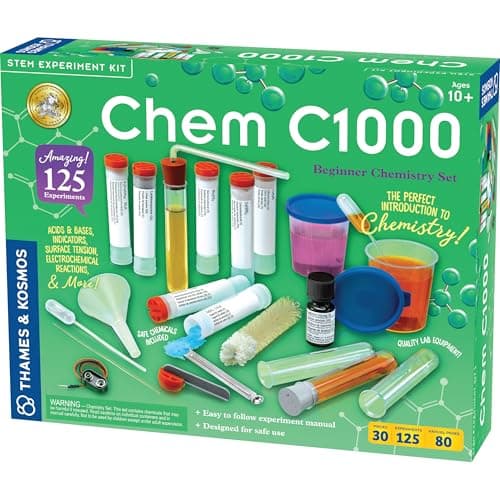
| 1 | Best overall Thames & Kosmos CHEM C1000 Real reagents under a named European safety standard, with the entire manual published free before you buy. | Ten, and a child who has asked for chemistry by name | |
| 2 | 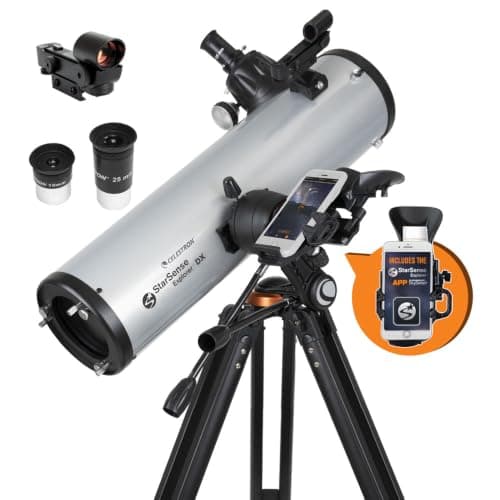 Best telescope Celestron StarSense Explorer DX 130AZ One hundred and thirty millimetres of aperture, and a phone app that solves the problem that ends most first telescope nights. | A family that has tried a telescope before and given up | |
| 3 | 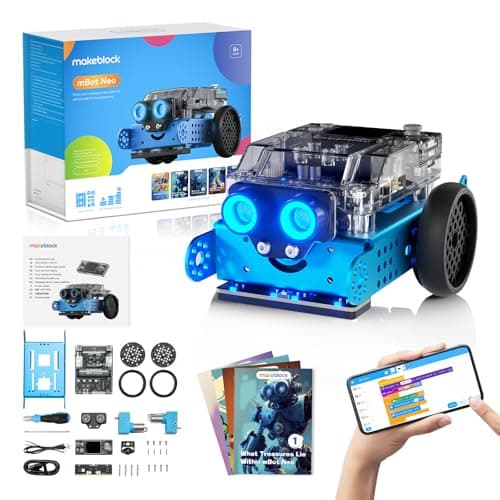 Best for real code Makeblock mBot Neo (mBot2) Blocks, then Python, then Arduino C on one chassis — ten is the year the middle rung becomes realistic. | Ten, and the last robot you need to buy | |
| 4 | 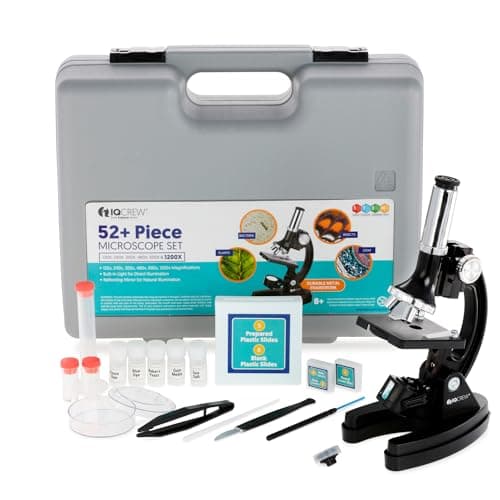 Best build quality AmScope 120X-1200X Beginner Microscope Kit A metal frame and a real stage — the microscope that outlives the interest rather than the other way round. | Ten and up, where the scope needs to survive to secondary school | |
| — | 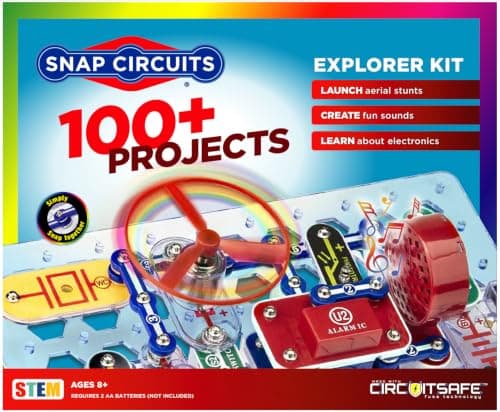 The one to skip Snap Circuits Jr. Thirty parts and a hundred projects, at an age that will exhaust both in a fortnight. | Eight, not ten |
5 picks, including 1 we tell you to skip. Ages shown are the manufacturer’s own rating, not ours.
Why ten is a threshold year
A lot of manufacturers converge on 10+ for a specific class of product, and the reason is consistent: it is the age at which a child can be trusted to follow a safety instruction they do not fully understand.
That is what gates real chemistry. The instruction "do not lean over the tube" has to be followed on the one occasion it matters, not on average. Thames & Kosmos rates the C-series 10+ and states compliance with EN 71-4, and that rating is about the contents rather than the difficulty.
The arithmetic
What unlocks at ten
| CHEM C1000 — stated age | 10 and up |
|---|---|
| MEL Chemistry — stated age | 10+ |
| 4M Crystal Growing — stated age | 10 and up |
| mBot2 — Python support | Published, via mBlock |
| StarSense Explorer DX 130AZ | No published age; app-guided |
The mistake to avoid at ten
Buying down. It is the mirror image of the usual error and it is common at this age, because ten-year-olds still look like children to the adult buying the present.
The published numbers make the cost visible. Elenco publishes 100+ projects from 30 parts for the Jr set and 305 from 60+ for the Classic, and states the Classic manual contains all the Jr projects. A ten-year-old handed the Jr set is being given a fifth of the content and will need the other set within months.
Say the unwelcome thing
Do not buy a chemistry set without reading the manual
Thames & Kosmos publishes its complete experiment manuals free on its own website. That is unusual and it is the single most useful thing available to somebody choosing a chemistry set.
Ten minutes reading the actual manual tells you whether the reading level, the equipment and the experiments suit your particular child. No review can do that, and a set that is pitched wrong becomes a cupboard object regardless of how good it is.
Worth knowing before you buy
Chemistry at ten wants an adult in the room, and the reason is not mainly danger. Sets sold in Europe are made to EN 71-4 and are safe as directed. The reason to be present is that the first genuinely surprising reaction is the moment the interest is either made or lost, and it lands better with somebody to say it to.
Practical points: work on a wipeable surface, wear the supplied goggles rather than shelving them, and keep the chemicals in their labeled vials. If there is a younger sibling, the set lives somewhere they cannot reach between sessions.
What to buy
- Asked for chemistry: CHEM C1000, after reading the manual.
- Interested in space: the StarSense Explorer, or the FirstScope on a budget.
- Wants to code properly: mBot2, for the Python path.
- Serious about biology: the AmScope, for the metal frame.
For the age above this one, see STEM kits for teens. For the categories in full, chemistry sets and telescopes.
In full
Every pick, and what is wrong with it
Published specifications only, each linked back to the page it came from. Where a manufacturer publishes nothing, the row says so — we do not fill blanks in.
1. Best overall
Thames & Kosmos CHEM C1000
Thames & Kosmos · 640118 · maker rates it 10+
Real reagents under a named European safety standard, with the entire manual published free before you buy.
- Chemicals included
- Seven, in cylindrical vials
- Manual
- Full experiment manual published free on the manufacturer's own site
- Safety standard
- “EN 71-4, in which the safety requirements for chemistry experimental kits are established”
- Covers
- Lab setup and safe handling, indicators and litmus, invisible ink, gas reactions
Thames & Kosmos publishes seven chemicals in cylindrical vials, a full experiment manual free on its own site, and compliance with EN 71-4, the European standard for chemistry experiment kits, rated 10 and up.
Read the manual before buying. It is free, it is on the manufacturer's own site, and ten minutes with it tells you whether this is pitched at your child better than any review can — including this one.
If ten feels early, the step down is the C500 at 28 experiments and a 48-page manual. The equipment carries forward between them, so starting low costs almost nothing.
Replay signal
- Open-ended or one-shot
- Guided rather than open-ended, but the manual is a term's worth of weekends
- Does anything run out
- Yes — seven finite chemicals, with replacements sold separately
- Room to grow
- The C-series continues into C2000 and C3000, carrying the same equipment forward
- Adult required
- Real chemicals at a 10+ rating: a sit-with-them kit at the lower end of that range
Why we say so: Thames & Kosmos publishes the full manual free on its own site — you can read exactly what your child will be doing before spending anything — and states compliance with EN 71-4, the European chemistry-kit safety standard.
What’s wrong with it
Consumable — seven chemicals, replacements sold separately. Budget for refills or treat the set as finite.
| Chemicals included | Seven, in cylindrical vials |
|---|---|
| Manual | Full experiment manual published free on the manufacturer's own site |
| Safety standard | “EN 71-4, in which the safety requirements for chemistry experimental kits are established” |
| Covers | Lab setup and safe handling, indicators and litmus, invisible ink, gas reactions |
| Stated age | 10 and up |
| Consumables | Yes — the seven chemicals are used up |
Every figure above is from Thames & Kosmos, experiment manuals. Blanks are shown as “not published” rather than filled in.
2. Best telescope
Celestron StarSense Explorer DX 130AZ
Celestron · 22461 · maker rates it Not published
One hundred and thirty millimetres of aperture, and a phone app that solves the problem that ends most first telescope nights.
- Aperture
- 130 mm (5.1 in)
- Focal length
- 650 mm
- Focal ratio
- f/5
- Optical design
- Newtonian reflector
Celestron publishes 130 mm aperture at 650 mm focal length, f/5, as a Newtonian reflector on an altazimuth mount, with a smartphone app that identifies where the telescope is pointing and directs you to targets.
The app is the specification that matters, and it addresses the real failure mode. Most first telescopes are abandoned because nobody could find anything — not because the optics were poor.
If the budget will not stretch, the FirstScope at 76 mm is the honest entry point and the Gskyer AZ70400 is the portable one. Both are on the telescopes page.
Replay signal
- Open-ended or one-shot
- Open-ended — the sky is the consumable and it restocks itself
- Does anything run out
- Nothing runs out
- Room to grow
- Standard eyepieces; 130 mm gathers enough light for planets and brighter deep-sky objects
- Adult required
- Much less than a normal telescope. The published point of StarSense is that the phone does the finding
Why we say so: Celestron publishes 130 mm of aperture at 650 mm focal length, f/5, with a smartphone app that identifies where the telescope is pointing. The app is the specification that matters for a family: not finding anything is what ends most first telescope nights, and this removes that step.
What’s wrong with it
Significantly more expensive than a beginner scope, and it needs a compatible smartphone to deliver its main advantage.
| Aperture | 130 mm (5.1 in) |
|---|---|
| Focal length | 650 mm |
| Focal ratio | f/5 |
| Optical design | Newtonian reflector |
| Finding aid | StarSense smartphone app — the phone identifies the sky and directs you |
| Mount | Altazimuth with slow-motion controls |
| Stated age | Not published |
Every figure above is from Celestron, StarSense Explorer DX 130AZ. Blanks are shown as “not published” rather than filled in.
3. Best for real code
Makeblock mBot Neo (mBot2)
Makeblock · mBot2 · maker rates it 8+
Blocks, then Python, then Arduino C on one chassis — ten is the year the middle rung becomes realistic.
- Controller
- CyberPi — Xtensa 32-bit LX6 dual-core at 240 MHz, 8 MB flash, 8 MB PSRAM
- Programming
- Scratch-style blocks, Python in mBlock, and Arduino C/C++ via the Arduino IDE
- Sensors
- On-board light, microphone, gyroscope and accelerometer, plus ultrasonic, quad RGB, temperature and IR modules
- Battery
- Built-in 2500 mAh LiPo, about 1 hour to charge, about 5 hours of play
Makeblock publishes a CyberPi controller with Scratch-style blocks, Python in mBlock and Arduino C via the Arduino IDE, on-board light, microphone, gyroscope and accelerometer sensors plus add-on modules, a 2500 mAh battery giving about five hours, and 60-plus compatible modules, rated 8+.
Ten is when Python stops being aspirational. A child who has spent a year in block editors has the concepts — sequence, loop, condition — and typing them is a translation exercise rather than a new subject.
Physical output is what makes it stick. A syntax error that stops a robot mid-floor is more instructive than one that prints red text in a browser.
Replay signal
- Open-ended or one-shot
- Open-ended at the top of the range — this is the one a child does not outgrow at eleven
- Does anything run out
- Nothing runs out; rechargeable
- Room to grow
- Blocks, then Python, then Arduino C on the same robot, with 60+ add-on modules
- Adult required
- Not for driving it. Probably for the first Python session
Why we say so: Makeblock publishes the processor, the three programming environments on one robot, the 2500 mAh battery figures and the 60+ compatible modules. Blocks-to-Python-to-C on one chassis is the published upgrade path, and it is why this survives the year a child gets bored of pressing buttons.
What’s wrong with it
Expensive, and a child who never leaves the block editor is paying for capability they will not use.
| Controller | CyberPi — Xtensa 32-bit LX6 dual-core at 240 MHz, 8 MB flash, 8 MB PSRAM |
|---|---|
| Programming | Scratch-style blocks, Python in mBlock, and Arduino C/C++ via the Arduino IDE |
| Sensors | On-board light, microphone, gyroscope and accelerometer, plus ultrasonic, quad RGB, temperature and IR modules |
| Battery | Built-in 2500 mAh LiPo, about 1 hour to charge, about 5 hours of play |
| Expansion | 60+ compatible modules, up to 10 connected at once, 8 motor and servo ports |
| Stated age | Ages 8+ |
Every figure above is from Makeblock, mBot2 coding robot kit. Blanks are shown as “not published” rather than filled in.
4. Best build quality
AmScope 120X-1200X Beginner Microscope Kit
AmScope · M30-ABS-KT2 · maker rates it 8+
A metal frame and a real stage — the microscope that outlives the interest rather than the other way round.
- Magnifications
- Six levels — 120x, 240x, 300x, 480x, 600x and 1200x
- Frame
- Metal arm, with stage clips
- Lighting
- Built-in LED plus a reflecting mirror
- Extras
- Rotating color filter wheel; 52-piece accessory kit
AmScope publishes six magnification levels — 120x, 240x, 300x, 480x, 600x and 1200x — with a metal arm and stage clips, a built-in LED and a reflecting mirror, a rotating color filter wheel, a 70 x 65 mm stage and a 52-piece accessory kit, with a published shipping weight of 6 lb. AmScope publishes it “For ages 8+”.
At ten the tradeoff finally favours this over a friendlier scope: the child can prepare slides properly, so losing top lighting costs less than it would at eight.
Ignore the top magnification. At 1200x an entry-level objective gives a large, dim image with no more real detail than 600x — the useful work is in the lower half of the range.
Replay signal
- Open-ended or one-shot
- Open-ended — specimens are free and infinite
- Does anything run out
- The prepared slides in the accessory kit run out; blank slides do not
- Room to grow
- 1200x is well past what a child needs and past what the optics comfortably resolve, but the metal frame will outlast the interest
Why we say so: AmScope publishes six magnification levels, a metal arm and a 70 x 65 mm stage. Treat the top magnification with skepticism — at 1200x an entry-level objective delivers a large, dim, blurry image — and buy this for the metal frame and the usable lower range instead.
What’s wrong with it
No top lighting, so everything must be thin and on a slide, and the 1200x headline is optimistic on these optics.
| Magnifications | Six levels — 120x, 240x, 300x, 480x, 600x and 1200x |
|---|---|
| Frame | Metal arm, with stage clips |
| Lighting | Built-in LED plus a reflecting mirror |
| Extras | Rotating color filter wheel; 52-piece accessory kit |
| Stage | 70 x 65 mm |
| Shipping weight | 6 lb — AmScope publishes no product weight |
| Stated age | “For ages 8+” |
Every figure above is from AmScope, M30-ABS-KT2 microscope. Blanks are shown as “not published” rather than filled in.
Skip this one
Snap Circuits Jr.
Elenco · SC-100 · maker rates it 8+
Thirty parts and a hundred projects, at an age that will exhaust both in a fortnight.
- Projects
- Over 100
- Parts
- 30
- Projects per part
- 3.3
- Stated age
- Ages 8+
Elenco publishes over 100 projects from 30 parts, rated 8+.
The skip here is about timing rather than quality. Elenco states that the SC-300 manual contains every SC-100 project plus 200 more — so a ten-year-old given the Jr set will finish it quickly and then need the Classic, having paid for the overlap.
Start at the Classic, or go straight to the Pro if the interest is already established. The full ladder is on the comparison page.
Replay signal
- Open-ended or one-shot
- Semi-open. The manual is a ladder, but 30 parts is enough vocabulary to go off-book
- Does anything run out
- Nothing runs out
- Room to grow
- Every SC-100 project is reprinted in the SC-300 manual, so the step up loses nothing
Why we say so: Elenco publishes over 100 projects from 30 parts, and publishes that the SC-300 manual contains all of the SC-100 projects plus 200 more. That overlap is what makes the upgrade path a genuine upgrade rather than a re-buy.
What’s wrong with it
Elenco publishes every SC-100 project inside the SC-300 manual, so buying this at ten means paying twice for the same content.
| Projects | Over 100 |
|---|---|
| Parts | 30 |
| Projects per part | 3.3 |
| Stated age | Ages 8+ |
| Projects include | FM radio, AM radio, digital voice recorder, burglar alarm, doorbell |
| Tools needed | None — snap-together parts “require no tools and ensure correct connections” |
| Consumables | None |
Every figure above is from Elenco, Snap Circuits Jr. 100 Experiments. Blanks are shown as “not published” rather than filled in.
We are not putting a buy button on this one. It is easy enough to find if you want it anyway — but we would rather send you to something that gets played with twice.
Questions people actually ask
Frequently asked
What is the best STEM toy for a 10 year old?
A real chemistry set, if they have asked for one. Thames & Kosmos rates the CHEM C1000 at 10 and up, states compliance with EN 71-4, and publishes the complete manual free online so you can read exactly what your child will be doing before spending anything.
Why do so many science kits say 10+?
Because ten is roughly the age at which a child can be trusted to follow a safety instruction they do not fully understand, on the one occasion it matters rather than on average. That is what gates real reagents, and it is a rating about contents rather than difficulty.
Should I buy a beginner set for a 10 year old to start with?
Usually not. Elenco publishes 100+ projects from 30 parts for Snap Circuits Jr and 305 from over 60 for the Classic — and states the Classic manual contains every Jr project. A ten-year-old given the Jr set gets a fifth of the content and needs the other set within months.
What telescope should I buy for a 10 year old?
One that helps them find things. Celestron's StarSense Explorer DX 130AZ publishes 130mm of aperture plus a smartphone app that identifies where the scope is pointing — which addresses the actual reason most first telescopes get abandoned, which is not finding anything rather than poor optics. Telescopes compared.
Sources
Where these figures came from
Every specification on this page traces to one of these. If a manufacturer publishes nothing on a point, the page says so rather than filling the gap.
Read next
Where to go from here
Back to Shop by Age, or read how we pick.