The picks
The Best First Building Set
Every construction category claims to be the first one. Their published age ratings disagree, and that settles most of it.
By Sawyer V. · Published
The short answer
Published age floors decide most of this. At three, magnetic tiles and notched logs are the only real options. At four, bricks open up. At five, planks and discs. At seven, rods and connectors. Buy the system whose published floor sits at or just below the child’s age.
Block & Beaker earns a commission when you buy through our links, at no cost to you. It never changes a ranking, and we say so plainly when the right answer is the cheaper set, or nothing at all. Full disclosure · How we pick.
At a glance
The picks, ranked
Tap any row to jump to the full reasoning. Prices come live from Amazon where we have them and read “check price” where we don’t — never a number we cannot stand behind today.
| # | Product | Best for | Price |
|---|---|---|---|
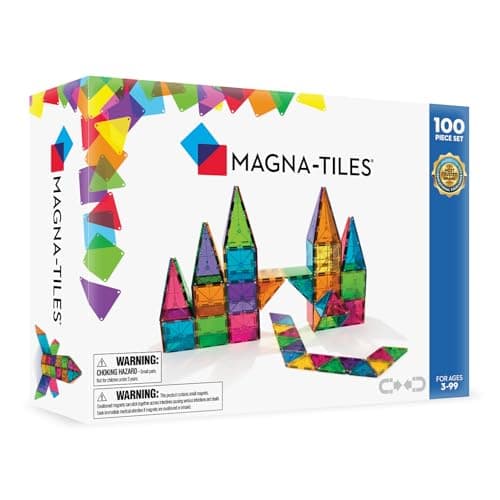
| 1 | Best first set overall MAGNA-TILES Classic 100-Piece Set A published 3-99 range, a full shape breakdown, and magnets that supply the precision small hands cannot. | Three and up, as the widest published age range on this site | |
| 2 | 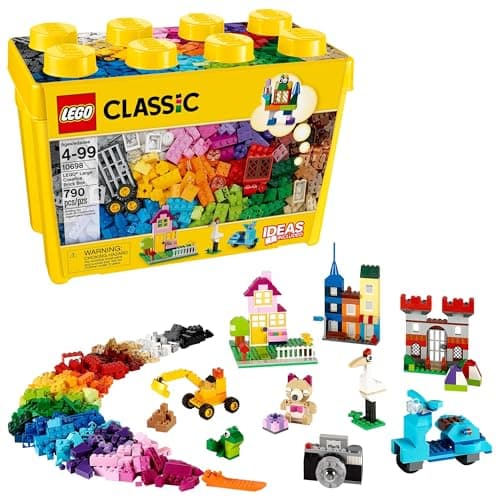 Best from four LEGO Classic Large Creative Brick Box 790 pieces in 33 colors with windows, doors, baseplates and wheels, compatible with all LEGO sets. | Four and up, where every future set joins the same box | |
| 3 | 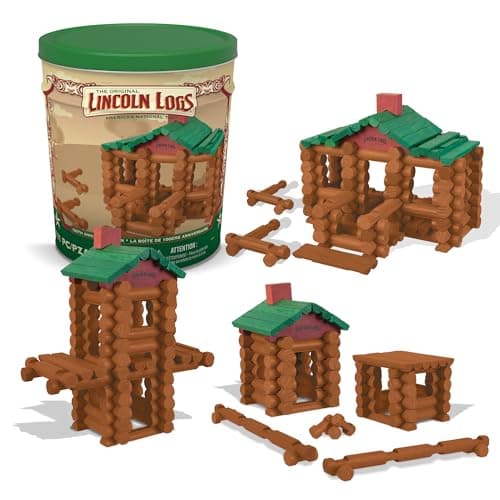 Best wooden set at three Lincoln Logs 100th Anniversary Tin 111 real maple pieces joined by notches, so a three-year-old gets a standing structure first time. | Three to six, for a child who wants the build to stay up | |
| 4 | 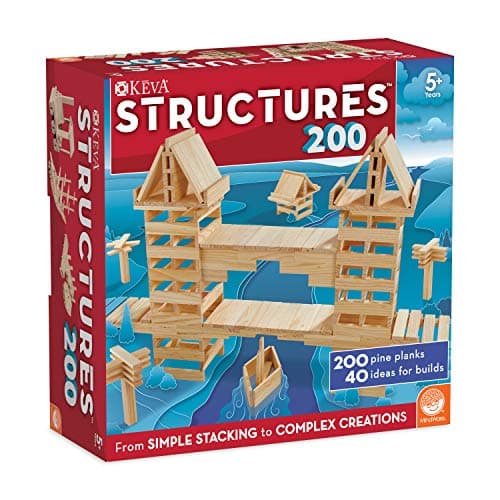 Best from five KEVA Structures 200 Plank Set 200 identical planks, no connectors of any kind, and no published upper age limit. | Five and up, with the highest ceiling here | |
| — | Not a first set K'NEX 35 Model Building Set Frequently given as a first construction toy and it is rated four years above the alternatives. | Seven and up |
5 picks, including 1 we tell you to skip. Ages shown are the manufacturer’s own rating, not ours.
Let the published age floors decide
Every construction brand describes its set as a first building set. Their own published age ratings are more useful than any of that copy, because a rating at the low end is a small-parts safety floor set by testing rather than a marketing choice.
The arithmetic
Published age floors across the categories
| Magnetic tiles (Magna-Tiles) | 3-99 years |
|---|---|
| Notched wooden logs (Lincoln Logs) | 3+ |
| Magnetic frames (Magformers) | 3+ |
| Gears (Gears! Gears! Gears!) | 3+ |
| Bricks (LEGO Classic) | 4 and up |
| Planks (KEVA Structures) | 5 and up |
| Discs (Brain Flakes) | 5 and up |
| Rods and connectors (K'NEX) | 7 and above |
What decides the floor: how the pieces join
Magnets and notches remove precision. Bring two tiles close and they snap; drop a log into a notch and it sits. Neither needs a grip a three-year-old does not have.
Studs need alignment and force. A brick has to be squared up and pressed. That is a genuine fine-motor task, which is why the published floor is a year later.
Planks need balance. Nothing holds anything, so the child supplies all the stability. Excellent at five, dispiriting at three.
Rods and connectors need strength. A firm, accurate push into a specific hole, repeated hundreds of times. Hence 7+.
The second question: what do you want them to build?
Once age has narrowed the field, the remaining question is what the system can physically make.
Places — houses, rooms, scenes — need solid faces or walls. Tiles and bricks. Connetix publishes windows, doors and fences, which pushes play furthest in this direction.
Structures — towers, bridges, spans — need identical interchangeable pieces. Planks, and later rods.
Machines — anything that moves — need gears or rods. Gears! Gears! Gears! publishes 100 pieces, hand-cranked with no batteries, rated 3+, which is the only mechanism set available to a preschooler.
Organic shapes — spheres, domes, creatures — need discs or pentagons. Brain Flakes at 5+, or Magformers for the geometry.
Worth knowing before you buy
Every low age rating in this category — 3+, 4+, 5+ — is a small-parts safety floor set by toy safety testing, not a difficulty estimate. It applies to the youngest child who can reach the box, not to the one whose birthday it was.
If you can only buy one, ever
Magnetic tiles at three. The published 3-99 range is not marketing: an open-ended set with no finished state genuinely has no age it stops working at, and nothing in the box is consumed, so the tenth year costs what the first did.
The runner-up is bricks at four, on the strength of the published compatibility guarantee — every future LEGO set adds to the same collection instead of starting a new pile.
Say the unwelcome thing
Do not buy a small starter set to test the water
Thirty-two tiles or a tiny brick tub answers a question you did not mean to ask. Below about sixty pieces a child runs out mid-build, the structure stays unfinished, and the set gets read as boring.
One hundred pieces is the honest floor for a first construction set.
Where to go next
How many pieces do you actually need covers volume. Which building sets work together covers what happens when a second set arrives, and magnetic tiles compared covers the top recommendation in detail.
In full
Every pick, and what is wrong with it
Published specifications only, each linked back to the page it came from. Where a manufacturer publishes nothing, the row says so — we do not fill blanks in.
1. Best first set overall
MAGNA-TILES Classic 100-Piece Set
Magna-Tiles · 4300 · maker rates it 3-99 years
A published 3-99 range, a full shape breakdown, and magnets that supply the precision small hands cannot.
- Pieces
- 100
- Shape mix
- 50 squares, 4 large squares, 20 equilateral triangles, 11 right triangles, 15 isosceles triangles
- Stated age
- “3-99 Years”
- Material
- “Food-grade, non-toxic MABS plastic that are free from BPAs, phthalates, and latex”
Magna-Tiles publishes 100 pieces — 50 squares, 4 large squares, 20 equilateral, 11 right and 15 isosceles triangles — a stated 3-99 age range, magnets held by a lattice plus fastening rivets, and compatibility across all Magna-Tiles sets.
The mechanical reason tiles win at three is that magnets do the hard part. A three-year-old cannot align a brick stud or balance a plank, but they can bring two tiles near each other and feel them snap. The structure stands in the first minute, without an adult.
The published 3-99 range is the other half. A set with no finished state has no natural top age, which is why this is the one purchase that can genuinely be the first and the last.
Replay signal
- Open-ended or one-shot
- Open-ended — there is no finished state to reach
- Does anything run out
- Nothing runs out
- Room to grow
- Every set combines with every other Magna-Tiles set
Why we say so: Magna-Tiles publishes the full 100-piece shape breakdown, lists no consumable parts, and states that “all pieces are compatible with and complementary to all other MAGNA-TILES sets.”
What’s wrong with it
The most expensive way to buy 100 pieces, and no windows or doors in the box.
| Pieces | 100 |
|---|---|
| Shape mix | 50 squares, 4 large squares, 20 equilateral triangles, 11 right triangles, 15 isosceles triangles |
| Stated age | “3-99 Years” |
| Material | “Food-grade, non-toxic MABS plastic that are free from BPAs, phthalates, and latex” |
| Magnet retention | Signature lattice plus “fastening rivets keep magnets safe and secure” |
| Consumables | None |
Every figure above is from Magna-Tiles, Classic 100-Piece Set. Blanks are shown as “not published” rather than filled in.
2. Best from four
LEGO Classic Large Creative Brick Box
LEGO · 10698 · maker rates it 4+
790 pieces in 33 colors with windows, doors, baseplates and wheels, compatible with all LEGO sets.
- Pieces
- 790
- Colors
- 33
- Stated age
- 4 and up
- Includes
- 8 types of windows and doors, 2 green baseplates, 6 tires and wheel rims
LEGO publishes 790 pieces in 33 colors, 8 types of windows and doors, 2 green baseplates and 6 tires and wheel rims, rated 4 and up, compatible with all LEGO construction sets.
The compatibility statement is the long-game argument. Every themed set the child is ever given eventually becomes loose bricks, and this is the box they join.
Replay signal
- Open-ended or one-shot
- Open-ended — this is the box with no instructions and no finished model
- Does anything run out
- Nothing runs out
- Room to grow
- Every LEGO set the child is ever given pours into the same box
Why we say so: LEGO publishes the 790-piece count, the 33 colors and the box's compatibility with all LEGO construction sets. The absence of a build-this model is the product's stated design, not an omission.
What’s wrong with it
Rated 4+, and studs demand a precision that arrives about a year after tiles do.
| Pieces | 790 |
|---|---|
| Colors | 33 |
| Stated age | 4 and up |
| Includes | 8 types of windows and doors, 2 green baseplates, 6 tires and wheel rims |
| Compatibility | Compatible with all LEGO construction sets |
| Consumables | None |
Every figure above is from LEGO, Large Creative Brick Box 10698. Blanks are shown as “not published” rather than filled in.
3. Best wooden set at three
Lincoln Logs 100th Anniversary Tin
Lincoln Logs · 100th Anniversary Tin · maker rates it 3+
111 real maple pieces joined by notches, so a three-year-old gets a standing structure first time.
- Pieces
- 111, real maple wood
- Contents
- Roof and roof facade pieces, wall logs, chimney, porch, fences, bonfire and bonfire seats
- Build ideas included
- 3 — a tall tower, two small houses with a bonfire, a large cabin
- Joining method
- Notched indentations; no clips, glue or connectors
Basic Fun publishes 111 real maple pieces including roof pieces, wall logs, chimney, porch, fences and a bonfire, joined by notched indentations with no clips, glue or connectors, with 3 build ideas, rated 3+.
Notch-only joining is the same insight as magnets: remove the precision requirement and a three-year-old succeeds immediately. The trade is that notches decide the shape of what gets built.
Replay signal
- Open-ended or one-shot
- Open-ended after the three published ideas — notched logs impose a style, not a model
- Does anything run out
- Nothing runs out, and maple survives being trodden on
- Room to grow
- Limited by piece count rather than by concept; sets combine
Why we say so: Basic Fun publishes 111 real maple pieces joined by notches with no connectors. Notch-only joining is why a three-year-old can build with these: there is nothing to align precisely and nothing to press hard.
What’s wrong with it
The notches impose a style — almost everything built is a cabin.
| Pieces | 111, real maple wood |
|---|---|
| Contents | Roof and roof facade pieces, wall logs, chimney, porch, fences, bonfire and bonfire seats |
| Build ideas included | 3 — a tall tower, two small houses with a bonfire, a large cabin |
| Joining method | Notched indentations; no clips, glue or connectors |
| Stated age | 3+ |
| Consumables | None |
Every figure above is from Basic Fun, Lincoln Logs 100th Anniversary Tin. Blanks are shown as “not published” rather than filled in.
4. Best from five
KEVA Structures 200 Plank Set
KEVA Planks · Structures 200 · maker rates it 5+
200 identical planks, no connectors of any kind, and no published upper age limit.
- Planks
- 200, solid pine, precision-cut to identical dimensions
- Plank size
- About 4 1/2 in long x 3/4 in wide x 1/4 in thick
- Connectors
- None — planks stack with no glue, clips or notches
- Includes
- Idea booklet
KEVA publishes 200 solid pine planks precision-cut to identical dimensions with no glue, clips or notches, plus an idea booklet, rated 5 and up.
This is the opposite design philosophy. Tiles and logs remove the difficulty; planks are the difficulty. That is exactly right at five and frustrating at three.
Replay signal
- Open-ended or one-shot
- As open-ended as construction gets — every plank is identical, so nothing constrains the build but balance
- Does anything run out
- Nothing runs out, and wood does not break the way plastic clips do
- Room to grow
- The same planks are used in adult-level structural challenges; there is no ceiling
Why we say so: The manufacturer publishes that the planks are precision-cut to identical dimensions and use no connectors of any kind. Identical, connector-free pieces is why this set has no upper age limit: the difficulty comes entirely from what the child attempts, not from what the box permits.
What’s wrong with it
Nothing holds together, so a knock ends the build.
| Planks | 200, solid pine, precision-cut to identical dimensions |
|---|---|
| Plank size | About 4 1/2 in long x 3/4 in wide x 1/4 in thick |
| Connectors | None — planks stack with no glue, clips or notches |
| Includes | Idea booklet |
| Stated age | 5 and up |
| Consumables | None |
Every figure above is from KEVA Planks, Structures 200 Plank Set. Blanks are shown as “not published” rather than filled in.
Skip this one
K'NEX 35 Model Building Set
K'NEX · 35 Model Building Set · maker rates it 7+
Frequently given as a first construction toy and it is rated four years above the alternatives.
- Pieces
- 480, in a mix of classic and micro sizes
- Models in the instruction booklet
- 35
- System
- Rods and connectors that attach in multiple orientations
- Stated age
- Ages 7 and above
K’NEX publishes 480 pieces and 35 models in the booklet, using rods and connectors attaching at multiple fixed orientations, rated ages 7 and above.
It is an excellent system and a poor first purchase for a young child. The published rating is 7, the pieces are small, and connecting them takes real hand strength. Given at four it produces frustration and gets blamed on the child.
Replay signal
- Open-ended or one-shot
- Both: 35 published models to work through, then a rod-and-connector system with no correct answer
- Does anything run out
- Nothing runs out
- Room to grow
- Rods and connectors are a shared standard across the K'NEX range, so later sets combine
Why we say so: K'NEX publishes 480 pieces and 35 models in the booklet. The rod-and-connector geometry is the reason this builds in three dimensions from the start — a connector accepts rods at several fixed angles, so a beginner gets a rigid frame rather than a flat wall.
What’s wrong with it
480 pieces in classic and micro sizes, needing a firm precise push.
| Pieces | 480, in a mix of classic and micro sizes |
|---|---|
| Models in the instruction booklet | 35 |
| System | Rods and connectors that attach in multiple orientations |
| Stated age | Ages 7 and above |
| Consumables | None |
Every figure above is from Basic Fun, K'NEX 35 Model Building Set. Blanks are shown as “not published” rather than filled in.
We are not putting a buy button on this one. It is easy enough to find if you want it anyway — but we would rather send you to something that gets played with twice.
Questions people actually ask
Frequently asked
What is the best first building set for a 3 year old?
Magnetic tiles. Magna-Tiles publishes a 3-99 age range, and the mechanical reason they work at three is that magnets supply the precision small hands cannot — a structure stands in the first minute without an adult. Notched wooden logs are the other 3+ option.
What age can a child start with LEGO?
LEGO publishes 4 and up for the Classic Large Creative Brick Box. Studs need squaring up and pressing, which is a genuine fine-motor task — that is why the published floor sits a year later than magnetic tiles or notched logs.
Are wooden or plastic building sets better for a first set?
The material matters less than the joining method. Notched wooden logs are rated 3+ because notches remove the precision requirement; unconnected wooden planks are rated 5+ because balance is the whole difficulty. Compare the published age floor, not the material.
How many pieces should a first building set have?
About 100. Below roughly sixty a child runs out of pieces mid-structure, the build stays unfinished, and the set gets read as boring — which answers a question about the child that was really about the box. How many pieces do you need?.
Sources
Where these figures came from
Every specification on this page traces to one of these. If a manufacturer publishes nothing on a point, the page says so rather than filling the gap.
Read next
Where to go from here
Back to Building Sets, or read how we pick.