The picks
Outdoor and Nature Kits for Kids
The only corner of the science aisle where the supply of things to study is infinite and free.
By Sawyer V. · Published
The short answer
Outdoor kits invert the usual problem with science purchases: nothing runs out, because the specimens are whatever the child finds. A bug habitat with magnified viewers works from four and never needs a refill, which almost nothing else in this category can say.
Block & Beaker earns a commission when you buy through our links, at no cost to you. It never changes a ranking, and we say so plainly when the right answer is the cheaper set, or nothing at all. Full disclosure · How we pick.
At a glance
The picks, ranked
Tap any row to jump to the full reasoning. Prices come live from Amazon where we have them and read “check price” where we don’t — never a number we cannot stand behind today.
| # | Product | Best for | Price |
|---|---|---|---|
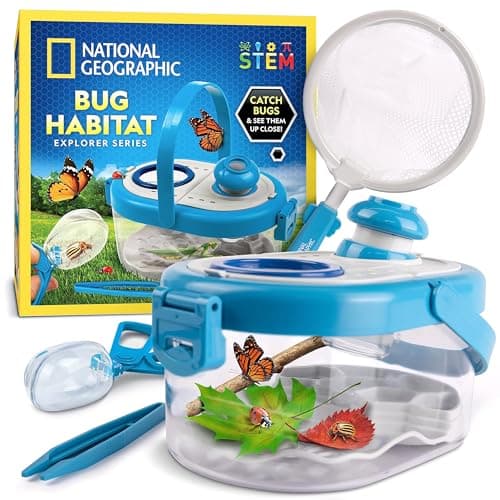
| 1 | Best overall NATIONAL GEOGRAPHIC Bug Catcher Kit A habitat with two magnified viewers and a scissor catcher — usable at four, and the garden restocks it. | Four and up, and the youngest genuine science purchase here | |
| 2 | 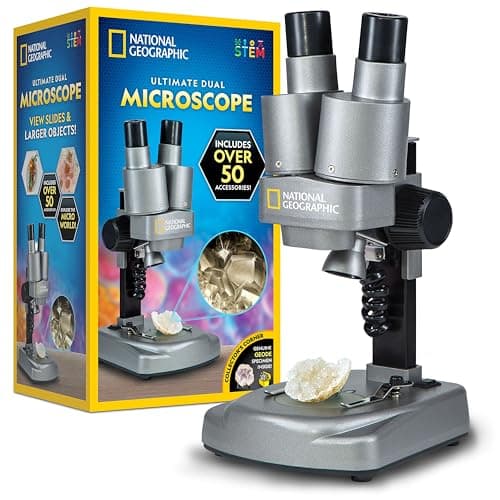 Best for what gets brought indoors NATIONAL GEOGRAPHIC Dual LED Student Microscope Twenty and fifty times with top lighting — the range where a leaf or a beetle looks extraordinary rather than abstract. | Eight and up, as the instrument that follows the collecting | |
| 3 | Best for pond water My First Lab Duo-Scope Microscope Both lighting modes and 400x — the step where pond water becomes the most interesting thing in the garden. | Nine and up, once whole-object viewing is no longer enough | Sold direct by My First Lab → Not stocked on Amazon. This link goes to the maker and we earn nothing on it. |
| 4 | 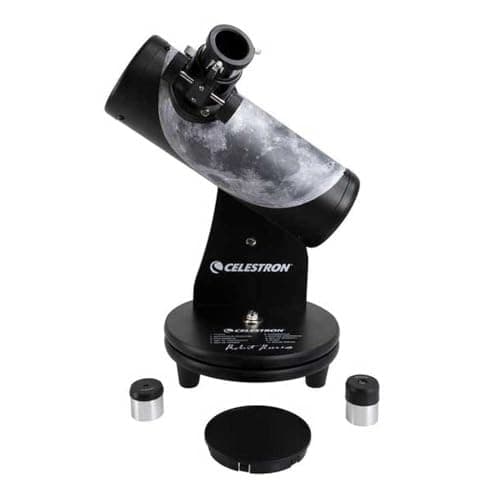 Best after dark Celestron FirstScope Telescope The one outdoor instrument that works better in winter, when everything else has stopped. | The outdoor interest that continues when it gets cold | |
| — | 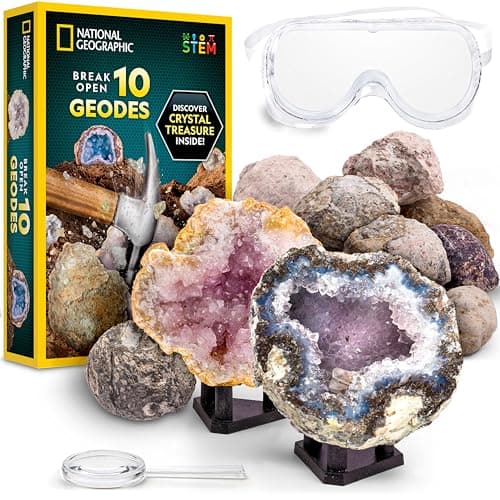 The one to skip here NATIONAL GEOGRAPHIC Break Open 10 Premium Geodes Real geology, and the opposite of what this page is about — a fixed indoor supply rather than an infinite outdoor one. | An indoor afternoon, on a different page |
5 picks, including 1 we tell you to skip. Ages shown are the manufacturer’s own rating, not ours.
Why outdoor kits break the usual rule
Everywhere else in the science category, the first question we ask is what runs out. Chemicals are consumed, geodes crack once, crates arrive and are built.
Outdoor kits are the exception, and it is not a marketing claim — it is structural. The consumable is the specimen, and the specimen is a woodlouse. There is no version of this where the supply runs down.
The arithmetic
What each kit consumes
| Bug catcher kit | Nothing |
|---|---|
| Microscope, blank slides | Slides only, and they are cheap |
| Telescope | Nothing |
| Chemistry set | Five to seven chemicals |
| Geode kit | Ten geodes |
What to look for in an outdoor kit
A way to catch without crushing. A net or a scissor catcher rather than fingers. This is the single feature that separates a nature kit from a container.
Magnification that works on opaque things. Anything that needs a specimen to be thin and backlit is a laboratory instrument, not a field one. Top lighting or a hand lens.
Something to keep the animal alive in briefly. A ventilated habitat with a removable base is the difference between observing an insect and killing one, and children mind about that more than adults expect.
Nothing that needs a table. The whole point is that it goes outside. A kit with a delicate stand stays on a windowsill.
The seasonal problem, and how to plan around it
Nature kits have a real weakness that nobody selling them mentions: from late autumn to early spring there is dramatically less to find. A bug catcher given at Christmas has months to wait.
Two ways round it. Buy them in spring, which is unhelpful advice for a December birthday but true. Or pair an outdoor kit with something that works indoors or after dark — a microscope for what gets brought in, or a telescope for the long nights, which is the one outdoor instrument that improves in winter.
Worth knowing before you buy
The rule worth teaching alongside the kit is catch and release, same day, same place. A ventilated habitat is for observing for an hour, not for keeping. Insects kept in a plastic box overnight generally do not survive, and a child who realizes that afterwards feels it.
Two practical cautions: teach which insects not to pick up before the first outing rather than after, and check local rules before collecting anything from a protected site. Some species and some places are legally off limits.
Say the unwelcome thing
Do not buy the kit with the longest feature list
Outdoor kits are prone to accessory padding — twelve plastic tools in a bag, most of which are a magnifier of the same power in a different shape.
What matters is a catcher that does not crush, a container the animal can breathe in, and one lens good enough to see with. A kit doing those three things well beats one listing twenty pieces.
What to buy
- Four to seven: the bug catcher kit.
- Eight and up, brings things indoors: a low-power microscope with top lighting.
- Nine and up, wants pond water: the Duo-Scope, for the concavity slide.
- Winter: a telescope.
In full
Every pick, and what is wrong with it
Published specifications only, each linked back to the page it came from. Where a manufacturer publishes nothing, the row says so — we do not fill blanks in.
1. Best overall
NATIONAL GEOGRAPHIC Bug Catcher Kit
National Geographic · Bug Catcher Kit · maker rates it 4+
A habitat with two magnified viewers and a scissor catcher — usable at four, and the garden restocks it.
- Habitat
- Clear bug habitat with a removable base
- Viewers
- Latching lid with two magnified viewers — one fixed, one movable
- Tools
- Scissor-style bug catcher, net, tweezers
- Includes
- Learning guide
National Geographic publishes a clear bug habitat with a removable base, a latching lid with two magnified viewers — one fixed and one movable — plus a scissor-style bug catcher, a net, tweezers and a learning guide, rated 4+.
The scissor catcher is the specification worth noticing. It lets a four-year-old pick up an insect without crushing it, which is the difference between a nature kit and a lesson in being gentle that arrives too late.
Two viewers at different magnifications is the other thoughtful detail: a child looks through the fixed one to find the insect and the movable one to look closely.
Replay signal
- Open-ended or one-shot
- Completely open-ended for the age — the garden restocks it
- Does anything run out
- Nothing runs out
- Room to grow
- Pairs naturally with a low-power microscope when the child wants a closer look
- Adult required
- For the catch-and-release rule; not for the looking
Why we say so: National Geographic publishes a habitat with two magnified viewers, a scissor catcher, a net and tweezers, rated 4+. The scissor catcher is the specification worth noticing: it lets a four-year-old pick up an insect without crushing it, which is the difference between a nature kit and a lesson about being gentle.
What’s wrong with it
It is seasonal in a cold climate. Between November and March there is a great deal less to catch.
| Habitat | Clear bug habitat with a removable base |
|---|---|
| Viewers | Latching lid with two magnified viewers — one fixed, one movable |
| Tools | Scissor-style bug catcher, net, tweezers |
| Includes | Learning guide |
| Stated age | 4+ |
| Consumables | None — the specimens are outside and free |
Every figure above is from National Geographic toys, Bug Catcher Kit. Blanks are shown as “not published” rather than filled in.
2. Best for what gets brought indoors
NATIONAL GEOGRAPHIC Dual LED Student Microscope
National Geographic · Dual LED Student Microscope · maker rates it 8+
Twenty and fifty times with top lighting — the range where a leaf or a beetle looks extraordinary rather than abstract.
- Magnifications
- 20x and 50x, from two sets of optical glass lenses
- Lighting
- Upper and lower LED
- Accessories
- 50+ pieces, including 10 prepared slides, blank slides and covers, tweezers, eye-dropper and a mini geode
- Weight
- 2.6 lb
National Geographic publishes 20x and 50x from two sets of optical glass lenses, upper and lower LED lighting, and 50-plus accessories including 10 prepared slides, blank slides and covers, tweezers, an eye-dropper and a mini geode, rated 8+.
Low magnification is the right call for outdoor finds and it is counter-intuitive. At 20x an insect is recognisably an insect — three-dimensional, whole, astonishing. At 400x it is an unidentifiable field of texture.
Top lighting is what makes it work on anything opaque, which is everything a child brings in from a garden.
Replay signal
- Open-ended or one-shot
- Open-ended, and the low magnification is the reason — 20x is where insects and leaves look extraordinary
- Does anything run out
- The 10 prepared slides run out; blank slides and the garden do not
- Room to grow
- Limited on magnification, generous on subject matter
Why we say so: National Geographic publishes 20x and 50x with upper and lower LED lighting. Low magnification plus top lighting is a deliberate design for looking at whole objects rather than slides, which for a child under about ten is a far better first microscope than a 1000x compound scope they cannot focus.
What’s wrong with it
Fifty times is a real ceiling. Pond microorganisms and cells are out of reach at this magnification.
| Magnifications | 20x and 50x, from two sets of optical glass lenses |
|---|---|
| Lighting | Upper and lower LED |
| Accessories | 50+ pieces, including 10 prepared slides, blank slides and covers, tweezers, eye-dropper and a mini geode |
| Weight | 2.6 lb |
| Stated age | 8+ |
Every figure above is from National Geographic toys, Dual LED Student Microscope. Blanks are shown as “not published” rather than filled in.
3. Best for pond water
My First Lab Duo-Scope Microscope
My First Lab · MFL-06 · maker rates it 9+
Both lighting modes and 400x — the step where pond water becomes the most interesting thing in the garden.
- Magnifications
- 40x, 100x and 400x, from a 10x eyepiece with 4x, 10x and 40x objectives
- Optics
- Real optical glass lenses
- Lighting
- Dual LED, above and below the stage
- Slides included
- 5 blank, 1 concavity (well), 4 prepared
My First Lab publishes 40x, 100x and 400x from a 10x eyepiece with 4x, 10x and 40x objectives, real optical glass, dual LED lighting above and below, and five blank slides plus one concavity and four prepared, rated 9 and older, requiring three AA batteries.
The concavity slide is the outdoor-specific piece. A well slide holds a drop of pond water without it spreading flat, which is what lets a child watch things swimming rather than squashed.
Five blank slides plus a garden is what makes this open-ended. Four prepared slides is four pictures; blanks are a habit.
Replay signal
- Open-ended or one-shot
- Genuinely open-ended, unusually so for a science purchase — the world is the consumable
- Does anything run out
- The four prepared slides run out; the five blanks and everything in the garden do not
- Room to grow
- Light from above as well as below means it works on rocks, leaves and insects, not only on slides
Why we say so: The manufacturer publishes the dual-LED lighting, the blank-slide count and the real-glass optics. Blank slides plus top lighting is what turns a microscope from four pictures into a thing you point at whatever you found outside.
What’s wrong with it
Rated 9 and older, and preparing a wet slide is genuinely fiddly the first few times.
| Magnifications | 40x, 100x and 400x, from a 10x eyepiece with 4x, 10x and 40x objectives |
|---|---|
| Optics | Real optical glass lenses |
| Lighting | Dual LED, above and below the stage |
| Slides included | 5 blank, 1 concavity (well), 4 prepared |
| Stated age | Ages 9 and older |
| Batteries | 3 x AA (not included) |
| Weight | 1.95 lb |
Every figure above is from My First Lab, Duo-Scope MFL-06. Blanks are shown as “not published” rather than filled in.
Not stocked on Amazon. This link goes to the maker and we earn nothing on it.
4. Best after dark
Celestron FirstScope Telescope
Celestron · 21024 · maker rates it Not published
The one outdoor instrument that works better in winter, when everything else has stopped.
- Aperture
- “76mm (2.99″)”
- Focal length
- “300mm (12″)”
- Focal ratio
- “f/3.95”
- Eyepiece 1
- 20mm, 15x magnification
Celestron publishes 76 mm aperture, 300 mm focal length, f/3.95, with 20 mm and 4 mm eyepieces giving 15x and 75x, on a Dobsonian-style tabletop stand.
Included here because outdoor science has a seasonal problem and this is the answer to it. Bug catching dies in November; astronomy gets better, because the nights are long and the air is clear.
Use the 20 mm eyepiece. The 15x view of the moon is the single best first sight in the category, and the 75x eyepiece is dim by comparison.
Replay signal
- Open-ended or one-shot
- Open-ended in the most literal sense: the sky changes every month whether anyone touches it or not
- Does anything run out
- Nothing runs out
- Room to grow
- Standard eyepieces, so it accepts better ones later without replacing the telescope
- Adult required
- Finding the first object usually needs an adult; after that a tabletop Dobsonian is genuinely child-operable
Why we say so: Celestron publishes the 76mm aperture, 300mm focal length, f/3.95 ratio and both eyepiece magnifications. The table-top Dobsonian mount is the published design, and it is why a child can aim this one without a tripod fight.
What’s wrong with it
Needs a table and a clear night. In practice that is perhaps a dozen genuinely usable evenings a year.
| Aperture | “76mm (2.99″)” |
|---|---|
| Focal length | “300mm (12″)” |
| Focal ratio | “f/3.95” |
| Eyepiece 1 | 20mm, 15x magnification |
| Eyepiece 2 | 4mm, 75x magnification |
| Mount | “Dobsonian style stand”, table-top |
| Stated age | Not published — Celestron calls it “an ideal entry level astronomical telescope” |
Every figure above is from Celestron, FirstScope Telescope. Blanks are shown as “not published” rather than filled in.
Skip this one
NATIONAL GEOGRAPHIC Break Open 10 Premium Geodes
National Geographic · NGGEO10 · maker rates it 8+
Real geology, and the opposite of what this page is about — a fixed indoor supply rather than an infinite outdoor one.
- Geodes
- 10, hand-selected, 1.25 to 2.25 inches across
- Includes
- Safety goggles, magnifying glass, display stands, full-color learning guide
- Stated age
- Manufacturer's minimum age 8 years
- Safety note
- Contains small parts; not for children under 3
National Geographic publishes ten hand-selected natural geodes with safety goggles, a magnifying glass, display stands and a learning guide, rated 8+.
It is a good kit and it is on the geology page on its own terms.
The skip here is about shape rather than quality. This page exists because outdoor kits never run out; a box of ten geodes runs out like everything else, and buying it as an outdoor purchase gets the category wrong.
Replay signal
- Open-ended or one-shot
- One-shot by design. Ten geodes, ten moments, then it is a bowl of pretty rocks
- Does anything run out
- Yes, definitively — the clearest example on this site of a kit that ends
Why we say so: National Geographic publishes the count as ten natural geodes. Ten single-use items is a finite number, and we would rather say so than let a gift-buyer find out on Christmas afternoon.
What’s wrong with it
Ten single-use items, done indoors with a hammer. Nothing about it is restocked by going outside.
| Geodes | 10, hand-selected, 1.25 to 2.25 inches across |
|---|---|
| Includes | Safety goggles, magnifying glass, display stands, full-color learning guide |
| Stated age | Manufacturer's minimum age 8 years |
| Safety note | Contains small parts; not for children under 3 |
| Consumables | Yes — ten geodes, and each one only cracks open once |
Every figure above is from National Geographic toys, Break Open Geodes. Blanks are shown as “not published” rather than filled in.
We are not putting a buy button on this one. It is easy enough to find if you want it anyway — but we would rather send you to something that gets played with twice.
Questions people actually ask
Frequently asked
What is the best outdoor science kit for a young child?
National Geographic's Bug Catcher Kit, rated 4+. It publishes a habitat with two magnified viewers, a scissor-style catcher, a net and tweezers — and the scissor catcher is what lets a four-year-old pick up an insect without crushing it.
Do outdoor nature kits run out?
No, and that is the whole argument for them. The consumable is the specimen, and the specimen is whatever the child finds outside. A bug catcher bought at four can still be in use at nine, which almost nothing else in the science category can say.
What magnification is best for looking at insects?
Low — around 20x to 50x, with lighting from above. At 20x an insect is recognisably an insect, three-dimensional and whole. At 400x it is an unidentifiable field of texture, and a compound microscope that only lights from below cannot see an opaque specimen at all.
What do you do with a nature kit in winter?
Pair it with something that works indoors or after dark. A microscope handles what gets brought in, and a telescope is the one outdoor instrument that improves in winter — the nights are long and the air is clear. Telescopes compared.
Sources
Where these figures came from
Every specification on this page traces to one of these. If a manufacturer publishes nothing on a point, the page says so rather than filling the gap.
Read next
Where to go from here
Back to Science Kits, or read how we pick.