The picks
STEM Toys for 3 Year Olds
Three is the year almost everything becomes available — and the year to buy the thing that lasts until nine.
By Sawyer V. · Published
The short answer
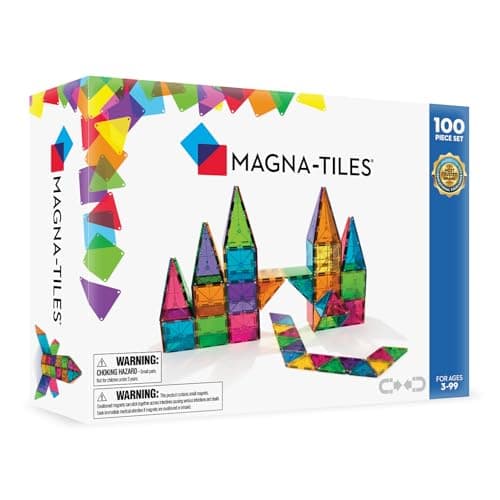
Three is when the 3+ ratings unlock and the category opens. The single best purchase is a 100-piece magnetic tile set: the magnets do the precision a three-year-old’s hands cannot, so a structure stands within the first minute, and Magna-Tiles publishes a 3-99 age range because there is no point at which it is finished.
Block & Beaker earns a commission when you buy through our links, at no cost to you. It never changes a ranking, and we say so plainly when the right answer is the cheaper set, or nothing at all. Full disclosure · How we pick.
At a glance
The picks, ranked
Tap any row to jump to the full reasoning. Prices come live from Amazon where we have them and read “check price” where we don’t — never a number we cannot stand behind today.
| # | Product | Best for | Price |
|---|---|---|---|
| 1 | Best overall MAGNA-TILES Classic 100-Piece Set The magnets do the fine motor work, so a three-year-old gets a standing structure without an adult. | The one purchase that is still in use at eight | |
| 2 | 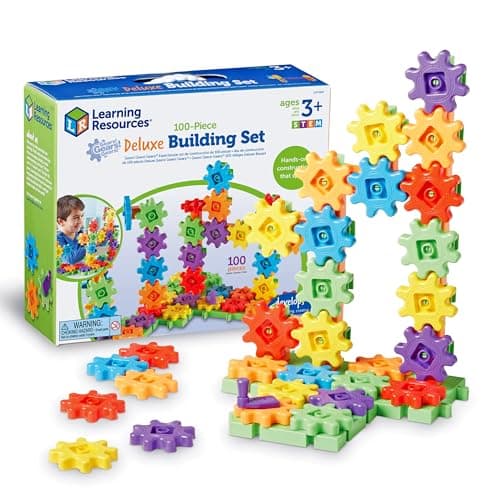 Best cause and effect Gears! Gears! Gears! 100-Piece Deluxe Building Set Turn one handle and forty-six gears move, including the ones nobody touched. | A child who asks why things happen | |
| 3 | 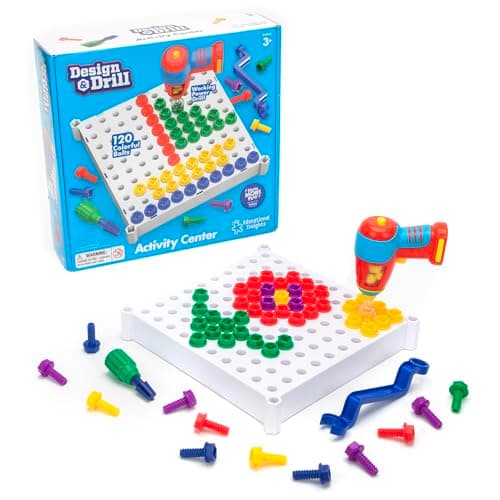 Best real tool Design & Drill Activity Center A working drill sized for three-year-old hands, in a 146-piece set with pattern cards. | A child who is fascinated by whatever an adult is doing | |
| 4 | Best for pretend play CONNETIX Rainbow Creative Pack, 100 Pieces Windows, doors and fences, so what gets built is a place rather than a shape. | A three-year-old who narrates while they build | |
| — |  The one to skip this year Code & Go Robot Mouse Activity Set A genuinely good first coding toy, rated 4+, and a year early at three. | Four, not three |
5 picks, including 1 we tell you to skip. Ages shown are the manufacturer’s own rating, not ours.
What changes at three
Three is the year the toy shop opens. Most STEM toys are rated 3+ because of small-parts testing, so the constraint that dominated at two simply lifts.
Developmentally, three brings two things that matter here. Pretend play arrives properly, which means a structure can be a house rather than a shape — and that is what makes a build worth keeping. And a three-year-old can hold a simple goal across a few minutes, which is what makes a construction toy a project rather than a sequence of unrelated actions.
What is still absent: fine motor precision, reading, and any ability to plan more than a step or two ahead. Anything requiring alignment, instructions or sequencing belongs at four or five.
Why magnetic tiles are the answer at this specific age
The arithmetic
Why the magnets matter at three
| Force needed to join two magnetic tiles | Effectively none — they attract |
|---|---|
| Alignment accuracy needed | About a centimeter |
| Force and alignment needed for interlocking bricks | Both precise |
| Magna-Tiles stated age | 3-99 years |
| LEGO Classic stated age | 4+ |
The practical consequence is that a three-year-old with tiles builds independently, and a three-year-old with bricks asks for help. Which of those happens determines whether the toy gets picked up again tomorrow.
How many tiles
A hundred, not sixty. Arithmetic on the published tile sizes: a simple four-wall enclosure uses 16 to 20 tiles, a roof adds 8 to 12, and a second story adds 20 or so. That is around 55 for a two-story building with a roof — which leaves nothing from a 60-piece set and plenty from a 100-piece one.
Running out mid-build is the most common reason a construction set is abandoned in week two, and it is entirely avoidable at purchase.
Worth knowing before you buy
The 3+ ratings on this page are small-parts safety floors that have now been cleared, but two things still apply.
If there is a younger sibling in the house, everything here is a hazard to them regardless of the older child’s age. A tile set that lives on a table rather than the floor solves most of it.
On magnets specifically: the risk is two or more loose magnets, which can attract through tissue. Brands that publish their retention method — Magna-Tiles states a lattice plus fastening rivets, Connetix states ultrasonic sealing plus riveting — are telling you something worth having. Check tiles for cracked corners periodically and retire any with an open seam.
What to buy
- One purchase: 100 magnetic tiles. Nothing else in this category has the same span.
- They narrate while building: Connetix, for the doors and windows.
- They ask how things work: Gears.
- They copy adults using tools: Design & Drill.
Next year, coding toys become available — the four-year-old page covers that step. For the full construction category, see magnetic tiles, and for science at this age, first science kits.
In full
Every pick, and what is wrong with it
Published specifications only, each linked back to the page it came from. Where a manufacturer publishes nothing, the row says so — we do not fill blanks in.
1. Best overall
MAGNA-TILES Classic 100-Piece Set
Magna-Tiles · 4300 · maker rates it 3-99 years
The magnets do the fine motor work, so a three-year-old gets a standing structure without an adult.
- Pieces
- 100
- Shape mix
- 50 squares, 4 large squares, 20 equilateral triangles, 11 right triangles, 15 isosceles triangles
- Stated age
- “3-99 Years”
- Material
- “Food-grade, non-toxic MABS plastic that are free from BPAs, phthalates, and latex”
Magna-Tiles publishes the full shape mix — 50 squares, 4 large squares, 20 equilateral, 11 right and 15 isosceles triangles — rated 3 to 99 years, with all pieces compatible with all other Magna-Tiles sets.
The reason this works at exactly three is mechanical. Every other construction toy asks a child to hold one piece steady while pushing another into it, which needs precision a three-year-old does not have. A magnetic tile snaps into place from about a centimeter away.
The three triangle types matter more than they look. They are what let a child put a roof on something rather than only building walls, and a building with a roof is a building rather than a shape.
Replay signal
- Open-ended or one-shot
- Open-ended — there is no finished state to reach
- Does anything run out
- Nothing runs out
- Room to grow
- Every set combines with every other Magna-Tiles set
Why we say so: Magna-Tiles publishes the full 100-piece shape breakdown, lists no consumable parts, and states that “all pieces are compatible with and complementary to all other MAGNA-TILES sets.”
What’s wrong with it
The most expensive per tile of any brand, and the Classic set has no windows or doors — squares and triangles only.
| Pieces | 100 |
|---|---|
| Shape mix | 50 squares, 4 large squares, 20 equilateral triangles, 11 right triangles, 15 isosceles triangles |
| Stated age | “3-99 Years” |
| Material | “Food-grade, non-toxic MABS plastic that are free from BPAs, phthalates, and latex” |
| Magnet retention | Signature lattice plus “fastening rivets keep magnets safe and secure” |
| Consumables | None |
Every figure above is from Magna-Tiles, Classic 100-Piece Set. Blanks are shown as “not published” rather than filled in.
2. Best cause and effect
Gears! Gears! Gears! 100-Piece Deluxe Building Set
Learning Resources · LER9162 · maker rates it 3+
Turn one handle and forty-six gears move, including the ones nobody touched.
- Pieces
- 100
- Contents
- 46 gears, 26 square pillars, 21 six-way axles, 6 interlocking bases, 1 crank handle, activity guide
- Stated age
- 3+
- Batteries
- None — hand-cranked
Learning Resources publishes 46 gears, 26 square pillars, 21 six-way axles, 6 interlocking bases, a crank handle and an activity guide, rated 3+, with no batteries at all.
This is a three-year-old’s first mechanism. They build something, turn a handle, and every part of it responds — including parts on the far side of the board. Watching a child work out that the movement travels is genuinely worth the price.
The interlocking bases mean a second set doubles the machine rather than producing a separate one, which makes this a good candidate for a future birthday too.
Replay signal
- Open-ended or one-shot
- Open-ended, with immediate cause and effect: turn the handle, the whole thing moves
- Does anything run out
- Nothing runs out
- Room to grow
- Sets from the same line interlock, so a second box doubles the machine
Why we say so: Learning Resources publishes the full 100-piece contents list, the ages 3+ rating and the hand crank. No batteries appear in the published contents, which is why this one still works when everything else in the toy box is flat.
What’s wrong with it
The core idea is grasped fast. After a child understands that gears drive gears, the rest is arrangement.
| Pieces | 100 |
|---|---|
| Contents | 46 gears, 26 square pillars, 21 six-way axles, 6 interlocking bases, 1 crank handle, activity guide |
| Stated age | 3+ |
| Batteries | None — hand-cranked |
| Consumables | None |
Every figure above is from Learning Resources, Gears! Gears! Gears! Deluxe Building Set. Blanks are shown as “not published” rather than filled in.
3. Best real tool
Design & Drill Activity Center
Educational Insights · EI-4112 · maker rates it 3+
A working drill sized for three-year-old hands, in a 146-piece set with pattern cards.
- Pieces
- 146
- Contents
- Kid-friendly power drill, activity board, colored bolts, design and activity cards
- Stated age
- Ages 3+
- Batteries
- Required for the drill (not included)
Educational Insights publishes 146 pieces: a kid-friendly power drill, an activity board, colored bolts and design and activity cards, rated 3+.
The drill actually spins, and that is the entire product. A three-year-old handed a tool that works behaves differently from one handed a representation of a tool, and the concentration this produces is the reason it earns its place.
The pattern cards provide structure first — match the card, place the bolts — and the board can be filled freely afterward.
Replay signal
- Open-ended or one-shot
- Both: the activity cards give a ladder, and the board can be filled freely once they are done
- Does anything run out
- Nothing runs out
- Room to grow
- Little beyond about five — this is squarely a preschool toy
- Adult required
- For the first go, then not. The drill is designed for a three-year-old to hold
Why we say so: Educational Insights publishes the 146-piece contents including the child-sized drill and pattern cards. A real trigger-operated tool at a 3+ rating is unusual, and it is the whole appeal: the child is using a tool rather than a representation of one.
What’s wrong with it
A short runway — most children are finished with it around five — and the drill needs batteries not included.
| Pieces | 146 |
|---|---|
| Contents | Kid-friendly power drill, activity board, colored bolts, design and activity cards |
| Stated age | Ages 3+ |
| Batteries | Required for the drill (not included) |
| Consumables | None |
Every figure above is from Educational Insights, Design & Drill Activity Center. Blanks are shown as “not published” rather than filled in.
4. Best for pretend play
CONNETIX Rainbow Creative Pack, 100 Pieces
Connetix · Rainbow Creative Pack 100 pc · maker rates it 3+
Windows, doors and fences, so what gets built is a place rather than a shape.
- Pieces
- 100
- Stated age
- “Recommended for builders aged 3+”
- Material
- “non-toxic, BPA and phthalate-free ABS plastic”
- Construction
- “ultrasonically sealed and riveted for extra safety”
Connetix publishes a 100-piece Rainbow Creative Pack recommended for builders aged 3+, in non-toxic BPA and phthalate-free ABS, ultrasonically sealed and riveted, including window and door pieces, fences and a travel bag.
At three, pretend play and construction are the same activity. A door means a house, a house means someone lives there, and a building with a resident survives the afternoon instead of being knocked down.
The fences do something specific that nothing else here does: they enclose an area without walling it, which is what a farm or a zoo needs.
Replay signal
- Open-ended or one-shot
- Open-ended, and the window, door and fence pieces push play toward buildings rather than abstract towers
- Does anything run out
- Nothing runs out
- Room to grow
- Connetix publishes ball-run and expansion packs that attach to the same tiles
Why we say so: Connetix publishes the age rating, the material and the ultrasonic-seal-plus-rivet construction, and sells ball-run packs built for the same tiles.
What’s wrong with it
No published shape breakdown, so the square-to-triangle ratio is unknown until the box is open.
| Pieces | 100 |
|---|---|
| Stated age | “Recommended for builders aged 3+” |
| Material | “non-toxic, BPA and phthalate-free ABS plastic” |
| Construction | “ultrasonically sealed and riveted for extra safety” |
| Includes | Window and door pieces, fences, and a travel bag |
| Consumables | None |
Every figure above is from Connetix, Rainbow Creative Pack 100 pc. Blanks are shown as “not published” rather than filled in.
Skip this one
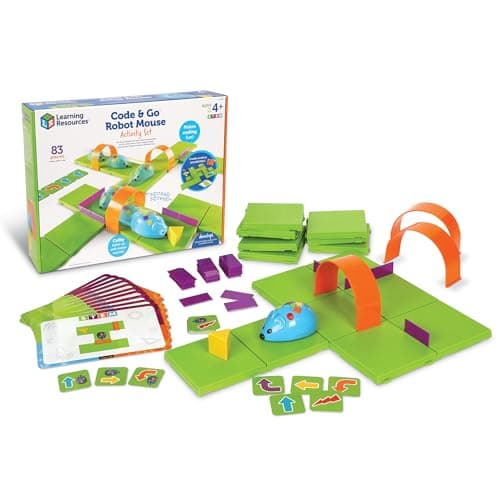
Code & Go Robot Mouse Activity Set
Learning Resources · LER2831 · maker rates it 4+
A genuinely good first coding toy, rated 4+, and a year early at three.
- Set size
- 83 pieces
- Contents
- Colby the robot mouse, 16 maze grids, 22 maze walls, 3 tunnels, 30 double-sided coding cards, 10 activity cards, cheese wedge, activity guide
- Maze size
- The 16 grids build a 20″ x 20″ board
- Screen required
- None
Learning Resources publishes an 83-piece set with 16 maze grids building a 20-inch board, 22 walls, 3 tunnels, 30 double-sided coding cards and 10 activity cards, rated 4+.
We recommend this warmly on the four-year-old page. At three, the published rating is honest: the toy asks a child to plan a route, translate it into a sequence of symbols, and then wait to see if the plan was right. That is a substantial cognitive step and it arrives at around four.
Bought at three, it usually becomes a mouse that gets driven around manually — enjoyable, and not what it was bought for.
Replay signal
- Open-ended or one-shot
- The mouse is fixed, but the maze is not — 16 grids and 22 walls is a new problem every time
- Does anything run out
- Nothing runs out
- Room to grow
- The 10 activity cards are a starting ladder; after that the child sets the puzzles
- Adult required
- Reading is not required — the coding cards use directional symbols, so a four-year-old can work alone
Why we say so: Learning Resources publishes the 83-piece contents including 16 rearrangeable grids and 22 walls, and states the cards are picture-based. A rearrangeable maze is why this does not become a solved puzzle after one weekend.
What’s wrong with it
Rated 4+, and the gap is real: sequencing six symbol cards requires holding a plan in mind that most three-year-olds cannot.
| Set size | 83 pieces |
|---|---|
| Contents | Colby the robot mouse, 16 maze grids, 22 maze walls, 3 tunnels, 30 double-sided coding cards, 10 activity cards, cheese wedge, activity guide |
| Maze size | The 16 grids build a 20″ x 20″ board |
| Screen required | None |
| Batteries | 3 x AAA (not included) |
| Stated age | Ages 4+ |
Every figure above is from Learning Resources, Code & Go Robot Mouse Activity Set. Blanks are shown as “not published” rather than filled in.
We are not putting a buy button on this one. It is easy enough to find if you want it anyway — but we would rather send you to something that gets played with twice.
Questions people actually ask
Frequently asked
What is the best STEM toy for a 3-year-old?
A 100-piece magnetic tile set. Magna-Tiles publishes a 3-99 age range, and the reason it works at exactly three is mechanical: the magnets supply the precision a three-year-old's hands cannot, so a structure stands within the first minute without an adult.
How many magnetic tiles does a 3-year-old need?
A hundred. A two-story building with a roof uses around 55 tiles by arithmetic on the published sizes, which leaves nothing from a 60-piece set. Running out mid-build is the most common reason a construction set gets abandoned early.
Can a 3-year-old use a coding toy?
Mostly not yet. Learning Resources rates the Code & Go Robot Mouse 4+, and the gap is real — sequencing symbol cards requires planning a route and holding it in mind, which arrives at around four. Bought at three it usually becomes a mouse that is pushed around by hand.
Why do so many STEM toys start at 3?
Small-parts safety testing. A 3+ rating usually means the pieces have not passed testing for children who still mouth objects, rather than that the toy is too difficult. That is why the category expands so sharply at three.
Sources
Where these figures came from
Every specification on this page traces to one of these. If a manufacturer publishes nothing on a point, the page says so rather than filling the gap.
Read next
Where to go from here
Back to Shop by Age, or read how we pick.