The picks
Chemistry Subscription Boxes
Only one subscription on this site is actually chemistry. The others are general STEM crates, and a boxed set is often the better buy anyway.
By Sawyer V. · Published
The short answer
MEL Science publishes MEL Chemistry at 10+, with 2-3 experiments per set, a new kit by the 23rd of each month, and a home lab in the first shipment. It is the only chemistry-specific subscription here. Thames & Kosmos publishes 28 experiments in the C500 for a single purchase — do that arithmetic first.
Block & Beaker earns a commission when you buy through our links, at no cost to you. It never changes a ranking, and we say so plainly when the right answer is the cheaper set, or nothing at all. Full disclosure · How we pick.

At a glance
The picks, ranked
Tap any row to jump to the full reasoning. Prices come live from Amazon where we have them and read “check price” where we don’t — never a number we cannot stand behind today.
| # | Product | Best for | Price |
|---|---|---|---|
| 1 | The only chemistry subscription MEL Chemistry monthly subscription 2-3 experiments a month, a new kit by the 23rd, and a reusable home lab in the first box. | Ten and up, where the ritual is the point | |
| 2 | 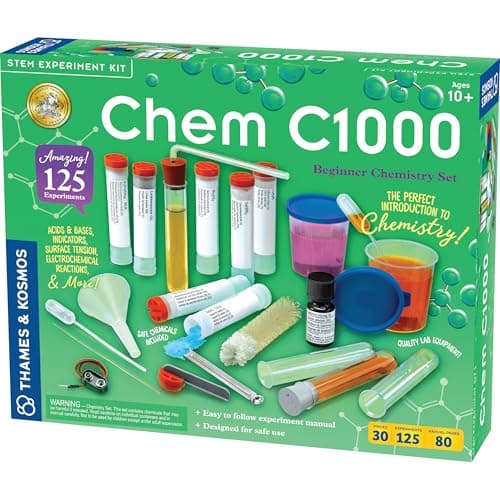 Better value bought once Thames & Kosmos CHEM C1000 Seven chemicals, a full manual published free on the maker's own site, and stated EN 71-4 compliance. | Ten and up, for depth in one box | |
| 3 | 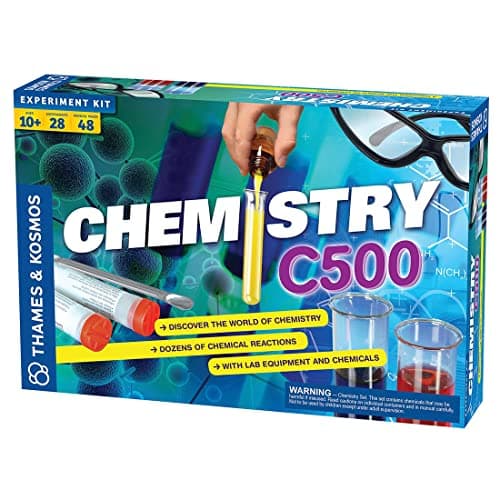 The smaller one-off Thames & Kosmos Chemistry C500 28 experiments and a 48-page manual from five chemicals, bought once. | Ten and up, as a first chemistry set | |
| 4 | The closest general subscription Tinker Crate monthly subscription One hands-on project a month, stepping up to Eureka Crate at 12+. | Ages 9-12, for engineering rather than chemistry | |
| — | Not chemistry, and rated younger Kiwi Crate monthly subscription A general STEAM crate that turns up in chemistry searches. | Ages 6-9 |
5 picks, including 1 we tell you to skip. Ages shown are the manufacturer’s own rating, not ours.
The arithmetic nobody does
The arithmetic
Experiments per year, as published
| MEL Chemistry | 2-3 per set, one set a month — roughly 24-36 a year |
|---|---|
| Thames & Kosmos C500 | 28 experiments, bought once |
| Thames & Kosmos CHEM C1000 | Seven chemicals, full manual free online |
| Tinker Crate | One project a month — 12 a year, engineering |
| Kiwi Crate | One project a month — 12 a year, ages 6-9 |
What a subscription actually buys
A schedule. A kit that arrives every month creates an occasion. For a household where good intentions stall, that is worth real money.
Equipment that carries forward. MEL publishes a home lab in the first shipment, so later months are reagents rather than another flask.
Someone else’s curriculum. You are not choosing what comes next, which is a relief or a limitation depending on the child.
What it does not buy
More chemistry per dollar than a boxed set, necessarily; and not a manual you can read before you buy. Thames & Kosmos publishes the CHEM C1000 manual free on its own site, which is the single most useful thing any maker in this category does.
Worth knowing before you buy
Every product here is published at 10+ except the KiwiCo crates. MEL’s first shipment includes a solid fuel stove, and Thames & Kosmos states EN 71-4 compliance for its chemistry kits — real reagents mean an adult in the room at the lower end of that range, and reagents stored out of reach.
What arrives, month by month
MEL Chemistry. MEL Science publishes 2-3 experiments per set and a new kit by the 23rd of each month, rated 10+. The first shipment includes a home lab — a flask, a solid fuel stove, safety glasses and beakers — so the equipment arrives once and the reagents arrive monthly.
Tinker Crate. KiwiCo publishes ages 9-12, one project per month, on monthly, 3-month, 6-month or 12-month plans, described as learning how things work and creating new inventions. Each crate is published as built once.
Kiwi Crate. KiwiCo publishes ages 6-9 and “a brand-new project delivered to their door each month”, described as hands-on STEAM, on the same plan lengths. Neither KiwiCo line is chemistry-specific.
So the field is smaller than the search results suggest: one chemistry subscription with a published chemistry syllabus, and two general STEM crates that are often sold into the same search.
What you still own when you stop paying
This is the question the marketing never answers. With MEL, the published home lab — flask, stove, glasses, beakers — stays; the reagents do not, because they are used up as they arrive.
With the KiwiCo crates, the published position is plainer still: each crate is built once. What remains is whatever the child made, which is sometimes a keeper and sometimes cardboard.
A boxed set inverts that. Thames & Kosmos publishes the C500 as 28 experiments, a 48-page manual and five chemicals with safety glasses, test tubes, dropper pipettes and a measuring spoon; the C1000 publishes seven chemicals, EN 71-4 compliance and a full manual free on the maker’s own site. The glassware is yours, the manual is yours, and nothing stops arriving when a card expires.
The age floor is the same either way
Chemistry does not get easier because it arrives monthly. MEL Science publishes 10+, Thames & Kosmos publishes 10 and up for both the C500 and the C1000, and the reason is the same in all three cases: real reagents, and in MEL’s case a solid fuel stove in the first shipment.
Below that line the honest options are not chemistry subscriptions at all. KiwiCo publishes Kiwi Crate at 6-9 and Tinker Crate at 9-12, and National Geographic publishes its Mega Science Lab at 8+ with 45 experiments in the kit plus a bonus guide of 85+ household experiments.
One more thing worth saying plainly: none of these makers publish how much of a month’s kit is preparation and how much is the experiment itself. We are not going to estimate it, and neither should a review that has not subscribed.
So which one
The ritual is the problem you are solving: MEL Chemistry.
You want to read the manual first: CHEM C1000.
First chemistry set, bought once: Chemistry C500.
Say the unwelcome thing
Do not buy a chemistry subscription for a child under ten
Every chemistry product here publishes 10+. Below that, the honest options are the no-chemicals kits — Thames & Kosmos publishes Kids First Science Laboratory with 24 reusable tools and no chemicals at 3 to 6+ — rather than a reagent box rated for an older child.
Where to go next
STEM subscription boxes covers the whole subscription field, science kits vs subscription boxes does the annual math, and chemistry sets for kids covers the boxed sets in full.
In full
Every pick, and what is wrong with it
Published specifications only, each linked back to the page it came from. Where a manufacturer publishes nothing, the row says so — we do not fill blanks in.
1. The only chemistry subscription
MEL Chemistry monthly subscription
MEL Science · MEL Chemistry · maker rates it 10+
2-3 experiments a month, a new kit by the 23rd, and a reusable home lab in the first box.
- Stated age
- 10+
- Experiments per set
- 2-3
- Cadence
- A new kit by the 23rd of each month
- First shipment
- Includes a home lab — flask, solid fuel stove, safety glasses, beakers
MEL Science publishes a stated age of 10+, 2-3 experiments per set, a new kit by the 23rd of each month, and a first shipment that includes a home lab — a flask, a solid fuel stove, safety glasses and beakers. Its site currently describes monthly kits and a starter kit shipped with the first order.
The equipment surviving month to month is what makes this work: later boxes arrive as refills rather than as another set of the same glassware.
Two or three experiments a month is a small number, and it is the honest figure. What you are buying is a scheduled hour, not volume.
Replay signal
- Open-ended or one-shot
- Guided experiments, not open-ended play
- Does anything run out
- Each month's reagents run out; the equipment from the first shipment does not
- Room to grow
- The reusable home lab means later months arrive as refills rather than restarts
- Adult required
- A solid fuel stove and real reagents at a 10+ rating means an adult in the room
Why we say so: MEL Science publishes the 2-3 experiments per set, the monthly cadence, the 10+ rating and the contents of the first shipment's home lab.
What’s wrong with it
Reagents are used up every month, and a solid fuel stove needs an adult.
| Stated age | 10+ |
|---|---|
| Experiments per set | 2-3 |
| Cadence | A new kit by the 23rd of each month |
| First shipment | Includes a home lab — flask, solid fuel stove, safety glasses, beakers |
| Consumables | Yes — reagents are used up each month |
Every figure above is from MEL Science, chemistry subscription. Blanks are shown as “not published” rather than filled in.
2. Better value bought once
Thames & Kosmos CHEM C1000
Thames & Kosmos · 640118 · maker rates it 10+
Seven chemicals, a full manual published free on the maker's own site, and stated EN 71-4 compliance.
- Chemicals included
- Seven, in cylindrical vials
- Manual
- Full experiment manual published free on the manufacturer's own site
- Safety standard
- “EN 71-4, in which the safety requirements for chemistry experimental kits are established”
- Covers
- Lab setup and safe handling, indicators and litmus, invisible ink, gas reactions
Thames & Kosmos publishes seven chemicals in cylindrical vials, a full experiment manual free on its own site, compliance with “EN 71-4, in which the safety requirements for chemistry experimental kits are established”, and coverage including lab setup and safe handling, indicators and litmus, invisible ink and gas reactions, rated 10 and up.
The free manual is the reason to start here: you can read exactly what a child will be doing before spending anything, which no subscription lets you do.
Replay signal
- Open-ended or one-shot
- Guided rather than open-ended, but the manual is a term's worth of weekends
- Does anything run out
- Yes — seven finite chemicals, with replacements sold separately
- Room to grow
- The C-series continues into C2000 and C3000, carrying the same equipment forward
- Adult required
- Real chemicals at a 10+ rating: a sit-with-them kit at the lower end of that range
Why we say so: Thames & Kosmos publishes the full manual free on its own site — you can read exactly what your child will be doing before spending anything — and states compliance with EN 71-4, the European chemistry-kit safety standard.
What’s wrong with it
The seven chemicals are used up, with replacements sold separately.
| Chemicals included | Seven, in cylindrical vials |
|---|---|
| Manual | Full experiment manual published free on the manufacturer's own site |
| Safety standard | “EN 71-4, in which the safety requirements for chemistry experimental kits are established” |
| Covers | Lab setup and safe handling, indicators and litmus, invisible ink, gas reactions |
| Stated age | 10 and up |
| Consumables | Yes — the seven chemicals are used up |
Every figure above is from Thames & Kosmos, experiment manuals. Blanks are shown as “not published” rather than filled in.
3. The smaller one-off
Thames & Kosmos Chemistry C500
Thames & Kosmos · 665012 · maker rates it 10+
28 experiments and a 48-page manual from five chemicals, bought once.
- Experiments
- 28
- Manual
- 48 pages
- Chemicals included
- 5
- Equipment
- Safety glasses, test tubes, dropper pipettes, double-headed measuring spoon
Thames & Kosmos publishes 28 experiments, a 48-page manual, five chemicals, safety glasses, test tubes, dropper pipettes and a double-headed measuring spoon, rated 10 years and up, with one 9V battery required and not included.
Twenty-eight experiments in one box against two or three a month is the comparison that matters. A year of subscription is roughly 24 to 36 experiments — and the C500 does not stop arriving if a card expires.
Replay signal
- Open-ended or one-shot
- Guided, not open-ended: 28 experiments, then the manual is finished
- Does anything run out
- Yes — the chemicals are consumed, and Thames & Kosmos sells replacements
- Room to grow
- Steps up to the larger C1000, C2000 and C3000 sets in the same line
- Adult required
- The maker rates it 10+ and it involves real chemicals
Why we say so: Thames & Kosmos publishes 28 experiments, a 48-page manual and five chemicals. Five finite chemicals across 28 experiments is arithmetic, not opinion — this set has an end, and it is better to know that before Boxing Day than after.
What’s wrong with it
Five finite chemicals: this set has an end, and it is printed in the manual.
| Experiments | 28 |
|---|---|
| Manual | 48 pages |
| Chemicals included | 5 |
| Equipment | Safety glasses, test tubes, dropper pipettes, double-headed measuring spoon |
| Stated age | 10 years and up |
| Batteries | 1 x 9V (not included) |
| Consumables | Yes — the five chemicals are used up |
Every figure above is from Thames & Kosmos, Chemistry C500. Blanks are shown as “not published” rather than filled in.
4. The closest general subscription
Tinker Crate monthly subscription
KiwiCo · Tinker Crate · maker rates it 9-12
One hands-on project a month, stepping up to Eureka Crate at 12+.
- Stated age
- Ages 9-12
- Subject
- “learn how things work and create new inventions” through monthly hands-on STEM kits
- Cadence
- One project per month
- Plans
- Monthly, 3-month, 6-month or 12-month
KiwiCo publishes Tinker Crate for ages 9-12 as one project per month — “learn how things work and create new inventions” — on monthly, 3-month, 6-month or 12-month plans, stepping up into Eureka Crate at 12+.
If the child said “science kit” and meant building things, this is the better subscription. If they said chemistry and meant chemistry, it is not.
Replay signal
- Open-ended or one-shot
- One-shot per crate, and the builds are more machine than craft at this age band
- Does anything run out
- Yes, monthly by design
- Room to grow
- Steps up into Eureka Crate at 12+
Why we say so: KiwiCo publishes the 9-12 age band, the monthly engineering-project format, and the step up to Eureka Crate at 12+.
What’s wrong with it
Engineering builds, not chemistry — no reagents at all.
| Stated age | Ages 9-12 |
|---|---|
| Subject | “learn how things work and create new inventions” through monthly hands-on STEM kits |
| Cadence | One project per month |
| Plans | Monthly, 3-month, 6-month or 12-month |
| Consumables | Yes — each crate is built once |
Every figure above is from KiwiCo, Tinker Crate. Blanks are shown as “not published” rather than filled in.
Skip this one
Kiwi Crate monthly subscription
KiwiCo · Kiwi Crate · maker rates it 6-9
A general STEAM crate that turns up in chemistry searches.
- Stated age
- Ages 6-9
- Cadence
- “a brand-new project delivered to their door each month”
- Plans
- Monthly, 3-month, 6-month or 12-month
- Subject
- “hands-on STEAM”
KiwiCo publishes Kiwi Crate for ages 6-9 as “a brand-new project delivered to their door each month”, described as “hands-on STEAM”, on monthly to 12-month plans.
It is a good subscription for a seven-year-old. It is on this page because it is what many chemistry searches land on, and the published age band alone rules it out for the ten-year-old who asked for chemicals.
Replay signal
- Open-ended or one-shot
- Each crate is a one-shot build; the subscription is what creates the repeat
- Does anything run out
- Every crate runs out. That is the model, not a flaw — you are buying twelve projects, not one toy
- Room to grow
- KiwiCo publishes a ladder by age: Kiwi 6-9, Tinker 9-12, Eureka 12+
Why we say so: KiwiCo publishes the age bands and the one-project-per-month cadence. A subscription's replay value is structural — it arrives again next month — which is a different thing from a toy that keeps getting picked up, and the two should not be compared as if they were the same.
What’s wrong with it
Published for 6-9, with no chemistry-specific content.
| Stated age | Ages 6-9 |
|---|---|
| Cadence | “a brand-new project delivered to their door each month” |
| Plans | Monthly, 3-month, 6-month or 12-month |
| Subject | “hands-on STEAM” |
| Consumables | Yes — each crate is built once |
Every figure above is from KiwiCo, monthly crates by age. Blanks are shown as “not published” rather than filled in.
We are not putting a buy button on this one. It is easy enough to find if you want it anyway — but we would rather send you to something that gets played with twice.
Questions people actually ask
Frequently asked
What is the best chemistry subscription box?
MEL Chemistry is the only chemistry-specific subscription we cover. MEL Science publishes 2-3 experiments per set, a new kit by the 23rd of each month, a 10+ rating, and a home lab — flask, solid fuel stove, safety glasses and beakers — in the first shipment.
Is a chemistry subscription better than buying a chemistry set?
It depends on whether the schedule is what you need. MEL publishes 2-3 experiments a month; Thames & Kosmos publishes 28 experiments in the C500 for a single purchase, plus the full C1000 manual free online so you can read it before buying. Science kits vs subscription boxes.
What age are chemistry subscriptions for?
MEL Chemistry publishes 10+, and Thames & Kosmos publishes its C-series at 10 and up. KiwiCo's crates are younger and are not chemistry: Kiwi Crate is published for ages 6-9 and Tinker Crate for 9-12.
Are there chemistry kits for younger children?
Not with real reagents. Thames & Kosmos publishes Kids First Science Laboratory at 3 to 6+ with 24 reusable tools and no chemicals, using household materials instead. First science kits for ages 3 to 6.
When does MEL Chemistry ship each month?
MEL Science publishes a new kit by the 23rd of each month, with 2-3 experiments per set. The first shipment also includes the home lab: a flask, a solid fuel stove, safety glasses and beakers.
Is Tinker Crate a chemistry subscription?
No. KiwiCo publishes Tinker Crate for ages 9-12 as one hands-on STEM project per month on monthly, 3, 6 or 12-month plans - engineering and mechanisms rather than a published chemistry syllabus. Kiwi Crate, at ages 6-9, is general STEAM.
How long do you have to commit to a subscription?
KiwiCo publishes monthly, 3-month, 6-month and 12-month plans for both Tinker Crate and Kiwi Crate. MEL Science publishes a monthly cadence with a new kit by the 23rd. Check current terms with the seller before ordering - we do not publish prices or plan pricing here.
Sources
Where these figures came from
Every specification on this page traces to one of these. If a manufacturer publishes nothing on a point, the page says so rather than filling the gap.
Read next
Where to go from here
Back to Science Kits, or read how we pick.