The picks
Microscopes for Teens
A teenager wants a microscope that looks serious and resolves real specimens. Two published numbers decide that, and the biggest one is not either of them.
By Sawyer V. · Published
The short answer
For a teenager, buy optical glass, a metal frame and a usable middle range rather than the top number. AmScope publishes six magnifications from 120x to 1200x on a metal arm; My First Lab publishes 40x, 100x and 400x from real glass optics with dual LED lighting, rated 9 and older.
Block & Beaker earns a commission when you buy through our links, at no cost to you. It never changes a ranking, and we say so plainly when the right answer is the cheaper set, or nothing at all. Full disclosure · How we pick.
At a glance
The picks, ranked
Tap any row to jump to the full reasoning. Prices come live from Amazon where we have them and read “check price” where we don’t — never a number we cannot stand behind today.
| # | Product | Best for | Price |
|---|---|---|---|
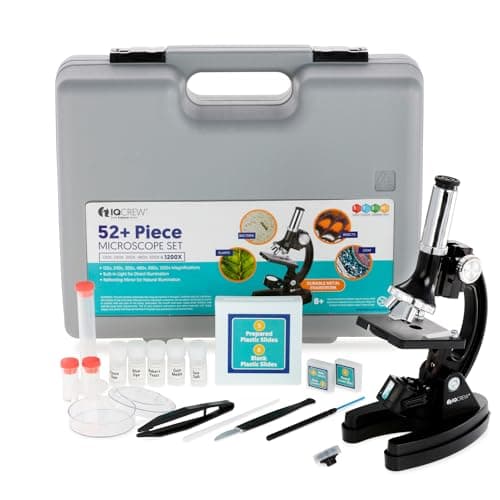
| 1 | Best for a serious student AmScope 120X-1200X Beginner Microscope Kit Six magnification levels on a metal arm, with a 52-piece accessory kit and a 70 x 65 mm stage. | Older students, with the top magnification treated as marketing | |
| 2 | Best all-rounder My First Lab Duo-Scope Microscope 40x, 100x and 400x from a 10x eyepiece with three objectives, plus lighting above and below the stage. | Nine and older | Sold direct by My First Lab → Not stocked on Amazon. This link goes to the maker and we earn nothing on it. |
| 3 | 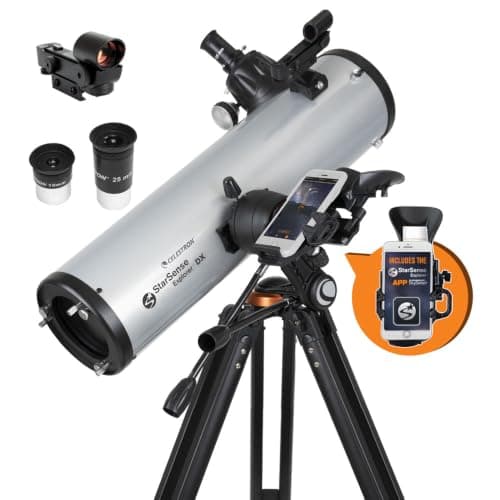 If the interest is the sky, not slides Celestron StarSense Explorer DX 130AZ 130 mm of aperture at f/5, with a smartphone app that identifies where the telescope is pointing. | Older students, outdoors | |
| — | 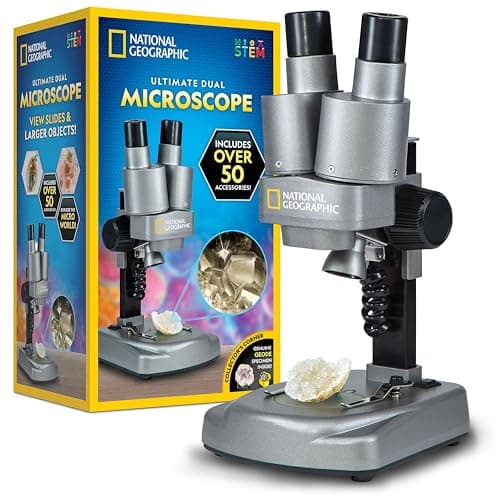 Too low-powered for this page NATIONAL GEOGRAPHIC Dual LED Student Microscope 20x and 50x with upper and lower LEDs — a superb first microscope, and not a teenager's. | Eight and up, for younger children |
4 picks, including 1 we tell you to skip. Ages shown are the manufacturer’s own rating, not ours.
The two numbers that matter, and the one that does not
Optics. Real optical glass rather than plastic. Both microscopes here publish glass.
Lighting. Light from below shows prepared slides; light from above shows objects. Dual lighting doubles what the instrument is for.
Maximum magnification is the number on the box and the least useful of the three. Beyond an objective’s resolving power, extra magnification enlarges blur.
The arithmetic
Published specifications
| AmScope 120X-1200X kit | 6 levels, 120x-1200x · metal arm · “For ages 8+” |
|---|---|
| My First Lab Duo-Scope | 40x, 100x, 400x · dual LED · 9 and older |
| Nat Geo Dual LED Student | 20x and 50x · dual LED · 8+ |
| Celestron StarSense DX 130AZ | 130 mm aperture, f/5 · app-guided · age not published |
What a teenager will actually look at
Prepared slides for a week, then whatever is around: pond water, onion skin, hair, salt, a leaf’s underside. That is why blank slides and top lighting matter more than the magnification ceiling — the supply of specimens is free and endless, and the four slides in the box are not.
Homeschool use
For homeschool study the same two specifications decide it, plus one more: whether the frame stays in focus while several people take turns. A metal arm does; a light plastic one drifts.
Worth knowing before you buy
Slides and cover slips are thin glass and break into small, sharp pieces. Prepared slide sets are fine for supervised work; for a younger sibling in the same room, keep the blanks in their box.
Weight, and where the microscope ends up living
My First Lab publishes 1.95 lb for the Duo-Scope and National Geographic publishes 2.6 lb for its dual LED scope. AmScope publishes no product weight for the 120X-1200X kit at all — only a 6 lb shipping weight for the boxed kit, which includes the hard case and the 52 accessories.
That spread decides something practical. The heaviest instrument is the steadiest and the one that stays where it is put — a desk, a shelf, a spare table. The lightest is the one a student carries to the kitchen table, uses for twenty minutes and carries back.
For a teenager with their own room and a desk, weight is an advantage. For a shared house where the microscope has to be cleared away before dinner, it is the reason a 1.95 lb instrument gets used four times as often.
Slides: what is included, and what runs out
My First Lab publishes 5 blank slides, 1 concavity slide and 4 prepared slides. AmScope publishes a 52-piece accessory kit. National Geographic publishes 50+ accessories including 10 prepared slides.
The number to read is the blank count, not the total. Prepared slides are finite and a student works through them in an evening; blank slides are what turn a microscope into an instrument the student uses on their own material.
The concavity slide in the Duo-Scope set is the quiet one. A well slide holds a drop of pond water without squashing it, which is the single most reliable way to see something alive and moving, and it is the difference between a microscope that impresses once and one that gets used all summer.
On lighting and power, AmScope publishes a built-in LED plus a reflecting mirror, so it works in daylight with no power; My First Lab publishes dual LEDs above and below the stage with 3 x AA batteries, not included; National Geographic publishes upper and lower LED lighting.
What the published age tells you here, and what it does not
One of these instruments publishes no age at all: Celestron publishes none for the StarSense Explorer DX 130AZ, calling the FirstScope instead “an ideal entry level astronomical telescope”. AmScope does publish one for the 120X-1200X kit — “For ages 8+” — which is a floor on a metal-framed instrument rather than a judgment about who it suits.
We are not going to invent numbers to fill those gaps. My First Lab publishes ages 9 and older for the Duo-Scope and National Geographic publishes 8+ for its dual LED scope, and those two figures are the only published age data on this page.
For a teenager none of it is the deciding factor anyway. The questions that matter are whether the frame holds focus, whether there are blank slides, and whether the instrument is light enough to be carried to wherever the interesting thing is.
So which one
A teenager who wants a proper instrument: the AmScope 120X-1200X kit, used between 120x and 600x.
One microscope for a mixed-age household: the My First Lab Duo-Scope.
They actually want the sky: the Celestron StarSense Explorer DX 130AZ.
Say the unwelcome thing
Do not buy on the maximum magnification
1200x on an entry-level compound scope is not 1200x of detail. If two microscopes publish the same optics and one advertises a bigger top number, the bigger number is the marketing, not the instrument.
Where to go next
Microscopes for kids covers the younger end and explains why low magnification wins there. Lab tools that never run out covers the rest of the permanent equipment.
In full
Every pick, and what is wrong with it
Published specifications only, each linked back to the page it came from. Where a manufacturer publishes nothing, the row says so — we do not fill blanks in.
1. Best for a serious student
AmScope 120X-1200X Beginner Microscope Kit
AmScope · M30-ABS-KT2 · maker rates it 8+
Six magnification levels on a metal arm, with a 52-piece accessory kit and a 70 x 65 mm stage.
- Magnifications
- Six levels — 120x, 240x, 300x, 480x, 600x and 1200x
- Frame
- Metal arm, with stage clips
- Lighting
- Built-in LED plus a reflecting mirror
- Extras
- Rotating color filter wheel; 52-piece accessory kit
AmScope publishes six levels — 120x, 240x, 300x, 480x, 600x and 1200x — a metal arm with stage clips, built-in LED plus a reflecting mirror, a rotating color filter wheel, a 52-piece accessory kit, a 70 × 65 mm stage and a shipping weight of 6 lb, published “For ages 8+”.
Buy it for the metal frame and the usable lower range. A metal arm holds focus when a plastic one flexes, and focus is what separates a microscope a teenager uses from one that frustrates them.
Treat 1200x with skepticism. Magnification past an objective’s resolving power produces a bigger blur, not more detail — the 120x to 600x range is where this instrument actually works.
Replay signal
- Open-ended or one-shot
- Open-ended — specimens are free and infinite
- Does anything run out
- The prepared slides in the accessory kit run out; blank slides do not
- Room to grow
- 1200x is well past what a child needs and past what the optics comfortably resolve, but the metal frame will outlast the interest
Why we say so: AmScope publishes six magnification levels, a metal arm and a 70 x 65 mm stage. Treat the top magnification with skepticism — at 1200x an entry-level objective delivers a large, dim, blurry image — and buy this for the metal frame and the usable lower range instead.
What’s wrong with it
At 1200x an entry-level objective gives a large, dim, blurry image — and no age is published.
| Magnifications | Six levels — 120x, 240x, 300x, 480x, 600x and 1200x |
|---|---|
| Frame | Metal arm, with stage clips |
| Lighting | Built-in LED plus a reflecting mirror |
| Extras | Rotating color filter wheel; 52-piece accessory kit |
| Stage | 70 x 65 mm |
| Shipping weight | 6 lb — AmScope publishes no product weight |
| Stated age | “For ages 8+” |
Every figure above is from AmScope, M30-ABS-KT2 microscope. Blanks are shown as “not published” rather than filled in.
2. Best all-rounder
My First Lab Duo-Scope Microscope
My First Lab · MFL-06 · maker rates it 9+
40x, 100x and 400x from a 10x eyepiece with three objectives, plus lighting above and below the stage.
- Magnifications
- 40x, 100x and 400x, from a 10x eyepiece with 4x, 10x and 40x objectives
- Optics
- Real optical glass lenses
- Lighting
- Dual LED, above and below the stage
- Slides included
- 5 blank, 1 concavity (well), 4 prepared
The maker publishes 40x, 100x and 400x from a 10x eyepiece with 4x, 10x and 40x objectives, real optical glass lenses, dual LED lighting above and below the stage, five blank slides, one concavity slide and four prepared slides, rated ages 9 and older, needing three AA batteries, at 1.95 lb.
Light from above as well as below is the specification that earns its place here: it lets a teenager look at rocks, leaves and insects, not only at purchased slides.
Blank slides matter for the same reason. Four prepared slides run out; the garden does not.
Replay signal
- Open-ended or one-shot
- Genuinely open-ended, unusually so for a science purchase — the world is the consumable
- Does anything run out
- The four prepared slides run out; the five blanks and everything in the garden do not
- Room to grow
- Light from above as well as below means it works on rocks, leaves and insects, not only on slides
Why we say so: The manufacturer publishes the dual-LED lighting, the blank-slide count and the real-glass optics. Blank slides plus top lighting is what turns a microscope from four pictures into a thing you point at whatever you found outside.
What’s wrong with it
Three AA batteries, not included, and only four prepared slides.
| Magnifications | 40x, 100x and 400x, from a 10x eyepiece with 4x, 10x and 40x objectives |
|---|---|
| Optics | Real optical glass lenses |
| Lighting | Dual LED, above and below the stage |
| Slides included | 5 blank, 1 concavity (well), 4 prepared |
| Stated age | Ages 9 and older |
| Batteries | 3 x AA (not included) |
| Weight | 1.95 lb |
Every figure above is from My First Lab, Duo-Scope MFL-06. Blanks are shown as “not published” rather than filled in.
Not stocked on Amazon. This link goes to the maker and we earn nothing on it.
3. If the interest is the sky, not slides
Celestron StarSense Explorer DX 130AZ
Celestron · 22461 · maker rates it Not published
130 mm of aperture at f/5, with a smartphone app that identifies where the telescope is pointing.
- Aperture
- 130 mm (5.1 in)
- Focal length
- 650 mm
- Focal ratio
- f/5
- Optical design
- Newtonian reflector
Celestron publishes 130 mm (5.1 in) of aperture, a 650 mm focal length, f/5, a Newtonian reflector on an altazimuth mount with slow-motion controls, and the StarSense app that identifies the sky and directs you.
Teenagers often ask for “a microscope” when what they want is to look at something impressive. If the interest is astronomy, this is the purchase — see microscope or telescope first.
Replay signal
- Open-ended or one-shot
- Open-ended — the sky is the consumable and it restocks itself
- Does anything run out
- Nothing runs out
- Room to grow
- Standard eyepieces; 130 mm gathers enough light for planets and brighter deep-sky objects
- Adult required
- Much less than a normal telescope. The published point of StarSense is that the phone does the finding
Why we say so: Celestron publishes 130 mm of aperture at 650 mm focal length, f/5, with a smartphone app that identifies where the telescope is pointing. The app is the specification that matters for a family: not finding anything is what ends most first telescope nights, and this removes that step.
What’s wrong with it
A different instrument entirely, and no age is published.
| Aperture | 130 mm (5.1 in) |
|---|---|
| Focal length | 650 mm |
| Focal ratio | f/5 |
| Optical design | Newtonian reflector |
| Finding aid | StarSense smartphone app — the phone identifies the sky and directs you |
| Mount | Altazimuth with slow-motion controls |
| Stated age | Not published |
Every figure above is from Celestron, StarSense Explorer DX 130AZ. Blanks are shown as “not published” rather than filled in.
Skip this one
NATIONAL GEOGRAPHIC Dual LED Student Microscope
National Geographic · Dual LED Student Microscope · maker rates it 8+
20x and 50x with upper and lower LEDs — a superb first microscope, and not a teenager's.
- Magnifications
- 20x and 50x, from two sets of optical glass lenses
- Lighting
- Upper and lower LED
- Accessories
- 50+ pieces, including 10 prepared slides, blank slides and covers, tweezers, eye-dropper and a mini geode
- Weight
- 2.6 lb
National Geographic publishes 20x and 50x from two sets of optical glass lenses, upper and lower LED lighting and 50+ accessories including 10 prepared slides, rated 8+, at 2.6 lb.
Low magnification with top lighting is exactly right for a nine-year-old looking at beetles. A teenager who wants cell structure will be disappointed, and this is the most common mismatch in the category.
Replay signal
- Open-ended or one-shot
- Open-ended, and the low magnification is the reason — 20x is where insects and leaves look extraordinary
- Does anything run out
- The 10 prepared slides run out; blank slides and the garden do not
- Room to grow
- Limited on magnification, generous on subject matter
Why we say so: National Geographic publishes 20x and 50x with upper and lower LED lighting. Low magnification plus top lighting is a deliberate design for looking at whole objects rather than slides, which for a child under about ten is a far better first microscope than a 1000x compound scope they cannot focus.
What’s wrong with it
Two magnifications, topping out at 50x.
| Magnifications | 20x and 50x, from two sets of optical glass lenses |
|---|---|
| Lighting | Upper and lower LED |
| Accessories | 50+ pieces, including 10 prepared slides, blank slides and covers, tweezers, eye-dropper and a mini geode |
| Weight | 2.6 lb |
| Stated age | 8+ |
Every figure above is from National Geographic toys, Dual LED Student Microscope. Blanks are shown as “not published” rather than filled in.
We are not putting a buy button on this one. It is easy enough to find if you want it anyway — but we would rather send you to something that gets played with twice.
Questions people actually ask
Frequently asked
What microscope should I buy for a teenager?
One with real glass optics, a metal frame and a usable middle range. AmScope publishes six levels from 120x to 1200x on a metal arm with a 52-piece accessory kit; My First Lab publishes 40x, 100x and 400x with dual LED lighting, rated 9 and older.
Is 1200x magnification useful?
Rarely. Magnification beyond an objective's resolving power produces a larger, dimmer, blurrier image rather than more detail. On an entry-level compound microscope the usable working range is roughly 40x to 600x.
What magnification does a teenager need?
400x covers plant and animal cells, which is what most school-level work asks for. Anything below about 50x is a nature scope for looking at whole objects rather than slides. Microscopes for kids.
Do these microscopes need batteries?
My First Lab publishes three AA batteries, not included, for its dual LED lighting. AmScope publishes a built-in LED plus a reflecting mirror, so it can be used in daylight without power. The battery guide.
How much does a student microscope weigh?
Where it is published: National Geographic publishes 2.6 lb for its dual LED scope and My First Lab publishes 1.95 lb for the Duo-Scope. AmScope publishes no product weight for the 120X-1200X kit, only a 6 lb shipping weight for the boxed kit. Heavier is steadier; lighter gets carried to the table more often.
Do student microscopes come with blank slides?
Some do, and it matters more than the total accessory count. My First Lab publishes 5 blank slides, 1 concavity (well) slide and 4 prepared slides. National Geographic publishes 50+ accessories including 10 prepared slides, and AmScope publishes a 52-piece accessory kit.
Which microscope works without power?
The AmScope. It publishes a built-in LED plus a reflecting mirror, so daylight is enough. My First Lab publishes 3 x AA batteries, not included, for its dual LEDs, and National Geographic publishes upper and lower LED lighting.
Does a teenager need 400x?
For cells, yes. My First Lab publishes 40x, 100x and 400x, which covers school biology work. National Geographic's 20x and 50x scope cannot reach cells, and AmScope's usable range runs to roughly 600x.
Sources
Where these figures came from
Every specification on this page traces to one of these. If a manufacturer publishes nothing on a point, the page says so rather than filling the gap.
Read next
Where to go from here
Back to Science Kits, or read how we pick.