Guide and picks
Toys That Actually Teach
The question worth asking is not whether a toy is good. It is whether it is still being played with in March.
By Sawyer V. · Published
The short answer
Four things predict whether a toy keeps getting picked up, and all four are checkable from published information: is it open-ended or does it have a finished state; does anything run out; is there room to grow; and does it need an adult to work at all. That last one is the most under-rated.
Block & Beaker earns a commission when you buy through our links, at no cost to you. It never changes a ranking, and we say so plainly when the right answer is the cheaper set, or nothing at all. Full disclosure · How we pick.
At a glance
The picks, ranked
Tap any row to jump to the full reasoning. Prices come live from Amazon where we have them and read “check price” where we don’t — never a number we cannot stand behind today.
| # | Product | Best for | Price |
|---|---|---|---|
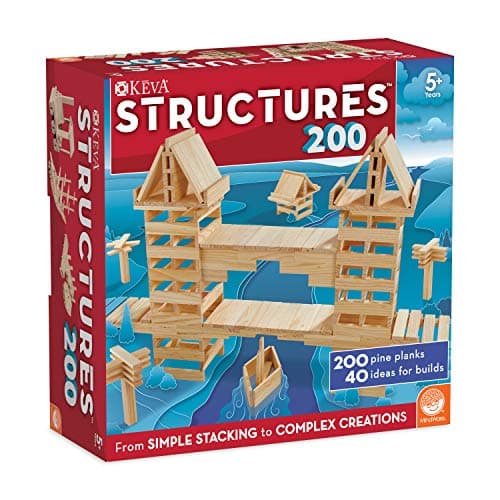
| 1 | Scores highest on all four KEVA Structures 200 Plank Set Two hundred identical planks, no connectors, no instructions, no ceiling. | Five and up, and the clearest example of the argument | |
| 2 | 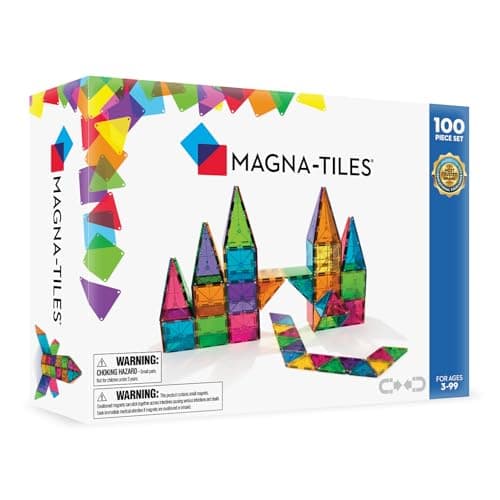 The reliable answer MAGNA-TILES Classic 100-Piece Set Published as 3 to 99 years, with nothing to use up and every set compatible with every other. | Three and up, and the safest bet in the category | |
| 3 | 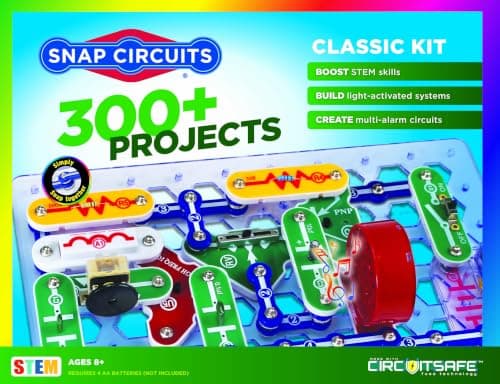 Best ladder Snap Circuits Classic Three hundred and five published projects, and enough spare parts to leave the manual behind. | Eight and up, where the published depth is the argument | |
| — | Fails one component, and it matters ThinkFun Robot Turtles A genuinely good game whose published rules require an adult every single time. | Four, in a household where an adult will reliably play |
4 picks, including 1 we tell you to skip. Ages shown are the manufacturer’s own rating, not ours.
The gap this page exists to close
Almost every toy review measures quality. Build quality, educational value, fun factor, value for money. Those are all real and none of them is the question a person buying a present actually has, which is: will this still be out of the cupboard in six weeks?
Those are different properties. A beautifully made kit that is finished in an afternoon scores well on quality and badly on the thing that matters. A box of identical wooden planks scores the reverse.
The four things to check
1. Open-ended, or a finished state? Does the toy have a correct final form? A model kit is finished when it is built. A tile set is never finished, because there is no state the box is asking for. Both are legitimate; only one keeps going.
2. Does anything run out? Read the published contents for consumables. Chemicals, geodes, crystal compound, single-use materials. This is the most checkable of the four and the most often ignored: National Geographic publishes ten geodes, and ten is a number that gets reached.
3. Room to grow? Published project counts, expansion ranges, cross-compatibility, upgrade paths. Elenco publishes 305 projects and states the manual contains the smaller set’s projects too. Makeblock publishes three programming environments on one robot. Those are ceilings a child takes years to reach.
4. Does it need an adult? The most under-rated of the four. A toy that structurally requires a grown-up gets used when a grown-up is free, which in most households is not often. Robot Turtlespublishes an adult as a required player. That is not a flaw, but it predicts use better than anything else on the box.
The arithmetic
The test, applied to five products
| KEVA Structures | Open · nothing runs out · no ceiling · no adult |
|---|---|
| Magna-Tiles Classic | Open · nothing runs out · cross-set compatible · no adult |
| Snap Circuits Classic | Guided · nothing runs out · 305 projects · no adult |
| Break Open 10 Geodes | One-shot · runs out at 10 · no ceiling to reach · adult for hammering |
| Robot Turtles | Open · nothing runs out · rules scale · adult required |
What this does not measure
Being honest about the limits: this test says nothing about whether a toy is enjoyable, well made, or right for a particular child. A toy can score four out of four and be dull.
It also under-values experiences. A geode kit scores badly and is a genuinely memorable afternoon. The right response is not to avoid those purchases but to price them correctly — against a trip out rather than against a toy — and to say so on the card.
Say the unwelcome thing
Do not confuse impressive with lasting
The most impressive box under a tree is frequently the one with the shortest life: the biggest kit, the most components, the longest list of things included.
Piece counts predict very little. Two hundred identical wooden planks outlast a 500-piece kit of specialized parts, because interchangeable pieces are a larger creative space than specialized ones.
How we use this
Every product page on this site carries a Replay Signal: these four components, answered from published information, with a mandatory “why we say so” line citing the fact underneath. Where a manufacturer publishes nothing that supports a component, we omit it rather than guessing.
That is the whole method, and it is set out in full on how we pick. If you would rather skip to the products, the age pages apply it directly.
In full
Every pick, and what is wrong with it
Published specifications only, each linked back to the page it came from. Where a manufacturer publishes nothing, the row says so — we do not fill blanks in.
1. Scores highest on all four
KEVA Structures 200 Plank Set
KEVA Planks · Structures 200 · maker rates it 5+
Two hundred identical planks, no connectors, no instructions, no ceiling.
- Planks
- 200, solid pine, precision-cut to identical dimensions
- Plank size
- About 4 1/2 in long x 3/4 in wide x 1/4 in thick
- Connectors
- None — planks stack with no glue, clips or notches
- Includes
- Idea booklet
The manufacturer publishes 200 solid pine planks precision-cut to identical dimensions, with no glue, clips or notches, plus an idea booklet, rated 5 and up.
Run the test. Open-ended: completely — every plank is interchangeable, so nothing in the box constrains the build. Runs out: nothing. Room to grow: unbounded, because difficulty comes from what the child attempts. Adult needed: no.
That is four out of four from a box of identical wooden sticks, which is the point of the whole argument. Sophistication is not what makes a toy last.
Replay signal
- Open-ended or one-shot
- As open-ended as construction gets — every plank is identical, so nothing constrains the build but balance
- Does anything run out
- Nothing runs out, and wood does not break the way plastic clips do
- Room to grow
- The same planks are used in adult-level structural challenges; there is no ceiling
Why we say so: The manufacturer publishes that the planks are precision-cut to identical dimensions and use no connectors of any kind. Identical, connector-free pieces is why this set has no upper age limit: the difficulty comes entirely from what the child attempts, not from what the box permits.
What’s wrong with it
It falls over constantly, and a child who finds that infuriating rather than interesting will not persist.
| Planks | 200, solid pine, precision-cut to identical dimensions |
|---|---|
| Plank size | About 4 1/2 in long x 3/4 in wide x 1/4 in thick |
| Connectors | None — planks stack with no glue, clips or notches |
| Includes | Idea booklet |
| Stated age | 5 and up |
| Consumables | None |
Every figure above is from KEVA Planks, Structures 200 Plank Set. Blanks are shown as “not published” rather than filled in.
2. The reliable answer
MAGNA-TILES Classic 100-Piece Set
Magna-Tiles · 4300 · maker rates it 3-99 years
Published as 3 to 99 years, with nothing to use up and every set compatible with every other.
- Pieces
- 100
- Shape mix
- 50 squares, 4 large squares, 20 equilateral triangles, 11 right triangles, 15 isosceles triangles
- Stated age
- “3-99 Years”
- Material
- “Food-grade, non-toxic MABS plastic that are free from BPAs, phthalates, and latex”
Magna-Tiles publishes the full 100-piece shape mix, an age range of 3-99 years, no consumables, and compatibility with all other Magna-Tiles sets.
A published age range spanning ninety-six years is a claim about open-endedness rather than about ninety-year-olds, and it is supported by the product: there is no finished state to reach.
The compatibility statement is the room-to-grow component. Every future purchase adds to the same collection rather than starting a new one.
Replay signal
- Open-ended or one-shot
- Open-ended — there is no finished state to reach
- Does anything run out
- Nothing runs out
- Room to grow
- Every set combines with every other Magna-Tiles set
Why we say so: Magna-Tiles publishes the full 100-piece shape breakdown, lists no consumable parts, and states that “all pieces are compatible with and complementary to all other MAGNA-TILES sets.”
What’s wrong with it
Structures stay relatively simple for years — an eight-year-old's tile castle looks much like a five-year-old's.
| Pieces | 100 |
|---|---|
| Shape mix | 50 squares, 4 large squares, 20 equilateral triangles, 11 right triangles, 15 isosceles triangles |
| Stated age | “3-99 Years” |
| Material | “Food-grade, non-toxic MABS plastic that are free from BPAs, phthalates, and latex” |
| Magnet retention | Signature lattice plus “fastening rivets keep magnets safe and secure” |
| Consumables | None |
Every figure above is from Magna-Tiles, Classic 100-Piece Set. Blanks are shown as “not published” rather than filled in.
3. Best ladder
Snap Circuits Classic
Elenco · SC-300 · maker rates it 8+
Three hundred and five published projects, and enough spare parts to leave the manual behind.
- Projects
- “Build over 300 exciting projects” — manual covers projects 1-305
- Parts
- “Contains over 60 Snap-Together parts”
- Projects per part
- 5.1 — the highest ratio in the line
- Stated age
- “Ages 8+” and “Not for Children under 3 yrs.”
Elenco publishes 305 numbered projects from over 60 parts, rated 8+, with parts that require no tools and ensure correct connections.
This scores differently from the two above. It is not open-ended in the same way — there is a manual and it has a last page. But 305 is a long ladder, the parts do not run out, and sixty components is enough to build something the manual never described.
It also illustrates a real distinction: a set with a deep ladder and a set with no ceiling are both good purchases, and they are good in different ways.
Replay signal
- Open-ended or one-shot
- The sweet spot of the line — enough parts to invent with, cheap enough not to be an event
- Does anything run out
- Nothing runs out
- Room to grow
- 305 published projects is years of Sunday afternoons at one a week
Why we say so: Elenco publishes 305 numbered projects against 60+ parts. Five projects per part is the highest ratio anywhere in the Snap Circuits line, which is the arithmetic reason this is the set to buy rather than the cheap one or the big one.
What’s wrong with it
Requires four AA batteries not included, so it fails the never-needs-anything test that the wooden sets pass.
| Projects | “Build over 300 exciting projects” — manual covers projects 1-305 |
|---|---|
| Parts | “Contains over 60 Snap-Together parts” |
| Projects per part | 5.1 — the highest ratio in the line |
| Stated age | “Ages 8+” and “Not for Children under 3 yrs.” |
| Batteries | “Requires 4 ‘AA’ batteries (not included)” |
| Relationship to SC-100 | Manual includes all SC-100 projects plus 200 new ones |
Every figure above is from Elenco, Snap Circuits Classic. Blanks are shown as “not published” rather than filled in.
Skip this one
ThinkFun Robot Turtles
ThinkFun · 1900 · maker rates it 4+
A genuinely good game whose published rules require an adult every single time.
- Stated age
- Ages 4 and up
- Players
- 2-5, one of whom is an adult acting as “the computer”
- Batteries
- None
- Format
- Board game teaching programming fundamentals
ThinkFun publishes it for ages 4 and up, 2-5 players, with an adult acting as the computer executing the child’s program.
We are using this as the worked example of the fourth component rather than as a criticism. The adult-as-computer mechanic is exactly what makes the game work at four — the adult doing precisely what the cards say is the lesson.
But it means the game cannot be picked up on a wet afternoon when nobody is free, and that is the difference between a game that gets played twice and one that gets played twenty times. Worth knowing before you buy, which is why it is in our headline rather than the small print.
Replay signal
- Open-ended or one-shot
- Open-ended, because the adult builds the board — difficulty scales with the child rather than with a deck
- Does anything run out
- Nothing runs out
- Room to grow
- The published rules add function cards and obstacles as the child improves
- Adult required
- Yes, always — an adult plays the computer. That is the design, and it is the whole cost
Why we say so: ThinkFun publishes the 4+ rating and the rule that an adult executes the child's program. An adult being structurally required is the single biggest predictor of whether a toy actually gets used, so it belongs in the headline rather than the small print.
What’s wrong with it
Two to five players including an adult acting as the computer. An adult-required toy is played when an adult is free.
| Stated age | Ages 4 and up |
|---|---|
| Players | 2-5, one of whom is an adult acting as “the computer” |
| Batteries | None |
| Format | Board game teaching programming fundamentals |
| Consumables | None |
Every figure above is from ThinkFun games. Blanks are shown as “not published” rather than filled in.
We are not putting a buy button on this one. It is easy enough to find if you want it anyway — but we would rather send you to something that gets played with twice.
Questions people actually ask
Frequently asked
How can I tell if a toy will last before I buy it?
Check four things in the published contents: whether it has a finished state, whether anything runs out, whether there is a published ceiling to grow into, and whether an adult is structurally required. All four are on the box or the manufacturer's site.
Why does it matter whether a toy needs an adult?
Because an adult-required toy gets used when an adult is free, which in most households is not often. ThinkFun publishes Robot Turtles as requiring an adult to act as the computer — that mechanic makes the game work at four, and it also means it cannot be picked up on a wet afternoon.
Do piece counts predict how long a toy lasts?
Barely. Two hundred identical wooden planks outlast a 500-piece kit of specialized parts, because interchangeable pieces are a larger creative space than parts that each fit one place. Compare piece counts within a system, never across.
Are consumable kits a bad buy?
No, but they should be priced as experiences rather than toys. National Geographic publishes ten geodes; ten is a number that gets reached. Judged against an afternoon out that is good value, and judged against a construction set it is not.
Sources
Where these figures came from
Every specification on this page traces to one of these. If a manufacturer publishes nothing on a point, the page says so rather than filling the gap.
Read next
Where to go from here
Back to Guides, or read how we pick.