Guide and picks
STEM Toys for Homeschool
A homeschool buys differently from a birthday. The question is not what is exciting on Saturday — it is what still works in March, across more than one child.
By Sawyer V. · Published
The short answer
Buy instruments rather than kits. A microscope, a weather station and a set of planks are used every term and never run out; a geode kit is used once. My First Lab publishes a 40x-400x microscope with dual LED lighting at 9 and older, and 4M publishes four working weather instruments with nothing consumed.
Block & Beaker earns a commission when you buy through our links, at no cost to you. It never changes a ranking, and we say so plainly when the right answer is the cheaper set, or nothing at all. Full disclosure · How we pick.

At a glance
The picks, ranked
Tap any row to jump to the full reasoning. Prices come live from Amazon where we have them and read “check price” where we don’t — never a number we cannot stand behind today.
| # | Product | Best for | Price |
|---|---|---|---|
| 1 | Best single purchase My First Lab Duo-Scope Microscope 40x, 100x and 400x from real glass optics, with lighting above and below the stage. | Nine and older, and every year after | Sold direct by My First Lab → Not stocked on Amazon. This link goes to the maker and we earn nothing on it. |
| 2 | 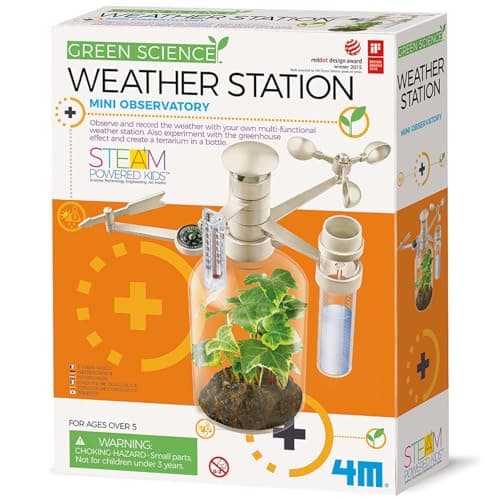 Best for daily data 4M Weather Station Kit Four working instruments — wind vane, anemometer, thermometer and rain gauge — with nothing consumed. | Eight and up | |
| 3 | 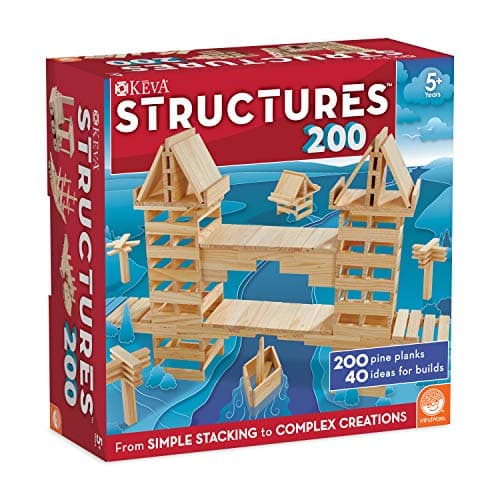 Best across several ages KEVA Structures 200 Plank Set 200 identical pine planks with no connectors — a five-year-old and a twelve-year-old use the same box. | Five and up, with no upper limit published | |
| 4 | 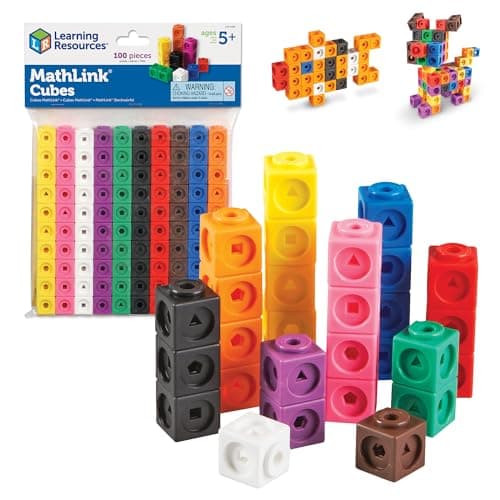 Best math manipulative MathLink Cubes, Set of 100 100 cubes in 10 colors that link on all sides, with geometric shape cut-outs. | Five and up | |
| 5 | 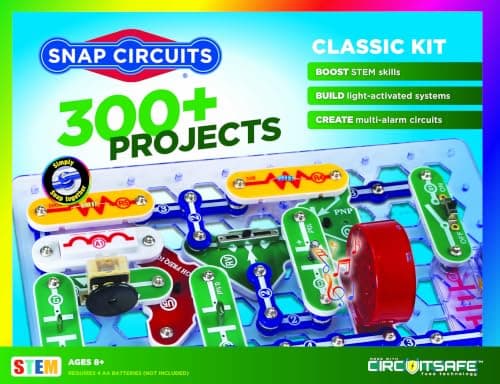 Best project ladder Snap Circuits Classic 305 numbered projects from 60+ parts — a term of Friday afternoons, already sequenced. | Eight and up | |
| — | 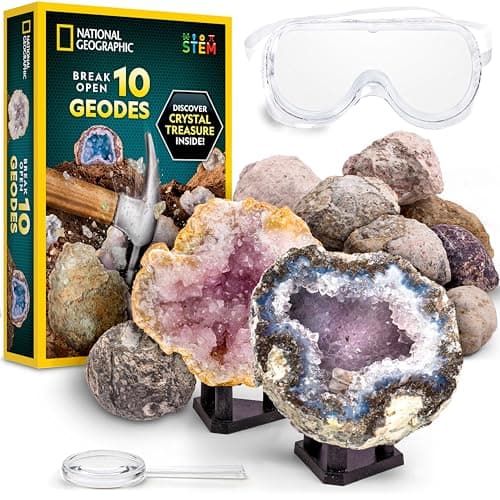 The one to skip for a homeschool NATIONAL GEOGRAPHIC Break Open 10 Premium Geodes Ten geodes, cracked once each, and then a bowl of pretty rocks. | A single afternoon |
6 picks, including 1 we tell you to skip. Ages shown are the manufacturer’s own rating, not ours.
What a homeschool needs that a gift does not
It has to be reusable. A kit that is used up is a single lesson. An instrument is every lesson.
It has to work for more than one child. Sets with a narrow published age band get outgrown by the oldest and are off-limits to the youngest.
It has to work without a teacher hovering. Self-checking materials — a microscope, a circuit that lights, a puzzle with one answer — let one adult supervise several children.
It has to go back in a box. Storage is a real constraint when the classroom is also the kitchen.
The arithmetic
Consumable or permanent, as published
| My First Lab Duo-Scope | Permanent — 4 prepared slides run out, 5 blanks do not |
|---|---|
| 4M Weather Station | Permanent — nothing consumed; weather resupplies daily |
| KEVA Structures 200 | Permanent — no consumables, no upper age |
| MathLink Cubes | Permanent — no batteries, nothing consumed |
| Snap Circuits Classic | Permanent parts, 305 numbered projects |
| Break Open 10 Geodes | Consumable — ten, then finished |
Equipment before kits
The strongest homeschool purchases on this site are instruments, not experiment boxes: a microscope, a telescope, a weather station, a set of lab tools. They cost more once and nothing after, they serve every age in the house, and they turn the outdoors and the kitchen into the supply cupboard.
Kits still have a place — a numbered manual is a ready-made sequence when you have four subjects to plan — but buy them knowing how many times they work. See what else a science kit needs for the hidden requirements.
Across several ages at once
Three published specifications tell you a set will stretch: a wide age range (Magna-Tiles publishes 3-99), no upper age at all (KEVA), or a tool rather than a game (MathLink Cubes, a microscope). Those are the boxes that survive a family where the children are four years apart.
What we are not claiming
We do not map any of these to a curriculum or a standard, and no maker on this page publishes one that we cite. These are toys and instruments chosen on published specifications — what you teach with them is your call.
Worth knowing before you buy
Slides and cover slips are thin glass; the Snap Circuits set is published as not for children under three; and MathLink Cubes and planks are small parts in a room with a toddler. In a mixed-age house, storage between lessons is the safety measure that matters most.
So which one
One purchase for the whole year: the My First Lab Duo-Scope.
Daily data with nothing to buy again: the 4M Weather Station.
Several ages, one box: KEVA Structures 200.
A ready-made ladder: Snap Circuits Classic.
Say the unwelcome thing
Do not build a year around consumable kits
Crystal kits, geode kits and dig kits are excellent single afternoons and poor curriculum spine. Buy one as a treat if you like; do not let them take the budget the microscope needed.
Where to go next
Lab tools that never run out covers the permanent equipment, science kits a child can use alone covers supervision, and microscopes for kids covers the first instrument in detail.
In full
Every pick, and what is wrong with it
Published specifications only, each linked back to the page it came from. Where a manufacturer publishes nothing, the row says so — we do not fill blanks in.
1. Best single purchase
My First Lab Duo-Scope Microscope
My First Lab · MFL-06 · maker rates it 9+
40x, 100x and 400x from real glass optics, with lighting above and below the stage.
- Magnifications
- 40x, 100x and 400x, from a 10x eyepiece with 4x, 10x and 40x objectives
- Optics
- Real optical glass lenses
- Lighting
- Dual LED, above and below the stage
- Slides included
- 5 blank, 1 concavity (well), 4 prepared
The maker publishes 40x, 100x and 400x from a 10x eyepiece with 4x, 10x and 40x objectives, real optical glass lenses, dual LED lighting above and below the stage, five blank slides, one concavity slide and four prepared slides, rated ages 9 and older.
A microscope is the most open-ended purchase in this whole category: the specimens are free and infinite because they are the garden. Blank slides and top lighting are what turn it from four pictures into a year of study.
It also serves several ages at once. A six-year-old looks at a leaf; a twelve-year-old looks at onion cells; the instrument does not change.
Replay signal
- Open-ended or one-shot
- Genuinely open-ended, unusually so for a science purchase — the world is the consumable
- Does anything run out
- The four prepared slides run out; the five blanks and everything in the garden do not
- Room to grow
- Light from above as well as below means it works on rocks, leaves and insects, not only on slides
Why we say so: The manufacturer publishes the dual-LED lighting, the blank-slide count and the real-glass optics. Blank slides plus top lighting is what turns a microscope from four pictures into a thing you point at whatever you found outside.
What’s wrong with it
Three AA batteries, not included, and only four prepared slides.
| Magnifications | 40x, 100x and 400x, from a 10x eyepiece with 4x, 10x and 40x objectives |
|---|---|
| Optics | Real optical glass lenses |
| Lighting | Dual LED, above and below the stage |
| Slides included | 5 blank, 1 concavity (well), 4 prepared |
| Stated age | Ages 9 and older |
| Batteries | 3 x AA (not included) |
| Weight | 1.95 lb |
Every figure above is from My First Lab, Duo-Scope MFL-06. Blanks are shown as “not published” rather than filled in.
Not stocked on Amazon. This link goes to the maker and we earn nothing on it.
2. Best for daily data
4M Weather Station Kit
4M · 4573 · maker rates it 8+
Four working instruments — wind vane, anemometer, thermometer and rain gauge — with nothing consumed.
- Instruments built
- 4 — wind vane, anemometer, thermometer and rain gauge
- Contents
- Thermometer and support arm, two support-column halves, rain gauge arm, funnel, plastic tube, wind vane and arm, compass, anemometer arm, cups, hub, spindles, cap screws, instructions
- Assembled size
- About 8.5 in x 4.75 in
- Extra experiment
- A greenhouse-effect terrarium using a recycled bottle
4M publishes four instruments built by the child — a wind vane, an anemometer, a thermometer and a rain gauge — with a full parts list, an assembled size of about 8.5 × 4.75 inches, a greenhouse-effect terrarium experiment using a recycled bottle, rated 8 and up, with nothing consumed.
This is the rare science kit with no published ending: the weather supplies new data every single day, and readings become a record a child can chart over a term.
Replay signal
- Open-ended or one-shot
- Genuinely open-ended: the weather supplies new data every single day
- Does anything run out
- Nothing runs out
- Room to grow
- Readings become a record; the interest scales into charting and comparison
- Adult required
- For the build, which is fiddly; not for the daily readings
Why we say so: 4M publishes four working instruments and a full parts list. Once built, nothing is consumed and the sky restocks the experiment daily — which makes this one of the few science kits with no published ending.
What’s wrong with it
The build is fiddly, and an adult usually does most of it.
| Instruments built | 4 — wind vane, anemometer, thermometer and rain gauge |
|---|---|
| Contents | Thermometer and support arm, two support-column halves, rain gauge arm, funnel, plastic tube, wind vane and arm, compass, anemometer arm, cups, hub, spindles, cap screws, instructions |
| Assembled size | About 8.5 in x 4.75 in |
| Extra experiment | A greenhouse-effect terrarium using a recycled bottle |
| Stated age | 8 and up (a Green Science version is rated 5+) |
| Consumables | None — the instruments are permanent |
Every figure above is from 4M, Weather Station Kit (4573). Blanks are shown as “not published” rather than filled in.
3. Best across several ages
KEVA Structures 200 Plank Set
KEVA Planks · Structures 200 · maker rates it 5+
200 identical pine planks with no connectors — a five-year-old and a twelve-year-old use the same box.
- Planks
- 200, solid pine, precision-cut to identical dimensions
- Plank size
- About 4 1/2 in long x 3/4 in wide x 1/4 in thick
- Connectors
- None — planks stack with no glue, clips or notches
- Includes
- Idea booklet
The maker publishes 200 planks of solid pine precision-cut to identical dimensions, with no glue, clips or notches and an idea booklet, rated 5 and up.
Identical, connector-free pieces mean the difficulty comes from what the child attempts. In a house with three children of different ages, that is the cheapest way to keep one box useful to all of them.
Replay signal
- Open-ended or one-shot
- As open-ended as construction gets — every plank is identical, so nothing constrains the build but balance
- Does anything run out
- Nothing runs out, and wood does not break the way plastic clips do
- Room to grow
- The same planks are used in adult-level structural challenges; there is no ceiling
Why we say so: The manufacturer publishes that the planks are precision-cut to identical dimensions and use no connectors of any kind. Identical, connector-free pieces is why this set has no upper age limit: the difficulty comes entirely from what the child attempts, not from what the box permits.
What’s wrong with it
Nothing holds a build together, so a knock ends it.
| Planks | 200, solid pine, precision-cut to identical dimensions |
|---|---|
| Plank size | About 4 1/2 in long x 3/4 in wide x 1/4 in thick |
| Connectors | None — planks stack with no glue, clips or notches |
| Includes | Idea booklet |
| Stated age | 5 and up |
| Consumables | None |
Every figure above is from KEVA Planks, Structures 200 Plank Set. Blanks are shown as “not published” rather than filled in.
4. Best math manipulative
MathLink Cubes, Set of 100
Learning Resources · LER4285 · maker rates it 5+
100 cubes in 10 colors that link on all sides, with geometric shape cut-outs.
- Cubes
- 100, in 10 colors
- Cube size
- 3/4 inch
- Connection
- Links on all sides, with geometric shape cut-outs for patterning
- Stated age
- Ages 5 and up
Learning Resources publishes 100 cubes in 10 colors, 3/4 inch each, linking on all sides with geometric shape cut-outs for patterning, rated 5 and up, with no batteries and nothing consumed.
All-sides connection is the specification that matters: cubes that join in six directions build arrays, volumes and models, not just towers. The same 100 cubes cover counting at five and fractions or volume at nine.
Replay signal
- Open-ended or one-shot
- Completely open-ended, and unusually cheap for something that is
- Does anything run out
- Nothing runs out
- Room to grow
- The same cubes cover counting at five and volume, arrays and fractions at nine
Why we say so: Learning Resources publishes that the cubes link on all sides with geometric cut-outs. All-sides connection is what turns a counting toy into a building toy — a cube that only joins end to end makes towers, and one that joins on six faces makes arrays, volumes and models.
What’s wrong with it
A tool rather than a game: it needs an adult with something to teach.
| Cubes | 100, in 10 colors |
|---|---|
| Cube size | 3/4 inch |
| Connection | Links on all sides, with geometric shape cut-outs for patterning |
| Stated age | Ages 5 and up |
| Batteries | None |
| Consumables | None |
Every figure above is from Learning Resources, MathLink Cubes, Set of 100. Blanks are shown as “not published” rather than filled in.
5. Best project ladder
Snap Circuits Classic
Elenco · SC-300 · maker rates it 8+
305 numbered projects from 60+ parts — a term of Friday afternoons, already sequenced.
- Projects
- “Build over 300 exciting projects” — manual covers projects 1-305
- Parts
- “Contains over 60 Snap-Together parts”
- Projects per part
- 5.1 — the highest ratio in the line
- Stated age
- “Ages 8+” and “Not for Children under 3 yrs.”
Elenco publishes “Build over 300 exciting projects” with a manual covering projects 1-305, “over 60 Snap-Together parts”, rated 8+ with a not-for-under-threes warning, and four AA batteries not included.
For a homeschool, the numbered manual is the feature rather than the compromise: it is a ready-made sequence somebody else built, and the parts are never used up.
Replay signal
- Open-ended or one-shot
- The sweet spot of the line — enough parts to invent with, cheap enough not to be an event
- Does anything run out
- Nothing runs out
- Room to grow
- 305 published projects is years of Sunday afternoons at one a week
Why we say so: Elenco publishes 305 numbered projects against 60+ parts. Five projects per part is the highest ratio anywhere in the Snap Circuits line, which is the arithmetic reason this is the set to buy rather than the cheap one or the big one.
What’s wrong with it
Four AA batteries, not included, and the manual does the planning for you.
| Projects | “Build over 300 exciting projects” — manual covers projects 1-305 |
|---|---|
| Parts | “Contains over 60 Snap-Together parts” |
| Projects per part | 5.1 — the highest ratio in the line |
| Stated age | “Ages 8+” and “Not for Children under 3 yrs.” |
| Batteries | “Requires 4 ‘AA’ batteries (not included)” |
| Relationship to SC-100 | Manual includes all SC-100 projects plus 200 new ones |
Every figure above is from Elenco, Snap Circuits Classic. Blanks are shown as “not published” rather than filled in.
Skip this one
NATIONAL GEOGRAPHIC Break Open 10 Premium Geodes
National Geographic · NGGEO10 · maker rates it 8+
Ten geodes, cracked once each, and then a bowl of pretty rocks.
- Geodes
- 10, hand-selected, 1.25 to 2.25 inches across
- Includes
- Safety goggles, magnifying glass, display stands, full-color learning guide
- Stated age
- Manufacturer's minimum age 8 years
- Safety note
- Contains small parts; not for children under 3
National Geographic publishes ten hand-selected geodes of 1.25 to 2.25 inches, with safety goggles, a magnifying glass, display stands and a full-color learning guide, rated 8+.
It is a lovely afternoon and a poor curriculum purchase. A homeschool budget spent on consumables buys one lesson per item; the same money in a microscope buys the whole year.
Replay signal
- Open-ended or one-shot
- One-shot by design. Ten geodes, ten moments, then it is a bowl of pretty rocks
- Does anything run out
- Yes, definitively — the clearest example on this site of a kit that ends
Why we say so: National Geographic publishes the count as ten natural geodes. Ten single-use items is a finite number, and we would rather say so than let a gift-buyer find out on Christmas afternoon.
What’s wrong with it
Ten single-use items — the opposite of what a school year needs.
| Geodes | 10, hand-selected, 1.25 to 2.25 inches across |
|---|---|
| Includes | Safety goggles, magnifying glass, display stands, full-color learning guide |
| Stated age | Manufacturer's minimum age 8 years |
| Safety note | Contains small parts; not for children under 3 |
| Consumables | Yes — ten geodes, and each one only cracks open once |
Every figure above is from National Geographic toys, Break Open Geodes. Blanks are shown as “not published” rather than filled in.
We are not putting a buy button on this one. It is easy enough to find if you want it anyway — but we would rather send you to something that gets played with twice.
Questions people actually ask
Frequently asked
What STEM equipment does a homeschool actually need?
Instruments before kits. A microscope with blank slides and dual lighting, a weather station that resupplies itself daily, a construction set with no upper age, and a math manipulative cover most of what a year needs without anything running out.
Are science kits worth it for homeschool?
As sequences, yes; as a spine, rarely. Elenco publishes 305 numbered projects in Snap Circuits Classic with nothing consumed, which is a ready-made ladder. Consumable kits — geodes, crystals, digs — publish a fixed number of results and then stop. Science kits vs subscription boxes.
What works across several ages at once?
Sets whose published range is wide or open. Magna-Tiles publishes 3-99 years, KEVA publishes 200 identical planks with no upper age, and a microscope serves a six-year-old looking at leaves and a twelve-year-old looking at cells.
Do homeschool STEM toys need an adult present?
The best ones do not, once started. Self-checking materials — a circuit that lights, a puzzle with one answer, a microscope — let one adult supervise several children at different stages. Science kits a child can use alone.
Sources
Where these figures came from
Every specification on this page traces to one of these. If a manufacturer publishes nothing on a point, the page says so rather than filling the gap.
Read next
Where to go from here
Back to Guides, or read how we pick.