Guide and picks
Kitchen Science for Kids
Most of what a science kit sells you is already in the cupboard. Here is what is worth paying for anyway.
By Sawyer V. · Published
The short answer
A great deal of children's science needs nothing but vinegar, bicarbonate of soda, red cabbage and washing-up liquid. What a kit genuinely buys you is equipment a child can hold, a sequence somebody has thought about, and an explanation of what happened.
Block & Beaker earns a commission when you buy through our links, at no cost to you. It never changes a ranking, and we say so plainly when the right answer is the cheaper set, or nothing at all. Full disclosure · How we pick.
At a glance
The picks, ranked
Tap any row to jump to the full reasoning. Prices come live from Amazon where we have them and read “check price” where we don’t — never a number we cannot stand behind today.
| # | Product | Best for | Price |
|---|---|---|---|
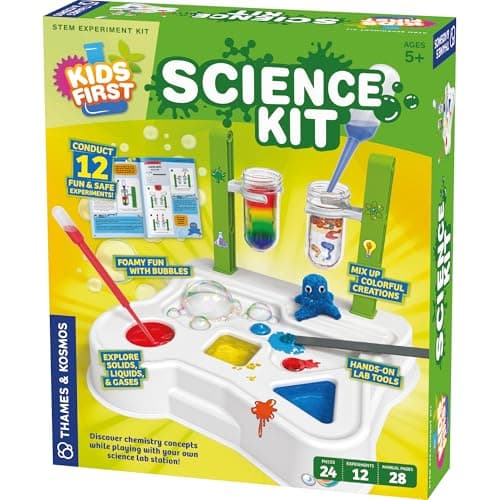
| 1 | Best overall Kids First Science Laboratory Twenty-four reusable tools and no chemicals at all — the kit is the equipment, the kitchen is the supply. | Three to six, and exactly the household-materials model | |
| 2 | 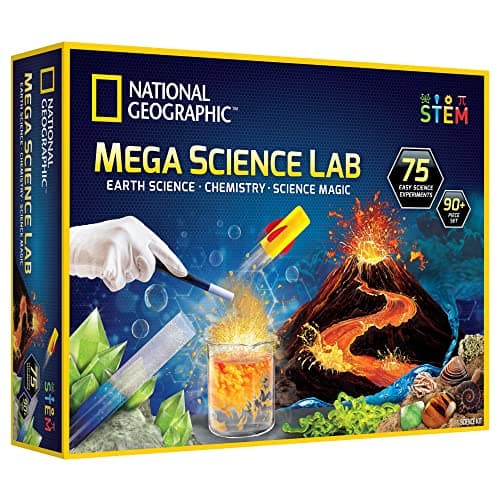 Best value for household experiments NATIONAL GEOGRAPHIC Mega Science Lab Forty-five kit experiments plus a bonus guide of 85 more using household items. | Eight and up, where two thirds of the content needs only a kitchen | |
| 3 | 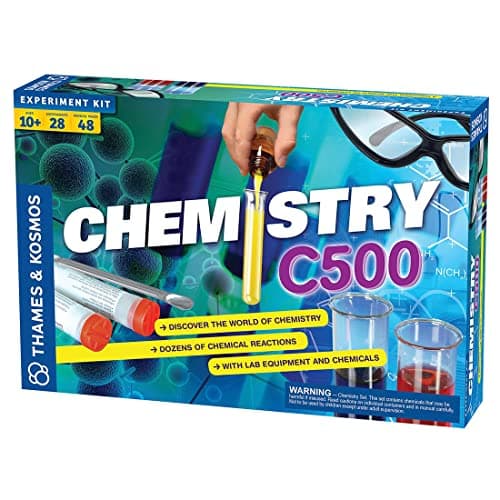 Where a real kit earns its money Thames & Kosmos Chemistry C500 Twenty-eight experiments with five actual reagents and a 48-page manual — things a kitchen cannot do. | Ten and up, when kitchen chemistry has been outgrown | |
| 4 | Best kitchen-adjacent instrument My First Lab Duo-Scope Microscope Onion skin, salt crystals, a drop of milk — the kitchen is full of things worth 100x. | Nine and up, and turning the kitchen into specimens | Sold direct by My First Lab → Not stocked on Amazon. This link goes to the maker and we earn nothing on it. |
| — | The one to skip for this MEL Chemistry monthly subscription Genuinely good chemistry, and the opposite of kitchen science — it arrives, it is used up, it arrives again. | A monthly subscription, on a different page |
5 picks, including 1 we tell you to skip. Ages shown are the manufacturer’s own rating, not ours.
What genuinely works with what you already own
These are the household experiments that carry the most science per minute of setup. None needs a kit.
- Red cabbage indicator. Boil chopped red cabbage, strain, and the purple liquid turns pink in acid and green in alkali. It is a genuine pH indicator, it costs the price of a cabbage, and it is the single best household chemistry demonstration there is.
- Bicarbonate and vinegar. Carbon dioxide production you can pour — the gas is denser than air, so it can be tipped from one container onto a candle flame and put it out.
- Milk, food coloring and washing-up liquid. Surface tension made visible. The detergent breaks the tension and the colors run.
- Density column. Honey, washing-up liquid, water, oil. They layer by density and stay layered.
- Salt and ice. Salt lowers the freezing point, so a string laid on an ice cube and salted will freeze into it and lift it.
The point of listing them is not that kits are pointless. It is that a kit competing with these needs to offer something they do not.
What a kit actually adds
The arithmetic
What you are paying for
| Equipment sized for small hands | 24 tools in the Kids First lab |
|---|---|
| A sequence somebody designed | 10 double-sided cards |
| An explanation of the result | 48 pages across 28 experiments (C500) |
| Reagents a kitchen does not have | 5-7 chemicals in the C-series |
| Household experiments bundled in | 85+ in the Mega Science Lab guide |
The explanation is the most under-rated of these. A child who makes a volcano has done an activity; a child who is told, in a paragraph pitched at them, that an acid and a carbonate produce carbon dioxide has learned a fact they can use again.
Making household experiments feel like science
The difference between kitchen science and messing about is one habit: change one thing at a time and say what you expect first.
"What happens if we use twice as much vinegar?" is a genuine experiment. Doing it with a prediction stated out loud beforehand is the entire scientific method, at four.
Equipment helps here more than materials do, which is why a tool set with no chemicals is a better young purchase than a box of sachets. Measuring the vinegar into a real beaker makes the comparison real.
Worth knowing before you buy
Kitchen science has a small number of genuine rules. Never mix cleaning products — bleach with anything ammonia-based produces toxic gas, and this is the one household chemistry hazard that actually hurts people.
Anything involving heat is an adult job. Boiling cabbage for indicator is a hob and a hot pan, not a child's task, though straining and testing afterwards is entirely theirs.
Label anything kept. A jar of purple liquid in a fridge needs a label, both so nobody drinks it and because labeling is part of the habit being taught.
Say the unwelcome thing
Do not buy a kit that is mostly sachets
A great many cheap science kits are a box of pre-measured powders and a leaflet. You are paying for bicarbonate of soda in small bags, and when the bags are gone the kit is a tray.
The test is what remains after the first weekend. If the answer is "an empty box", buy a tool set instead and supply the materials from a cupboard.
What to buy
- Three to six: Kids First Science Laboratory — tools, not chemicals.
- Eight and up: the Mega Science Lab, for the 85 household experiments.
- Ten and up, outgrown the kitchen: the Chem C500.
- Nine and up, wants to look closer: a microscope with blank slides.
See also experiment kits, first science kits and chemistry sets.
In full
Every pick, and what is wrong with it
Published specifications only, each linked back to the page it came from. Where a manufacturer publishes nothing, the row says so — we do not fill blanks in.
1. Best overall
Kids First Science Laboratory
Thames & Kosmos · Kids First Science Laboratory · maker rates it 3-6+
Twenty-four reusable tools and no chemicals at all — the kit is the equipment, the kitchen is the supply.
- Contents
- 24 large plastic scientific tools, described as durable, reusable and easy to handle
- Experiment cards
- 10, double-sided
- Stated age
- 3 to 6+
- Chemicals included
- None — experiments use household materials
Thames & Kosmos publishes 24 large plastic scientific tools — described as durable, reusable and easy to handle — with 10 double-sided experiment cards, for ages 3 to 6 and up, and no chemicals.
No chemicals is the design rather than a gap. A four-year-old does not need reagents; they need a beaker they can hold and a pipette that works with a weak grip, plus somebody saying what is happening.
It is the rare science purchase at this age with no consumable at all. The tools are still tools in a year, and they work with anything an adult finds online.
Replay signal
- Open-ended or one-shot
- The 20 card sides are a starting ladder; the tools then work on anything in the kitchen
- Does anything run out
- Nothing in the box runs out, because nothing in the box is consumed
- Room to grow
- The same tools carry into any household-materials experiment for years
- Adult required
- Yes at three, less so at five. The cards are picture-led but the setup is not
Why we say so: Thames & Kosmos publishes 24 reusable tools and no chemicals. A preschool science kit with no consumables in it is unusual, and it is the reason this one survives past its first fortnight when kit-of-the-week alternatives do not.
What’s wrong with it
Ten cards is a short ladder. After those, the value depends on an adult being willing to invent the next thing to pour.
| Contents | 24 large plastic scientific tools, described as durable, reusable and easy to handle |
|---|---|
| Experiment cards | 10, double-sided |
| Stated age | 3 to 6+ |
| Chemicals included | None — experiments use household materials |
| Consumables | None in the box |
Every figure above is from Thames & Kosmos, Kids First range. Blanks are shown as “not published” rather than filled in.
2. Best value for household experiments
NATIONAL GEOGRAPHIC Mega Science Lab
National Geographic · Mega Science Lab · maker rates it 8+
Forty-five kit experiments plus a bonus guide of 85 more using household items.
- Experiments in the kit
- 45, across chemistry, earth science and science magic
- Bonus guide
- 85+ further experiments using household items, for 130+ in total
- Includes
- Volcano build, glow-in-the-dark crystal growth, and the tools for both
- Stated age
- 8+
National Geographic publishes 45 experiments across chemistry, earth science and science magic, plus a bonus guide of more than 85 experiments using household items — over 130 in total — rated 8+.
That second number is exactly what this page is about. Roughly two thirds of the published content runs on things already in the house, which is why this kit outlasts its price band.
The bonus guide costs the manufacturer almost nothing to include and roughly triples the life of the purchase. More kits should do it.
Replay signal
- Open-ended or one-shot
- Guided, and the 45 in-kit experiments end. The 85 household ones do not
- Does anything run out
- The supplied materials run out; the household half of the book never does
- Room to grow
- The bonus guide is the genuinely durable part, and it costs the manufacturer almost nothing to include
- Adult required
- Supervision for the chemistry third; the earth science and household experiments are largely self-run
Why we say so: National Geographic publishes 45 in-kit experiments plus a bonus guide of 85+ using household items. That second number is why this kit outlasts most of its price band: roughly two-thirds of the published content needs nothing but a kitchen.
What’s wrong with it
Three subjects in one box means each is shallower than a dedicated kit at the same price.
| Experiments in the kit | 45, across chemistry, earth science and science magic |
|---|---|
| Bonus guide | 85+ further experiments using household items, for 130+ in total |
| Includes | Volcano build, glow-in-the-dark crystal growth, and the tools for both |
| Stated age | 8+ |
| Consumables | Yes — the supplied chemicals and crystal compounds are used up |
Every figure above is from National Geographic toys, Mega Science Lab. Blanks are shown as “not published” rather than filled in.
3. Where a real kit earns its money
Thames & Kosmos Chemistry C500
Thames & Kosmos · 665012 · maker rates it 10+
Twenty-eight experiments with five actual reagents and a 48-page manual — things a kitchen cannot do.
- Experiments
- 28
- Manual
- 48 pages
- Chemicals included
- 5
- Equipment
- Safety glasses, test tubes, dropper pipettes, double-headed measuring spoon
Thames & Kosmos publishes 28 experiments, a 48-page manual, five chemicals, safety glasses, test tubes, dropper pipettes and a double-headed measuring spoon, rated 10 years and up, requiring one 9V battery.
Included to mark the boundary honestly. Kitchen science covers acids and bases, density, surface tension and gas production. It cannot cover controlled reactions with known reagents, and at some point a child who is genuinely interested wants those.
Forty-eight pages across 28 experiments is roughly a page and a half each — enough for a method, a result and an explanation, which is the part a web search does not give you.
Replay signal
- Open-ended or one-shot
- Guided, not open-ended: 28 experiments, then the manual is finished
- Does anything run out
- Yes — the chemicals are consumed, and Thames & Kosmos sells replacements
- Room to grow
- Steps up to the larger C1000, C2000 and C3000 sets in the same line
- Adult required
- The maker rates it 10+ and it involves real chemicals
Why we say so: Thames & Kosmos publishes 28 experiments, a 48-page manual and five chemicals. Five finite chemicals across 28 experiments is arithmetic, not opinion — this set has an end, and it is better to know that before Boxing Day than after.
What’s wrong with it
Consumable and rated 10+. This is the step after kitchen science, not an alternative to it.
| Experiments | 28 |
|---|---|
| Manual | 48 pages |
| Chemicals included | 5 |
| Equipment | Safety glasses, test tubes, dropper pipettes, double-headed measuring spoon |
| Stated age | 10 years and up |
| Batteries | 1 x 9V (not included) |
| Consumables | Yes — the five chemicals are used up |
Every figure above is from Thames & Kosmos, Chemistry C500. Blanks are shown as “not published” rather than filled in.
4. Best kitchen-adjacent instrument
My First Lab Duo-Scope Microscope
My First Lab · MFL-06 · maker rates it 9+
Onion skin, salt crystals, a drop of milk — the kitchen is full of things worth 100x.
- Magnifications
- 40x, 100x and 400x, from a 10x eyepiece with 4x, 10x and 40x objectives
- Optics
- Real optical glass lenses
- Lighting
- Dual LED, above and below the stage
- Slides included
- 5 blank, 1 concavity (well), 4 prepared
My First Lab publishes 40x, 100x and 400x, real optical glass, dual LED lighting above and below the stage, and five blank slides plus one concavity and four prepared, rated 9 and older.
The five blank slides are what connect this to a kitchen. Onion skin is the classic first cell view and it costs nothing; salt and sugar crystals under 100x are visibly different from each other in a way that surprises children.
This is the cheapest way to make an ordinary kitchen into a supply of specimens that does not run out.
Replay signal
- Open-ended or one-shot
- Genuinely open-ended, unusually so for a science purchase — the world is the consumable
- Does anything run out
- The four prepared slides run out; the five blanks and everything in the garden do not
- Room to grow
- Light from above as well as below means it works on rocks, leaves and insects, not only on slides
Why we say so: The manufacturer publishes the dual-LED lighting, the blank-slide count and the real-glass optics. Blank slides plus top lighting is what turns a microscope from four pictures into a thing you point at whatever you found outside.
What’s wrong with it
Rated 9 and older, and preparing a wet slide neatly takes a few attempts.
| Magnifications | 40x, 100x and 400x, from a 10x eyepiece with 4x, 10x and 40x objectives |
|---|---|
| Optics | Real optical glass lenses |
| Lighting | Dual LED, above and below the stage |
| Slides included | 5 blank, 1 concavity (well), 4 prepared |
| Stated age | Ages 9 and older |
| Batteries | 3 x AA (not included) |
| Weight | 1.95 lb |
Every figure above is from My First Lab, Duo-Scope MFL-06. Blanks are shown as “not published” rather than filled in.
Not stocked on Amazon. This link goes to the maker and we earn nothing on it.
Skip this one
MEL Chemistry monthly subscription
MEL Science · MEL Chemistry · maker rates it 10+
Genuinely good chemistry, and the opposite of kitchen science — it arrives, it is used up, it arrives again.
- Stated age
- 10+
- Experiments per set
- 2-3
- Cadence
- A new kit by the 23rd of each month
- First shipment
- Includes a home lab — flask, solid fuel stove, safety glasses, beakers
MEL Science publishes 2-3 experiments per monthly set for ages 10 and up, arriving by the 23rd of each month, with the first shipment including a home lab of flask, solid fuel stove, safety glasses and beakers.
It is a strong product and it is covered properly on the subscription page.
The skip here is a category point. Somebody reading about kitchen science is looking for what they can do this afternoon with what they own, and a subscription is the furthest thing from that.
Replay signal
- Open-ended or one-shot
- Guided experiments, not open-ended play
- Does anything run out
- Each month's reagents run out; the equipment from the first shipment does not
- Room to grow
- The reusable home lab means later months arrive as refills rather than restarts
- Adult required
- A solid fuel stove and real reagents at a 10+ rating means an adult in the room
Why we say so: MEL Science publishes the 2-3 experiments per set, the monthly cadence, the 10+ rating and the contents of the first shipment's home lab.
What’s wrong with it
A solid fuel stove and real reagents at 10+, on a monthly schedule. Nothing about it uses what you already own.
| Stated age | 10+ |
|---|---|
| Experiments per set | 2-3 |
| Cadence | A new kit by the 23rd of each month |
| First shipment | Includes a home lab — flask, solid fuel stove, safety glasses, beakers |
| Consumables | Yes — reagents are used up each month |
Every figure above is from MEL Science, chemistry subscription. Blanks are shown as “not published” rather than filled in.
We are not putting a buy button on this one. It is easy enough to find if you want it anyway — but we would rather send you to something that gets played with twice.
Questions people actually ask
Frequently asked
What kitchen science experiments actually work?
Red cabbage indicator is the best one — boil chopped red cabbage, strain, and the purple liquid turns pink in acid and green in alkali. Bicarbonate and vinegar produces pourable carbon dioxide, milk with food coloring and detergent shows surface tension, and honey, oil and water layer by density.
Are science kits worth buying if kitchen experiments are free?
For three things a kitchen does not supply: equipment sized for small hands, a sequence somebody designed, and an explanation of what happened. Thames & Kosmos publishes a 48-page manual across 28 experiments — roughly a page and a half each, which is the part a web search does not give you.
How do I make household experiments feel like real science?
Change one thing at a time, and say what you expect before you do it. 'What happens if we use twice as much vinegar?' with a prediction stated out loud is the entire scientific method, and it works at four.
What kitchen science is actually dangerous?
Mixing cleaning products. Bleach with anything ammonia-based produces toxic gas, and it is the one household chemistry hazard that genuinely hurts people. Anything involving heat is an adult job, and anything kept in the fridge needs a label.
Sources
Where these figures came from
Every specification on this page traces to one of these. If a manufacturer publishes nothing on a point, the page says so rather than filling the gap.
Read next
Where to go from here
Back to Science Kits, or read how we pick.