The picks
Crystal Growing Kits for Kids
Every crystal kit is a countdown. The published number of growing powders is the number of results, and it is worth reading before Boxing Day.
By Sawyer V. · Published
The short answer
Buy on two published numbers: how many crystals the kit grows, and what is left afterwards. National Geographic publishes 8 growing powders plus 5 real mineral specimens; 4M publishes 7 experiments from 3 bags of compound and nothing permanent. Every kit here has a defined end.
Block & Beaker earns a commission when you buy through our links, at no cost to you. It never changes a ranking, and we say so plainly when the right answer is the cheaper set, or nothing at all. Full disclosure · How we pick.
At a glance
The picks, ranked
Tap any row to jump to the full reasoning. Prices come live from Amazon where we have them and read “check price” where we don’t — never a number we cannot stand behind today.
| # | Product | Best for | Price |
|---|---|---|---|
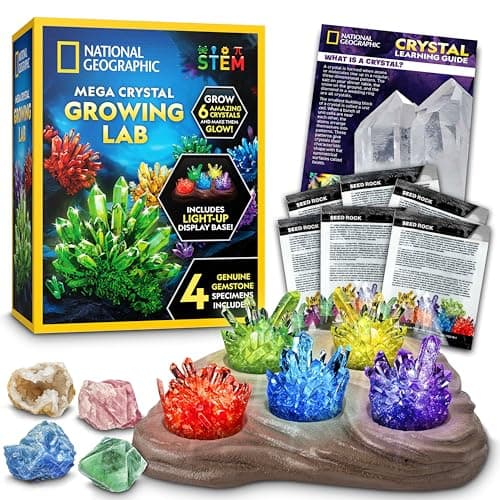
| 1 | Best crystal growing kit overall NATIONAL GEOGRAPHIC Mega Crystal Growing Kit Eight crystals in 3 to 4 days, plus five real mineral specimens and a magnifier that outlive the powders. | Eight to twelve, where something should survive the kit | |
| 2 | 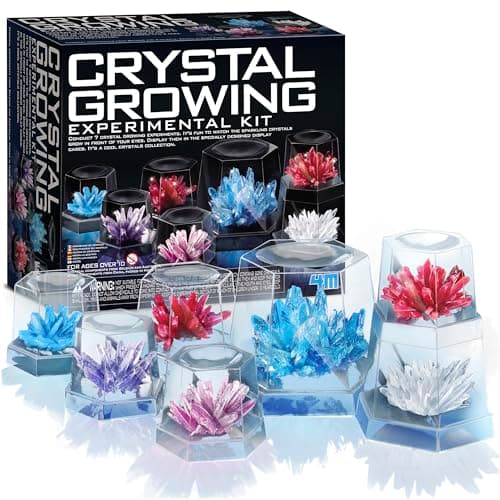 Best for the display cases 4M Crystal Growing Experiment Kit Seven experiments with seven display bases, covers and ring templates supplied. | Ten and up, for a child who wants keepable results | |
| 3 | 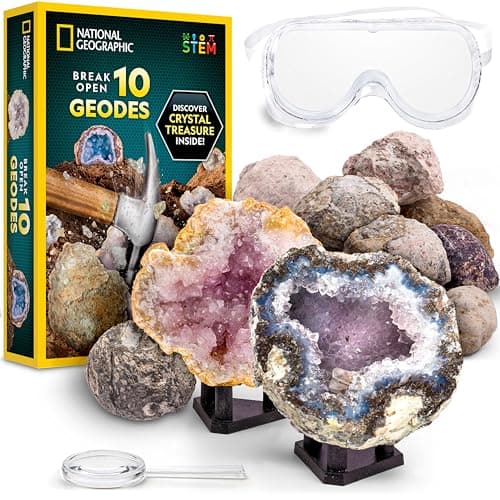 Best for crystals you do not have to grow NATIONAL GEOGRAPHIC Break Open 10 Premium Geodes Ten natural geodes, cracked open with goggles supplied — real crystals in seconds rather than days. | Eight and up, for an immediate result | |
| 4 | 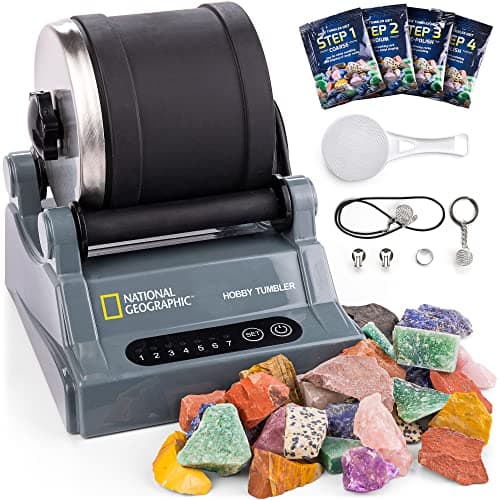 Best if the interest lasts NATIONAL GEOGRAPHIC Hobby Rock Tumbler Kit The machine outlives its supplies, and afterwards it polishes rocks that cost nothing. | Eight and up, when crystals turn into a geology habit | |
| — | 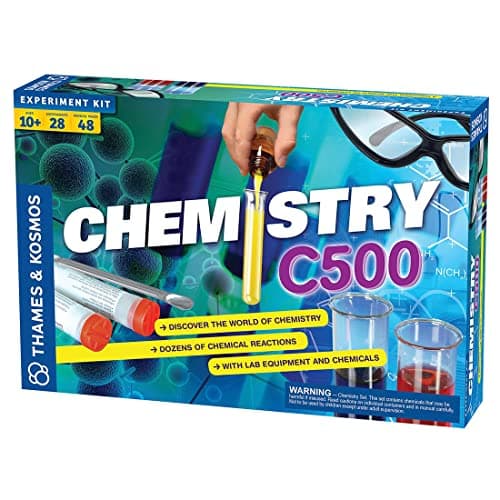 Not a crystal kit Thames & Kosmos Chemistry C500 Frequently cross-shopped at the same age rating, and it is a chemistry course rather than a crystal activity. | Ten and up, for real chemistry |
5 picks, including 1 we tell you to skip. Ages shown are the manufacturer’s own rating, not ours.
The number that decides a crystal kit
Crystal growing is the most countable category on this site. The kit contains a fixed quantity of growing compound, that compound becomes a fixed number of crystals, and then it is finished.
The arithmetic
Published counts, and what survives
| Nat Geo Mega Crystal | 8 crystals, 3-4 days; 5 natural specimens survive |
|---|---|
| 4M Crystal Growing | 7 experiments from 3 bags; 7 display cases survive |
| Break Open Geodes | 10 natural geodes; goggles and magnifier survive |
| Nat Geo Rock Tumbler | 4 grits, 9 rough stones; the machine survives |
| Mega Science Lab | Glow-in-the-dark crystal growth inside a 45-experiment kit |
Grown crystals versus natural ones
Worth being clear, because the category quietly blurs it.
A grown crystal is a chemistry result. The child dissolves a supplied compound, seeds it, and watches a structure form over days. What is being learned is saturation and crystallization, and the object at the end is manufactured.
A natural crystal is a geology object. Nothing is learned about chemistry by cracking a geode; what happens instead is that a child sees a real mineral that formed underground and nobody has looked at before.
The Mega Crystal kit is the only one here that does both, which is why it leads.
Time is the specification nobody reads
Three to four days is what National Geographic publishes for its growing powders. That is the fastest here and it is still not an afternoon.
Days rather than minutes is 4M’s own phrasing, across seven separate experiments — so the kit realistically spans several weeks.
Seconds is the geode answer, which is why it is on this page at all.
A crystal kit therefore needs a surface that stays undisturbed for the duration. In a household with no spare shelf, that constraint decides the purchase more than any published count.
Worth knowing before you buy
Crystal-growing compounds are chemicals and the published ratings are 8-12 and 10+ respectively. Keep the sachets away from younger siblings, and do not let a finished crystal be treated as a sweet — several of them look remarkably like one.
Geode cracking needs the supplied goggles, a hard surface and an adult swinging the hammer for younger children.
Who each kit suits
A child who wants a result today: geodes. Everything else involves waiting.
A child aged eight to twelve who likes the idea of growing things: the Mega Crystal kit, for the fast growing time and the natural specimens.
A patient ten-year-old who wants keepable results: the 4M kit, for the seven display cases.
A child whose geology interest has already survived one kit: the tumbler, because it never runs out.
Say the unwelcome thing
Do not buy a crystal kit as the main present
Every kit on this page publishes a finite number of results, and the fastest produces nothing at all on the day it is opened.
As a second gift alongside something open-ended it is excellent. As the biggest parcel it produces a child staring at a jar.
Where to go next
Rock and geology kits covers the natural-mineral side in full. The 4M crystal kit review goes deeper on that one product, and lab tools that never run out covers the permanent alternative.
In full
Every pick, and what is wrong with it
Published specifications only, each linked back to the page it came from. Where a manufacturer publishes nothing, the row says so — we do not fill blanks in.
1. Best crystal growing kit overall
NATIONAL GEOGRAPHIC Mega Crystal Growing Kit
National Geographic · Mega Crystal Growing Kit · maker rates it 8-12
Eight crystals in 3 to 4 days, plus five real mineral specimens and a magnifier that outlive the powders.
- Crystals grown
- 8, published as growing in 3 to 4 days
- Growing supplies
- 8 colors of crystal growing powder, 8 seed rocks, 2 silicone growing chambers
- Real specimens included
- 5 — quartz, rose quartz, fluorite, calcite and amethyst
- Display
- USB-powered light-up display base
National Geographic publishes 8 colors of crystal growing powder, 8 seed rocks, 2 silicone growing chambers, a USB-powered light-up display base, a stir stick, a magnifying glass and a full-color learning guide, rated 8-12, with crystals growing in 3 to 4 days.
The five real specimens are the reason this tops the list. Quartz, rose quartz, fluorite, calcite and amethyst are natural minerals that do not get consumed — so when the eight powders are gone the child still owns a small reference collection and a magnifier to look at it with.
Three to four days is also the fastest published growing time here, which matters more than it sounds for a child who has just unwrapped it.
Replay signal
- Open-ended or one-shot
- Eight results, then the growing half is finished
- Does anything run out
- Yes — eight powders, eight crystals
- Room to grow
- The five natural specimens and the magnifier outlive the powders
- Adult required
- For hot water at the mixing stage
Why we say so: National Geographic publishes eight growing powders and, separately, five real mineral specimens. That split matters: the grown crystals end after eight, and the natural specimens are permanent — so this is the crystal kit that leaves something behind.
What’s wrong with it
The growing half still ends after eight, and the display base needs a USB port.
| Crystals grown | 8, published as growing in 3 to 4 days |
|---|---|
| Growing supplies | 8 colors of crystal growing powder, 8 seed rocks, 2 silicone growing chambers |
| Real specimens included | 5 — quartz, rose quartz, fluorite, calcite and amethyst |
| Display | USB-powered light-up display base |
| Also included | Stir stick, magnifying glass, full-color STEM learning guide |
| Stated age | 8-12 |
| Consumables | Yes — the growing powder is the product |
Every figure above is from National Geographic toys, Mega Crystal Growing Kit. Blanks are shown as “not published” rather than filled in.
2. Best for the display cases
4M Crystal Growing Experiment Kit
4M · 5557 · maker rates it 10+
Seven experiments with seven display bases, covers and ring templates supplied.
- Experiments
- 7 crystal-growing experiments
- Contents
- 3 bags of crystal compound, 3 bags of seeding mixture, stirring bowl and spoon, 7 display bases, 7 display covers, 7 ring templates
- Stated age
- 10 years and up
- Consumables
- Yes — the compound is the whole product
4M publishes 7 crystal-growing experiments using 3 bags of crystal compound and 3 bags of seeding mixture, with a stirring bowl and spoon, 7 display bases, 7 display covers and 7 ring templates, rated 10 years and up, each experiment taking days rather than minutes.
The display components are the underrated part. Seven cases mean the results are objects a child keeps rather than things that get knocked over, which is what makes a slow experiment feel worth the wait.
The honest limit is stated plainly by the maker: when the compound is gone, the kit is a set of display cases.
Replay signal
- Open-ended or one-shot
- One-shot, seven times over
- Does anything run out
- Definitively. Three bags of compound, and when they are gone the kit is a set of display cases
Why we say so: 4M publishes three bags of crystal compound across seven experiments. That is the arithmetic that decides this purchase: it is seven results, spread over weeks because crystals take days to grow, and then it is finished. Excellent as an event; poor as the main present.
What’s wrong with it
Three bags of compound is the whole product, and results take days rather than hours.
| Experiments | 7 crystal-growing experiments |
|---|---|
| Contents | 3 bags of crystal compound, 3 bags of seeding mixture, stirring bowl and spoon, 7 display bases, 7 display covers, 7 ring templates |
| Stated age | 10 years and up |
| Consumables | Yes — the compound is the whole product |
| Time per experiment | Days, not minutes — crystals grow on their own schedule |
Every figure above is from 4M, Crystal Growing Experiment Kit. Blanks are shown as “not published” rather than filled in.
3. Best for crystals you do not have to grow
NATIONAL GEOGRAPHIC Break Open 10 Premium Geodes
National Geographic · NGGEO10 · maker rates it 8+
Ten natural geodes, cracked open with goggles supplied — real crystals in seconds rather than days.
- Geodes
- 10, hand-selected, 1.25 to 2.25 inches across
- Includes
- Safety goggles, magnifying glass, display stands, full-color learning guide
- Stated age
- Manufacturer's minimum age 8 years
- Safety note
- Contains small parts; not for children under 3
National Geographic publishes ten hand-selected geodes 1.25 to 2.25 inches across, with safety goggles, a magnifying glass, display stands and a full-color learning guide, minimum age 8, noting small parts and not for under-threes.
This is the right purchase for a child who wants crystals now. Growing takes days and the result is a manufactured crystal; cracking a geode takes seconds and the result is a natural one nobody has seen before.
It is also the clearest countdown in the category — ten rocks, ten moments.
Replay signal
- Open-ended or one-shot
- One-shot by design. Ten geodes, ten moments, then it is a bowl of pretty rocks
- Does anything run out
- Yes, definitively — the clearest example on this site of a kit that ends
Why we say so: National Geographic publishes the count as ten natural geodes. Ten single-use items is a finite number, and we would rather say so than let a gift-buyer find out on Christmas afternoon.
What’s wrong with it
Ten single-use rocks, and a hammer is involved.
| Geodes | 10, hand-selected, 1.25 to 2.25 inches across |
|---|---|
| Includes | Safety goggles, magnifying glass, display stands, full-color learning guide |
| Stated age | Manufacturer's minimum age 8 years |
| Safety note | Contains small parts; not for children under 3 |
| Consumables | Yes — ten geodes, and each one only cracks open once |
Every figure above is from National Geographic toys, Break Open Geodes. Blanks are shown as “not published” rather than filled in.
4. Best if the interest lasts
NATIONAL GEOGRAPHIC Hobby Rock Tumbler Kit
National Geographic · Hobby Rock Tumbler · maker rates it 8+
The machine outlives its supplies, and afterwards it polishes rocks that cost nothing.
- Includes
- Tumbler, four polishing grits, sifter, learning guide
- Rough gemstones
- Nine types
- Barrel
- Noise-reducing, leak-proof, stainless steel lid
- Controls
- One-touch settings with an automatic shutoff timer
National Geographic publishes a tumbler with four polishing grits, nine rough gemstone types, a sifter, a noise-reducing leak-proof barrel with a stainless steel lid, one-touch controls with an automatic shutoff timer and jewelry fastenings, rated 8+.
Every other kit on this page ends. This one converts to free input once the supplied rough is used, which is the transition from a kit to a hobby.
Replay signal
- Open-ended or one-shot
- Semi-open: the machine is permanent, the grit is not, and rocks from a beach are free
- Does anything run out
- The grits and the supplied gemstones run out; refill grit is sold separately
- Room to grow
- Once the supplied rough is gone, the tumbler works on anything the child collects
- Adult required
- For loading and for the timer; the tumbling itself is unattended
Why we say so: National Geographic publishes four polishing grits, nine gemstone types and an automatic shutoff timer. The machine outliving the grit is what makes this different from a one-shot geology kit — but it runs for days per batch, so it is a patience purchase, not an afternoon one.
What’s wrong with it
Runs for days per batch, and the four grits are consumed and sold separately.
| Includes | Tumbler, four polishing grits, sifter, learning guide |
|---|---|
| Rough gemstones | Nine types |
| Barrel | Noise-reducing, leak-proof, stainless steel lid |
| Controls | One-touch settings with an automatic shutoff timer |
| Extras | Jewelry fastenings for the polished stones |
| Stated age | 8+ |
| Consumables | Yes — the four grits and the supplied rough are used up |
Every figure above is from National Geographic toys, Hobby Rock Tumbler Kit. Blanks are shown as “not published” rather than filled in.
Skip this one
Thames & Kosmos Chemistry C500
Thames & Kosmos · 665012 · maker rates it 10+
Frequently cross-shopped at the same age rating, and it is a chemistry course rather than a crystal activity.
- Experiments
- 28
- Manual
- 48 pages
- Chemicals included
- 5
- Equipment
- Safety glasses, test tubes, dropper pipettes, double-headed measuring spoon
Thames & Kosmos publishes 28 experiments, a 48-page manual and five chemicals with safety glasses, test tubes and dropper pipettes, rated 10 years and up, stating compliance with EN 71-4.
We list it to rule it out. A buyer searching for a crystal kit wants an attractive object at the end; the C500 wants a reader who will follow a manual with an adult present. Both are good, and they are not substitutes.
Replay signal
- Open-ended or one-shot
- Guided, not open-ended: 28 experiments, then the manual is finished
- Does anything run out
- Yes — the chemicals are consumed, and Thames & Kosmos sells replacements
- Room to grow
- Steps up to the larger C1000, C2000 and C3000 sets in the same line
- Adult required
- The maker rates it 10+ and it involves real chemicals
Why we say so: Thames & Kosmos publishes 28 experiments, a 48-page manual and five chemicals. Five finite chemicals across 28 experiments is arithmetic, not opinion — this set has an end, and it is better to know that before Boxing Day than after.
What’s wrong with it
Twenty-eight experiments across five chemicals, and an adult is assumed throughout.
| Experiments | 28 |
|---|---|
| Manual | 48 pages |
| Chemicals included | 5 |
| Equipment | Safety glasses, test tubes, dropper pipettes, double-headed measuring spoon |
| Stated age | 10 years and up |
| Batteries | 1 x 9V (not included) |
| Consumables | Yes — the five chemicals are used up |
Every figure above is from Thames & Kosmos, Chemistry C500. Blanks are shown as “not published” rather than filled in.
We are not putting a buy button on this one. It is easy enough to find if you want it anyway — but we would rather send you to something that gets played with twice.
Questions people actually ask
Frequently asked
How many crystals do you get in a crystal growing kit?
It is published, and it is finite. National Geographic's Mega Crystal Growing Kit publishes 8 growing powders and 8 seed rocks, so eight crystals. 4M publishes 7 experiments from 3 bags of compound. When the compound is gone, both kits are finished.
How long do crystals take to grow in a kit?
National Geographic publishes 3 to 4 days for its growing powders, which is the fastest here. 4M describes its seven experiments as taking days rather than minutes. No crystal kit produces a result on the afternoon it is opened, which is worth saying before a birthday.
What age is a crystal growing kit for?
National Geographic publishes 8-12 for the Mega Crystal Growing Kit and 4M publishes 10 and up. The ratings are about care and precision rather than danger — an inaccurate mix simply does not crystallize — though the compounds are chemicals and should be kept from younger siblings.
Is a crystal kit or a geode kit better?
They answer different wishes. A grown crystal teaches saturation and crystallization over several days and produces a manufactured object. A geode cracks open in seconds and produces a natural mineral nobody has seen before. Nat Geo's Mega Crystal kit is the only one here that includes both, since it packs five real specimens alongside the growing powders. Break Open Geodes review.
Sources
Where these figures came from
Every specification on this page traces to one of these. If a manufacturer publishes nothing on a point, the page says so rather than filling the gap.
Read next
Where to go from here
Back to Science Kits, or read how we pick.