The picks
STEM Advent Calendars
They all publish 24 doors. What they do not all publish is how many of those doors contain an experiment, and how many contain an object the child still owns in January.
By Sawyer V. · Published
The short answer
Buy on the published split between experiments and keepable objects, not on the day count — every calendar here publishes 24. National Geographic’s Science Advent Calendar publishes 13 experiments plus 11 specimens and a final-day pyrite dig, the only split that leaves a collection behind. Thames & Kosmos Vol. 4 publishes 24 experiments and nothing permanent. The Gemstone calendar publishes 24 objects and no experiments at all. Buy before 1 December or the structure is broken.
Block & Beaker earns a commission when you buy through our links, at no cost to you. It never changes a ranking, and we say so plainly when the right answer is the cheaper set, or nothing at all. Full disclosure · How we pick.
At a glance
The picks, ranked
Tap any row to jump to the full reasoning. Prices come live from Amazon where we have them and read “check price” where we don’t — never a number we cannot stand behind today.
| # | Product | Best for | Price |
|---|---|---|---|
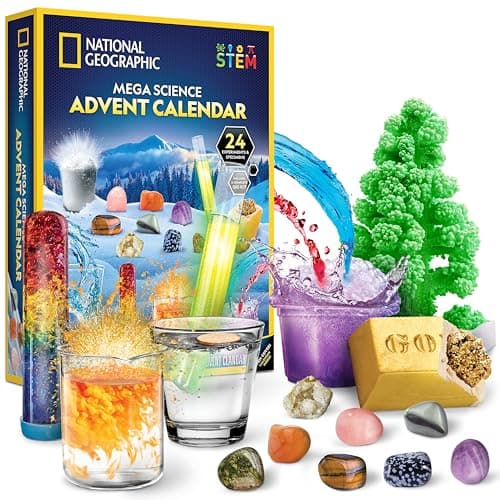
| 1 | Best overall — the only published split that leaves a collection NATIONAL GEOGRAPHIC Science Advent Calendar 13 experiments, 11 specimens and a final-day pyrite dig brick, with a storage pouch. | Eight to twelve, for a child who wants to keep what they open | |
| 2 | 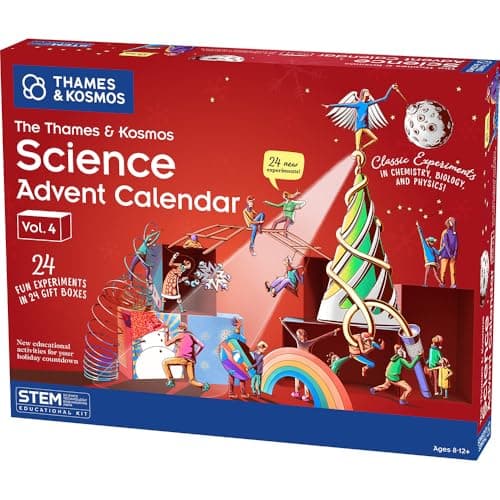 Most experiments — 24 out of 24 Thames & Kosmos Science Advent Calendar Vol. 4 An experiment every single day, each in its own box with a 4-page manual. | Eight and up, where the point is the science and not the souvenir | |
| 3 | 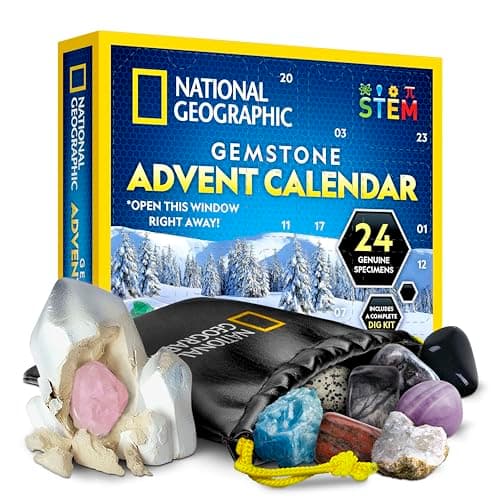 Zero consumables — 24 objects that stay objects NATIONAL GEOGRAPHIC Gemstone Advent Calendar 24 polished gemstones, five jewelry settings, a pouch and a rose quartz dig brick. | A rock collector, at any age the adult judges the small stones safe | |
| 4 | 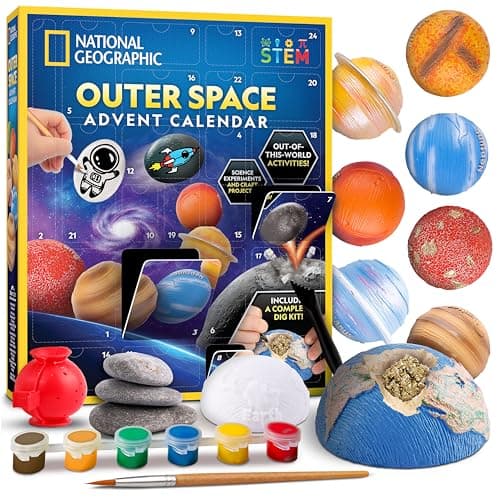 Best for a child who already has the rocks NATIONAL GEOGRAPHIC Space Advent Calendar 8 magnet-backed planets to paint, named constellation glow stickers, a pyrite dig. | A space-minded child, where the output should go on a wall | |
| 5 | 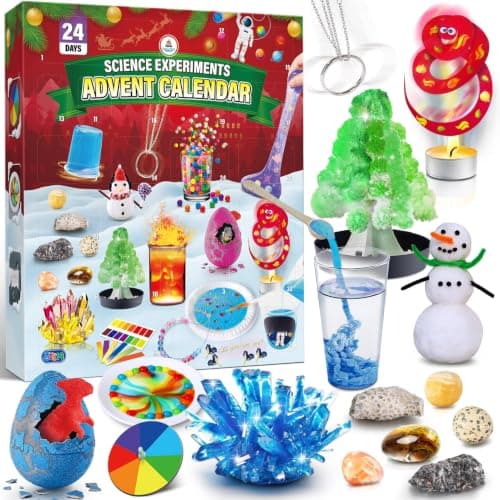 Lowest price band here UNGLINGA Science Advent Calendar 24 published chemistry, physics and geology projects with the tools included. | A second calendar, a classroom, or a budget that stops well short of forty dollars | |
| — | 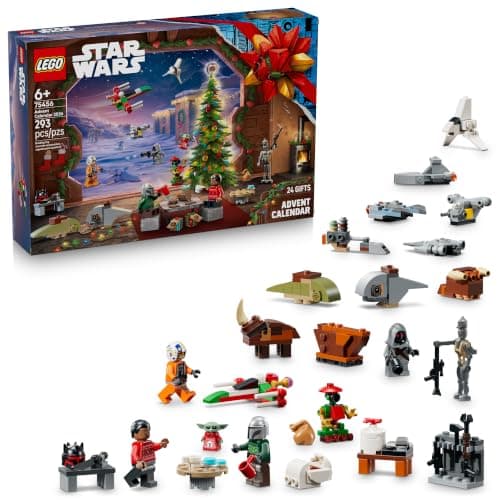 Not a STEM calendar LEGO Star Wars Advent Calendar 2026 293 pieces across 24 doors, 8 mini vehicles and a named cast of minifigures. | Six and up, as a licensed building toy — which is a different purchase |
6 picks, including 1 we tell you to skip. Ages shown are the manufacturer’s own rating, not ours.
The one figure to buy on
The arithmetic
STEM advent calendars: published days, experiments and keepables
| NATIONAL GEOGRAPHIC Science | 24 days — 13 experiments + 11 specimens + final-day pyrite dig. Ages 8-12 |
|---|---|
| Thames & Kosmos Vol. 4 | 24 days — 24 experiments, 0 keepables. 4-page manual per box. Ages 8+ |
| NATIONAL GEOGRAPHIC Gemstone | 24 days — 0 experiments, 24 gemstones + 5 jewelry settings. Age not published |
| NATIONAL GEOGRAPHIC Space | 24 days — 8 planet magnets, named constellation stickers, 1 pyrite dig. Age not published |
| UNGLINGA Science | 24 days — 24 projects; experiment/keepable split not published. Age not published |
| LEGO Star Wars 75456 | 24 doors — 293 pieces, 8 mini vehicles, 0 published science. Ages 6+ |
Why the day count is the wrong number
Twenty-four is a constraint, not a feature. An advent calendar has 24 doors because December has 24 days before Christmas. Every maker in the category publishes 24, so the figure tells you nothing about what is behind them.
What varies is the residue. Thames & Kosmos publishes 24 experiments and no objects; the Gemstone calendar publishes 24 objects and no experiments; the Science calendar publishes both. Those are three genuinely different gifts sold in the same shape of box.
And the published age, where there is one. Two of the five science calendars here publish a rating and three do not. On a product containing small polished stones and powders, an unpublished age is information — see buying above the age rating.
Not the brand on the front. National Geographic appears three times on this page with three different consumable counts, which is the clearest possible demonstration that the brand does not predict the contents.
The deadline that makes this category different
Nothing else on this site has an expiry date. A microscope bought on 2 January is as good as a microscope bought in November; an advent calendar bought on 2 December has already lost a day, and one bought on the 15th is a box of sixteen things to do at once.
That has two consequences worth planning around. The first is obvious: order with enough margin that a delayed delivery does not land on 3 December. The second is less obvious — this is the one category where stock genuinely runs out and does not come back, because an unsold 2026 calendar is worth less in January than the shelf it is sitting on. Prices in this category move upward as December approaches, which is the opposite of the rest of the year.
If the date has already slipped past the start of December, the honest move is to stop looking at calendars. A single kit opened on the day it arrives is better than a twenty-four-door structure started three weeks late. See gifts that are ready to use and Christmas STEM gifts.
What an advent calendar is actually good at
It removes the choosing. The single hardest thing about a science kit is getting it started on a Tuesday. A calendar makes that decision for the household 24 times in a row, which is why a child who ignores a 75-experiment lab will do an experiment every morning for three weeks.
It is a daily appointment at a scale children can finish. Thames & Kosmos publishes that its experiments “can be done quickly”. A five-minute experiment before school is a completable thing; the same experiment as item 41 of 75 in a box is not.
It makes a collection visible. The two calendars that hand over specimens produce something a child can lay out and count, and counting a collection is most of why collections work. Our rock and geology kits page covers where that habit goes next.
And what it is bad at: depth. Twenty-four five-minute activities is not a chemistry set, and no calendar on this page replaces a real chemistry set. Buy a calendar as December and buy a kit as the present.
Worth knowing before you buy
So which one
One calendar, and it should leave something behind: the Science Advent Calendar — 13 experiments plus 11 specimens.
They want to do an experiment every day: Thames & Kosmos Vol. 4, 24 for 24, with household materials only.
They already collect rocks: the Gemstone calendar and its five jewelry settings — nothing in it is used up.
They are into space: the Space calendar, for eight painted planets and a named star map.
Two or three children, one budget: the UNGLINGA calendar, with its missing age rating noted.
Say the unwelcome thing
Do not buy a licensed building calendar and call it STEM
LEGO publishes 293 pieces, eight mini vehicles and a minifigure cast for the Star Wars calendar, and publishes no science or engineering content for it at all. Twelve pieces a morning is a two-minute build and a two-minute build is not a project. It is a perfectly good Star Wars toy; it is simply not the thing anyone searching for a STEM advent calendar is looking for, and the two sit side by side on the same shelf at the same price.
Where to go next
Christmas STEM gifts covers the main present rather than the countdown, stocking fillers covers the small things, and STEM gifts under $20 covers the band most of these calendars sit just above.
In full
Every pick, and what is wrong with it
Published specifications only, each linked back to the page it came from. Where a manufacturer publishes nothing, the row says so — we do not fill blanks in.
1. Best overall — the only published split that leaves a collection
NATIONAL GEOGRAPHIC Science Advent Calendar
National Geographic · NGSCIADVENT2 · maker rates it 8-12
13 experiments, 11 specimens and a final-day pyrite dig brick, with a storage pouch.
- Days
- 24
- Experiments
- 13 — “selected 13 incredible experiments from our science kits”
- Specimens
- 11 fossils and gemstones — “carnelian, chevron amethyst, snowflake obsidian, gastropod, geode, tiger's eye, and more”
- Final day
- A pyrite (fool's gold) specimen excavated from a mini dig brick
Blue Marble publishes 24 days made up of 13 experiments selected from its science kits and 11 fossils and gemstones — naming carnelian, chevron amethyst, snowflake obsidian, a gastropod, a geode and tiger’s eye — with a storage pouch and, on the final day, a pyrite specimen excavated from a mini dig brick. Rated ages 8-12.
The split is why this leads. Eleven of the twenty-four doors hand over a permanent object, which means that on 25 December the child owns a labeled rock collection rather than a memory of twenty-four afternoons. Every other science calendar here is either all experiments or all objects; this is the only one that publishes both.
The named experiments are the recognizable ones from the rest of the National Geographic range — a glowing test tube, floating coins, a crystal tree — which also tells you what the calendar is not: it is a sampler of the maker’s own kits, one day at a time, rather than twenty-four new ideas. If the child already owns the Mega Science Lab, expect some overlap.
See the full review, and rock and geology kits for where the specimen half of this leads next.
Replay signal
- Open-ended or one-shot
- A 24-day structure with a published end date — this is an event, not a toy
- Does anything run out
- Yes — 13 of the 24 days are consumable experiments
- Room to grow
- The specimens and the pouch become a rock collection that outlives December
Why we say so: Blue Marble publishes 13 experiments and 11 specimens plus a final-day pyrite dig, which is the only split in this category that leaves something behind. Read the ratio rather than the day count: twelve of the twenty-four days hand over a permanent object, and that is the difference between a calendar and a box of twenty-four afternoons.
What’s wrong with it
Thirteen of the 24 days are consumed on the day. The experiments do not come back.
| Days | 24 |
|---|---|
| Experiments | 13 — “selected 13 incredible experiments from our science kits” |
| Specimens | 11 fossils and gemstones — “carnelian, chevron amethyst, snowflake obsidian, gastropod, geode, tiger's eye, and more” |
| Final day | A pyrite (fool's gold) specimen excavated from a mini dig brick |
| Experiments named | “hiding/revealing a secret message, making a test tube glow, floating coins, growing a colorful crystal tree” |
| Also included | Storage pouch for the specimen collection |
| Box wordmark | The box reads “Mega Science Advent Calendar” and carries a “24 experiments & specimens” badge; the listing title is “Science Advent Calendar”. Same product, model NGSCIADVENT2 |
| Stated age | Ages 8-12 |
| Consumables | Yes — the 13 experiments are single-use; the specimens are not |
Every figure above is from National Geographic toys (Blue Marble), Science Advent Calendar — published listing copy. Blanks are shown as “not published” rather than filled in.
2. Most experiments — 24 out of 24
Thames & Kosmos Science Advent Calendar Vol. 4
Thames & Kosmos · 661010 · maker rates it 8+
An experiment every single day, each in its own box with a 4-page manual.
- Experiments
- 24 — one per day
- Subjects
- “chemistry, biology, and physics”
- Format
- “Daily box cleverly unfolds to reveal an instruction manual with step-by-step directions and scientific explanations”
- What you supply
- “only require additional items that are commonly found in every household”
Thames & Kosmos publishes 24 experiments across chemistry, biology and physics, one per day, each daily box unfolding into a 4-page instruction manual with step-by-step directions and scientific explanations. Product dimensions 14.6 x 11.5 x 2.2 inches at 1.2 lbs, SKU 661010, released 2026, rated ages 8+.
The specification that decides this one is not the experiment count — it is the sentence about materials. Thames & Kosmos publishes that the experiments “only require additional items that are commonly found in every household”. A December calendar that needs a shopping trip on day 9 stops on day 9, and this is the only calendar here whose maker addresses that in writing.
Twenty-four for twenty-four is the highest experiment density in the category and the honest trade is that there is no residue. Buy this for a child who wants to do something each morning and the Science calendar above for a child who wants to have something.
See the full review and science experiment kits.
Replay signal
- Open-ended or one-shot
- Twenty-four experiments and then it is finished. No open-ended phase at all
- Does anything run out
- Yes, completely — nothing physical is left when December ends
- Room to grow
- None published. The learning is the residue
Why we say so: Thames & Kosmos publishes 24 experiments across chemistry, biology and physics, each in its own box with a 4-page manual, and states that the experiments “can be done quickly and only require additional items that are commonly found in every household”. That last line is the specification that matters on a December purchase: a calendar that needs a shopping trip on day 9 stops on day 9.
What’s wrong with it
Nothing physical is left on 25 December. All 24 days are consumed.
| Experiments | 24 — one per day |
|---|---|
| Subjects | “chemistry, biology, and physics” |
| Format | “Daily box cleverly unfolds to reveal an instruction manual with step-by-step directions and scientific explanations” |
| What you supply | “only require additional items that are commonly found in every household” |
| Manual pages | 4 |
| Product dimensions | 14.6 x 11.5 x 2.2 in; 1.2 lbs |
| Stated age | Ages 8+ |
| Year released | 2026 |
| Consumables | Yes — all 24 days are experiments |
Every figure above is from Thames & Kosmos, Science Advent Calendar Vol. 4 (661010). Blanks are shown as “not published” rather than filled in.
3. Zero consumables — 24 objects that stay objects
NATIONAL GEOGRAPHIC Gemstone Advent Calendar
National Geographic · NGGEMADVENT · maker rates it Not published
24 polished gemstones, five jewelry settings, a pouch and a rose quartz dig brick.
- Days
- 24
- Gemstones
- 24 polished stones — “agate, green aventurine, hematite, sodalite, turquenite, tiger's eye, blue calcite and more”
- Final day
- Rose quartz excavated from a mini dig brick
- Jewelry settings
- 5 — “so kids can create their own special jewelry with their new gemstones”
Blue Marble publishes 24 polished gemstones — naming agate, green aventurine, hematite, sodalite, turquenite, tiger’s eye and blue calcite — plus five jewelry settings, a collector’s pouch, and a final-day rose quartz excavated from a mini dig brick. It publishes no experiment and no age rating.
A consumable count of zero is rare enough in this category to be the whole reason to buy it. Everything else here is partly or entirely used up by the 24th; this is 24 objects that are still 24 objects in June, which is the closest an advent calendar gets to passing this site’s own test for whether a thing keeps getting picked up.
The five jewelry settings are the published after-December use and they are the reason this is not simply a bag of stones. They are also why we would hand this to a child who already has a rock collection rather than one starting from nothing — a first collection wants a geode to crack open more than it wants twenty-four polished stones.
No published age is a real gap on a product containing two dozen small stones. See toy safety standards explained and the safety note below.
Replay signal
- Open-ended or one-shot
- Not open-ended, but nothing is used up either — 24 objects that stay objects
- Does anything run out
- Nothing runs out
- Room to grow
- Five jewelry settings and a pouch are the published after-December use
Why we say so: Blue Marble publishes 24 polished gemstones, a final-day rose quartz dig brick, five jewelry settings and a collector's pouch, and publishes no experiment at all. That makes this the only calendar in this group with a zero consumable count — and the reason it belongs beside the geology shelf rather than the chemistry one.
What’s wrong with it
No experiments at all, and Blue Marble publishes no age rating for it.
| Days | 24 |
|---|---|
| Gemstones | 24 polished stones — “agate, green aventurine, hematite, sodalite, turquenite, tiger's eye, blue calcite and more” |
| Final day | Rose quartz excavated from a mini dig brick |
| Jewelry settings | 5 — “so kids can create their own special jewelry with their new gemstones” |
| Also included | Collector's pouch |
| Experiments | None — this is a specimen calendar, not an experiment calendar |
| Stated age | Not published by the manufacturer |
| Consumables | None — every one of the 24 days is a permanent object |
Every figure above is from National Geographic toys (Blue Marble), Gemstone Advent Calendar — published listing copy. Blanks are shown as “not published” rather than filled in.
4. Best for a child who already has the rocks
NATIONAL GEOGRAPHIC Space Advent Calendar
National Geographic · NGSPACEADVENT · maker rates it Not published
8 magnet-backed planets to paint, named constellation glow stickers, a pyrite dig.
- Days
- 24 — “crafts, science experiments, and hands-on discoveries”
- Planets
- 8 magnet-backed planet models to paint
- Constellations
- Glow-in-the-dark stickers for “Canis Major, Ursa Major, Ursa Minor, Orion, and starscapes”
- Specimen
- A pyrite specimen excavated from an Earth-shaped dig brick
Blue Marble publishes 24 days of crafts, experiments and hands-on activities including 8 magnet-backed planet models to paint, glow-in-the-dark stickers for Canis Major, Ursa Major, Ursa Minor, Orion and starscapes, a pyrite specimen excavated from an Earth-shaped dig brick, two bouncy balls to make and three celestial bodies molded with agar powder.
This is the one calendar here whose output is decoration. Eight painted planets end up on a fridge and the constellations end up on a ceiling, which is a different kind of residue from a rock collection and a better one for a child who already owns rocks.
Named constellations matter more than they look. A sticker set that specifies Orion and both Bears is a star map a child can check against an actual window in December, when those four are the easiest things in a northern sky. That turns a craft into the first use of a telescope they do not own yet.
As with the Gemstone calendar, no age is published. Treat the agar powder and paints as requiring the same supervision as any kit that mixes something.
Replay signal
- Open-ended or one-shot
- A 24-day sequence with a finished state, like every calendar in the category
- Does anything run out
- Yes — the craft materials are single-use
- Room to grow
- The 8 painted planet magnets and the glow stickers stay on a fridge and a ceiling afterwards
Why we say so: Blue Marble publishes 8 magnet-backed planets, named constellation sticker sets and a pyrite dig brick. This is the one calendar here whose output is decoration rather than a collection or a set of results, which makes it the right pick for a child who already has the rocks.
What’s wrong with it
Craft materials are single-use and Blue Marble publishes no age rating.
| Days | 24 — “crafts, science experiments, and hands-on discoveries” |
|---|---|
| Planets | 8 magnet-backed planet models to paint |
| Constellations | Glow-in-the-dark stickers for “Canis Major, Ursa Major, Ursa Minor, Orion, and starscapes” |
| Specimen | A pyrite specimen excavated from an Earth-shaped dig brick |
| Also included | 2 space-themed bouncy balls to make, and 3 celestial bodies molded with agar powder |
| Stated age | Not published by the manufacturer |
| Consumables | Yes — the paints, agar powder and bouncy-ball mix are used up |
Every figure above is from National Geographic toys (Blue Marble), Space Advent Calendar — published listing copy. Blanks are shown as “not published” rather than filled in.
5. Lowest price band here
UNGLINGA Science Advent Calendar
UNGLINGA · Not published · maker rates it Not published
24 published chemistry, physics and geology projects with the tools included.
- Days
- 24 — “24 fun chemistry, physics & geology projects”
- Subjects
- “chemistry, physics, geology, earth science & natural wonders”
- Activities named
- “grow crystals, collect the gemstones, explore underwater currents”
- What you supply
- “Comes with necessary tools, materials & detailed step-by-step instructions”
UNGLINGA publishes 24 chemistry, physics and geology projects covering earth science and natural wonders, states that the kit comes with the necessary tools, materials and step-by-step instructions, and names growing crystals, collecting gemstones and exploring underwater currents among the activities.
It is in the lowest price band of anything on this page by a wide margin, and that is the argument for it: in a house with two or three children, one calendar each at this price is a different proposition from one calendar shared.
What is missing is published detail. UNGLINGA does not publish an age rating, and it does not publish how many of the 24 days are experiments rather than objects — the exact figure this page says to buy on. We are not going to fill either gap in; we are telling you it is a gap, which is why this sits below three calendars whose makers publish both.
For the published-age question generally, see how to read a toy box.
Replay signal
- Open-ended or one-shot
- A 24-day sequence with a finished state
- Does anything run out
- Yes — a calendar of projects is consumable by construction
- Room to grow
- The collected gemstones are the only published residue
Why we say so: UNGLINGA publishes 24 projects spanning chemistry, physics and geology and states that the kit includes the tools and materials needed. What it does not publish is an age rating, or a breakdown of how many of the 24 days are experiments rather than objects — so it is here on price and published project count, with both absences stated rather than filled in.
What’s wrong with it
No published age rating and no published split between experiments and keepsakes.
| Days | 24 — “24 fun chemistry, physics & geology projects” |
|---|---|
| Subjects | “chemistry, physics, geology, earth science & natural wonders” |
| Activities named | “grow crystals, collect the gemstones, explore underwater currents” |
| What you supply | “Comes with necessary tools, materials & detailed step-by-step instructions” |
| Stated age | Not published by the manufacturer |
| Experiment count | Published as 24 projects; no split between experiments and keepable specimens is published |
| Consumables | Not published in detail — the crystal-growing day is consumable by definition |
Every figure above is from UNGLINGA, Science Advent Calendar — published listing copy. Blanks are shown as “not published” rather than filled in.
Skip this one
LEGO Star Wars Advent Calendar 2026
LEGO · 75456 · maker rates it 6+
293 pieces across 24 doors, 8 mini vehicles and a named cast of minifigures.
- Pieces
- 293
- Days
- 24 doors
- Minifigures
- “The Mandalorian and Grogu in holiday sweaters, Moff Gideon, Carson Teva and Jawa”, plus figures of IG-11 and a Pit Droid
- Mini builds
- 8 vehicles — “N-1 Starfighter, The Razor Crest, a speeder bike, Sandcrawler, Imperial Shuttle, Mandalorian Gauntlet Fighter, Imperial Light Cruiser and an X-wing”
LEGO publishes 293 pieces behind 24 doors, eight mini build vehicles — the N-1 Starfighter, the Razor Crest, a speeder bike, a Sandcrawler, an Imperial Shuttle, a Mandalorian Gauntlet Fighter, an Imperial Light Cruiser and an X-wing — and minifigures of The Mandalorian, Grogu, Moff Gideon, Carson Teva and a Jawa, rated ages 6 and up.
It is the skip on this page and not because it is a bad product. It is a good licensed building calendar and it outsells every science calendar here. It is the skip because it is the thing people buy when they searched for a STEM advent calendar, and LEGO publishes no science content for it whatsoever — no experiment, no mechanism, no stated learning outcome.
Do the arithmetic the box does not: 293 pieces divided by 24 doors is roughly twelve pieces a morning. A twelve-piece build is a two-minute build. Compare that against 219 Technic pieces in one box, which is an afternoon with a working engine at the end of it, for a similar outlay.
If a LEGO calendar is what the child wants, buy it as a LEGO calendar. See LEGO sets for kids and LEGO Technic by age.
Replay signal
- Open-ended or one-shot
- LEGO bricks are open-ended; 293 of them split across 24 mornings is not much to be open-ended with
- Does anything run out
- Nothing runs out
- Room to grow
- “can be added to other LEGO Star Wars sets (each sold separately)”
Why we say so: LEGO publishes 293 pieces across 24 doors, eight mini vehicles and a named minifigure list, and publishes no science or engineering content whatsoever. It is a well-made licensed building calendar, and it is on this site only so it can be told apart from the science ones — the figure to notice is 293 pieces divided by 24 days, which is about twelve pieces a morning.
What’s wrong with it
LEGO publishes no science or engineering content. 293 pieces over 24 days is about twelve a morning.
| Pieces | 293 |
|---|---|
| Days | 24 doors |
| Minifigures | “The Mandalorian and Grogu in holiday sweaters, Moff Gideon, Carson Teva and Jawa”, plus figures of IG-11 and a Pit Droid |
| Mini builds | 8 vehicles — “N-1 Starfighter, The Razor Crest, a speeder bike, Sandcrawler, Imperial Shuttle, Mandalorian Gauntlet Fighter, Imperial Light Cruiser and an X-wing” |
| Science content | None published |
| Stated age | “kids ages 6 years old and up” |
| Consumables | None |
Every figure above is from LEGO, Star Wars Advent Calendar 2026 (75456) — published listing copy. Blanks are shown as “not published” rather than filled in.
We are not putting a buy button on this one. It is easy enough to find if you want it anyway — but we would rather send you to something that gets played with twice.
Questions people actually ask
Frequently asked
What is the best STEM advent calendar?
National Geographic's Science Advent Calendar, on the published split: Blue Marble publishes 13 experiments plus 11 fossils and gemstones and a final-day pyrite dig brick, rated ages 8-12. It is the only calendar in the category that publishes both experiments and keepable specimens, so the child still owns a collection after 25 December.
How many experiments are in a STEM advent calendar?
It varies from 24 to zero, and the day count hides it. Thames & Kosmos Vol. 4 publishes 24 experiments for 24 days. National Geographic's Science calendar publishes 13 experiments and 11 specimens. The Gemstone calendar publishes 24 gemstones and no experiments at all.
What age is a science advent calendar for?
Where it is published: ages 8-12 for the National Geographic Science calendar and 8+ for Thames & Kosmos Vol. 4. The Gemstone calendar, the Space calendar and the UNGLINGA calendar publish no age rating, which on products containing small polished stones and powders is worth knowing before buying. How to read a toy box.
When should I buy a STEM advent calendar?
Before 1 December, with delivery margin. This is the only category on this site with an expiry date: a 24-door structure started on the 15th is sixteen activities to do at once. Stock in this category also genuinely sells out rather than restocking, because an unsold calendar has no January value.
Is the LEGO Star Wars advent calendar a STEM toy?
No. LEGO publishes 293 pieces, 8 mini build vehicles and a minifigure list for set 75456 at ages 6+, and publishes no science or engineering content for it. That is roughly twelve pieces per door, which is a two-minute build. It is a licensed building toy and a good one, but it is not a science calendar. LEGO Technic by age.
Which advent calendar has nothing that gets used up?
The National Geographic Gemstone calendar. Blue Marble publishes 24 polished gemstones, five jewelry settings, a collector's pouch and a final-day rose quartz dig brick, and publishes no experiment - so the consumable count is zero and all 24 items are still objects in June.
Do science advent calendars need household items?
Thames & Kosmos publishes that its experiments "only require additional items that are commonly found in every household", which is the only maker on this page to address it in writing. The other calendars do not publish a required-extras list, so assume water, paper and a kitchen surface at minimum. What else you need with a science kit.
Sources
Where these figures came from
Every specification on this page traces to one of these. If a manufacturer publishes nothing on a point, the page says so rather than filling the gap.
Read next
Where to go from here
Back to Gift Guides, or read how we pick.