The picks
STEM Gifts Two Children Can Share
One present for two children is either the most efficient gift you will buy or a source of grievance until March. The published specs tell you which.
By Sawyer V. · Published
The short answer
A shared STEM gift needs three published properties: enough pieces for two builders at once, an age range wide enough to cover both children, and no turn order. Construction sets meet all three. Single-player puzzle games meet none of them, however good they are.
Block & Beaker earns a commission when you buy through our links, at no cost to you. It never changes a ranking, and we say so plainly when the right answer is the cheaper set, or nothing at all. Full disclosure · How we pick.
At a glance
The picks, ranked
Tap any row to jump to the full reasoning. Prices come live from Amazon where we have them and read “check price” where we don’t — never a number we cannot stand behind today.
| # | Product | Best for | Price |
|---|---|---|---|
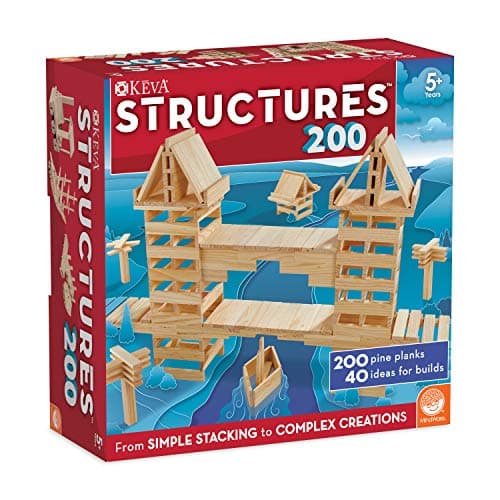
| 1 | Best shared gift overall KEVA Structures 200 Plank Set Two hundred identical planks, no connectors and no upper age limit — the fairest set in this list. | A sibling pair from five upward, any age gap | |
| 2 | 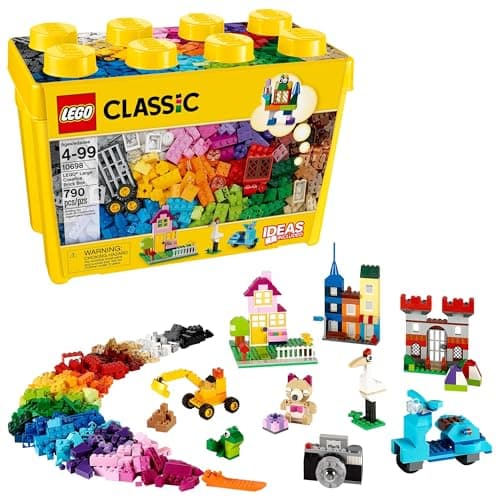 Most pieces LEGO Classic Large Creative Brick Box 790 pieces in 33 colors, published as compatible with all LEGO construction sets. | Four and up, two children, a long horizon | |
| 3 | 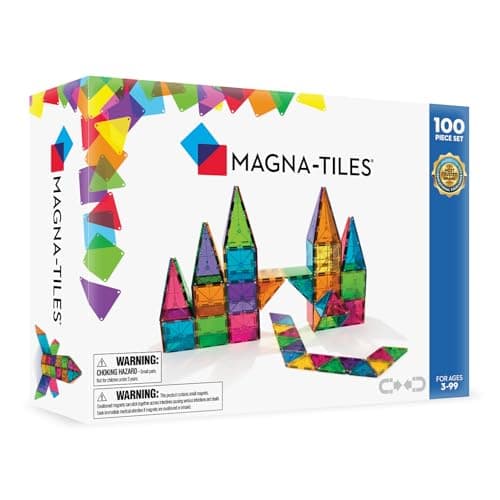 Best for a wide age gap MAGNA-TILES Classic 100-Piece Set A published 3-99 age range, so the youngest and oldest are genuinely both catered for. | Three to nine in the same household | |
| 4 | Best game to share ThinkFun Robot Turtles Published as a genuine multiplayer game, which almost nothing in this category is. | Two to five players, one an adult | |
| — |  Do not buy this for two ThinkFun Gravity Maze An excellent game, published as single player, and regularly given to a pair. | One child, aged eight or over |
5 picks, including 1 we tell you to skip. Ages shown are the manufacturer’s own rating, not ours.
The three tests a shared gift has to pass
The arithmetic
What makes a gift work for two children
| Enough pieces | Both can build at once without negotiating |
|---|---|
| Wide published age range | Covers both children, not just the older one |
| No turn order | Nobody is waiting for anything |
| Interchangeable pieces | No 'best piece' to fight over |
| No single solution | One child cannot use up the game |
Volume is the real specification
Most sibling friction over a construction toy is a supply problem wearing a fairness costume. One hundred magnetic tiles is enough for one builder; two children with 100 tiles will run out mid-structure and blame each other.
The published numbers worth holding on to: around 200 magnetic tiles for two builders, 200 KEVA planks as supplied, and 790 LEGO Classic pieces, which is comfortably enough for two and probably three.
Age gaps and what the ratings really mean
A wide published age range is the single most useful thing on a shared gift. Magna-Tiles publishes 3-99. KEVA publishes 5 and up with no upper bound. Both mean the same thing: the set has no finished state, so each child works at their own level from the same pile.
The opposite pattern is a narrow range like 6-10. That is a set aimed at one child, and the sibling is either too young to join or old enough to be bored.
Worth knowing before you buy
In a mixed-age household the youngest child’s age governs, not the recipient’s. A 4+ rating is a small-parts safety floor set by testing, and it does not stop applying because the parcel had someone else’s name on it. If there is a toddler in the house, the toddler decides.
The second-job trick for toys with one of something
Some good toys have exactly one interesting object — one robot, one microscope. They can still work for two children if there is a real second job.
The Code & Go Robot Mouse publishes 16 rearrangeable maze grids and 22 walls alongside its 30 coding cards. One child builds the maze while the other writes the program, and both jobs matter. Botley publishes 27 obstacle pieces for the same reason.
A microscope has no second job, which is why it is a gift for one child even though two can look through it.
When to buy two things instead
Be honest about the goal. If the point is the children playing together, buy a construction set or a multiplayer game. If the point is a peaceful afternoon, two separate single-player puzzles will do it better — and Kanoodle publishes 200+ puzzles at a price that makes buying two entirely reasonable.
Say the unwelcome thing
Do not wrap one puzzle game for two children
A single-player game given to a pair creates a solver and a spectator within about four minutes, and the challenges the older child solves are gone for good.
Buy something with no solution to use up, or buy two.
Where to go next
Coding toys for two or more children covers the robot side. STEM strategy games covers multiplayer logic, and the grandparent’s guide covers buying for a household you do not live in.
In full
Every pick, and what is wrong with it
Published specifications only, each linked back to the page it came from. Where a manufacturer publishes nothing, the row says so — we do not fill blanks in.
1. Best shared gift overall
KEVA Structures 200 Plank Set
KEVA Planks · Structures 200 · maker rates it 5+
Two hundred identical planks, no connectors and no upper age limit — the fairest set in this list.
- Planks
- 200, solid pine, precision-cut to identical dimensions
- Plank size
- About 4 1/2 in long x 3/4 in wide x 1/4 in thick
- Connectors
- None — planks stack with no glue, clips or notches
- Includes
- Idea booklet
The manufacturer publishes 200 solid pine planks precision-cut to identical dimensions, with no connectors of any kind, rated 5 and up.
Identical pieces are what makes this fair. In a mixed set there are desirable pieces and ordinary ones, and children know exactly which is which. Two hundred interchangeable planks cannot be hoarded, because every plank is the same plank.
No published upper age limit means a nine-year-old and a five-year-old are both building at their own ceiling from the same pile, which is unusual and worth a lot.
Replay signal
- Open-ended or one-shot
- As open-ended as construction gets — every plank is identical, so nothing constrains the build but balance
- Does anything run out
- Nothing runs out, and wood does not break the way plastic clips do
- Room to grow
- The same planks are used in adult-level structural challenges; there is no ceiling
Why we say so: The manufacturer publishes that the planks are precision-cut to identical dimensions and use no connectors of any kind. Identical, connector-free pieces is why this set has no upper age limit: the difficulty comes entirely from what the child attempts, not from what the box permits.
What’s wrong with it
Nothing clips, so one child's knock ends the other child's tower.
| Planks | 200, solid pine, precision-cut to identical dimensions |
|---|---|
| Plank size | About 4 1/2 in long x 3/4 in wide x 1/4 in thick |
| Connectors | None — planks stack with no glue, clips or notches |
| Includes | Idea booklet |
| Stated age | 5 and up |
| Consumables | None |
Every figure above is from KEVA Planks, Structures 200 Plank Set. Blanks are shown as “not published” rather than filled in.
2. Most pieces
LEGO Classic Large Creative Brick Box
LEGO · 10698 · maker rates it 4+
790 pieces in 33 colors, published as compatible with all LEGO construction sets.
- Pieces
- 790
- Colors
- 33
- Stated age
- 4 and up
- Includes
- 8 types of windows and doors, 2 green baseplates, 6 tires and wheel rims
LEGO publishes 790 pieces in 33 colors, rated 4 and up, compatible with all LEGO construction sets, with no consumables.
Seven hundred and ninety is the highest piece count in this list by a distance, and volume is the most reliable cure for sibling friction. The published compatibility statement also means every future set from either child joins the same collection.
Replay signal
- Open-ended or one-shot
- Open-ended — this is the box with no instructions and no finished model
- Does anything run out
- Nothing runs out
- Room to grow
- Every LEGO set the child is ever given pours into the same box
Why we say so: LEGO publishes the 790-piece count, the 33 colors and the box's compatibility with all LEGO construction sets. The absence of a build-this model is the product's stated design, not an omission.
What’s wrong with it
At 4+ it is a small-parts decision if a younger sibling is also in the house.
| Pieces | 790 |
|---|---|
| Colors | 33 |
| Stated age | 4 and up |
| Includes | 8 types of windows and doors, 2 green baseplates, 6 tires and wheel rims |
| Compatibility | Compatible with all LEGO construction sets |
| Consumables | None |
Every figure above is from LEGO, Large Creative Brick Box 10698. Blanks are shown as “not published” rather than filled in.
3. Best for a wide age gap
MAGNA-TILES Classic 100-Piece Set
Magna-Tiles · 4300 · maker rates it 3-99 years
A published 3-99 age range, so the youngest and oldest are genuinely both catered for.
- Pieces
- 100
- Shape mix
- 50 squares, 4 large squares, 20 equilateral triangles, 11 right triangles, 15 isosceles triangles
- Stated age
- “3-99 Years”
- Material
- “Food-grade, non-toxic MABS plastic that are free from BPAs, phthalates, and latex”
Magna-Tiles publishes a 3-99 year age range, the full shape mix — 50 squares, 4 large squares, 20 equilateral, 11 right and 15 isosceles triangles — and states all pieces work with all other Magna-Tiles sets.
The 3-99 range is the widest published span of anything on this site, which is exactly what a sibling gift needs. The caution is volume: at 100 tiles two children compete. See what to buy after the first 100.
Replay signal
- Open-ended or one-shot
- Open-ended — there is no finished state to reach
- Does anything run out
- Nothing runs out
- Room to grow
- Every set combines with every other Magna-Tiles set
Why we say so: Magna-Tiles publishes the full 100-piece shape breakdown, lists no consumable parts, and states that “all pieces are compatible with and complementary to all other MAGNA-TILES sets.”
What’s wrong with it
One hundred tiles is enough for one builder. Two children really want 200.
| Pieces | 100 |
|---|---|
| Shape mix | 50 squares, 4 large squares, 20 equilateral triangles, 11 right triangles, 15 isosceles triangles |
| Stated age | “3-99 Years” |
| Material | “Food-grade, non-toxic MABS plastic that are free from BPAs, phthalates, and latex” |
| Magnet retention | Signature lattice plus “fastening rivets keep magnets safe and secure” |
| Consumables | None |
Every figure above is from Magna-Tiles, Classic 100-Piece Set. Blanks are shown as “not published” rather than filled in.
4. Best game to share
ThinkFun Robot Turtles
ThinkFun · 1900 · maker rates it 4+
Published as a genuine multiplayer game, which almost nothing in this category is.
- Stated age
- Ages 4 and up
- Players
- 2-5, one of whom is an adult acting as “the computer”
- Batteries
- None
- Format
- Board game teaching programming fundamentals
ThinkFun publishes 2-5 players with an adult acting as the computer, rated 4 and up, no batteries and no consumables.
If the goal is the two children doing something together rather than merely near each other, this is the one game here designed for it.
Replay signal
- Open-ended or one-shot
- Open-ended, because the adult builds the board — difficulty scales with the child rather than with a deck
- Does anything run out
- Nothing runs out
- Room to grow
- The published rules add function cards and obstacles as the child improves
- Adult required
- Yes, always — an adult plays the computer. That is the design, and it is the whole cost
Why we say so: ThinkFun publishes the 4+ rating and the rule that an adult executes the child's program. An adult being structurally required is the single biggest predictor of whether a toy actually gets used, so it belongs in the headline rather than the small print.
What’s wrong with it
An adult has to act as the computer, so the children cannot start it alone.
| Stated age | Ages 4 and up |
|---|---|
| Players | 2-5, one of whom is an adult acting as “the computer” |
| Batteries | None |
| Format | Board game teaching programming fundamentals |
| Consumables | None |
Every figure above is from ThinkFun games. Blanks are shown as “not published” rather than filled in.
Skip this one
ThinkFun Gravity Maze
ThinkFun · 44001006 · maker rates it 8+
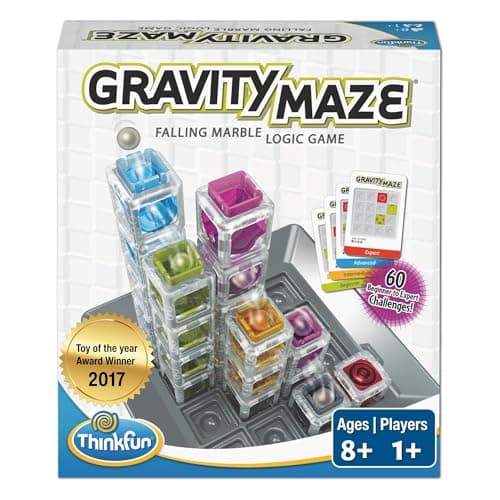
An excellent game, published as single player, and regularly given to a pair.
- Challenges
- 60, beginner to expert
- Contents
- Game grid, 9 towers, 1 target piece, 3 marbles, 60 challenge cards
- Players
- 1
- Batteries
- None
ThinkFun publishes 60 challenges, a grid with 9 towers, 1 target piece and 3 marbles, one player, rated 8+.
Given to two children this produces a solver and a spectator, and the spectator is almost always the younger one. Worse, a solved challenge cannot be re-solved, so the older child quietly consumes the younger’s share of the game.
If both children want puzzles, two cheap solo games beat one good shared one — games for one player has the options.
Replay signal
- Open-ended or one-shot
- Finite by design — 60 challenges, and a determined child will finish them
- Does anything run out
- Nothing physically runs out, but the challenge cards do end
- Room to grow
- The towers can be used freely once the cards are done, though nothing in the box prompts that
Why we say so: ThinkFun publishes 60 challenges and a fixed component list. Sixty is a real number with a real end, and single-player puzzle games are the category where that matters most — better to know before you buy it as the main present.
What’s wrong with it
One grid, one target, 60 cards — and the game is over for both once one child sees the answer.
| Challenges | 60, beginner to expert |
|---|---|
| Contents | Game grid, 9 towers, 1 target piece, 3 marbles, 60 challenge cards |
| Players | 1 |
| Batteries | None |
| Stated age | Ages 8+ |
| Consumables | None |
Every figure above is from ThinkFun, Gravity Maze. Blanks are shown as “not published” rather than filled in.
We are not putting a buy button on this one. It is easy enough to find if you want it anyway — but we would rather send you to something that gets played with twice.
Questions people actually ask
Frequently asked
What STEM toy is best for two children to share?
A construction set with interchangeable pieces and a wide published age range. KEVA Structures publishes 200 identical planks with no connectors and no upper age limit, so two children of different ages build at their own level from the same pile and there is no 'best piece' to argue over.
How many magnetic tiles do two children need?
Around 200. One hundred is enough for a single builder, and two children sharing 100 will run out mid-structure — which is when a shared gift becomes a negotiation. What to buy after the first 100.
Can two children share a logic puzzle game?
Not well. Gravity Maze, IQ Puzzler Pro, Code Master and Rush Hour Junior are all published as single player with one board and one set of pieces. Once one child solves a challenge it is used up for both. Two inexpensive solo games work better than one shared game.
Does the age rating apply to the whole household?
For safety, yes. A low age rating such as 3+ or 4+ is a small-parts floor set by toy safety testing, and it applies to whoever can reach the pieces — not just the child whose birthday it was. Toy safety standards explained.
Sources
Where these figures came from
Every specification on this page traces to one of these. If a manufacturer publishes nothing on a point, the page says so rather than filling the gap.
Read next
Where to go from here
Back to Gift Guides, or read how we pick.