Guide and picks
Montessori Toys vs STEM Toys
Two different design philosophies that agree about more than either community usually admits.
By Sawyer V. · Published
The short answer
Montessori materials are designed around self-correction, one isolated concept at a time, and natural materials with no batteries. STEM toys are designed around reasoning, often with more than one concept at once and often electronic. The overlap is large: open-ended construction sets satisfy both.
Block & Beaker earns a commission when you buy through our links, at no cost to you. It never changes a ranking, and we say so plainly when the right answer is the cheaper set, or nothing at all. Full disclosure · How we pick.
At a glance
The picks, ranked
Tap any row to jump to the full reasoning. Prices come live from Amazon where we have them and read “check price” where we don’t — never a number we cannot stand behind today.
| # | Product | Best for | Price |
|---|---|---|---|
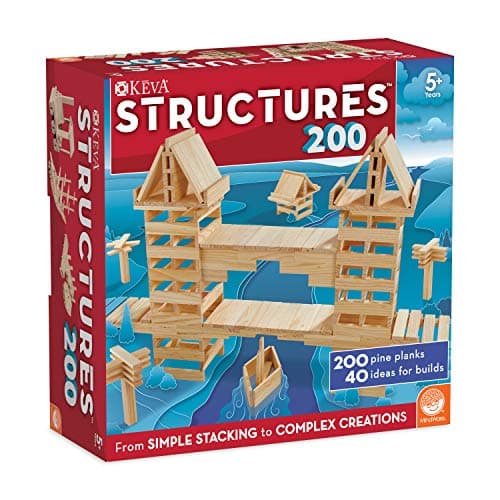
| 1 | Satisfies both KEVA Structures 200 Plank Set Identical wooden planks, no connectors, no batteries, self-correcting by gravity. | Five and up, in a household with either philosophy | |
| 2 | 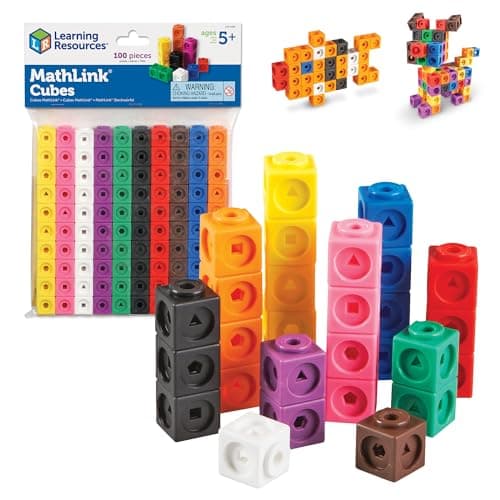 The concrete-to-abstract material MathLink Cubes, Set of 100 A hundred cubes that make mathematics physical before it becomes symbolic. | Five to nine, and a household that likes manipulatives | |
| 3 | 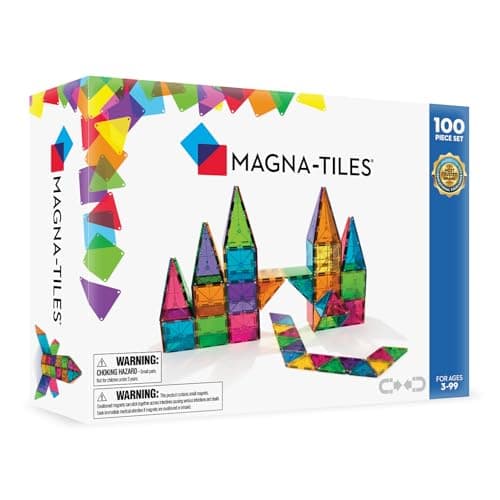 Contested, and worth having anyway MAGNA-TILES Classic 100-Piece Set Open-ended and self-correcting, and made of plastic with magnets in it. | Three and up, in a household that is not strict about it | |
| — | 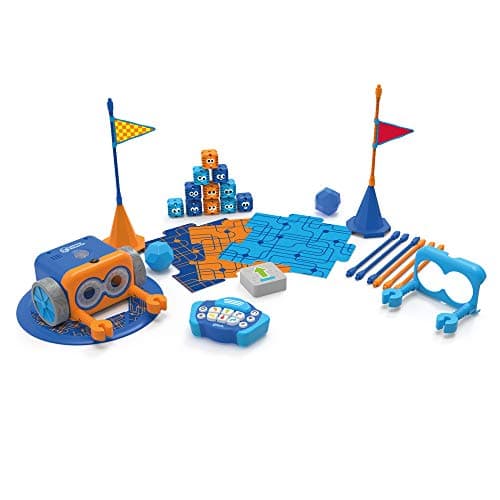 Not Montessori, and fine Botley 2.0 The Coding Robot Activity Set A battery-powered plastic robot with lights and sounds — the honest example of where the two diverge. | Five and up, in a household that is not applying the philosophy |
4 picks, including 1 we tell you to skip. Ages shown are the manufacturer’s own rating, not ours.
What Montessori materials are actually designed around
Four principles come up consistently, and they are design constraints rather than aesthetics.
Self-correction. The material shows the child whether they are right without an adult saying so. A cylinder that will not fit its hole is the correction.
Isolation of a concept. One variable at a time. A set that teaches size teaches only size, so the child’s attention is not split.
Natural materials. Wood, metal, fabric, glass. Partly sensory — different materials have different weight and temperature — and partly about durability and beauty.
No batteries. The child supplies the energy and the intention. A toy that performs on its own puts the child in the audience.
What STEM toys are designed around
Less codified, but broadly: reasoning that is required rather than optional, iteration on failure, and content from science, technology, engineering or math. Materials, battery use and how many concepts are in play at once are unconstrained.
Where they agree
The arithmetic
Shared criteria, and the toys that meet both
| Self-correcting | A tower falls; a marble stops; a circuit stays dark |
|---|---|
| Open-ended | Construction sets, planks, linking cubes |
| Child-directed | No adult adjudication needed |
| No batteries | KEVA planks, Gears, magnetic tiles, linking cubes |
| Natural materials | KEVA planks, wooden marble runs |
Where they genuinely diverge
Batteries and electronics. This is the clearest split. A coding robot is a legitimate and useful STEM toy and is not a Montessori material. There is no reconciling that, and pretending otherwise helps nobody.
Fantasy and character. Montessori practice discourages fantasy elements for young children in favor of the real world. A robot with a face and a name contradicts that directly.
Multiple concepts at once. A science kit covering chemistry, earth science and magic tricks is the opposite of isolating one concept.
Plastic. Most of this category is plastic, including several things we recommend. Wooden equivalents exist for construction toys and mostly do not for circuits.
Say the unwelcome thing
Do not buy a toy labeled Montessori without checking
“Montessori” is as unregulated a marketing term as “STEM”. Neither has a certifying body, and both appear on products that meet none of the criteria.
Check against the four principles instead: is it self-correcting, does it isolate one concept, what is it made of, does it need batteries. Those are observable, and they are more reliable than the word on the box.
What we would actually do
For a household applying Montessori consistently: wooden open-ended construction, linking manipulatives, and no electronics before six.KEVA planks and a wooden marble run cover most of it.
For a household that likes the principles without the orthodoxy: use self-correction and open-endedness as buying criteria and ignore the material question. That gets you most of the benefit and does not rule out magnetic tiles or circuits.
For anyone else: the four-part test in toys that actually teach overlaps heavily with the Montessori criteria and asks less of you.
In full
Every pick, and what is wrong with it
Published specifications only, each linked back to the page it came from. Where a manufacturer publishes nothing, the row says so — we do not fill blanks in.
1. Satisfies both
KEVA Structures 200 Plank Set
KEVA Planks · Structures 200 · maker rates it 5+
Identical wooden planks, no connectors, no batteries, self-correcting by gravity.
- Planks
- 200, solid pine, precision-cut to identical dimensions
- Plank size
- About 4 1/2 in long x 3/4 in wide x 1/4 in thick
- Connectors
- None — planks stack with no glue, clips or notches
- Includes
- Idea booklet
The manufacturer publishes 200 solid pine planks precision-cut to identical dimensions, with no glue, clips or notches, rated 5 and up.
On Montessori criteria: natural material, no batteries, self-correcting — a structure stands or falls with no adult judgment — and it isolates one concept, which is balance.
On STEM criteria: continuous structural reasoning, no ceiling, and failure that is informative rather than final. It scores about as well as anything can on both sets of criteria at once.
Replay signal
- Open-ended or one-shot
- As open-ended as construction gets — every plank is identical, so nothing constrains the build but balance
- Does anything run out
- Nothing runs out, and wood does not break the way plastic clips do
- Room to grow
- The same planks are used in adult-level structural challenges; there is no ceiling
Why we say so: The manufacturer publishes that the planks are precision-cut to identical dimensions and use no connectors of any kind. Identical, connector-free pieces is why this set has no upper age limit: the difficulty comes entirely from what the child attempts, not from what the box permits.
What’s wrong with it
Falls over constantly, which is the self-correction working and is not what everyone wants at four in the afternoon.
| Planks | 200, solid pine, precision-cut to identical dimensions |
|---|---|
| Plank size | About 4 1/2 in long x 3/4 in wide x 1/4 in thick |
| Connectors | None — planks stack with no glue, clips or notches |
| Includes | Idea booklet |
| Stated age | 5 and up |
| Consumables | None |
Every figure above is from KEVA Planks, Structures 200 Plank Set. Blanks are shown as “not published” rather than filled in.
2. The concrete-to-abstract material
MathLink Cubes, Set of 100
Learning Resources · LER4285 · maker rates it 5+
A hundred cubes that make mathematics physical before it becomes symbolic.
- Cubes
- 100, in 10 colors
- Cube size
- 3/4 inch
- Connection
- Links on all sides, with geometric shape cut-outs for patterning
- Stated age
- Ages 5 and up
Learning Resources publishes 100 cubes in 10 colors, three quarters of an inch each, linking on all sides with geometric shape cut-outs, rated 5 and up.
The concrete-to-abstract progression is one of Montessori’s central ideas and it is exactly what these do: quantity becomes a thing you can hold before it becomes a numeral.
The material is the honest divergence. These are plastic, and a household committed to natural materials will prefer wooden equivalents — which exist and cost considerably more.
Replay signal
- Open-ended or one-shot
- Completely open-ended, and unusually cheap for something that is
- Does anything run out
- Nothing runs out
- Room to grow
- The same cubes cover counting at five and volume, arrays and fractions at nine
Why we say so: Learning Resources publishes that the cubes link on all sides with geometric cut-outs. All-sides connection is what turns a counting toy into a building toy — a cube that only joins end to end makes towers, and one that joins on six faces makes arrays, volumes and models.
What’s wrong with it
Plastic rather than a natural material, which for a strict Montessori household is a real objection.
| Cubes | 100, in 10 colors |
|---|---|
| Cube size | 3/4 inch |
| Connection | Links on all sides, with geometric shape cut-outs for patterning |
| Stated age | Ages 5 and up |
| Batteries | None |
| Consumables | None |
Every figure above is from Learning Resources, MathLink Cubes, Set of 100. Blanks are shown as “not published” rather than filled in.
3. Contested, and worth having anyway
MAGNA-TILES Classic 100-Piece Set
Magna-Tiles · 4300 · maker rates it 3-99 years
Open-ended and self-correcting, and made of plastic with magnets in it.
- Pieces
- 100
- Shape mix
- 50 squares, 4 large squares, 20 equilateral triangles, 11 right triangles, 15 isosceles triangles
- Stated age
- “3-99 Years”
- Material
- “Food-grade, non-toxic MABS plastic that are free from BPAs, phthalates, and latex”
Magna-Tiles publishes 100 pieces in a specified shape mix, rated 3-99 years, in food-grade MABS plastic with magnets held by a lattice and fastening rivets.
On the Montessori side of the ledger: completely open-ended, entirely self-directed, no batteries, and it isolates geometry and structure.
On the other side: plastic, and the magnets arguably do work the child’s hands should be doing. That objection is coherent — a magnetic tile removes the fine motor challenge deliberately, which is the whole reason it works at three.
Replay signal
- Open-ended or one-shot
- Open-ended — there is no finished state to reach
- Does anything run out
- Nothing runs out
- Room to grow
- Every set combines with every other Magna-Tiles set
Why we say so: Magna-Tiles publishes the full 100-piece shape breakdown, lists no consumable parts, and states that “all pieces are compatible with and complementary to all other MAGNA-TILES sets.”
What’s wrong with it
Plastic and magnetic, both of which some Montessori guidance discourages. It is a genuine philosophical divergence rather than a misunderstanding.
| Pieces | 100 |
|---|---|
| Shape mix | 50 squares, 4 large squares, 20 equilateral triangles, 11 right triangles, 15 isosceles triangles |
| Stated age | “3-99 Years” |
| Material | “Food-grade, non-toxic MABS plastic that are free from BPAs, phthalates, and latex” |
| Magnet retention | Signature lattice plus “fastening rivets keep magnets safe and secure” |
| Consumables | None |
Every figure above is from Magna-Tiles, Classic 100-Piece Set. Blanks are shown as “not published” rather than filled in.
Skip this one
Botley 2.0 The Coding Robot Activity Set
Learning Resources · LER2938 · maker rates it 5+
A battery-powered plastic robot with lights and sounds — the honest example of where the two diverge.
- Set size
- 78 pieces
- Contents
- Botley 2.0, remote programmer, 2 face plates, 40 coding cards, 6 double-sided boards, 27 obstacle pieces, starter guide
- Maximum program length
- “coding sequences of up to 150 steps”
- Movement
- Six directions, plus 16 coded interactions
Learning Resources publishes 78 pieces, sequences of up to 150 steps, six directions and 16 interactions, 100% screen-free, rated 5+, requiring five AAA batteries.
We are marking this as the skip on a Montessori comparison page and recommending it warmly everywhere else, which is the honest position. It is our top coding pick on the robots page.
But it is not a Montessori material by any reading: it has batteries, it makes noises, it has a face, and it does several things at once. A household applying the philosophy consistently should know that rather than be sold a false compatibility.
Replay signal
- Open-ended or one-shot
- Open-ended once the cards are understood — the child builds the maze, not just the program
- Does anything run out
- Nothing runs out except batteries
- Room to grow
- A 150-step ceiling means the challenge scales for years past the first week
- Adult required
- Needed for the first session, then not — there is no app account and nothing to log into
Why we say so: Learning Resources publishes the 78-piece contents, the 150-step maximum sequence, the six directions and 16 interactions, and states the set is 100% screen-free with no tablet or app required.
What’s wrong with it
Batteries, plastic, sound effects and a fantasy element. It contradicts several Montessori principles at once.
| Set size | 78 pieces |
|---|---|
| Contents | Botley 2.0, remote programmer, 2 face plates, 40 coding cards, 6 double-sided boards, 27 obstacle pieces, starter guide |
| Maximum program length | “coding sequences of up to 150 steps” |
| Movement | Six directions, plus 16 coded interactions |
| Screen required | None — “100% screen-free play” |
| Batteries | “Requires 5 AAA batteries (not included)” |
| Stated age | 5+ (K-2nd grade) |
Every figure above is from Learning Resources, Botley 2.0 Activity Set. Blanks are shown as “not published” rather than filled in.
We are not putting a buy button on this one. It is easy enough to find if you want it anyway — but we would rather send you to something that gets played with twice.
Questions people actually ask
Frequently asked
What is the difference between Montessori and STEM toys?
Montessori materials are designed around self-correction, isolating one concept, natural materials and no batteries. STEM toys are designed around required reasoning, with no constraint on materials or electronics. Open-ended construction sets satisfy both sets of criteria.
Are magnetic tiles Montessori?
Contested, and honestly so. They are open-ended, self-directed and battery-free, which fits. They are also plastic and magnetic, and the magnets deliberately remove the fine motor challenge — which is a coherent objection rather than a misunderstanding.
Can a coding robot be a Montessori toy?
No, on any consistent reading. Batteries, sounds, a character with a face and several things happening at once all contradict the principles. That does not make it a bad toy — it is our top coding pick elsewhere — but the incompatibility is real. Where we do recommend it.
Is 'Montessori' a regulated term on toys?
No, exactly like 'STEM'. Neither has a certifying body and both appear on products meeting none of the criteria. Check against the four principles — self-correcting, one concept, natural materials, no batteries — rather than the word on the box.
Sources
Where these figures came from
Every specification on this page traces to one of these. If a manufacturer publishes nothing on a point, the page says so rather than filling the gap.
Read next
Where to go from here
Back to Guides, or read how we pick.