Guide and picks
Science Kits by Age
The science aisle has one cliff in it. Almost everything publishes eight and up, and the reason is what is inside the box.
By Sawyer V. · Published
The short answer
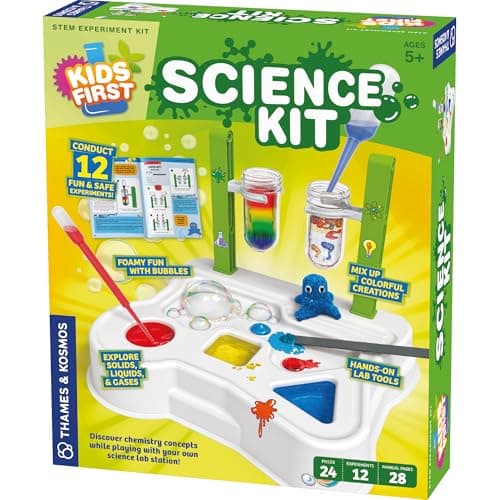
The science shelf has a wall at eight. Below it, buy tools and field kits: Kids First Science Laboratory publishes 3 to 6+ with 24 reusable tools and no chemicals, and the Bug Catcher Kit publishes 4+. From eight, boxed experiment kits open up — the Dual LED microscope and Mega Science Lab both publish 8+. Real reagents start at ten.
Block & Beaker earns a commission when you buy through our links, at no cost to you. It never changes a ranking, and we say so plainly when the right answer is the cheaper set, or nothing at all. Full disclosure · How we pick.
At a glance
The picks, ranked
Tap any row to jump to the full reasoning. Prices come live from Amazon where we have them and read “check price” where we don’t — never a number we cannot stand behind today.
| # | Product | Best for | Price |
|---|---|---|---|
| 1 | Ages 3 to 6 Kids First Science Laboratory 24 large reusable tools and 10 double-sided cards, with no chemicals in the box. | Three to six, for tools rather than a kit | |
| 2 | 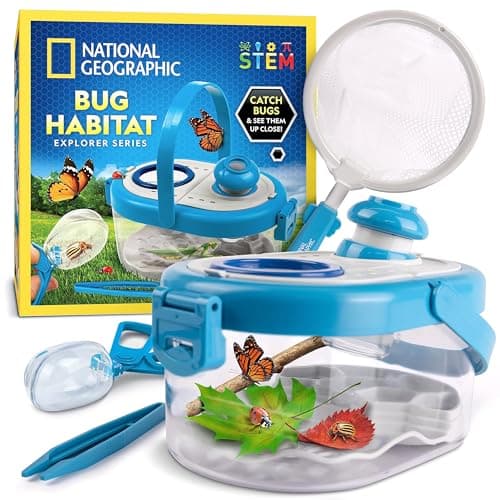 Ages 4 to 7 NATIONAL GEOGRAPHIC Bug Catcher Kit A habitat with two magnified viewers and real tools — and the specimens are free. | Four and up, for a child who already looks at things outside | |
| 3 | 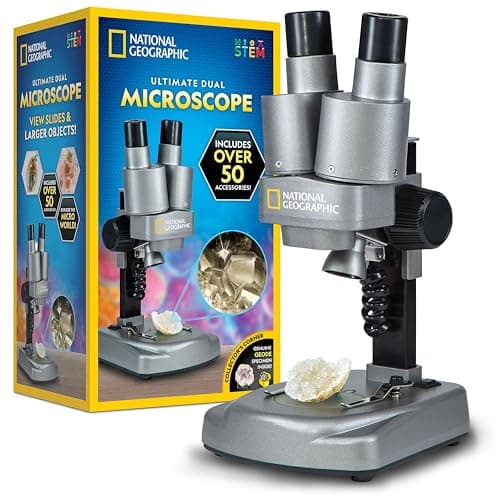 Ages 8 to 11 NATIONAL GEOGRAPHIC Dual LED Student Microscope 20x and 50x with lighting above and below the stage, plus 50+ accessory pieces. | Eight and up, as the one science purchase that never runs out | |
| 4 | 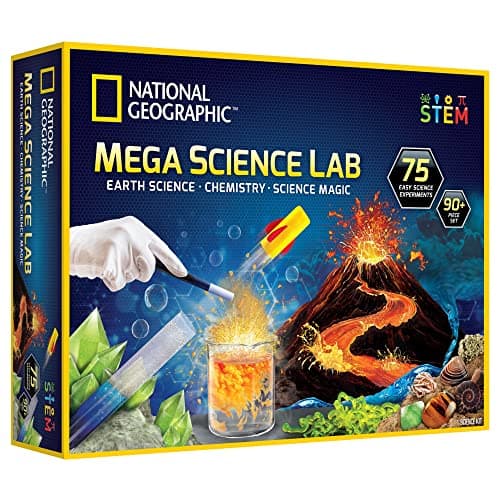 Ages 8 to 10 NATIONAL GEOGRAPHIC Mega Science Lab 45 in-kit experiments plus a bonus guide of 85+ using household items. | Eight to ten, for breadth before a specialism appears | |
| 5 | 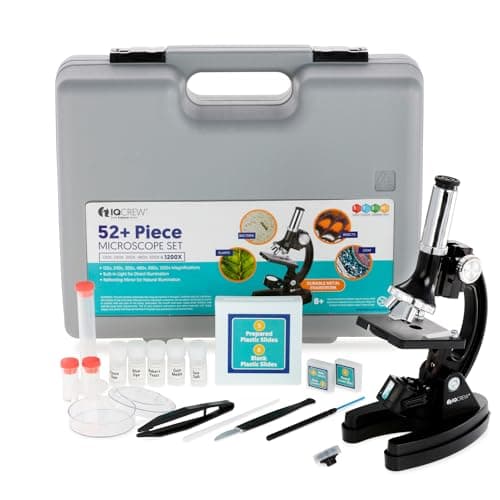 Twelve and up, bought on the spec sheet AmScope 120X-1200X Beginner Microscope Kit Six magnifications on a metal arm, with a 52-piece accessory kit and an 8+ floor. | Twelve and up, when the toy range has been outgrown | |
| — | 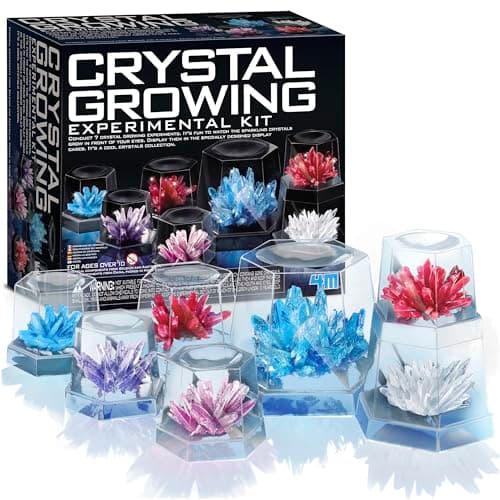 Not the kit to buy by age 4M Crystal Growing Experiment Kit Seven crystal-growing experiments — and the compound is the whole product. | Ten and up, for one week of patience |
6 picks, including 1 we tell you to skip. Ages shown are the manufacturer’s own rating, not ours.
The whole shelf, by published age
The arithmetic
Science purchases and the age their maker publishes
| Kids First Science Laboratory | 3 to 6+ — 24 reusable tools, no chemicals |
|---|---|
| Bug Catcher Kit | 4+ — habitat, two magnified viewers, net and tweezers |
| Dual LED Student Microscope | 8+ — 20x and 50x, light above and below |
| Mega Science Lab | 8+ — 45 in-kit experiments, 85+ household |
| Break Open Geodes | 8 years minimum; small parts, not for under 3 |
| Dinosaur Dig Kit | 8+ — 2 fossils, gypsum-and-clay brick |
| Volcano Science Kit | 8 and up, adult supervision published |
| Weather Station Kit | 8 and up — 4 instruments (a Green Science version is 5+) |
| Hobby Rock Tumbler | 8+ — 4 grits, 9 gemstone types, shutoff timer |
| Crystal Growing Kit (4M) | 10 years and up — 7 experiments, all consumable |
| CHEM C500 | 10 years and up — 28 experiments, 5 chemicals |
| CHEM C1000 | 10 and up — 7 chemicals, EN 71-4 named |
| My First Lab Duo-Scope | 9 and older — 40x, 100x, 400x, real glass optics |
| AmScope 120X-1200X kit | “For ages 8+” — metal arm, 70 x 65 mm stage |
Why almost everything publishes 8+
Three things push a science kit to eight, and a kit usually has at least two of them.
Chemicals. Anything with supplied reagents, plaster, eruption powder or crystal compound carries a handling warning, and makers set the age above the point where a child reliably does not taste things.
Small parts. National Geographic publishes “contains small parts; not for children under 3” on the geode kit, and the pattern repeats across the range. Tweezers, slides, droppers and marbles all cost published years.
Reading. A 48-page manual is the product in a chemistry set. The experiment is not the pouring, it is the method, and eight is roughly when a child can follow written steps without an adult reading each one aloud.
What to buy on each side of the wall
Three to five: tools, not kits. Buy reusable equipment and let the kitchen supply the experiment. Kids First Science Laboratory publishes 24 tools and no chemicals; the tools then outlast the ten cards by years.
Four to seven: field kits. The outdoors has no age rating. A bug catcher, a magnifier or a net publishes 4+ because there is nothing hazardous in the box, and the specimen supply is unlimited and free.
Eight to ten: breadth. The whole shelf opens at once and this is the wrong moment to specialize. A broad kit with a household bonus guide, or a microscope, covers the year or two before a child declares an interest.
Ten to twelve: the first real chemistry set. Thames & Kosmos publishes its C-series at 10 and up and states compliance with EN 71-4. This is a hard line rather than a cautious one — see chemistry sets by age.
Twelve and up: specifications, not ratings. By here the published age has stopped discriminating — an 8+ floor on a metal-framed compound scope says nothing about a fourteen-year-old. Judge them on aperture, magnification, frame material and stage size.
The consumable question, by age
A kit’s published age and its lifespan are independent, and a by-age list is where that becomes obvious. The 3-to-6 pick has zero consumables; four of the 8+ kits are destroyed in use; the 10+ crystal kit is entirely compound.
The practical rule this produces: the younger the child, the more the purchase should be equipment. A four-year-old does not remember an experiment, but they do pick up the magnifier again next week. By ten, a guided consumable kit with a real manual earns its place because the method is the thing being learned.
Worth knowing before you buy
So which one
Three or four: Kids First Science Laboratory.
Four to seven, and they like being outside: the Bug Catcher Kit.
Eight, one purchase, no idea what they like: Mega Science Lab.
Eight to eleven, and you want it to still be used next year: the Dual LED microscope.
Ten and up, and they want real chemistry: CHEM C500 at 10 and up, then CHEM C1000.
Twelve and up: the AmScope 120X-1200X kit, bought on the metal frame rather than the top number.
Say the unwelcome thing
Do not buy an 8+ experiment kit for a five-year-old because the box looks friendly
It is the most common mistake on this shelf, and the packaging encourages it. The 8+ rating on these kits is doing real work — supplied chemicals, small parts, a written manual — and bought three years early the outcome is an adult performing experiments while a child watches. Buy the tools at five and the kit at eight; the tools are still in use when the kit arrives.
Where to go next
First science kits for ages 3 to 6 covers the bottom of the ladder in depth, chemistry sets by age covers the 10+ line, and what to buy after a first science kit covers the second purchase. For the one subject this hub had no page for at all, see physics kits for kids — where every box on the shelf publishes 8 and up.
In full
Every pick, and what is wrong with it
Published specifications only, each linked back to the page it came from. Where a manufacturer publishes nothing, the row says so — we do not fill blanks in.
1. Ages 3 to 6
Kids First Science Laboratory
Thames & Kosmos · Kids First Science Laboratory · maker rates it 3-6+
24 large reusable tools and 10 double-sided cards, with no chemicals in the box.
- Contents
- 24 large plastic scientific tools, described as durable, reusable and easy to handle
- Experiment cards
- 10, double-sided
- Stated age
- 3 to 6+
- Chemicals included
- None — experiments use household materials
Thames & Kosmos publishes 24 large plastic scientific tools described as durable, reusable and easy to handle, 10 double-sided experiment cards, no chemicals — the experiments use household materials — and no consumables in the box, rated 3 to 6+.
Zero consumables is the specification that makes this the right purchase this young. Nearly every other science product under six is a sequence of single-use activities; 24 reusable tools work on whatever is in the kitchen after the ten cards are done.
Replay signal
- Open-ended or one-shot
- The 20 card sides are a starting ladder; the tools then work on anything in the kitchen
- Does anything run out
- Nothing in the box runs out, because nothing in the box is consumed
- Room to grow
- The same tools carry into any household-materials experiment for years
- Adult required
- Yes at three, less so at five. The cards are picture-led but the setup is not
Why we say so: Thames & Kosmos publishes 24 reusable tools and no chemicals. A preschool science kit with no consumables in it is unusual, and it is the reason this one survives past its first fortnight when kit-of-the-week alternatives do not.
What’s wrong with it
An adult sets up every session at three and four. The cards are picture-led; the setup is not.
| Contents | 24 large plastic scientific tools, described as durable, reusable and easy to handle |
|---|---|
| Experiment cards | 10, double-sided |
| Stated age | 3 to 6+ |
| Chemicals included | None — experiments use household materials |
| Consumables | None in the box |
Every figure above is from Thames & Kosmos, Kids First range. Blanks are shown as “not published” rather than filled in.
2. Ages 4 to 7
NATIONAL GEOGRAPHIC Bug Catcher Kit
National Geographic · Bug Catcher Kit · maker rates it 4+
A habitat with two magnified viewers and real tools — and the specimens are free.
- Habitat
- Clear bug habitat with a removable base
- Viewers
- Latching lid with two magnified viewers — one fixed, one movable
- Tools
- Scissor-style bug catcher, net, tweezers
- Includes
- Learning guide
National Geographic publishes a clear bug habitat with a removable base, a latching lid with two magnified viewers — one fixed and one movable — a scissor-style bug catcher, a net, tweezers and a learning guide, rated 4+, with no consumables because the specimens are outside and free.
This is the published answer to the 8+ wall at four and five. A field kit does not need chemicals or small precision parts, so its rating can sit four years below the boxed experiment kits while still being real science equipment.
Replay signal
- Open-ended or one-shot
- Completely open-ended for the age — the garden restocks it
- Does anything run out
- Nothing runs out
- Room to grow
- Pairs naturally with a low-power microscope when the child wants a closer look
- Adult required
- For the catch-and-release rule; not for the looking
Why we say so: National Geographic publishes a habitat with two magnified viewers, a scissor catcher, a net and tweezers, rated 4+. The scissor catcher is the specification worth noticing: it lets a four-year-old pick up an insect without crushing it, which is the difference between a nature kit and a lesson about being gentle.
What’s wrong with it
Needs a garden, a park or a verge. Indoors it is a box with nothing in it.
| Habitat | Clear bug habitat with a removable base |
|---|---|
| Viewers | Latching lid with two magnified viewers — one fixed, one movable |
| Tools | Scissor-style bug catcher, net, tweezers |
| Includes | Learning guide |
| Stated age | 4+ |
| Consumables | None — the specimens are outside and free |
Every figure above is from National Geographic toys, Bug Catcher Kit. Blanks are shown as “not published” rather than filled in.
3. Ages 8 to 11
NATIONAL GEOGRAPHIC Dual LED Student Microscope
National Geographic · Dual LED Student Microscope · maker rates it 8+
20x and 50x with lighting above and below the stage, plus 50+ accessory pieces.
- Magnifications
- 20x and 50x, from two sets of optical glass lenses
- Lighting
- Upper and lower LED
- Accessories
- 50+ pieces, including 10 prepared slides, blank slides and covers, tweezers, eye-dropper and a mini geode
- Weight
- 2.6 lb
National Geographic publishes 20x and 50x magnifications from two sets of optical glass lenses, upper and lower LED lighting, 50+ accessory pieces including 10 prepared slides, blank slides and covers, tweezers, an eye-dropper and a mini geode, at 2.6 lb, rated 8+.
Lighting from above as well as below is the published detail that decides this purchase. Lower light only works on thin, transparent slides; upper light means a leaf, a coin or a dead wasp works too, which is the difference between ten prepared slides and an endless supply.
Low magnification is a feature at this age rather than a compromise. See the review and microscopes for kids.
Replay signal
- Open-ended or one-shot
- Open-ended, and the low magnification is the reason — 20x is where insects and leaves look extraordinary
- Does anything run out
- The 10 prepared slides run out; blank slides and the garden do not
- Room to grow
- Limited on magnification, generous on subject matter
Why we say so: National Geographic publishes 20x and 50x with upper and lower LED lighting. Low magnification plus top lighting is a deliberate design for looking at whole objects rather than slides, which for a child under about ten is a far better first microscope than a 1000x compound scope they cannot focus.
What’s wrong with it
20x and 50x only. A child who wants to see bacteria will be disappointed.
| Magnifications | 20x and 50x, from two sets of optical glass lenses |
|---|---|
| Lighting | Upper and lower LED |
| Accessories | 50+ pieces, including 10 prepared slides, blank slides and covers, tweezers, eye-dropper and a mini geode |
| Weight | 2.6 lb |
| Stated age | 8+ |
Every figure above is from National Geographic toys, Dual LED Student Microscope. Blanks are shown as “not published” rather than filled in.
4. Ages 8 to 10
NATIONAL GEOGRAPHIC Mega Science Lab
National Geographic · Mega Science Lab · maker rates it 8+
45 in-kit experiments plus a bonus guide of 85+ using household items.
- Experiments in the kit
- 45, across chemistry, earth science and science magic
- Bonus guide
- 85+ further experiments using household items, for 130+ in total
- Includes
- Volcano build, glow-in-the-dark crystal growth, and the tools for both
- Stated age
- 8+
National Geographic publishes 45 experiments in the kit across chemistry, earth science and science magic, a bonus guide of 85+ further experiments using household items for 130+ in total, a volcano build and glow-in-the-dark crystal growth, rated 8+.
The bonus guide is why this sits on a by-age page rather than only on the roundup. Eight to ten is the age where you do not yet know whether a child is a chemist or a geologist, and roughly two-thirds of the published content needs nothing but a kitchen, so the kit keeps working while you find out.
Replay signal
- Open-ended or one-shot
- Guided, and the 45 in-kit experiments end. The 85 household ones do not
- Does anything run out
- The supplied materials run out; the household half of the book never does
- Room to grow
- The bonus guide is the genuinely durable part, and it costs the manufacturer almost nothing to include
- Adult required
- Supervision for the chemistry third; the earth science and household experiments are largely self-run
Why we say so: National Geographic publishes 45 in-kit experiments plus a bonus guide of 85+ using household items. That second number is why this kit outlasts most of its price band: roughly two-thirds of the published content needs nothing but a kitchen.
What’s wrong with it
The supplied chemicals and crystal compounds are used up. Two-thirds of the book is not.
| Experiments in the kit | 45, across chemistry, earth science and science magic |
|---|---|
| Bonus guide | 85+ further experiments using household items, for 130+ in total |
| Includes | Volcano build, glow-in-the-dark crystal growth, and the tools for both |
| Stated age | 8+ |
| Consumables | Yes — the supplied chemicals and crystal compounds are used up |
Every figure above is from National Geographic toys, Mega Science Lab. Blanks are shown as “not published” rather than filled in.
5. Twelve and up, bought on the spec sheet
AmScope 120X-1200X Beginner Microscope Kit
AmScope · M30-ABS-KT2 · maker rates it 8+
Six magnifications on a metal arm, with a 52-piece accessory kit and an 8+ floor.
- Magnifications
- Six levels — 120x, 240x, 300x, 480x, 600x and 1200x
- Frame
- Metal arm, with stage clips
- Lighting
- Built-in LED plus a reflecting mirror
- Extras
- Rotating color filter wheel; 52-piece accessory kit
AmScope publishes six magnification levels — 120x, 240x, 300x, 480x, 600x and 1200x — a metal arm with stage clips, built-in LED plus a reflecting mirror, a rotating color filter wheel, a 52-piece accessory kit, a 70 x 65 mm stage and a published shipping weight of 6 lb, rated “For ages 8+”.
That 8+ is why it sits here rather than further up the page. An 8+ floor on a metal-framed compound scope tells you almost nothing about whether a fourteen-year-old will use it, so above about twelve the specification sheet takes over from the rating — a metal frame and a real stage outlast the interest in a way a 2.6 lb plastic body does not.
Treat the top magnification with skepticism: at 1200x an entry-level objective gives a large, dim, blurry image. See the AmScope review and microscopes for teens.
Replay signal
- Open-ended or one-shot
- Open-ended — specimens are free and infinite
- Does anything run out
- The prepared slides in the accessory kit run out; blank slides do not
- Room to grow
- 1200x is well past what a child needs and past what the optics comfortably resolve, but the metal frame will outlast the interest
Why we say so: AmScope publishes six magnification levels, a metal arm and a 70 x 65 mm stage. Treat the top magnification with skepticism — at 1200x an entry-level objective delivers a large, dim, blurry image — and buy this for the metal frame and the usable lower range instead.
What’s wrong with it
1200x is a number, not a usable image. Buy it for the frame and the lower range.
| Magnifications | Six levels — 120x, 240x, 300x, 480x, 600x and 1200x |
|---|---|
| Frame | Metal arm, with stage clips |
| Lighting | Built-in LED plus a reflecting mirror |
| Extras | Rotating color filter wheel; 52-piece accessory kit |
| Stage | 70 x 65 mm |
| Shipping weight | 6 lb — AmScope publishes no product weight |
| Stated age | “For ages 8+” |
Every figure above is from AmScope, M30-ABS-KT2 microscope. Blanks are shown as “not published” rather than filled in.
Skip this one
4M Crystal Growing Experiment Kit
4M · 5557 · maker rates it 10+
Seven crystal-growing experiments — and the compound is the whole product.
- Experiments
- 7 crystal-growing experiments
- Contents
- 3 bags of crystal compound, 3 bags of seeding mixture, stirring bowl and spoon, 7 display bases, 7 display covers, 7 ring templates
- Stated age
- 10 years and up
- Consumables
- Yes — the compound is the whole product
4M publishes seven crystal-growing experiments, three bags of crystal compound, three bags of seeding mixture, a stirring bowl and spoon, seven display bases, seven display covers and seven ring templates, rated 10 years and up, with days rather than minutes per experiment.
It is on this page as the shape to recognize rather than a bad product. A published 10+ rating on a kit whose entire content is consumable is the opposite of what a by-age purchase should be: the age gate is high and the lifespan is short, so you pay a ten-year-old price for seven afternoons spread over three weeks.
Buy it as an extra alongside something permanent, not as the science present. See the review and crystal growing kits.
Replay signal
- Open-ended or one-shot
- One-shot, seven times over
- Does anything run out
- Definitively. Three bags of compound, and when they are gone the kit is a set of display cases
Why we say so: 4M publishes three bags of crystal compound across seven experiments. That is the arithmetic that decides this purchase: it is seven results, spread over weeks because crystals take days to grow, and then it is finished. Excellent as an event; poor as the main present.
What’s wrong with it
Published 10+, and once the compound is gone there is nothing left to use.
| Experiments | 7 crystal-growing experiments |
|---|---|
| Contents | 3 bags of crystal compound, 3 bags of seeding mixture, stirring bowl and spoon, 7 display bases, 7 display covers, 7 ring templates |
| Stated age | 10 years and up |
| Consumables | Yes — the compound is the whole product |
| Time per experiment | Days, not minutes — crystals grow on their own schedule |
Every figure above is from 4M, Crystal Growing Experiment Kit. Blanks are shown as “not published” rather than filled in.
We are not putting a buy button on this one. It is easy enough to find if you want it anyway — but we would rather send you to something that gets played with twice.
Questions people actually ask
Frequently asked
What science kit is right for a 4 year old?
A field kit or a tool set rather than an experiment kit. National Geographic publishes the Bug Catcher Kit at 4+ and Thames & Kosmos publishes Kids First Science Laboratory at 3 to 6+ with 24 reusable tools and no chemicals. First science kits for ages 3 to 6.
Why are so many science kits rated 8 and up?
Three reasons, usually in combination: supplied chemicals or plaster, small parts such as slides and tweezers, and a written manual the child has to follow. Five of the fourteen products on this page publish exactly 8+.
What science kit should I buy for a 10 year old?
Ten is where real chemistry opens up. Thames & Kosmos publishes CHEM C500 at 10 years and up with 28 experiments and a 48-page manual, and CHEM C1000 at 10 and up with seven chemicals and EN 71-4 compliance named. Chemistry sets by age.
What is a good science kit for middle school?
At eleven to thirteen, buy an instrument rather than a kit. My First Lab publishes the Duo-Scope at 9 and older with 40x, 100x and 400x on real glass optics, and AmScope publishes the 120X-1200X kit at 8+ with a metal arm and a 70 x 65 mm stage - a floor that has stopped telling you anything by this age. Microscopes for teens.
Is a microscope too advanced for an 8 year old?
No, if the magnification is low. National Geographic publishes the Dual LED Student Microscope at 8+ with 20x and 50x and lighting above and below the stage, which is what lets a child look at a leaf or a coin rather than only at prepared slides. Microscopes for kids.
Do science kits run out?
Most of the 8+ ones do. The volcano kit consumes plaster and eruption powder, the dig kit destroys its brick, the geode kit cracks ten geodes once each, and the 4M crystal kit is entirely compound. The tool sets, microscopes and the weather station publish no consumables. Experiment kits ranked by how many times they work.
Can I buy a kit rated above my child's age?
On science kits, be careful. These ratings are tied to published hazards - chemicals, small parts, adult supervision - rather than to difficulty, which is the opposite of the construction-toy ratings on this site. Buying above the age rating.
Sources
Where these figures came from
Every specification on this page traces to one of these. If a manufacturer publishes nothing on a point, the page says so rather than filling the gap.
Read next
Where to go from here
Back to Science Kits, or read how we pick.