Single review
National Geographic Dual LED Microscope Review
Reviewed from National Geographic's published specifications. We have not used it, and its low magnification is the reason it works.
By Sawyer V. · Published
The short answer
The National Geographic Dual LED microscope is the right first microscope for most children. It publishes 20x and 50x from two sets of optical glass lenses, upper and lower LED lighting, 50+ accessories including 10 prepared slides, a stated age of 8+ and a weight of 2.6 lb.
Block & Beaker earns a commission when you buy through our links, at no cost to you. It never changes a ranking, and we say so plainly when the right answer is the cheaper set, or nothing at all. Full disclosure · How we pick.
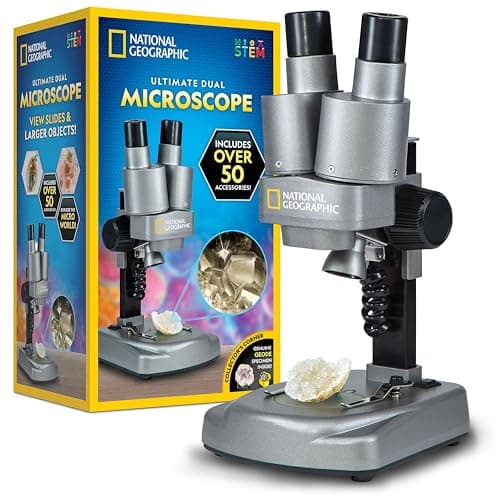
At a glance
The picks, ranked
Tap any row to jump to the full reasoning. Prices come live from Amazon where we have them and read “check price” where we don’t — never a number we cannot stand behind today.
| # | Product | Best for | Price |
|---|---|---|---|
| 1 | The product NATIONAL GEOGRAPHIC Dual LED Student Microscope Light from above as well as below, so rocks, coins and insects work. | Eight to twelve, looking at whole objects | |
| 2 | The one that does both My First Lab Duo-Scope Microscope 40x, 100x and 400x with dual lighting — objects and cells. | Nine and older | Sold direct by My First Lab → Not stocked on Amazon. This link goes to the maker and we earn nothing on it. |
| 3 | 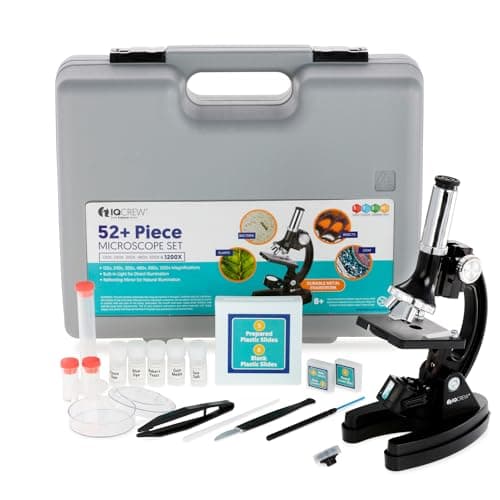 The compound scope AmScope 120X-1200X Beginner Microscope Kit Six magnifications to 1200x on a metal frame, with a 52-piece accessory kit. | Older students | |
| — | 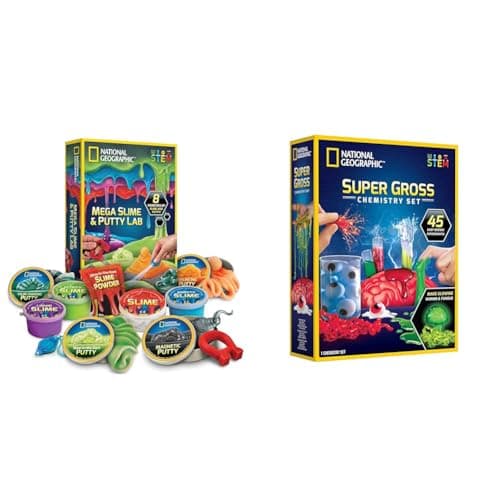 Same brand, different value NATIONAL GEOGRAPHIC Mega Slime Kit & Putty Lab The other Nat Geo kit in the same aisle, and mostly premade. | Eight and up |
4 picks, including 1 we tell you to skip. Ages shown are the manufacturer’s own rating, not ours.
What we can tell you, and what we cannot
We have not used it. No lab, no samples, no test children, and no star rating on this page or in its structured data.
National Geographic’s published magnifications, lighting, accessory count, age rating and weight we can report and compare. How crisp the image is at the edge of the field, we cannot.
The specification that decides it
The arithmetic
Nat Geo Dual LED microscope, published
| Magnification | 20x and 50x |
|---|---|
| Optics | Two sets of optical glass lenses |
| Lighting | Upper and lower LED |
| Accessories | 50+, including 10 prepared slides |
| Stated age | 8+ |
| Weight | 2.6 lb |
What the numbers mean in practice
20x and 50x is the range children actually use. At these powers the image is bright, the depth of field is forgiving, and a specimen stays in view when the table is nudged. High-power compound scopes fail on all three.
Upper lighting changes what counts as a specimen. Sand, a leaf, a fly’s wing, the edge of a coin, a scab of tree bark. No slide preparation, no cover slips, no waiting for an adult.
Ten prepared slides run out; the garden does not. Read the 50+ accessory count as a first afternoon, not as the value of the instrument.
50x means no cells. Onion skin and cheek cells need 100x and up. If that is the actual request, buy the Duo-Scope instead.
A household that already owns a 400x scope. If My First Lab’s Duo-Scope is already on the shelf, it publishes dual LED lighting too, so the main advantage here is already covered at higher magnification.
Who should skip it
A student who needs cells. School biology starts at 100x; this stops at 50x.
Anyone who already owns a compound scope. The overlap is small but the budget usually is too.
Much younger children. The published rating is 8+; below that, a handheld magnifier gets more use.
Say the unwelcome thing
Do not buy the highest magnification you can afford
It is the standard first-microscope mistake. A 1200x scope with only lower lighting restricts a child to ten prepared slides; a 50x scope with upper lighting turns the garden into the collection.
What 50+ accessories means in practice
National Geographic publishes 50+ accessories including 10 prepared slides. Ten prepared slides is one good evening, and then the accessory count stops being the point.
After that the instrument itself has to carry it, and this is where the published upper LED earns the purchase. A prepared slide is a finite resource; a garden is not, and lighting from above is what lets a child put a whole leaf, a beetle or a coin on the stage.
The comparison with the obvious upgrade is instructive. My First Lab publishes 5 blank slides, 1 concavity slide and 4 prepared slides with its Duo-Scope, at 40x, 100x and 400x, rated 9 and older, weighing 1.95 lb with 3 x AA batteries not included.
Fewer accessories, more capability, one year later. If the child is eight and curious about everything, the Nat Geo scope is right. If they are nine and asking specifically about cells, the Duo-Scope is.
Where it sits
This microscope appears in microscopes for kids, microscopes for teens and microscope or telescope first.
In full
Every pick, and what is wrong with it
Published specifications only, each linked back to the page it came from. Where a manufacturer publishes nothing, the row says so — we do not fill blanks in.
1. The product
NATIONAL GEOGRAPHIC Dual LED Student Microscope
National Geographic · Dual LED Student Microscope · maker rates it 8+
Light from above as well as below, so rocks, coins and insects work.
- Magnifications
- 20x and 50x, from two sets of optical glass lenses
- Lighting
- Upper and lower LED
- Accessories
- 50+ pieces, including 10 prepared slides, blank slides and covers, tweezers, eye-dropper and a mini geode
- Weight
- 2.6 lb
National Geographic publishes 20x and 50x magnification from two sets of optical glass lenses, upper and lower LED lighting, 50+ accessories including 10 prepared slides, a stated age of 8+ and a weight of 2.6 lb.
Dual lighting is the specification that decides this purchase. Light from below works only on thin, translucent slides; light from above lets a child put a beetle, a feather or a coin on the stage and see it immediately.
Optical glass rather than plastic lenses, at 2.6 lb, is the other half — light enough to carry to a table and real enough to give a sharp image at these magnifications.
Replay signal
- Open-ended or one-shot
- Open-ended, and the low magnification is the reason — 20x is where insects and leaves look extraordinary
- Does anything run out
- The 10 prepared slides run out; blank slides and the garden do not
- Room to grow
- Limited on magnification, generous on subject matter
Why we say so: National Geographic publishes 20x and 50x with upper and lower LED lighting. Low magnification plus top lighting is a deliberate design for looking at whole objects rather than slides, which for a child under about ten is a far better first microscope than a 1000x compound scope they cannot focus.
What’s wrong with it
50x is the ceiling — cells are out of reach.
| Magnifications | 20x and 50x, from two sets of optical glass lenses |
|---|---|
| Lighting | Upper and lower LED |
| Accessories | 50+ pieces, including 10 prepared slides, blank slides and covers, tweezers, eye-dropper and a mini geode |
| Weight | 2.6 lb |
| Stated age | 8+ |
Every figure above is from National Geographic toys, Dual LED Student Microscope. Blanks are shown as “not published” rather than filled in.
2. The one that does both
My First Lab Duo-Scope Microscope
My First Lab · MFL-06 · maker rates it 9+
40x, 100x and 400x with dual lighting — objects and cells.
- Magnifications
- 40x, 100x and 400x, from a 10x eyepiece with 4x, 10x and 40x objectives
- Optics
- Real optical glass lenses
- Lighting
- Dual LED, above and below the stage
- Slides included
- 5 blank, 1 concavity (well), 4 prepared
The maker publishes 40x, 100x and 400x from a 10x eyepiece with 4x, 10x and 40x objectives, real optical glass, dual LED lighting, five blank slides, one concavity slide and four prepared slides, rated ages 9 and older.
The natural upgrade, and the better buy if a child has specifically asked to see cells. See the Duo-Scope review.
Replay signal
- Open-ended or one-shot
- Genuinely open-ended, unusually so for a science purchase — the world is the consumable
- Does anything run out
- The four prepared slides run out; the five blanks and everything in the garden do not
- Room to grow
- Light from above as well as below means it works on rocks, leaves and insects, not only on slides
Why we say so: The manufacturer publishes the dual-LED lighting, the blank-slide count and the real-glass optics. Blank slides plus top lighting is what turns a microscope from four pictures into a thing you point at whatever you found outside.
What’s wrong with it
Three AA batteries, not included; a bigger jump in complexity.
| Magnifications | 40x, 100x and 400x, from a 10x eyepiece with 4x, 10x and 40x objectives |
|---|---|
| Optics | Real optical glass lenses |
| Lighting | Dual LED, above and below the stage |
| Slides included | 5 blank, 1 concavity (well), 4 prepared |
| Stated age | Ages 9 and older |
| Batteries | 3 x AA (not included) |
| Weight | 1.95 lb |
Every figure above is from My First Lab, Duo-Scope MFL-06. Blanks are shown as “not published” rather than filled in.
Not stocked on Amazon. This link goes to the maker and we earn nothing on it.
3. The compound scope
AmScope 120X-1200X Beginner Microscope Kit
AmScope · M30-ABS-KT2 · maker rates it 8+
Six magnifications to 1200x on a metal frame, with a 52-piece accessory kit.
- Magnifications
- Six levels — 120x, 240x, 300x, 480x, 600x and 1200x
- Frame
- Metal arm, with stage clips
- Lighting
- Built-in LED plus a reflecting mirror
- Extras
- Rotating color filter wheel; 52-piece accessory kit
AmScope publishes six levels — 120x, 240x, 300x, 480x, 600x and 1200x — a metal arm with stage clips, an LED plus reflecting mirror, a 52-piece accessory kit and a published “For ages 8+”.
More instrument, and narrower: prepared slides only. See the AmScope review.
Replay signal
- Open-ended or one-shot
- Open-ended — specimens are free and infinite
- Does anything run out
- The prepared slides in the accessory kit run out; blank slides do not
- Room to grow
- 1200x is well past what a child needs and past what the optics comfortably resolve, but the metal frame will outlast the interest
Why we say so: AmScope publishes six magnification levels, a metal arm and a 70 x 65 mm stage. Treat the top magnification with skepticism — at 1200x an entry-level objective delivers a large, dim, blurry image — and buy this for the metal frame and the usable lower range instead.
What’s wrong with it
Lights from below only, and publishes no age.
| Magnifications | Six levels — 120x, 240x, 300x, 480x, 600x and 1200x |
|---|---|
| Frame | Metal arm, with stage clips |
| Lighting | Built-in LED plus a reflecting mirror |
| Extras | Rotating color filter wheel; 52-piece accessory kit |
| Stage | 70 x 65 mm |
| Shipping weight | 6 lb — AmScope publishes no product weight |
| Stated age | “For ages 8+” |
Every figure above is from AmScope, M30-ABS-KT2 microscope. Blanks are shown as “not published” rather than filled in.
Skip this one
NATIONAL GEOGRAPHIC Mega Slime Kit & Putty Lab
National Geographic · NGMEGASPL · maker rates it 8+
The other Nat Geo kit in the same aisle, and mostly premade.
- Varieties
- 8 in total — 7 premade plus 1 DIY slime lab
- Premade types
- Magnetic putty, fluffy slime, glow-in-the-dark putty, liquid slime, color-changing putty, snotty slime, bouncing putty
- DIY portion
- One glow-in-the-dark slime lab with a stir stick
- Storage
- 8 tins
National Geographic publishes eight varieties — seven premade putties and slimes plus one DIY glow-in-the-dark slime lab — in 8 tins with a learning guide, rated 8 and up.
The brand is consistent on the microscope side and much less so here. Judge each kit on its contents.
Replay signal
- Open-ended or one-shot
- The seven premade putties are reusable toys rather than one-shot experiments
- Does anything run out
- Only the DIY lab runs out
- Room to grow
- Magnetic and color-changing putty demonstrate real properties, not just texture
- Adult required
- Not for the premade putties; briefly for the DIY mix
Why we say so: National Geographic publishes seven premade varieties plus one DIY lab. That ratio is the review: most of this kit is a reusable sensory toy with a science label, and one eighth of it is the experiment.
What’s wrong with it
Seven of eight varieties arrive ready-made.
| Varieties | 8 in total — 7 premade plus 1 DIY slime lab |
|---|---|
| Premade types | Magnetic putty, fluffy slime, glow-in-the-dark putty, liquid slime, color-changing putty, snotty slime, bouncing putty |
| DIY portion | One glow-in-the-dark slime lab with a stir stick |
| Storage | 8 tins |
| Includes | Full-color learning guide |
| Stated age | 8 and up |
| Consumables | Partly — the DIY ingredients are used once; the putties are reusable |
Every figure above is from National Geographic toys, Mega Slime Kit & Putty Lab. Blanks are shown as “not published” rather than filled in.
We are not putting a buy button on this one. It is easy enough to find if you want it anyway — but we would rather send you to something that gets played with twice.
Questions people actually ask
Frequently asked
Is the National Geographic Dual LED microscope worth it?
As a first microscope, yes. It publishes 20x and 50x from optical glass lenses, upper and lower LED lighting and 50+ accessories including 10 prepared slides, rated 8+. The upper light is the feature: it lets a child look at whole objects, not just prepared slides.
What age is the Nat Geo Dual LED microscope for?
National Geographic publishes 8+. At 2.6 lb it is light enough for a child to carry to a table themselves.
Can you see cells with a 50x microscope?
No. Onion skin and cheek cells need roughly 100x and up. My First Lab's Duo-Scope publishes 40x, 100x and 400x from age 9 and would be the right choice for that. Microscopes for kids.
What does dual LED lighting mean?
Light above and below the stage. Lower light works on thin prepared slides; upper light lets a child examine solid objects such as rocks, coins, leaves and insects.
How many slides come with the Nat Geo Dual LED microscope?
National Geographic publishes 50+ accessories including 10 prepared slides. Prepared slides are finite, so the upper LED - which lets a child examine whole objects instead - is what keeps the microscope in use.
Nat Geo Dual LED or My First Lab Duo-Scope?
The Nat Geo scope publishes 20x and 50x with upper and lower LEDs at 2.6 lb, rated 8+. The Duo-Scope publishes 40x, 100x and 400x with dual LEDs at 1.95 lb, rated 9 and older, with 3 x AA batteries not included. Cells need the Duo-Scope; whole objects are better on the Nat Geo. Microscopes for kids.
Can it be used on rocks, coins and insects?
Yes, and that is the point of it. National Geographic publishes upper as well as lower LED lighting, so solid objects can be lit from above and examined at 20x or 50x with no slide preparation at all.
Sources
Where these figures came from
Every specification on this page traces to one of these. If a manufacturer publishes nothing on a point, the page says so rather than filling the gap.
Read next
Where to go from here
Back to Reviews, or read how we pick.