Single review
AmScope 120X-1200X Microscope Review
Reviewed from AmScope's published specifications. We have not looked through it, and the honest reading of its headline number is below.
By Sawyer V. · Published
The short answer
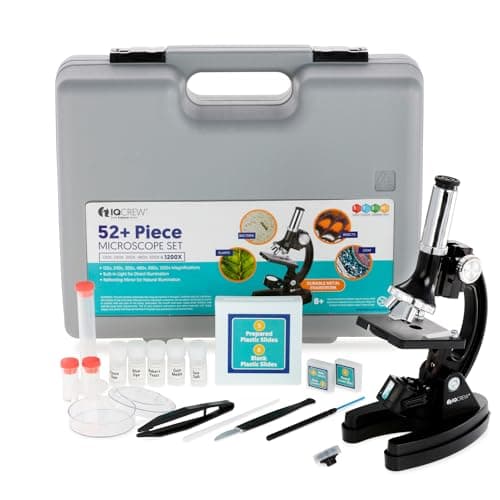
The AmScope 120X-1200X kit is worth it for an older student who will use its middle range. AmScope publishes six levels — 120x, 240x, 300x, 480x, 600x and 1200x — a metal arm with stage clips, an LED plus a reflecting mirror, a 52-piece accessory kit and a stated “For ages 8+”.
Block & Beaker earns a commission when you buy through our links, at no cost to you. It never changes a ranking, and we say so plainly when the right answer is the cheaper set, or nothing at all. Full disclosure · How we pick.
At a glance
The picks, ranked
Tap any row to jump to the full reasoning. Prices come live from Amazon where we have them and read “check price” where we don’t — never a number we cannot stand behind today.
| # | Product | Best for | Price |
|---|---|---|---|
| 1 | The product AmScope 120X-1200X Beginner Microscope Kit A metal frame and six magnification steps, with a 52-piece accessory kit. | Older students, used between 120x and 600x | |
| 2 | The better all-rounder My First Lab Duo-Scope Microscope 40x, 100x and 400x with lighting above and below the stage, so it works on objects too. | Nine and older | Sold direct by My First Lab → Not stocked on Amazon. This link goes to the maker and we earn nothing on it. |
| 3 | 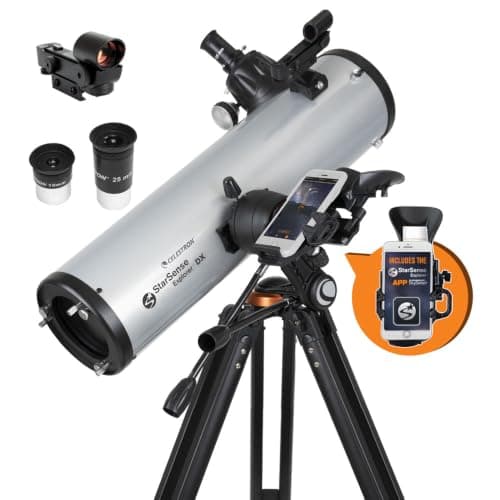 The other direction Celestron StarSense Explorer DX 130AZ 130 mm at f/5 with an app that identifies where the telescope is pointing. | Older students who want the sky | |
| — |  Not the same buyer NATIONAL GEOGRAPHIC Dual LED Student Microscope 20x and 50x with dual LEDs — excellent, and not a compound microscope. | Eight and up, for younger children |
4 picks, including 1 we tell you to skip. Ages shown are the manufacturer’s own rating, not ours.
What we can tell you, and what we cannot
We have not used it. No lab, no samples, no test children, and no star rating on this page or in its structured data.
AmScope’s published magnifications, frame material, lighting, stage size and accessory count we can report, and the optics limits below are physics rather than opinion. How well this particular unit is collimated out of the box, we cannot say.
The specification that decides it
The arithmetic
AmScope 120X-1200X kit, published
| Magnifications | Six — 120x, 240x, 300x, 480x, 600x, 1200x |
|---|---|
| Frame | Metal arm, with stage clips |
| Lighting | Built-in LED plus a reflecting mirror |
| Extras | Rotating color filter wheel; 52-piece accessory kit |
| Stage | 70 x 65 mm |
| Shipping weight | 6 lb — no product weight is published |
| Stated age | “For ages 8+” |
What the numbers mean in practice
1200x is not 1200x of detail. Magnification beyond an objective’s resolving power enlarges blur and dims the image. On a kit at this level the working range is roughly 120x to 600x, and the top step is best treated as a number on the box.
Six steps is genuinely useful. Finding a specimen at 120x and then stepping up is how microscopy actually works; a two-magnification scope makes that hunt much harder.
The published 8+ is a floor, not a fit. AmScope states “For ages 8+”, which is the bottom of what it considers safe rather than the age it works best. Judge it on the student: focusing a compound scope and handling glass slides is realistically nine or ten upward.
52 accessories is a mixed blessing. Prepared slides run out; blank slides and the world do not. The accessory count matters less than the frame.
Who should skip it
Younger children. National Geographic’s 20x/50x scope at 8+ is built for whole objects and is far less frustrating.
Anyone who wants to look at rocks and insects. This kit lights from below; for objects you want light from above.
Buyers chasing the biggest number. If that is the deciding factor, the money is better spent on optics quality at lower power.
Say the unwelcome thing
Do not buy a compound microscope for a six-year-old
Slide preparation, fine focus and glass cover slips are the actual barriers, not curiosity. A low-power scope with top lighting gets used weekly at that age; a 1200x compound scope gets used twice.
The stage, the mirror and the 52 accessories
AmScope publishes a 70 × 65 mm stage with clips. That is a small working area, and it tells you what the instrument expects: prepared slides, held flat, not a rock or a leaf.
The reflecting mirror is the specification most buyers skip, and it is the one that makes this scope usable anywhere. With a mirror the instrument needs no power at all in daylight — a window and a white wall is the whole setup. My First Lab, by comparison, publishes 3 x AA batteries, not included, for its dual LEDs.
The published rotating color filter wheel is a real teaching tool rather than a gimmick: colored light raises contrast on transparent specimens, which is exactly the problem a student hits on their first unstained slide.
As for the 52-piece accessory kit — treat it as a first evening. The prepared slides in kits like this run out, and what keeps a microscope in use is blank slides and something to put on them.
Where it sits
This kit leads microscopes for teens and appears in microscopes for kids, where the younger end is covered properly.
In full
Every pick, and what is wrong with it
Published specifications only, each linked back to the page it came from. Where a manufacturer publishes nothing, the row says so — we do not fill blanks in.
1. The product
AmScope 120X-1200X Beginner Microscope Kit
AmScope · M30-ABS-KT2 · maker rates it 8+
A metal frame and six magnification steps, with a 52-piece accessory kit.
- Magnifications
- Six levels — 120x, 240x, 300x, 480x, 600x and 1200x
- Frame
- Metal arm, with stage clips
- Lighting
- Built-in LED plus a reflecting mirror
- Extras
- Rotating color filter wheel; 52-piece accessory kit
AmScope publishes six magnification levels — 120x, 240x, 300x, 480x, 600x and 1200x — a metal arm with stage clips, built-in LED lighting plus a reflecting mirror, a rotating color filter wheel, a 52-piece accessory kit, a 70 × 65 mm stage and a shipping weight of 6 lb, published “For ages 8+”.
The metal arm is the reason to buy this one. A rigid frame holds focus while a student swaps slides and adjusts lighting; a flexing plastic body loses it constantly, which is what ends most first microscope sessions.
The reflecting mirror is a quiet advantage too: the instrument works in daylight with no power at all.
Replay signal
- Open-ended or one-shot
- Open-ended — specimens are free and infinite
- Does anything run out
- The prepared slides in the accessory kit run out; blank slides do not
- Room to grow
- 1200x is well past what a child needs and past what the optics comfortably resolve, but the metal frame will outlast the interest
Why we say so: AmScope publishes six magnification levels, a metal arm and a 70 x 65 mm stage. Treat the top magnification with skepticism — at 1200x an entry-level objective delivers a large, dim, blurry image — and buy this for the metal frame and the usable lower range instead.
What’s wrong with it
At 1200x an entry-level objective gives a large, dim, blurry image — and the published 8+ is a floor, not a fit.
| Magnifications | Six levels — 120x, 240x, 300x, 480x, 600x and 1200x |
|---|---|
| Frame | Metal arm, with stage clips |
| Lighting | Built-in LED plus a reflecting mirror |
| Extras | Rotating color filter wheel; 52-piece accessory kit |
| Stage | 70 x 65 mm |
| Shipping weight | 6 lb — AmScope publishes no product weight |
| Stated age | “For ages 8+” |
Every figure above is from AmScope, M30-ABS-KT2 microscope. Blanks are shown as “not published” rather than filled in.
2. The better all-rounder
My First Lab Duo-Scope Microscope
My First Lab · MFL-06 · maker rates it 9+
40x, 100x and 400x with lighting above and below the stage, so it works on objects too.
- Magnifications
- 40x, 100x and 400x, from a 10x eyepiece with 4x, 10x and 40x objectives
- Optics
- Real optical glass lenses
- Lighting
- Dual LED, above and below the stage
- Slides included
- 5 blank, 1 concavity (well), 4 prepared
The maker publishes 40x, 100x and 400x from a 10x eyepiece with 4x, 10x and 40x objectives, real optical glass, dual LED lighting, five blank slides, one concavity slide and four prepared slides, rated ages 9 and older.
Light from above is what the AmScope lacks for object work. For a mixed-age household this is usually the more useful instrument, even though its headline number is smaller.
Replay signal
- Open-ended or one-shot
- Genuinely open-ended, unusually so for a science purchase — the world is the consumable
- Does anything run out
- The four prepared slides run out; the five blanks and everything in the garden do not
- Room to grow
- Light from above as well as below means it works on rocks, leaves and insects, not only on slides
Why we say so: The manufacturer publishes the dual-LED lighting, the blank-slide count and the real-glass optics. Blank slides plus top lighting is what turns a microscope from four pictures into a thing you point at whatever you found outside.
What’s wrong with it
Three AA batteries, not included, and a lower top magnification.
| Magnifications | 40x, 100x and 400x, from a 10x eyepiece with 4x, 10x and 40x objectives |
|---|---|
| Optics | Real optical glass lenses |
| Lighting | Dual LED, above and below the stage |
| Slides included | 5 blank, 1 concavity (well), 4 prepared |
| Stated age | Ages 9 and older |
| Batteries | 3 x AA (not included) |
| Weight | 1.95 lb |
Every figure above is from My First Lab, Duo-Scope MFL-06. Blanks are shown as “not published” rather than filled in.
Not stocked on Amazon. This link goes to the maker and we earn nothing on it.
3. The other direction
Celestron StarSense Explorer DX 130AZ
Celestron · 22461 · maker rates it Not published
130 mm at f/5 with an app that identifies where the telescope is pointing.
- Aperture
- 130 mm (5.1 in)
- Focal length
- 650 mm
- Focal ratio
- f/5
- Optical design
- Newtonian reflector
Celestron publishes 130 mm (5.1 in) of aperture, 650 mm focal length, f/5, a Newtonian reflector on an altazimuth mount with slow-motion controls, and the StarSense app.
Worth naming here because “I want a microscope” often means “I want to see something astonishing”. See microscope or telescope first.
Replay signal
- Open-ended or one-shot
- Open-ended — the sky is the consumable and it restocks itself
- Does anything run out
- Nothing runs out
- Room to grow
- Standard eyepieces; 130 mm gathers enough light for planets and brighter deep-sky objects
- Adult required
- Much less than a normal telescope. The published point of StarSense is that the phone does the finding
Why we say so: Celestron publishes 130 mm of aperture at 650 mm focal length, f/5, with a smartphone app that identifies where the telescope is pointing. The app is the specification that matters for a family: not finding anything is what ends most first telescope nights, and this removes that step.
What’s wrong with it
A different instrument, and no age is published.
| Aperture | 130 mm (5.1 in) |
|---|---|
| Focal length | 650 mm |
| Focal ratio | f/5 |
| Optical design | Newtonian reflector |
| Finding aid | StarSense smartphone app — the phone identifies the sky and directs you |
| Mount | Altazimuth with slow-motion controls |
| Stated age | Not published |
Every figure above is from Celestron, StarSense Explorer DX 130AZ. Blanks are shown as “not published” rather than filled in.
Skip this one
NATIONAL GEOGRAPHIC Dual LED Student Microscope
National Geographic · Dual LED Student Microscope · maker rates it 8+
20x and 50x with dual LEDs — excellent, and not a compound microscope.
- Magnifications
- 20x and 50x, from two sets of optical glass lenses
- Lighting
- Upper and lower LED
- Accessories
- 50+ pieces, including 10 prepared slides, blank slides and covers, tweezers, eye-dropper and a mini geode
- Weight
- 2.6 lb
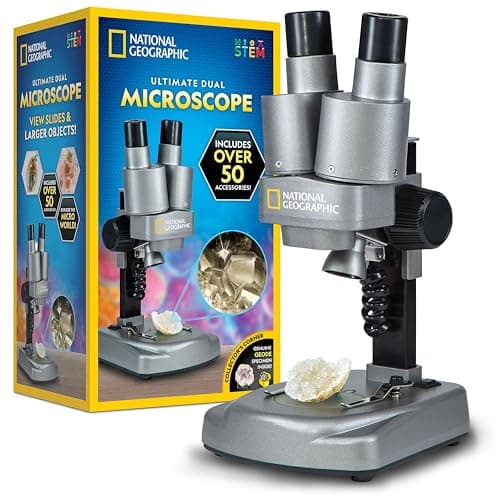
National Geographic publishes 20x and 50x from two sets of optical glass lenses, upper and lower LED lighting and 50+ accessories including 10 prepared slides, rated 8+.
For a nine-year-old looking at insects this is the better instrument. For a student who needs 400x, it is the wrong category — which is the mismatch this review exists to prevent.
Replay signal
- Open-ended or one-shot
- Open-ended, and the low magnification is the reason — 20x is where insects and leaves look extraordinary
- Does anything run out
- The 10 prepared slides run out; blank slides and the garden do not
- Room to grow
- Limited on magnification, generous on subject matter
Why we say so: National Geographic publishes 20x and 50x with upper and lower LED lighting. Low magnification plus top lighting is a deliberate design for looking at whole objects rather than slides, which for a child under about ten is a far better first microscope than a 1000x compound scope they cannot focus.
What’s wrong with it
Tops out at 50x, so cells are out of reach.
| Magnifications | 20x and 50x, from two sets of optical glass lenses |
|---|---|
| Lighting | Upper and lower LED |
| Accessories | 50+ pieces, including 10 prepared slides, blank slides and covers, tweezers, eye-dropper and a mini geode |
| Weight | 2.6 lb |
| Stated age | 8+ |
Every figure above is from National Geographic toys, Dual LED Student Microscope. Blanks are shown as “not published” rather than filled in.
We are not putting a buy button on this one. It is easy enough to find if you want it anyway — but we would rather send you to something that gets played with twice.
Questions people actually ask
Frequently asked
Is the AmScope 120X-1200X microscope worth it?
For an older student who uses its middle range, yes. AmScope publishes six magnifications, a metal arm with stage clips, an LED plus reflecting mirror and a 52-piece accessory kit. Treat 1200x as a box number: the usable range is roughly 120x to 600x.
What age is the AmScope beginner microscope for?
AmScope publishes “For ages 8+”, which is a safety floor rather than a recommendation. Focusing a compound microscope and handling glass slides realistically suits nine or ten upward; for younger children a 20x-50x scope with top lighting is easier.
Is 1200x magnification actually useful?
Rarely on a kit at this level. Beyond an objective's resolving power, extra magnification produces a larger, dimmer, blurrier image rather than more detail. Microscopes for teens.
Does it need batteries?
AmScope publishes a built-in LED plus a reflecting mirror, so it can be used in daylight without power. My First Lab's Duo-Scope, by contrast, publishes three AA batteries, not included.
Does the AmScope microscope need mains power or batteries?
Not necessarily. AmScope publishes a built-in LED plus a reflecting mirror, so the instrument can be used in daylight with no power. My First Lab's Duo-Scope, by contrast, publishes 3 x AA batteries, not included.
How big is the AmScope stage?
AmScope publishes a 70 x 65 mm stage with dual spring clips, on a metal arm. That is sized for prepared slides rather than for solid objects. The only weight AmScope publishes is a 6 lb shipping weight for the boxed kit.
Sources
Where these figures came from
Every specification on this page traces to one of these. If a manufacturer publishes nothing on a point, the page says so rather than filling the gap.
Read next
Where to go from here
Back to Reviews, or read how we pick.