The picks
Science Kits a Child Can Use Alone
A kit that needs a grown-up gets used when a grown-up is free, which is rarely and never on the mornings it would help most.
By Sawyer V. · Published
The short answer
Three published properties decide it: no reagents, no reading requirement, and a self-checking result. Tools like microscopes and bug catchers qualify; anything rated 10+ with real chemicals does not, because the rating is about what is in the bottles.
Block & Beaker earns a commission when you buy through our links, at no cost to you. It never changes a ranking, and we say so plainly when the right answer is the cheaper set, or nothing at all. Full disclosure · How we pick.
At a glance
The picks, ranked
Tap any row to jump to the full reasoning. Prices come live from Amazon where we have them and read “check price” where we don’t — never a number we cannot stand behind today.
| # | Product | Best for | Price |
|---|---|---|---|
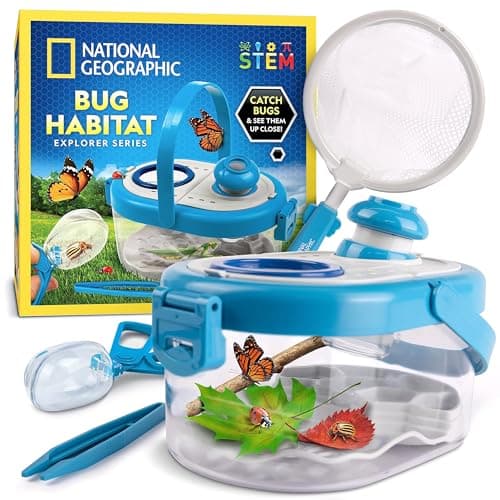
| 1 | Best from four NATIONAL GEOGRAPHIC Bug Catcher Kit No reagents, no reading, no consumables — and the specimen supply is the garden. | Four and up, outdoors, with no supervision needed for the looking | |
| 2 | Best from nine My First Lab Duo-Scope Microscope Once focusing is learned in one session, a microscope needs nobody at all. | Nine and up, indoors, in any weather | Sold direct by My First Lab → Not stocked on Amazon. This link goes to the maker and we earn nothing on it. |
| 3 | 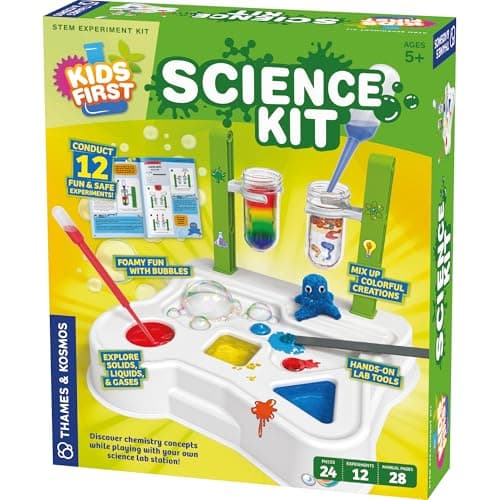 Best tool set for the youngest Kids First Science Laboratory 24 durable plastic tools and no chemicals at all, so nothing in the box is hazardous. | Three to six, with an adult to read the card once | |
| 4 | 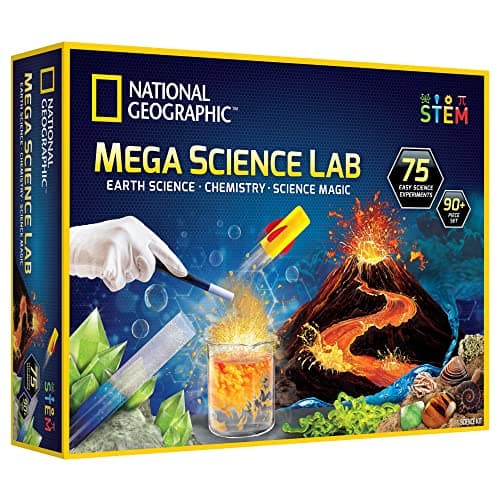 Partly unsupervised NATIONAL GEOGRAPHIC Mega Science Lab 45 in-kit experiments plus 85+ household ones, of which most need only an adult nearby. | Eight and up, for the earth-science and household two-thirds | |
| — | 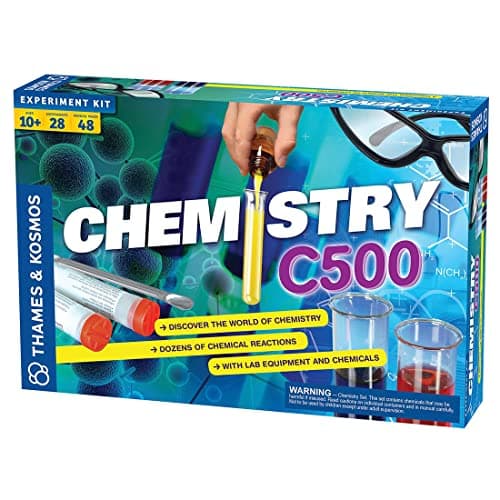 Never unsupervised Thames & Kosmos Chemistry C500 A genuine chemistry set, and the age rating is about the reagents rather than the difficulty. | Ten and up, with an adult in the room |
5 picks, including 1 we tell you to skip. Ages shown are the manufacturer’s own rating, not ours.
The three tests
Adult-needed is one of the four things we check on every product, because it quietly decides how often a toy is used. A kit requiring supervision is used when supervision is available.
The arithmetic
What makes a science purchase self-serve
| No reagents | Nothing to mix, heat or spill |
|---|---|
| No reading requirement | Picture-led or tool-led rather than manual-led |
| Self-checking result | The child knows if it worked without asking |
| No setup step | Nothing an adult has to fetch or prepare |
| Free specimens | Nothing to be rationed by an adult |
Why age ratings mislead here
A published age rating tells you three different things depending on the product, and only one of them is about supervision.
A 3+ or 4+ rating is a small-parts safety floor set by toy testing. It says nothing about whether an adult is needed.
An 8+ rating is usually a reading-and-patience estimate. Snap Circuits at 8+ is about following a numbered diagram; once a child has done one successfully they continue alone.
A 10+ rating on a chemistry set is about the contents. That is the one that means an adult, and it is the one people most often read as a difficulty estimate.
The hidden supervision costs
Some kits are technically safe to leave a child with and still fail in practice because of a setup step.
Household materials. An experiment needing vinegar and a measuring spoon needs an adult to fetch and approve both. The Kids First Science Laboratory is built entirely this way, which is why it is excellent and not unsupervised.
Batteries. A flat toy needs an adult with a screwdriver. The Duo-Scope publishes 3 AA, not included.
Anything involving water. Technically safe, practically a kitchen negotiation.
Worth knowing before you buy
“Can be used alone” is not the same as “should be used unobserved.” A four-year-old catching insects outdoors still needs somebody who knows where they are; the point is that the activity does not require an adult’s hands.
What to own so there is always something available
The practical recommendation is to own at least one self-serve science item alongside whatever guided kit is bought as a present. A bug catcher at four or a microscope at nine costs a fraction of a chemistry set and is available every single day.
Guided kits are events. Tools are the default. A household with only events has nothing to offer on a wet Tuesday, which is precisely when it matters.
Say the unwelcome thing
Do not buy a supervised kit for a household with no spare hour
A 10+ chemistry set in a house where nobody has an hour to sit down stays sealed, and the money is gone.
Be honest about the household rather than about the child. If the hour does not exist, buy something the child can start alone.
Where to go next
Lab tools that never run out covers the permanent category in full. What else a science kit needs covers batteries and household items, and STEM games for one player covers the same problem outside science.
In full
Every pick, and what is wrong with it
Published specifications only, each linked back to the page it came from. Where a manufacturer publishes nothing, the row says so — we do not fill blanks in.
1. Best from four
NATIONAL GEOGRAPHIC Bug Catcher Kit
National Geographic · Bug Catcher Kit · maker rates it 4+
No reagents, no reading, no consumables — and the specimen supply is the garden.
- Habitat
- Clear bug habitat with a removable base
- Viewers
- Latching lid with two magnified viewers — one fixed, one movable
- Tools
- Scissor-style bug catcher, net, tweezers
- Includes
- Learning guide
National Geographic publishes a clear habitat with a removable base, a latching lid with two magnified viewers, a scissor-style catcher, a net, tweezers and a learning guide, rated 4+, with no consumables.
Everything here is safe to hand to a four-year-old. There is nothing to mix, nothing to heat and nothing to read, and the removable base makes putting an insect back straightforward.
Replay signal
- Open-ended or one-shot
- Completely open-ended for the age — the garden restocks it
- Does anything run out
- Nothing runs out
- Room to grow
- Pairs naturally with a low-power microscope when the child wants a closer look
- Adult required
- For the catch-and-release rule; not for the looking
Why we say so: National Geographic publishes a habitat with two magnified viewers, a scissor catcher, a net and tweezers, rated 4+. The scissor catcher is the specification worth noticing: it lets a four-year-old pick up an insect without crushing it, which is the difference between a nature kit and a lesson about being gentle.
What’s wrong with it
An adult should set the catch-and-release rule once, at the start.
| Habitat | Clear bug habitat with a removable base |
|---|---|
| Viewers | Latching lid with two magnified viewers — one fixed, one movable |
| Tools | Scissor-style bug catcher, net, tweezers |
| Includes | Learning guide |
| Stated age | 4+ |
| Consumables | None — the specimens are outside and free |
Every figure above is from National Geographic toys, Bug Catcher Kit. Blanks are shown as “not published” rather than filled in.
2. Best from nine
My First Lab Duo-Scope Microscope
My First Lab · MFL-06 · maker rates it 9+
Once focusing is learned in one session, a microscope needs nobody at all.
- Magnifications
- 40x, 100x and 400x, from a 10x eyepiece with 4x, 10x and 40x objectives
- Optics
- Real optical glass lenses
- Lighting
- Dual LED, above and below the stage
- Slides included
- 5 blank, 1 concavity (well), 4 prepared
My First Lab publishes 40x, 100x and 400x from a 10x eyepiece with 4x, 10x and 40x objectives, real optical glass, dual LED lighting above and below the stage, and 5 blank slides, rated 9 and older.
The blank slides are what make this unsupervised. A child who can prepare their own specimen from whatever they found is not waiting for anyone, and top lighting means the specimen can be anything opaque.
Replay signal
- Open-ended or one-shot
- Genuinely open-ended, unusually so for a science purchase — the world is the consumable
- Does anything run out
- The four prepared slides run out; the five blanks and everything in the garden do not
- Room to grow
- Light from above as well as below means it works on rocks, leaves and insects, not only on slides
Why we say so: The manufacturer publishes the dual-LED lighting, the blank-slide count and the real-glass optics. Blank slides plus top lighting is what turns a microscope from four pictures into a thing you point at whatever you found outside.
What’s wrong with it
Three AA batteries not included, and the first session does need an adult.
| Magnifications | 40x, 100x and 400x, from a 10x eyepiece with 4x, 10x and 40x objectives |
|---|---|
| Optics | Real optical glass lenses |
| Lighting | Dual LED, above and below the stage |
| Slides included | 5 blank, 1 concavity (well), 4 prepared |
| Stated age | Ages 9 and older |
| Batteries | 3 x AA (not included) |
| Weight | 1.95 lb |
Every figure above is from My First Lab, Duo-Scope MFL-06. Blanks are shown as “not published” rather than filled in.
Not stocked on Amazon. This link goes to the maker and we earn nothing on it.
3. Best tool set for the youngest
Kids First Science Laboratory
Thames & Kosmos · Kids First Science Laboratory · maker rates it 3-6+
24 durable plastic tools and no chemicals at all, so nothing in the box is hazardous.
- Contents
- 24 large plastic scientific tools, described as durable, reusable and easy to handle
- Experiment cards
- 10, double-sided
- Stated age
- 3 to 6+
- Chemicals included
- None — experiments use household materials
Thames & Kosmos publishes 24 large plastic scientific tools described as durable, reusable and easy to handle, 10 double-sided experiment cards, no chemicals included, rated 3 to 6+.
“No chemicals included” is the safety story. The tools themselves can be handed over freely; the setup is what needs an adult, and only briefly.
Replay signal
- Open-ended or one-shot
- The 20 card sides are a starting ladder; the tools then work on anything in the kitchen
- Does anything run out
- Nothing in the box runs out, because nothing in the box is consumed
- Room to grow
- The same tools carry into any household-materials experiment for years
- Adult required
- Yes at three, less so at five. The cards are picture-led but the setup is not
Why we say so: Thames & Kosmos publishes 24 reusable tools and no chemicals. A preschool science kit with no consumables in it is unusual, and it is the reason this one survives past its first fortnight when kit-of-the-week alternatives do not.
What’s wrong with it
Experiments use household materials, so an adult has to read the card and fetch things.
| Contents | 24 large plastic scientific tools, described as durable, reusable and easy to handle |
|---|---|
| Experiment cards | 10, double-sided |
| Stated age | 3 to 6+ |
| Chemicals included | None — experiments use household materials |
| Consumables | None in the box |
Every figure above is from Thames & Kosmos, Kids First range. Blanks are shown as “not published” rather than filled in.
4. Partly unsupervised
NATIONAL GEOGRAPHIC Mega Science Lab
National Geographic · Mega Science Lab · maker rates it 8+
45 in-kit experiments plus 85+ household ones, of which most need only an adult nearby.
- Experiments in the kit
- 45, across chemistry, earth science and science magic
- Bonus guide
- 85+ further experiments using household items, for 130+ in total
- Includes
- Volcano build, glow-in-the-dark crystal growth, and the tools for both
- Stated age
- 8+
National Geographic publishes 45 in-kit experiments across chemistry, earth science and science magic, plus a bonus guide of 85+ using household items, rated 8+.
This is honest rather than absolute. Split the kit: earth science and the household experiments are largely self-run, the chemistry is not.
Replay signal
- Open-ended or one-shot
- Guided, and the 45 in-kit experiments end. The 85 household ones do not
- Does anything run out
- The supplied materials run out; the household half of the book never does
- Room to grow
- The bonus guide is the genuinely durable part, and it costs the manufacturer almost nothing to include
- Adult required
- Supervision for the chemistry third; the earth science and household experiments are largely self-run
Why we say so: National Geographic publishes 45 in-kit experiments plus a bonus guide of 85+ using household items. That second number is why this kit outlasts most of its price band: roughly two-thirds of the published content needs nothing but a kitchen.
What’s wrong with it
The chemistry third genuinely wants supervision.
| Experiments in the kit | 45, across chemistry, earth science and science magic |
|---|---|
| Bonus guide | 85+ further experiments using household items, for 130+ in total |
| Includes | Volcano build, glow-in-the-dark crystal growth, and the tools for both |
| Stated age | 8+ |
| Consumables | Yes — the supplied chemicals and crystal compounds are used up |
Every figure above is from National Geographic toys, Mega Science Lab. Blanks are shown as “not published” rather than filled in.
Skip this one
Thames & Kosmos Chemistry C500
Thames & Kosmos · 665012 · maker rates it 10+
A genuine chemistry set, and the age rating is about the reagents rather than the difficulty.
- Experiments
- 28
- Manual
- 48 pages
- Chemicals included
- 5
- Equipment
- Safety glasses, test tubes, dropper pipettes, double-headed measuring spoon
Thames & Kosmos publishes 28 experiments, a 48-page manual, five chemicals, safety glasses, test tubes and dropper pipettes, rated 10 years and up, stating compliance with EN 71-4 — the European standard for chemistry experiment kits.
We list it here specifically to rule it out. A 10+ rating on a chemistry set is a floor set by what is in the bottles, and the safety glasses are supplied because they are needed. This is a fine purchase and it is not a wet-Tuesday purchase.
Replay signal
- Open-ended or one-shot
- Guided, not open-ended: 28 experiments, then the manual is finished
- Does anything run out
- Yes — the chemicals are consumed, and Thames & Kosmos sells replacements
- Room to grow
- Steps up to the larger C1000, C2000 and C3000 sets in the same line
- Adult required
- The maker rates it 10+ and it involves real chemicals
Why we say so: Thames & Kosmos publishes 28 experiments, a 48-page manual and five chemicals. Five finite chemicals across 28 experiments is arithmetic, not opinion — this set has an end, and it is better to know that before Boxing Day than after.
What’s wrong with it
Five real chemicals under EN 71-4, plus a 9V battery not included.
| Experiments | 28 |
|---|---|
| Manual | 48 pages |
| Chemicals included | 5 |
| Equipment | Safety glasses, test tubes, dropper pipettes, double-headed measuring spoon |
| Stated age | 10 years and up |
| Batteries | 1 x 9V (not included) |
| Consumables | Yes — the five chemicals are used up |
Every figure above is from Thames & Kosmos, Chemistry C500. Blanks are shown as “not published” rather than filled in.
We are not putting a buy button on this one. It is easy enough to find if you want it anyway — but we would rather send you to something that gets played with twice.
Questions people actually ask
Frequently asked
Which science kits can a child use without supervision?
Ones with no reagents, no reading requirement and a self-checking result. National Geographic's Bug Catcher Kit is rated 4+ with no consumables at all, and a microscope becomes fully self-serve after one session of learning to focus. Anything rated 10+ with real chemicals does not qualify.
Does a 10+ age rating mean a kit is harder?
On a chemistry set, no — it means the contents need care. Thames & Kosmos rates the Chem C500 at 10+ and states compliance with EN 71-4, the European standard for chemistry experiment kits. That is a floor set by the reagents, not an estimate of difficulty. Toy safety standards explained.
Why does it matter whether a toy needs an adult?
Because a toy requiring a grown-up gets used when a grown-up is free, which is rarely and almost never on the mornings it would help most. It is one of the four things we check on every product, and it predicts retention better than almost any other specification.
What is the best self-serve science purchase?
A bug catcher at four, a microscope at nine. Both have no consumables, need no adult once started, and work on specimens that cost nothing — so unlike a guided kit they are available every day rather than being a single event. Lab tools that never run out.
Sources
Where these figures came from
Every specification on this page traces to one of these. If a manufacturer publishes nothing on a point, the page says so rather than filling the gap.
Read next
Where to go from here
Back to Science Kits, or read how we pick.