The picks
Solar and Energy Kits for Kids
The question nobody asks before buying a solar kit: what happens when it is cloudy?
By Sawyer V. · Published
The short answer
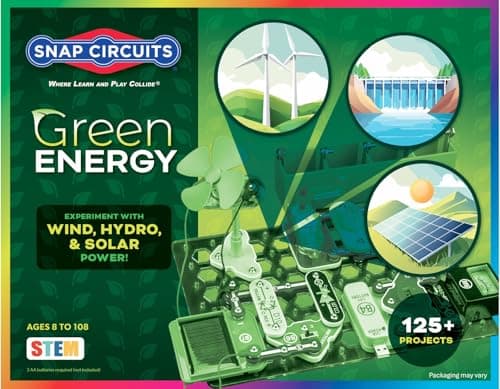
Check whether the kit works without direct sunlight before anything else. A purely solar toy is a disappointment for most of the year in a cloudy climate. Elenco's Green set publishes 125-plus projects from 45-plus parts, and most of them run on the battery holder rather than the panel.
Block & Beaker earns a commission when you buy through our links, at no cost to you. It never changes a ranking, and we say so plainly when the right answer is the cheaper set, or nothing at all. Full disclosure · How we pick.
At a glance
The picks, ranked
Tap any row to jump to the full reasoning. Prices come live from Amazon where we have them and read “check price” where we don’t — never a number we cannot stand behind today.
| # | Product | Best for | Price |
|---|---|---|---|
| 1 | Best overall Snap Circuits Green One hundred and twenty-five projects covering alternative energy, with parts that cross-connect to the rest of the Snap Circuits line. | Eight and up, as a themed addition to an existing circuit set | |
| 2 | 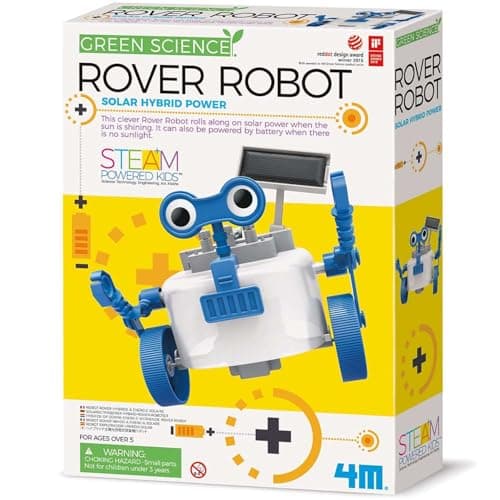 Best cheap demonstration 4M Green Science Solar Rover A hybrid drive — solar when there is sun, battery when there is not — which is the honest design. | Five and up, as a single build with a working result | |
| 3 | 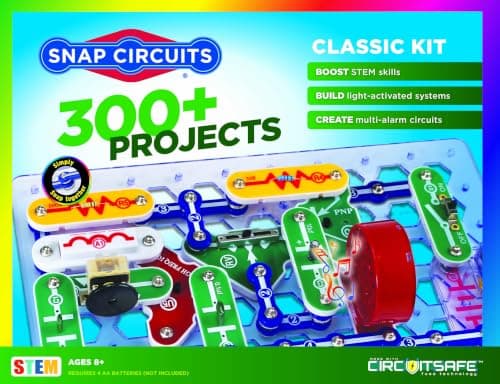 Buy this first Snap Circuits Classic Three hundred and five projects from 60-plus parts — the foundation the energy set plugs into. | Eight and up, with no circuit set in the house yet | |
| 4 | 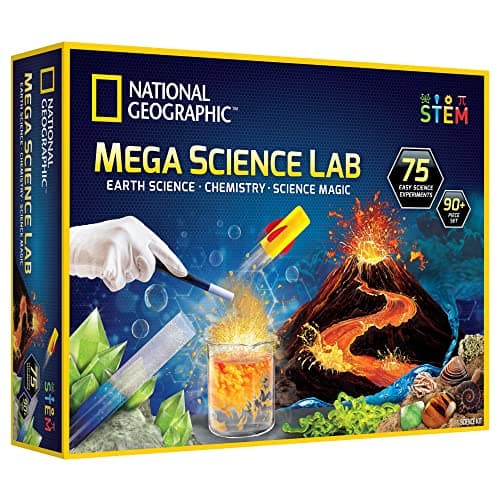 Best for energy as one topic among several NATIONAL GEOGRAPHIC Mega Science Lab One hundred and thirty-plus experiments across three subjects, most needing only household materials. | Eight and up, where the interest is science broadly | |
| — | 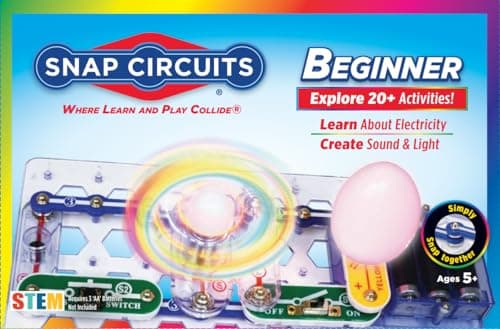 The one to skip Snap Circuits Beginner Twenty-one projects from 14 parts, with no energy content and no room to add any. | Five to seven, and not this topic |
5 picks, including 1 we tell you to skip. Ages shown are the manufacturer’s own rating, not ours.
The cloudy-day problem
Solar toys are sold with photographs taken in bright sun, and a surprising number of them need exactly that to work at all. A small photovoltaic panel produces a fraction of its rated output under overcast sky and essentially nothing indoors under domestic lighting.
That is a genuine product problem rather than a quibble. A solar kit given as a winter present in a northern climate may not run properly until spring.
The arithmetic
Does it work without direct sun?
| 4M Solar Rover | Yes — hybrid, 1 x AAA fallback |
|---|---|
| Snap Circuits Green | Yes — most projects run from the battery holder |
| Snap Circuits Classic | Yes — battery powered throughout |
| A panel-only solar toy | No |
What these kits actually teach
Energy conversion. The central idea, and it is a good one: light becomes electricity becomes motion. A child who has seen a motor speed up as a panel is tilted toward the sun has understood something real about power.
That energy is limited. Solar toys are slow and weak, and that is pedagogically useful. A rover that crawls in weak light and speeds up in strong light makes the relationship between input and output visible in a way a battery never does.
Circuits, if the kit is a circuit kit. This is where the Green set earns its place over a single-build solar toy: the panel is one component among 45, so the child learns where it fits rather than just that it works.
Order of purchase
Circuits first, energy second. A solar panel is only interesting to a child who knows what a circuit is; before that it is a mysterious black rectangle that makes a thing move.
The sequence we would recommend: a general circuit set at eight, the energy-themed set as a second purchase once the first manual has been worked through, and a component-level kit later if the interest holds.
Worth knowing before you buy
Nothing here involves mains electricity, and Elenco publishes that its snap-together parts require no tools and ensure correct connections. The Classic and Pro sets each require four AA batteries, not included.
The one genuine caution is upstream: solar panels are frequently the first step toward a teenager wanting to work with larger cells and higher voltages. That is the point at which supervision stops being optional.
Say the unwelcome thing
Do not buy a solar kit as a first electronics purchase
Energy is a topic within electronics rather than an entry to it. A child given a solar kit before a circuit kit learns that a panel makes a motor turn, which is a fact rather than an understanding.
Buy a general circuit set first — 305 published projects against 125 — and add the energy set once the child can build a circuit without the manual.
What to buy
- No circuit set yet: Snap Circuits Classic first.
- Already has one: the Green set, for cross-compatible energy parts.
- Young child, cheap demonstration: the solar rover, for the hybrid drive.
- Interest is science generally: the Mega Science Lab.
See also the full Snap Circuits comparison and electronics starter kits.
In full
Every pick, and what is wrong with it
Published specifications only, each linked back to the page it came from. Where a manufacturer publishes nothing, the row says so — we do not fill blanks in.
1. Best overall
Snap Circuits Green
Elenco · SCG-125 · maker rates it 8+
One hundred and twenty-five projects covering alternative energy, with parts that cross-connect to the rest of the Snap Circuits line.
- Projects
- Over 125
- Parts
- 45+
- Projects per part
- 2.8
- Stated age
- Ages 8 and up
Elenco publishes over 125 projects from 45-plus parts, rated 8 and up, focused on alternative energy, with parts cross-compatible across the Snap Circuits line.
Cross-compatibility is what makes this the pick. A household that owns the Classic set gains solar and energy components that plug into circuits the child already knows how to build — a far better experience than starting a new box.
Bought as a first circuit set it is poor value against the Classic. Bought second, as a theme, it is exactly right.
Replay signal
- Open-ended or one-shot
- Themed rather than general-purpose, which narrows it
- Does anything run out
- Nothing runs out
- Room to grow
- Parts are cross-compatible with the rest of the Snap Circuits line
Why we say so: Elenco publishes 125+ projects from 45+ parts for the Green set. Against the Classic's 305 projects from 60+ parts, the Green set is a theme rather than a step up — worth knowing before you buy it as one.
What’s wrong with it
Priced near the 305-project Classic set while publishing fewer than half its projects. Bought as an upgrade it is a downgrade.
| Projects | Over 125 |
|---|---|
| Parts | 45+ |
| Projects per part | 2.8 |
| Stated age | Ages 8 and up |
| Focus | Alternative energy |
| Consumables | None |
Every figure above is from Elenco, Snap Circuits Green. Blanks are shown as “not published” rather than filled in.
2. Best cheap demonstration
4M Green Science Solar Rover
4M · Green Science Solar Rover · maker rates it 5+
A hybrid drive — solar when there is sun, battery when there is not — which is the honest design.
- Power
- Solar panel in sunlight, battery in its absence — hybrid
- Batteries
- 1 x AAA (not included)
- Build
- One solar-powered rover, assembled by the child
- Stated age
- Ages 5+
4M publishes a hybrid drive, solar in sunlight and battery in its absence, requiring one AAA battery not included, rated 5+.
The hybrid is the detail worth paying for and most cheap solar toys do not have it. A purely solar rover is a lovely idea and a flat object on a grey afternoon.
As a demonstration of the principle for a young child it is excellent and it is inexpensive. As a system it is one afternoon.
Replay signal
- Open-ended or one-shot
- One-shot build, then a working toy — the rover survives the assembly
- Does anything run out
- Nothing runs out
- Room to grow
- Little. It builds one thing and that thing then drives around
- Adult required
- For the first assembly at five; not for running it
Why we say so: 4M publishes a hybrid solar-and-battery drive requiring one AAA. The hybrid is the useful detail: a purely solar toy is a disappointment on a cloudy afternoon, and the battery fallback means the thing still moves indoors.
What’s wrong with it
It builds one thing. Once the rover exists there is no second model in the box.
| Power | Solar panel in sunlight, battery in its absence — hybrid |
|---|---|
| Batteries | 1 x AAA (not included) |
| Build | One solar-powered rover, assembled by the child |
| Stated age | Ages 5+ |
| Consumables | None beyond the battery |
Every figure above is from 4M, Green Science Solar Rover. Blanks are shown as “not published” rather than filled in.
3. Buy this first
Snap Circuits Classic
Elenco · SC-300 · maker rates it 8+
Three hundred and five projects from 60-plus parts — the foundation the energy set plugs into.
- Projects
- “Build over 300 exciting projects” — manual covers projects 1-305
- Parts
- “Contains over 60 Snap-Together parts”
- Projects per part
- 5.1 — the highest ratio in the line
- Stated age
- “Ages 8+” and “Not for Children under 3 yrs.”
Elenco publishes over 300 projects with a manual covering 1-305, from over 60 snap-together parts that require no tools and ensure correct connections, rated 8+, requiring four AA batteries.
Included because "solar kit for kids" is often the wrong first purchase. Solar makes sense as a topic once a child understands a circuit; before that it is a panel connected to something mysterious.
Five projects per part is the highest ratio in the Snap Circuits line, and the full comparison is on the line comparison page.
Replay signal
- Open-ended or one-shot
- The sweet spot of the line — enough parts to invent with, cheap enough not to be an event
- Does anything run out
- Nothing runs out
- Room to grow
- 305 published projects is years of Sunday afternoons at one a week
Why we say so: Elenco publishes 305 numbered projects against 60+ parts. Five projects per part is the highest ratio anywhere in the Snap Circuits line, which is the arithmetic reason this is the set to buy rather than the cheap one or the big one.
What’s wrong with it
Not an energy kit. Solar and alternative energy components are in the Green set, not this one.
| Projects | “Build over 300 exciting projects” — manual covers projects 1-305 |
|---|---|
| Parts | “Contains over 60 Snap-Together parts” |
| Projects per part | 5.1 — the highest ratio in the line |
| Stated age | “Ages 8+” and “Not for Children under 3 yrs.” |
| Batteries | “Requires 4 ‘AA’ batteries (not included)” |
| Relationship to SC-100 | Manual includes all SC-100 projects plus 200 new ones |
Every figure above is from Elenco, Snap Circuits Classic. Blanks are shown as “not published” rather than filled in.
4. Best for energy as one topic among several
NATIONAL GEOGRAPHIC Mega Science Lab
National Geographic · Mega Science Lab · maker rates it 8+
One hundred and thirty-plus experiments across three subjects, most needing only household materials.
- Experiments in the kit
- 45, across chemistry, earth science and science magic
- Bonus guide
- 85+ further experiments using household items, for 130+ in total
- Includes
- Volcano build, glow-in-the-dark crystal growth, and the tools for both
- Stated age
- 8+
National Geographic publishes 45 experiments across chemistry, earth science and science magic, plus a bonus guide of more than 85 experiments using household items, rated 8+.
Included honestly rather than as an energy kit. If the stated interest in solar is really a general interest in science, this delivers far more per pound.
The bonus guide is the reason. Roughly two thirds of the published content needs nothing but a kitchen, which no dedicated energy kit on this page can match.
Replay signal
- Open-ended or one-shot
- Guided, and the 45 in-kit experiments end. The 85 household ones do not
- Does anything run out
- The supplied materials run out; the household half of the book never does
- Room to grow
- The bonus guide is the genuinely durable part, and it costs the manufacturer almost nothing to include
- Adult required
- Supervision for the chemistry third; the earth science and household experiments are largely self-run
Why we say so: National Geographic publishes 45 in-kit experiments plus a bonus guide of 85+ using household items. That second number is why this kit outlasts most of its price band: roughly two-thirds of the published content needs nothing but a kitchen.
What’s wrong with it
Energy is not a named section. This is breadth rather than a dedicated energy kit.
| Experiments in the kit | 45, across chemistry, earth science and science magic |
|---|---|
| Bonus guide | 85+ further experiments using household items, for 130+ in total |
| Includes | Volcano build, glow-in-the-dark crystal growth, and the tools for both |
| Stated age | 8+ |
| Consumables | Yes — the supplied chemicals and crystal compounds are used up |
Every figure above is from National Geographic toys, Mega Science Lab. Blanks are shown as “not published” rather than filled in.
Skip this one
Snap Circuits Beginner
Elenco · SCB-20 · maker rates it 5-8
Twenty-one projects from 14 parts, with no energy content and no room to add any.
- Projects
- 21
- Parts
- 14
- Projects per part
- 1.5
- Stated age
- Ages 5-8
Elenco publishes 21 projects from 14 parts, rated 5 to 8, with no tools required.
It shows up in searches because the brand matches, and it is the wrong end of the range for this subject entirely — fourteen parts cannot cover energy conversion.
For a young child interested in solar specifically, the solar rover is the cheaper and more direct answer. For a circuit foundation, the Classic set.
Replay signal
- Open-ended or one-shot
- Limited. 14 parts is a small vocabulary, and once the 21 projects are built the set goes quiet
- Does anything run out
- Nothing runs out
- Room to grow
- Parts work with the bigger sets, so it is not a dead end — but it is a short road
Why we say so: Elenco publishes 21 projects from 14 parts. That ratio is the whole story: this is the entry rung, and the number to hold it against is the 305 projects the Classic set publishes from 60+ parts.
What’s wrong with it
The lowest parts count in the line. Nothing about it addresses solar or renewable energy.
| Projects | 21 |
|---|---|
| Parts | 14 |
| Projects per part | 1.5 |
| Stated age | Ages 5-8 |
| Tools needed | None — parts snap together |
| Consumables | None |
Every figure above is from Elenco, Snap Circuits Beginner. Blanks are shown as “not published” rather than filled in.
We are not putting a buy button on this one. It is easy enough to find if you want it anyway — but we would rather send you to something that gets played with twice.
Questions people actually ask
Frequently asked
Do solar toys work indoors?
Generally not. A small photovoltaic panel produces a fraction of its rated output under overcast sky and essentially nothing under domestic lighting. Look for a hybrid design — 4M's Solar Rover publishes a battery fallback requiring one AAA, which is why it still moves on a grey afternoon.
Is Snap Circuits Green a good first electronics set?
No — buy it second. Elenco publishes 125+ projects from 45+ parts for the Green set against 305 from 60+ for the Classic, at a similar price band. The parts cross-connect across the line, so it works well as a themed addition once a child can already build a circuit.
What do solar kits actually teach?
Energy conversion — light becomes electricity becomes motion — and that energy is limited. A rover that crawls in weak light and speeds up in strong light makes the relationship between input and output visible in a way a battery never does.
Should I buy a solar kit before a circuit kit?
No. Energy is a topic within electronics rather than an entry to it. A child given a solar panel before they know what a circuit is learns that the panel makes a motor turn, which is a fact rather than an understanding.
Sources
Where these figures came from
Every specification on this page traces to one of these. If a manufacturer publishes nothing on a point, the page says so rather than filling the gap.
Read next
Where to go from here
Back to Electronics, or read how we pick.