Single review
4M Solar Rover Kit Review
Reviewed from 4M's published specifications. We have not built it, and the reason this kit outlives most solar toys is one line on the box.
By Sawyer V. · Published
The short answer
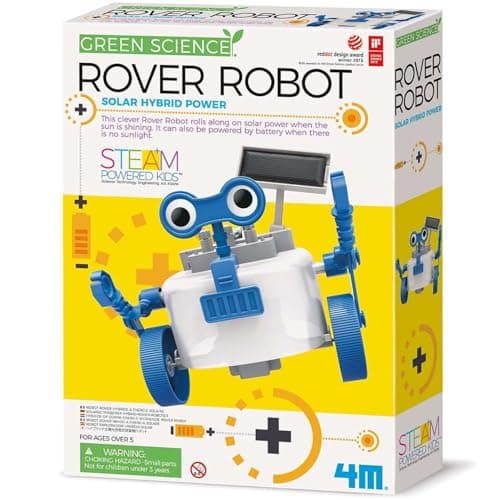
The 4M Solar Rover is worth it as a cheap, real introduction to solar power. 4M publishes a solar panel in sunlight and a battery in its absence, one AAA not included, and a stated age of 5+. That battery mode is what stops it being a summer-only toy.
Block & Beaker earns a commission when you buy through our links, at no cost to you. It never changes a ranking, and we say so plainly when the right answer is the cheaper set, or nothing at all. Full disclosure · How we pick.
At a glance
The picks, ranked
Tap any row to jump to the full reasoning. Prices come live from Amazon where we have them and read “check price” where we don’t — never a number we cannot stand behind today.
| # | Product | Best for | Price |
|---|---|---|---|
| 1 | The product 4M Green Science Solar Rover A solar-powered rover that also runs on a battery when the sun does not cooperate. | Five to nine, as a first solar kit | |
| 2 | 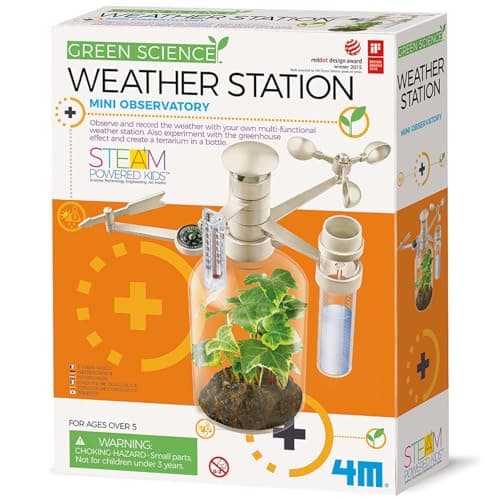 The same range, more sessions 4M Weather Station Kit Four instruments to build, then readings to take for weeks. | Eight and up | |
| 3 | 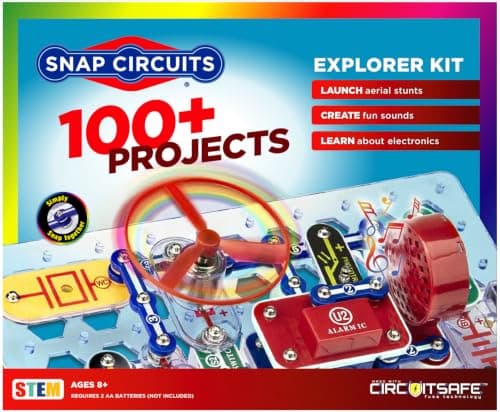 The better value per hour Snap Circuits Jr. 30 parts and over 100 projects, for three years later. | Eight and up | |
| — |  Not the same thing NATIONAL GEOGRAPHIC Mega Slime Kit & Putty Lab Frequently bought as a cheap science gift, and it is mostly premade. | Eight and up |
4 picks, including 1 we tell you to skip. Ages shown are the manufacturer’s own rating, not ours.
What we can tell you, and what we cannot
We have not built it. No lab, no samples, no test children, and no star rating on this page or in its structured data.
4M’s published power options, battery requirement and age rating we can report and compare. How well it climbs a carpet, we cannot.
The specification that decides it
The arithmetic
4M Solar Rover, published
| Power | Solar panel in sunlight, battery in its absence — hybrid |
|---|---|
| Batteries | 1 x AAA (not included) |
| Stated age | Ages 5+ |
| Range | 4M Green Science |
| Build | One solar-powered rover, assembled by the child |
| Consumables | None beyond the battery |
What the numbers mean in practice
Hybrid power doubles the number of days it runs. Direct sunlight is a stricter requirement than most buyers expect; a bright window is usually not enough for a small panel.
One model means one build. Price it accordingly. This is an afternoon and a toy afterwards, not a system.
Five is about the assembly, not the power. Small parts and a fiddly gear train mean an adult alongside at the lower end of the range.
Buy the AAA with it. The one line that determines whether it runs on the day it is opened.
It does not teach circuits. 4M publishes one rover with a panel and a battery holder, not a set of components to wire up. A child who wants to know how the motor is switched on needs a circuit kit, not this.
Who should skip it
Anyone wanting many projects. Elenco publishes over 100 in Snap Circuits Jr., though not until 8+.
Older children. By ten this is a half-hour build; a motorized construction set or the weather station lasts longer.
Households without direct sun. The battery mode saves it, but the point of the kit is the panel.
One build, and what that actually means
4M publishes the build as one solar-powered rover, assembled by the child, with no consumables beyond the battery. There is no second model in the box and no expansion to buy.
Price it accordingly. This is an afternoon of assembly, a demonstration that a panel can replace a battery, and a rover afterwards. That is a good afternoon, and it is not a system that fills a year.
The two sets most often bought alongside it show the contrast. 4M publishes its weather station kit as four instruments — a wind vane, an anemometer, a thermometer and a rain gauge — rated 8+, where the build is the beginning and the readings continue for weeks. Elenco publishes Snap Circuits Jr. as 30 parts and over 100 projects, rated 8+.
Both of those are years away for a five-year-old, which is the real case for the rover: at that age it is one of very few kits published low enough to be built at all.
Nothing runs out except the AAA. 4M publishes no consumables beyond the battery, which puts this in a different bracket from the crystal-growing and slime kits it sits next to in shops. Those are used up by design; this one is a rover that keeps working as long as the sun does.
Where it sits
The Solar Rover appears in solar and energy kits and STEM gifts under $50.
In full
Every pick, and what is wrong with it
Published specifications only, each linked back to the page it came from. Where a manufacturer publishes nothing, the row says so — we do not fill blanks in.
1. The product
4M Green Science Solar Rover
4M · Green Science Solar Rover · maker rates it 5+
A solar-powered rover that also runs on a battery when the sun does not cooperate.
- Power
- Solar panel in sunlight, battery in its absence — hybrid
- Batteries
- 1 x AAA (not included)
- Build
- One solar-powered rover, assembled by the child
- Stated age
- Ages 5+
4M publishes hybrid power — the solar panel in sunlight, a battery in its absence — one AAA not included, one rover assembled by the child, and a stated age of 5+, in its Green Science range.
The hybrid line is the feature. Solar-only toys work brilliantly on the two sunny afternoons after they are opened and then sit still, which teaches a child that solar power does not work rather than how it works.
Being able to run the same rover both ways is also the lesson: the child sees the panel replacing the battery, which is a far clearer demonstration than any diagram.
Replay signal
- Open-ended or one-shot
- One-shot build, then a working toy — the rover survives the assembly
- Does anything run out
- Nothing runs out
- Room to grow
- Little. It builds one thing and that thing then drives around
- Adult required
- For the first assembly at five; not for running it
Why we say so: 4M publishes a hybrid solar-and-battery drive requiring one AAA. The hybrid is the useful detail: a purely solar toy is a disappointment on a cloudy afternoon, and the battery fallback means the thing still moves indoors.
What’s wrong with it
One AAA is required and not included, and it is a single model.
| Power | Solar panel in sunlight, battery in its absence — hybrid |
|---|---|
| Batteries | 1 x AAA (not included) |
| Build | One solar-powered rover, assembled by the child |
| Stated age | Ages 5+ |
| Consumables | None beyond the battery |
Every figure above is from 4M, Green Science Solar Rover. Blanks are shown as “not published” rather than filled in.
2. The same range, more sessions
4M Weather Station Kit
4M · 4573 · maker rates it 8+
Four instruments to build, then readings to take for weeks.
- Instruments built
- 4 — wind vane, anemometer, thermometer and rain gauge
- Contents
- Thermometer and support arm, two support-column halves, rain gauge arm, funnel, plastic tube, wind vane and arm, compass, anemometer arm, cups, hub, spindles, cap screws, instructions
- Assembled size
- About 8.5 in x 4.75 in
- Extra experiment
- A greenhouse-effect terrarium using a recycled bottle
4M publishes four instruments in its weather station kit — a wind vane, an anemometer, a thermometer and a rain gauge — rated 8+, built first and then used to record conditions over time.
Buy this for the older child in the house: it is the one 4M kit with an afterlife beyond the build.
Replay signal
- Open-ended or one-shot
- Genuinely open-ended: the weather supplies new data every single day
- Does anything run out
- Nothing runs out
- Room to grow
- Readings become a record; the interest scales into charting and comparison
- Adult required
- For the build, which is fiddly; not for the daily readings
Why we say so: 4M publishes four working instruments and a full parts list. Once built, nothing is consumed and the sky restocks the experiment daily — which makes this one of the few science kits with no published ending.
What’s wrong with it
Published from 8, so it waits.
| Instruments built | 4 — wind vane, anemometer, thermometer and rain gauge |
|---|---|
| Contents | Thermometer and support arm, two support-column halves, rain gauge arm, funnel, plastic tube, wind vane and arm, compass, anemometer arm, cups, hub, spindles, cap screws, instructions |
| Assembled size | About 8.5 in x 4.75 in |
| Extra experiment | A greenhouse-effect terrarium using a recycled bottle |
| Stated age | 8 and up (a Green Science version is rated 5+) |
| Consumables | None — the instruments are permanent |
Every figure above is from 4M, Weather Station Kit (4573). Blanks are shown as “not published” rather than filled in.
3. The better value per hour
Snap Circuits Jr.
Elenco · SC-100 · maker rates it 8+
30 parts and over 100 projects, for three years later.
- Projects
- Over 100
- Parts
- 30
- Projects per part
- 3.3
- Stated age
- Ages 8+
Elenco publishes Snap Circuits Jr. with 30 snap-together parts and over 100 projects, rated 8+, with batteries required.
Over a hundred projects against one rover. Not the same age — the rover is published from 5 — but it is the set that fills a year once a child is eight.
Replay signal
- Open-ended or one-shot
- Semi-open. The manual is a ladder, but 30 parts is enough vocabulary to go off-book
- Does anything run out
- Nothing runs out
- Room to grow
- Every SC-100 project is reprinted in the SC-300 manual, so the step up loses nothing
Why we say so: Elenco publishes over 100 projects from 30 parts, and publishes that the SC-300 manual contains all of the SC-100 projects plus 200 more. That overlap is what makes the upgrade path a genuine upgrade rather than a re-buy.
What’s wrong with it
Published from 8, needs batteries, and is a much bigger purchase.
| Projects | Over 100 |
|---|---|
| Parts | 30 |
| Projects per part | 3.3 |
| Stated age | Ages 8+ |
| Projects include | FM radio, AM radio, digital voice recorder, burglar alarm, doorbell |
| Tools needed | None — snap-together parts “require no tools and ensure correct connections” |
| Consumables | None |
Every figure above is from Elenco, Snap Circuits Jr. 100 Experiments. Blanks are shown as “not published” rather than filled in.
Skip this one
NATIONAL GEOGRAPHIC Mega Slime Kit & Putty Lab
National Geographic · NGMEGASPL · maker rates it 8+
Frequently bought as a cheap science gift, and it is mostly premade.
- Varieties
- 8 in total — 7 premade plus 1 DIY slime lab
- Premade types
- Magnetic putty, fluffy slime, glow-in-the-dark putty, liquid slime, color-changing putty, snotty slime, bouncing putty
- DIY portion
- One glow-in-the-dark slime lab with a stir stick
- Storage
- 8 tins
National Geographic publishes eight varieties — seven premade putties and slimes plus one DIY glow-in-the-dark slime lab — in 8 tins with a learning guide, rated 8 and up.
At a similar price the rover gets built, understood and driven. That is a better hour.
Replay signal
- Open-ended or one-shot
- The seven premade putties are reusable toys rather than one-shot experiments
- Does anything run out
- Only the DIY lab runs out
- Room to grow
- Magnetic and color-changing putty demonstrate real properties, not just texture
- Adult required
- Not for the premade putties; briefly for the DIY mix
Why we say so: National Geographic publishes seven premade varieties plus one DIY lab. That ratio is the review: most of this kit is a reusable sensory toy with a science label, and one eighth of it is the experiment.
What’s wrong with it
Seven of the eight varieties are ready-made.
| Varieties | 8 in total — 7 premade plus 1 DIY slime lab |
|---|---|
| Premade types | Magnetic putty, fluffy slime, glow-in-the-dark putty, liquid slime, color-changing putty, snotty slime, bouncing putty |
| DIY portion | One glow-in-the-dark slime lab with a stir stick |
| Storage | 8 tins |
| Includes | Full-color learning guide |
| Stated age | 8 and up |
| Consumables | Partly — the DIY ingredients are used once; the putties are reusable |
Every figure above is from National Geographic toys, Mega Slime Kit & Putty Lab. Blanks are shown as “not published” rather than filled in.
We are not putting a buy button on this one. It is easy enough to find if you want it anyway — but we would rather send you to something that gets played with twice.
Questions people actually ask
Frequently asked
Is the 4M Solar Rover worth it?
As a cheap first solar kit, yes. 4M publishes a solar panel in sunlight and a battery in its absence, one AAA not included, and a stated age of 5+. It is one rover and one build, so price it as an afternoon rather than a system.
Does the 4M Solar Rover work indoors?
On the battery, yes. On solar it needs direct sunlight — a bright window is usually not enough for a panel this small, which is exactly why the hybrid option matters. Solar and energy kits for kids.
What age is the 4M Solar Rover for?
4M publishes 5+. The rating reflects the assembly — small parts and a gear train — rather than the solar concept, so expect to help at the lower end.
Does it need batteries?
One AAA, required and not included, for the battery mode. It will run on solar alone in direct sunlight.
Can the 4M Solar Rover be rebuilt?
4M publishes one solar-powered rover, assembled by the child, with no consumables beyond the battery. It can be taken apart and put back together, but it is the same rover each time - there is no second model in the box.
Solar rover or weather station?
Age decides it. 4M publishes the Solar Rover at 5+ as a single build, and the Weather Station at 8+ with four instruments - a wind vane, an anemometer, a thermometer and a rain gauge - that are used for weeks after the build.
Is the 4M Solar Rover a good first science kit?
For five and up, yes, with an adult alongside for the assembly. 4M publishes one rover, hybrid solar and battery power, one AAA not included, and no consumables beyond that battery - so it demonstrates a real idea and then stays a working toy.
Sources
Where these figures came from
Every specification on this page traces to one of these. If a manufacturer publishes nothing on a point, the page says so rather than filling the gap.
Read next
Where to go from here
Back to Reviews, or read how we pick.