Single review
Thames & Kosmos Science Advent Calendar Vol. 4 Review
Reviewed from Thames & Kosmos's published specifications. We have not opened one. The review is about two published sentences: an experiment every day, and nothing you have to go out and buy.
By Sawyer V. · Published
The short answer
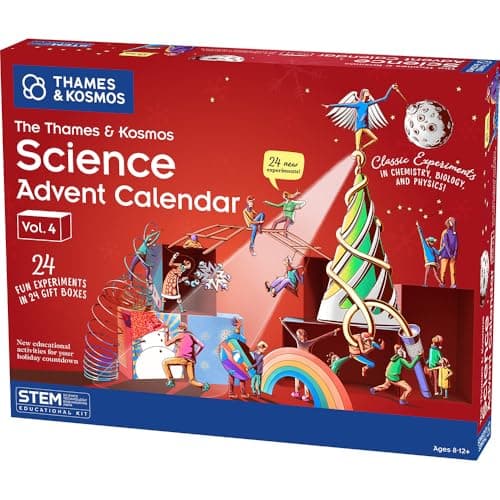
The Thames & Kosmos Science Advent Calendar Vol. 4 is the calendar to buy when the point is the experiment rather than the souvenir. Thames & Kosmos publishes 24 experiments for 24 days across chemistry, biology and physics, each daily box unfolding into its own 4-page manual, and publishes that they “only require additional items that are commonly found in every household”. Rated ages 8+, SKU 661010, released 2026. Nothing physical is left on 25 December, and that is the trade.
Block & Beaker earns a commission when you buy through our links, at no cost to you. It never changes a ranking, and we say so plainly when the right answer is the cheaper set, or nothing at all. Full disclosure · How we pick.
At a glance
The picks, ranked
Tap any row to jump to the full reasoning. Prices come live from Amazon where we have them and read “check price” where we don’t — never a number we cannot stand behind today.
| # | Product | Best for | Price |
|---|---|---|---|
| 1 | The product Thames & Kosmos Science Advent Calendar Vol. 4 24 experiments across three subjects, each in its own box with its own manual. | Eight and up, for a household that wants a five-minute activity every morning | |
| 2 | 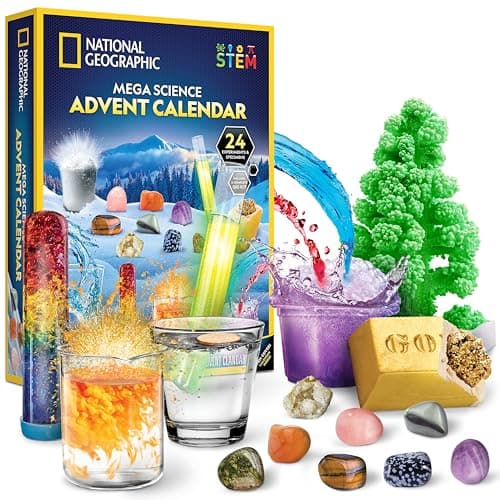 Buy this instead if it should leave something behind NATIONAL GEOGRAPHIC Science Advent Calendar 13 experiments plus 11 named specimens, a pouch, and a final-day pyrite dig. | Eight to twelve, for a child who collects things | |
| 3 | 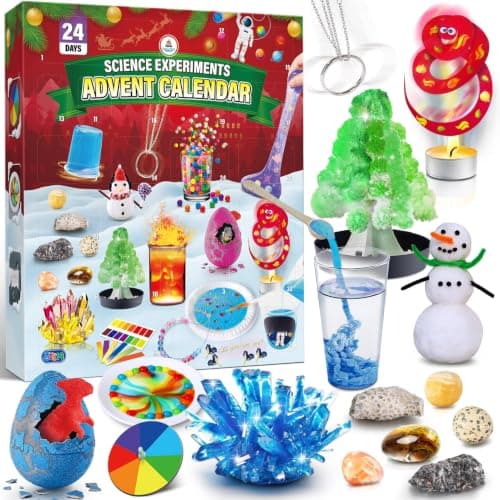 Cheapest 24-project option UNGLINGA Science Advent Calendar 24 published chemistry, physics and geology projects with tools included. | A second or third calendar in a house with several children | |
| 4 | 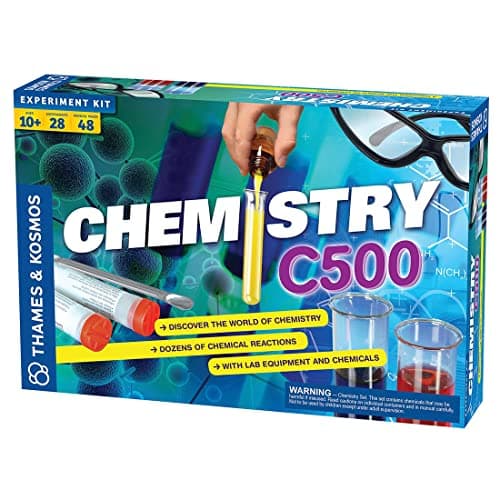 The same maker, with depth instead of variety Thames & Kosmos Chemistry C500 28 guided experiments, a 48-page manual, five chemicals and real glassware. | Ten and up, as the present rather than the countdown | |
| — | 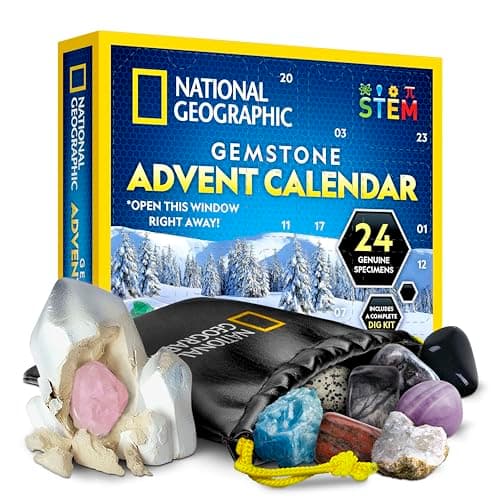 The wrong calendar if you came for experiments NATIONAL GEOGRAPHIC Gemstone Advent Calendar 24 polished gemstones, 5 jewelry settings, a pouch and a rose quartz dig brick. | A rock collector, as a completely different purchase |
5 picks, including 1 we tell you to skip. Ages shown are the manufacturer’s own rating, not ours.
What we can tell you, and what we cannot
We have not opened one. No lab, no samples, no test children, and no star rating here or in this page’s structured data. Everything below is Thames & Kosmos’s own published information plus arithmetic.
Three things to be precise about. Thames & Kosmos publishes 24 experiments but no piece count for Vol. 4 — the earlier Vol. 3 publishes 53 pieces, and we are not carrying that figure across to a different product. It publishes the three subject areas but not which experiment falls on which day, so we cannot tell you what day 1 is. And on 2026-10-17 the maker’s own store showed Vol. 4 as backordered while the Amazon listing showed it in stock at a buy-box price; the buy button here goes to the listing that was actually buyable.
The specification that decides it
The arithmetic
Thames & Kosmos Science Advent Calendar Vol. 4, published
| Experiments | 24 — one per day, no filler doors |
|---|---|
| Subjects | “chemistry, biology, and physics” |
| Keepable objects | 0 — every door is an activity |
| Daily format | Each box “unfolds to reveal an instruction manual with step-by-step directions” |
| Manual | 4 pages per box, 5.8 x 8.3 in |
| Extra materials | “only require additional items that are commonly found in every household” |
| Duration | “Experiments are quick to execute” |
| Product dimensions | 14.6 x 11.5 x 2.2 in; 1.2 lbs |
| Stated age | Ages 8+ |
| SKU / year | 661010 / released 2026 |
| Piece count | Not published for Vol. 4 |
What the numbers mean in practice
Twenty-four out of twenty-four removes the dud-door problem. Every multi-content calendar has mornings where the door contains a thing rather than an activity, and a child who wanted to do something is briefly disappointed. This calendar structurally cannot have one.
Household materials only is the claim that matters most. The failure mode for a December science calendar is not boredom, it is a missing ingredient on a Tuesday morning before school. Thames & Kosmos publishing that commitment is worth more than any experiment count.
A 4-page manual per box is the right size. Four pages is one experiment with an explanation, which means the explanation is actually there. Compare a 48-page manual covering 28 experiments in the Chem C500 — under two pages each. Per experiment, this calendar documents more.
Three subjects across 24 days is a sampler, deliberately. Chemistry, biology and physics in one box is about eight experiments each. That is enough to find out which one a child actually likes, and not enough to go deep in any of them — which is the correct design for a calendar and the wrong one for a present.
And zero keepables is a real cost, stated plainly. This site’s whole organizing question is whether a thing keeps getting picked up, and the honest answer here is that it cannot: the product ends on 24 December by design.
Vol. 4, and the volumes before it
Thames & Kosmos numbers these. Vol. 4 is SKU 661010 and released 2026; Vol. 3 is SKU 661007 and publishes a 53-piece count that Vol. 4 does not. We mention this only because the numbered volumes get searched for individually and because older volumes keep appearing on shelves — a Vol. 2 or Vol. 3 box bought in 2026 is a perfectly good 24-experiment calendar with different experiments in it, not a defective purchase.
What we will not do is tell you how Vol. 4’s experiments differ from Vol. 3’s. Thames & Kosmos publishes the subject areas for both and the individual experiments for neither, and guessing at the difference is exactly the kind of invention this site exists to avoid.
Who should skip it
Anyone who wants the gift to still exist in January. Zero keepables is published, not an oversight. Buy the National Geographic Science calendar for a collection, or the Gemstone calendar for 24 objects and no experiments.
A child under eight. The published floor is 8+ and a calendar is not a good place to cross a published age: there is no way to skip the three experiments that turn out to be too hard without leaving three empty doors. For younger children, the under-three Christmas page is the honest starting point.
A household that will not be there every morning. Twenty-four for twenty-four assumes someone opens a door each day. A calendar with keepable days survives a week away; this one just leaves seven experiments to do at once.
A teenager. Quick experiments with household materials at an 8+ floor is not the right purchase at fourteen. See science kits for teens.
Worth knowing before you buy
Where it sits
The calendar belongs in STEM advent calendars, beside the National Geographic Science calendar review. For the same maker with depth instead of variety, see the Chem C500 review and the CHEM C1000 review. For the wider shelf, science experiment kits and chemistry sets for kids.
In full
Every pick, and what is wrong with it
Published specifications only, each linked back to the page it came from. Where a manufacturer publishes nothing, the row says so — we do not fill blanks in.
1. The product
Thames & Kosmos Science Advent Calendar Vol. 4
Thames & Kosmos · 661010 · maker rates it 8+
24 experiments across three subjects, each in its own box with its own manual.
- Experiments
- 24 — one per day
- Subjects
- “chemistry, biology, and physics”
- Format
- “Daily box cleverly unfolds to reveal an instruction manual with step-by-step directions and scientific explanations”
- What you supply
- “only require additional items that are commonly found in every household”
Thames & Kosmos publishes 24 experiments, one per day, covering “chemistry, biology, and physics”, with each daily box that “cleverly unfolds to reveal an instruction manual with step-by-step directions and scientific explanations”. Published figures: 24 experiments, 4 manual pages, product dimensions 14.6 x 11.5 x 2.2 inches, product weight 1.2 lbs, manual dimensions 5.8 x 8.3 inches, SKU 661010, year released 2026, ages 8+.
Twenty-four for twenty-four is the highest experiment density published in this category, and it is the reason to buy this one. There is no filler door: every morning has something to do rather than something to look at.
The sentence that makes it work, though, is about materials. Thames & Kosmos publishes that the experiments “can be done quickly and only require additional items that are commonly found in every household”. On a product that has to function on 24 consecutive mornings in the busiest month of the year, a maker committing to that in writing is the most load-bearing claim on the listing — and it is the one claim none of the other calendars in this category makes.
The honest limit is the residue. When December ends, the child has done twenty-four experiments and owns nothing. If that matters, the National Geographic Science calendar trades eleven of those experiments for eleven named specimens.
Replay signal
- Open-ended or one-shot
- Twenty-four experiments and then it is finished. No open-ended phase at all
- Does anything run out
- Yes, completely — nothing physical is left when December ends
- Room to grow
- None published. The learning is the residue
Why we say so: Thames & Kosmos publishes 24 experiments across chemistry, biology and physics, each in its own box with a 4-page manual, and states that the experiments “can be done quickly and only require additional items that are commonly found in every household”. That last line is the specification that matters on a December purchase: a calendar that needs a shopping trip on day 9 stops on day 9.
What’s wrong with it
Keepable objects: zero. On 25 December there is nothing to put on a shelf.
| Experiments | 24 — one per day |
|---|---|
| Subjects | “chemistry, biology, and physics” |
| Format | “Daily box cleverly unfolds to reveal an instruction manual with step-by-step directions and scientific explanations” |
| What you supply | “only require additional items that are commonly found in every household” |
| Manual pages | 4 |
| Product dimensions | 14.6 x 11.5 x 2.2 in; 1.2 lbs |
| Stated age | Ages 8+ |
| Year released | 2026 |
| Consumables | Yes — all 24 days are experiments |
Every figure above is from Thames & Kosmos, Science Advent Calendar Vol. 4 (661010). Blanks are shown as “not published” rather than filled in.
2. Buy this instead if it should leave something behind
NATIONAL GEOGRAPHIC Science Advent Calendar
National Geographic · NGSCIADVENT2 · maker rates it 8-12
13 experiments plus 11 named specimens, a pouch, and a final-day pyrite dig.
- Days
- 24
- Experiments
- 13 — “selected 13 incredible experiments from our science kits”
- Specimens
- 11 fossils and gemstones — “carnelian, chevron amethyst, snowflake obsidian, gastropod, geode, tiger's eye, and more”
- Final day
- A pyrite (fool's gold) specimen excavated from a mini dig brick
Blue Marble publishes 24 days split into 13 experiments selected from its science kits and 11 fossils and gemstones — carnelian, chevron amethyst, snowflake obsidian, a gastropod, a geode and tiger’s eye among them — with a storage pouch and a final-day pyrite specimen in a mini dig brick, rated ages 8-12.
The straight alternative, and the decision is one question long: an experiment every morning, or a collection in January. Both are defensible; only one of them is what the person buying actually wants.
It is also the better buy for a child who has done a lot of experiments already and likes rocks. See the full review.
Replay signal
- Open-ended or one-shot
- A 24-day structure with a published end date — this is an event, not a toy
- Does anything run out
- Yes — 13 of the 24 days are consumable experiments
- Room to grow
- The specimens and the pouch become a rock collection that outlives December
Why we say so: Blue Marble publishes 13 experiments and 11 specimens plus a final-day pyrite dig, which is the only split in this category that leaves something behind. Read the ratio rather than the day count: twelve of the twenty-four days hand over a permanent object, and that is the difference between a calendar and a box of twenty-four afternoons.
What’s wrong with it
Eleven fewer experiments, and the thirteen are selections from the maker's own kits.
| Days | 24 |
|---|---|
| Experiments | 13 — “selected 13 incredible experiments from our science kits” |
| Specimens | 11 fossils and gemstones — “carnelian, chevron amethyst, snowflake obsidian, gastropod, geode, tiger's eye, and more” |
| Final day | A pyrite (fool's gold) specimen excavated from a mini dig brick |
| Experiments named | “hiding/revealing a secret message, making a test tube glow, floating coins, growing a colorful crystal tree” |
| Also included | Storage pouch for the specimen collection |
| Box wordmark | The box reads “Mega Science Advent Calendar” and carries a “24 experiments & specimens” badge; the listing title is “Science Advent Calendar”. Same product, model NGSCIADVENT2 |
| Stated age | Ages 8-12 |
| Consumables | Yes — the 13 experiments are single-use; the specimens are not |
Every figure above is from National Geographic toys (Blue Marble), Science Advent Calendar — published listing copy. Blanks are shown as “not published” rather than filled in.
3. Cheapest 24-project option
UNGLINGA Science Advent Calendar
UNGLINGA · Not published · maker rates it Not published
24 published chemistry, physics and geology projects with tools included.
- Days
- 24 — “24 fun chemistry, physics & geology projects”
- Subjects
- “chemistry, physics, geology, earth science & natural wonders”
- Activities named
- “grow crystals, collect the gemstones, explore underwater currents”
- What you supply
- “Comes with necessary tools, materials & detailed step-by-step instructions”
UNGLINGA publishes 24 chemistry, physics and geology projects covering earth science and natural wonders, states that the kit comes with the necessary tools, materials and step-by-step instructions, and names growing crystals, collecting gemstones and exploring underwater currents among the activities.
Here because of a real scenario: three children and one calendar is worse than three cheap calendars. At well under half the price band of the two above, that becomes possible.
The missing figures are the cost. No age rating and no breakdown of what the 24 projects actually are, against Thames & Kosmos publishing both. We are not filling those in.
Replay signal
- Open-ended or one-shot
- A 24-day sequence with a finished state
- Does anything run out
- Yes — a calendar of projects is consumable by construction
- Room to grow
- The collected gemstones are the only published residue
Why we say so: UNGLINGA publishes 24 projects spanning chemistry, physics and geology and states that the kit includes the tools and materials needed. What it does not publish is an age rating, or a breakdown of how many of the 24 days are experiments rather than objects — so it is here on price and published project count, with both absences stated rather than filled in.
What’s wrong with it
No published age rating, and no published experiment-versus-keepsake split.
| Days | 24 — “24 fun chemistry, physics & geology projects” |
|---|---|
| Subjects | “chemistry, physics, geology, earth science & natural wonders” |
| Activities named | “grow crystals, collect the gemstones, explore underwater currents” |
| What you supply | “Comes with necessary tools, materials & detailed step-by-step instructions” |
| Stated age | Not published by the manufacturer |
| Experiment count | Published as 24 projects; no split between experiments and keepable specimens is published |
| Consumables | Not published in detail — the crystal-growing day is consumable by definition |
Every figure above is from UNGLINGA, Science Advent Calendar — published listing copy. Blanks are shown as “not published” rather than filled in.
4. The same maker, with depth instead of variety
Thames & Kosmos Chemistry C500
Thames & Kosmos · 665012 · maker rates it 10+
28 guided experiments, a 48-page manual, five chemicals and real glassware.
- Experiments
- 28
- Manual
- 48 pages
- Chemicals included
- 5
- Equipment
- Safety glasses, test tubes, dropper pipettes, double-headed measuring spoon
Thames & Kosmos publishes 28 experiments, a 48-page manual, five included chemicals, and equipment comprising safety glasses, test tubes, dropper pipettes and a double-headed measuring spoon, rated 10 years and up.
Included because it is the honest answer to “we want chemistry, not a countdown”, from the same maker. Twenty-eight experiments with real reagents and safety glasses is a different activity from 24 quick demonstrations with household materials.
The two work well bought together, for the reason the whole calendar category exists: the calendar supplies the daily appointment and the chemistry set supplies the depth. See the Chem C500 review and chemistry sets for kids.
Replay signal
- Open-ended or one-shot
- Guided, not open-ended: 28 experiments, then the manual is finished
- Does anything run out
- Yes — the chemicals are consumed, and Thames & Kosmos sells replacements
- Room to grow
- Steps up to the larger C1000, C2000 and C3000 sets in the same line
- Adult required
- The maker rates it 10+ and it involves real chemicals
Why we say so: Thames & Kosmos publishes 28 experiments, a 48-page manual and five chemicals. Five finite chemicals across 28 experiments is arithmetic, not opinion — this set has an end, and it is better to know that before Boxing Day than after.
What’s wrong with it
The five chemicals are used up, and it needs an adult at the start.
| Experiments | 28 |
|---|---|
| Manual | 48 pages |
| Chemicals included | 5 |
| Equipment | Safety glasses, test tubes, dropper pipettes, double-headed measuring spoon |
| Stated age | 10 years and up |
| Batteries | 1 x 9V (not included) |
| Consumables | Yes — the five chemicals are used up |
Every figure above is from Thames & Kosmos, Chemistry C500. Blanks are shown as “not published” rather than filled in.
Skip this one
NATIONAL GEOGRAPHIC Gemstone Advent Calendar
National Geographic · NGGEMADVENT · maker rates it Not published
24 polished gemstones, 5 jewelry settings, a pouch and a rose quartz dig brick.
- Days
- 24
- Gemstones
- 24 polished stones — “agate, green aventurine, hematite, sodalite, turquenite, tiger's eye, blue calcite and more”
- Final day
- Rose quartz excavated from a mini dig brick
- Jewelry settings
- 5 — “so kids can create their own special jewelry with their new gemstones”
Blue Marble publishes 24 polished gemstones, five jewelry settings, a collector’s pouch and a final-day rose quartz dig brick. It publishes no experiment at all and no age rating.
It is the skip on this page in a narrow and specific sense: it is a good product and the wrong one for the person reading a review of a 24-experiment calendar. Both boxes say “advent calendar” and sit in the same aisle, and only one of them contains any science to do.
If the stones are what appeals, buy it deliberately rather than by accident. See STEM advent calendars for the side by side.
Replay signal
- Open-ended or one-shot
- Not open-ended, but nothing is used up either — 24 objects that stay objects
- Does anything run out
- Nothing runs out
- Room to grow
- Five jewelry settings and a pouch are the published after-December use
Why we say so: Blue Marble publishes 24 polished gemstones, a final-day rose quartz dig brick, five jewelry settings and a collector's pouch, and publishes no experiment at all. That makes this the only calendar in this group with a zero consumable count — and the reason it belongs beside the geology shelf rather than the chemistry one.
What’s wrong with it
Blue Marble publishes no experiment for it and no age rating.
| Days | 24 |
|---|---|
| Gemstones | 24 polished stones — “agate, green aventurine, hematite, sodalite, turquenite, tiger's eye, blue calcite and more” |
| Final day | Rose quartz excavated from a mini dig brick |
| Jewelry settings | 5 — “so kids can create their own special jewelry with their new gemstones” |
| Also included | Collector's pouch |
| Experiments | None — this is a specimen calendar, not an experiment calendar |
| Stated age | Not published by the manufacturer |
| Consumables | None — every one of the 24 days is a permanent object |
Every figure above is from National Geographic toys (Blue Marble), Gemstone Advent Calendar — published listing copy. Blanks are shown as “not published” rather than filled in.
We are not putting a buy button on this one. It is easy enough to find if you want it anyway — but we would rather send you to something that gets played with twice.
Questions people actually ask
Frequently asked
Is the Thames & Kosmos Science Advent Calendar worth it?
Yes, for a household that wants a five-minute activity every morning. Thames & Kosmos publishes 24 experiments for 24 days across chemistry, biology and physics, each in its own box with a 4-page manual, and publishes that they only need items commonly found in every household. The cost is that nothing is left on 25 December.
How many experiments are in the Thames & Kosmos advent calendar?
Twenty-four - one per door, with no filler days. That is the highest experiment count published in the category: the National Geographic Science calendar publishes 13 experiments among 24 doors, and the Gemstone calendar publishes none at all.
What age is the Thames & Kosmos Science Advent Calendar for?
Ages 8+, published by Thames & Kosmos. A calendar is a poor place to cross a published age floor, because an experiment that turns out to be too hard leaves an empty door rather than a skipped page. Buying above the age rating.
Do I need to buy anything extra for the experiments?
Thames & Kosmos publishes that the experiments "only require additional items that are commonly found in every household". It does not publish the list, so expect water, paper, a kitchen surface and the usual kitchen acids. It is the only maker in this category that commits to the household-materials claim in writing. What else you need with a science kit.
How many pieces are in Science Advent Calendar Vol. 4?
Not published. Thames & Kosmos publishes 24 experiments, 4 manual pages per box, product dimensions of 14.6 x 11.5 x 2.2 inches and a weight of 1.2 lbs, but no piece count for Vol. 4. The earlier Vol. 3 publishes 53 pieces; that is a different product and we do not carry the figure across.
What is the difference between Vol. 3 and Vol. 4?
Different experiments, and we cannot tell you which. Thames & Kosmos publishes the subject areas for both volumes and the individual experiments for neither. Vol. 4 is SKU 661010 released 2026; Vol. 3 is SKU 661007. An older volume bought today is a complete 24-experiment calendar, not a defective one.
Should I buy this or the National Geographic science advent calendar?
One question: activity or collection. Thames & Kosmos publishes 24 experiments and zero keepable objects. Blue Marble publishes 13 experiments plus 11 named specimens, a pouch and a final-day pyrite dig. Buy this for a child who wants to do something each morning. National Geographic Science Advent Calendar review.
Sources
Where these figures came from
Every specification on this page traces to one of these. If a manufacturer publishes nothing on a point, the page says so rather than filling the gap.
Read next
Where to go from here
Back to Reviews, or read how we pick.