Single review
Thames & Kosmos Chem C500 Review
Reviewed from the manufacturer's published specifications and the arithmetic on them. We have not used it, and we say so.
By Sawyer V. · Published
The short answer
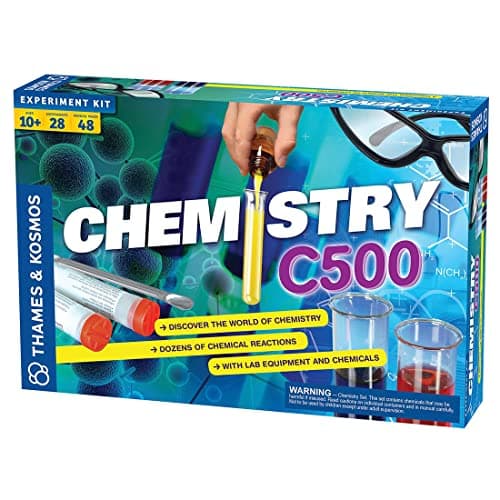
The Thames & Kosmos Chemistry C500 publishes 28 experiments, a 48-page manual and five included chemicals, with safety glasses, test tubes and pipettes, rated 10 years and up. Five finite chemicals across 28 experiments is arithmetic: this set has an end, and it is better to know that in November than in January.
Block & Beaker earns a commission when you buy through our links, at no cost to you. It never changes a ranking, and we say so plainly when the right answer is the cheaper set, or nothing at all. Full disclosure · How we pick.
At a glance
The picks, ranked
Tap any row to jump to the full reasoning. Prices come live from Amazon where we have them and read “check price” where we don’t — never a number we cannot stand behind today.
| # | Product | Best for | Price |
|---|---|---|---|
| 1 | The product Thames & Kosmos Chemistry C500 Real reagents, real glassware and a 48-page manual — the entry point to a line that continues upward. | Ten and up, as a genuine first chemistry set | |
| 2 | 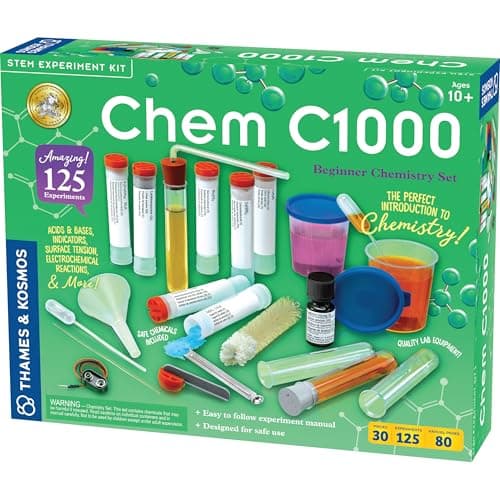 The bigger first set Thames & Kosmos CHEM C1000 More experiments and more equipment in the same line, for a household that does not want to buy twice. | A child already sure this is their subject | |
| 3 | 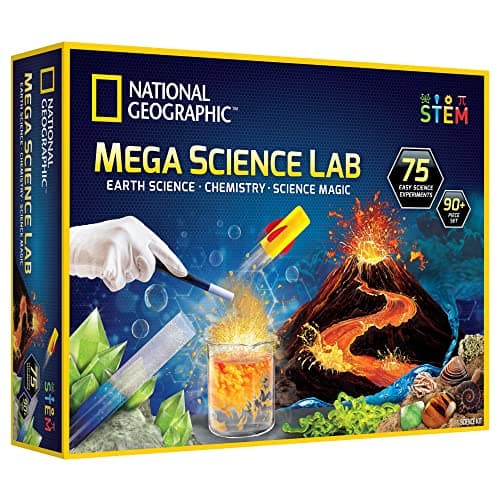 The broader alternative NATIONAL GEOGRAPHIC Mega Science Lab 45 experiments in the kit plus 85+ more using household items, published as 130+ in total. | A child who likes science generally, not chemistry specifically | |
| — | Not a set at all MEL Chemistry monthly subscription Frequently compared with boxed chemistry sets, and it is a subscription with a monthly bill. | A committed child and a household happy with a standing order |
4 picks, including 1 we tell you to skip. Ages shown are the manufacturer’s own rating, not ours.
What we can tell you, and what we cannot
We have not run these experiments. No lab, no samples, no test children, no star rating on this page or in its structured data.
Published experiment counts, manual length, reagent counts and safety standards we can report. Whether an individual experiment is impressive, and how much supervision a particular ten-year-old needs, we cannot.
The specification that decides it
The arithmetic
Chemistry C500, published
| Experiments | 28 |
|---|---|
| Manual | 48 pages |
| Chemicals included | 5 |
| Equipment | Safety glasses, test tubes, dropper pipettes, measuring spoon |
| Stated age | 10 years and up |
| Batteries | 1 x 9V, not included |
| Consumables | Yes — the five chemicals are used up |
| Steps up to | C1000, C2000, C3000 |
What the numbers mean in practice
A 10+ rating on a chemistry set is about the contents. Unlike the 8+ on Snap Circuits, which is a reading-and-patience estimate, this is a floor set by what is in the bottles. Thames & Kosmos states compliance with EN 71-4, the European standard covering chemistry experiment kits.
The equipment outlives the chemicals. Buying a refill is cheaper than buying another set, and the glassware is what makes the C1000 upgrade sensible later.
A 9V battery is required and not included. Small, easy to miss on the listing, and the reason one of the 28 experiments does not happen on the first day.
Worth knowing before you buy
This is a real chemistry set with real reagents, rated 10+ under EN 71-4. The safety glasses are supplied because they are needed, and the age rating should be read as a floor rather than as a suggestion about difficulty.
Who should skip it
A child under ten. The rating is about the chemicals. First science kits covers the ages below this one, where kits use household materials instead.
Anyone expecting years of use. Twenty-eight experiments is a good winter, not a childhood. If that is the requirement, a microscope or a construction set is the better shape of purchase.
Say the unwelcome thing
Do not buy this as a set-and-forget present
Real reagents at a 10+ rating means an adult is in the room. If nobody in the household has an hour to sit down with it, the kit stays sealed and the money is gone — buy something the child can start alone.
Where it sits
The C500 leads the chemistry sets roundup and appears on the ten-year-old page. For what a kit quietly expects you to already own, see what else a science kit needs.
In full
Every pick, and what is wrong with it
Published specifications only, each linked back to the page it came from. Where a manufacturer publishes nothing, the row says so — we do not fill blanks in.
1. The product
Thames & Kosmos Chemistry C500
Thames & Kosmos · 665012 · maker rates it 10+
Real reagents, real glassware and a 48-page manual — the entry point to a line that continues upward.
- Experiments
- 28
- Manual
- 48 pages
- Chemicals included
- 5
- Equipment
- Safety glasses, test tubes, dropper pipettes, double-headed measuring spoon
Thames & Kosmos publishes 28 experiments, a 48-page manual, five chemicals and the equipment to use them: safety glasses, test tubes, dropper pipettes and a double-headed measuring spoon.
The equipment is the durable half and it is worth separating from the consumable half. Glassware, spoon and glasses survive the set. The chemicals do not, and Thames & Kosmos sells replacements — which is a manufacturer telling you plainly that this is a kit with a refill model.
The published step up is the rest of the C-series: C1000, C2000 and C3000 build on the same equipment. That makes the C500 a genuine entry point rather than a dead end.
Replay signal
- Open-ended or one-shot
- Guided, not open-ended: 28 experiments, then the manual is finished
- Does anything run out
- Yes — the chemicals are consumed, and Thames & Kosmos sells replacements
- Room to grow
- Steps up to the larger C1000, C2000 and C3000 sets in the same line
- Adult required
- The maker rates it 10+ and it involves real chemicals
Why we say so: Thames & Kosmos publishes 28 experiments, a 48-page manual and five chemicals. Five finite chemicals across 28 experiments is arithmetic, not opinion — this set has an end, and it is better to know that before Boxing Day than after.
What’s wrong with it
The five chemicals are consumed, and a 9V battery is required and not included.
| Experiments | 28 |
|---|---|
| Manual | 48 pages |
| Chemicals included | 5 |
| Equipment | Safety glasses, test tubes, dropper pipettes, double-headed measuring spoon |
| Stated age | 10 years and up |
| Batteries | 1 x 9V (not included) |
| Consumables | Yes — the five chemicals are used up |
Every figure above is from Thames & Kosmos, Chemistry C500. Blanks are shown as “not published” rather than filled in.
2. The bigger first set
Thames & Kosmos CHEM C1000
Thames & Kosmos · 640118 · maker rates it 10+
More experiments and more equipment in the same line, for a household that does not want to buy twice.
- Chemicals included
- Seven, in cylindrical vials
- Manual
- Full experiment manual published free on the manufacturer's own site
- Safety standard
- “EN 71-4, in which the safety requirements for chemistry experimental kits are established”
- Covers
- Lab setup and safe handling, indicators and litmus, invisible ink, gas reactions
The C1000 is the right purchase when interest is already established, and an expensive way to find out it is not. The C500 answers the question at lower cost with the same equipment quality.
Replay signal
- Open-ended or one-shot
- Guided rather than open-ended, but the manual is a term's worth of weekends
- Does anything run out
- Yes — seven finite chemicals, with replacements sold separately
- Room to grow
- The C-series continues into C2000 and C3000, carrying the same equipment forward
- Adult required
- Real chemicals at a 10+ rating: a sit-with-them kit at the lower end of that range
Why we say so: Thames & Kosmos publishes the full manual free on its own site — you can read exactly what your child will be doing before spending anything — and states compliance with EN 71-4, the European chemistry-kit safety standard.
What’s wrong with it
More reagents to store and supervise, for a subject the child may not stay with.
| Chemicals included | Seven, in cylindrical vials |
|---|---|
| Manual | Full experiment manual published free on the manufacturer's own site |
| Safety standard | “EN 71-4, in which the safety requirements for chemistry experimental kits are established” |
| Covers | Lab setup and safe handling, indicators and litmus, invisible ink, gas reactions |
| Stated age | 10 and up |
| Consumables | Yes — the seven chemicals are used up |
Every figure above is from Thames & Kosmos, experiment manuals. Blanks are shown as “not published” rather than filled in.
3. The broader alternative
NATIONAL GEOGRAPHIC Mega Science Lab
National Geographic · Mega Science Lab · maker rates it 8+
45 experiments in the kit plus 85+ more using household items, published as 130+ in total.
- Experiments in the kit
- 45, across chemistry, earth science and science magic
- Bonus guide
- 85+ further experiments using household items, for 130+ in total
- Includes
- Volcano build, glow-in-the-dark crystal growth, and the tools for both
- Stated age
- 8+
National Geographic publishes 45 in-kit experiments across chemistry, earth science and science magic, plus a bonus guide of 85+ further experiments using household items.
That 85+ figure is the interesting one, because household-item experiments do not run out. For a child who has not yet chosen a subject, breadth that keeps working is the better buy.
Replay signal
- Open-ended or one-shot
- Guided, and the 45 in-kit experiments end. The 85 household ones do not
- Does anything run out
- The supplied materials run out; the household half of the book never does
- Room to grow
- The bonus guide is the genuinely durable part, and it costs the manufacturer almost nothing to include
- Adult required
- Supervision for the chemistry third; the earth science and household experiments are largely self-run
Why we say so: National Geographic publishes 45 in-kit experiments plus a bonus guide of 85+ using household items. That second number is why this kit outlasts most of its price band: roughly two-thirds of the published content needs nothing but a kitchen.
What’s wrong with it
Breadth over depth — it covers chemistry, earth science and science magic without going far into any.
| Experiments in the kit | 45, across chemistry, earth science and science magic |
|---|---|
| Bonus guide | 85+ further experiments using household items, for 130+ in total |
| Includes | Volcano build, glow-in-the-dark crystal growth, and the tools for both |
| Stated age | 8+ |
| Consumables | Yes — the supplied chemicals and crystal compounds are used up |
Every figure above is from National Geographic toys, Mega Science Lab. Blanks are shown as “not published” rather than filled in.
Skip this one
MEL Chemistry monthly subscription
MEL Science · MEL Chemistry · maker rates it 10+
Frequently compared with boxed chemistry sets, and it is a subscription with a monthly bill.
- Stated age
- 10+
- Experiments per set
- 2-3
- Cadence
- A new kit by the 23rd of each month
- First shipment
- Includes a home lab — flask, solid fuel stove, safety glasses, beakers
MEL Science publishes 2-3 experiments per set, a new kit by the 23rd of each month, a first shipment including a home lab — flask, solid fuel stove, safety glasses, beakers — and a 10+ rating.
Two to three experiments a month is less chemistry per month than the C500 delivers in one afternoon. What a subscription buys is ritual, not volume, and it only works if somebody actually sits down in the week the box arrives. As a gift it commits the recipient to a recurring cost, which is a different thing from a present.
Replay signal
- Open-ended or one-shot
- Guided experiments, not open-ended play
- Does anything run out
- Each month's reagents run out; the equipment from the first shipment does not
- Room to grow
- The reusable home lab means later months arrive as refills rather than restarts
- Adult required
- A solid fuel stove and real reagents at a 10+ rating means an adult in the room
Why we say so: MEL Science publishes the 2-3 experiments per set, the monthly cadence, the 10+ rating and the contents of the first shipment's home lab.
What’s wrong with it
Published as 2-3 experiments per monthly kit, with reagents used up each month.
| Stated age | 10+ |
|---|---|
| Experiments per set | 2-3 |
| Cadence | A new kit by the 23rd of each month |
| First shipment | Includes a home lab — flask, solid fuel stove, safety glasses, beakers |
| Consumables | Yes — reagents are used up each month |
Every figure above is from MEL Science, chemistry subscription. Blanks are shown as “not published” rather than filled in.
We are not putting a buy button on this one. It is easy enough to find if you want it anyway — but we would rather send you to something that gets played with twice.
Questions people actually ask
Frequently asked
How many experiments are in the Chem C500?
Thames & Kosmos publishes 28 experiments and a 48-page manual, using five included chemicals. Because the chemicals are consumed, 28 is a genuine total rather than a starting point, and the manufacturer sells replacement chemicals.
What age is the Chem C500 for?
Ten years and up. On a chemistry set that number is about the reagents rather than the difficulty — Thames & Kosmos states compliance with EN 71-4, the European standard for chemistry experiment kits, and the rating should be treated as a floor. Toy safety standards explained.
Does the Chem C500 need batteries?
One 9V battery, not included. It is easy to miss on retail listings and it is required for part of the experiment set.
Chem C500 or the bigger C1000?
Start with the C500 unless chemistry is already an established interest. Both use the same equipment quality and the line is designed to be climbed, so the C500 is an entry point rather than a compromise.
Sources
Where these figures came from
Every specification on this page traces to one of these. If a manufacturer publishes nothing on a point, the page says so rather than filling the gap.
Read next
Where to go from here
Back to Reviews, or read how we pick.