Guide and picks
The Battery Guide for STEM Toys
The most avoidable disappointment in this category, and it costs about the price of a coffee to prevent.
By Sawyer V. · Published
The short answer
Check the published battery requirement before you wrap anything. Botley 2.0 needs five AAA, the Code & Go Robot Mouse needs three AAA, and Snap Circuits Classic needs four AA — none included. That is eight AAA cells before anything happens on the morning.
Block & Beaker earns a commission when you buy through our links, at no cost to you. It never changes a ranking, and we say so plainly when the right answer is the cheaper set, or nothing at all. Full disclosure · How we pick.
At a glance
The picks, ranked
Tap any row to jump to the full reasoning. Prices come live from Amazon where we have them and read “check price” where we don’t — never a number we cannot stand behind today.
| # | Product | Best for | Price |
|---|---|---|---|
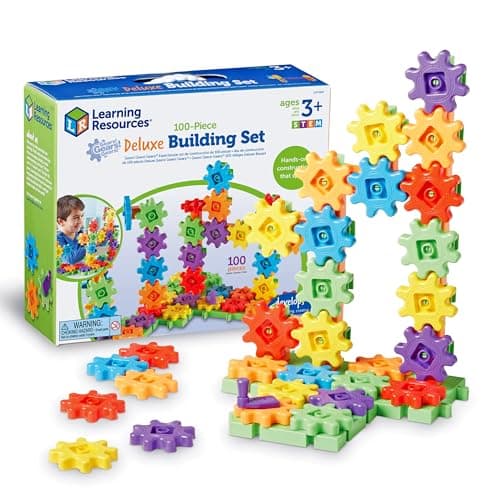
| 1 | Best with no batteries at all Gears! Gears! Gears! 100-Piece Deluxe Building Set A hundred pieces, a crank handle, and nothing to go flat — ever. | Three and up, and it works forever | |
| 2 | 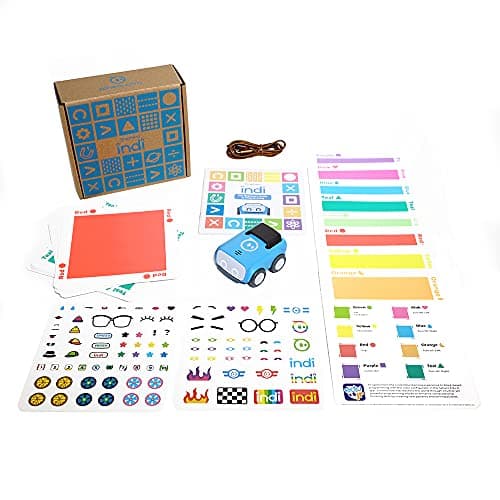 Best rechargeable Sphero indi At-Home Learning Kit Two-plus hours of play per USB charge — the running cost after purchase is nothing. | Four and up, and no cells to buy ever again | |
| 3 | 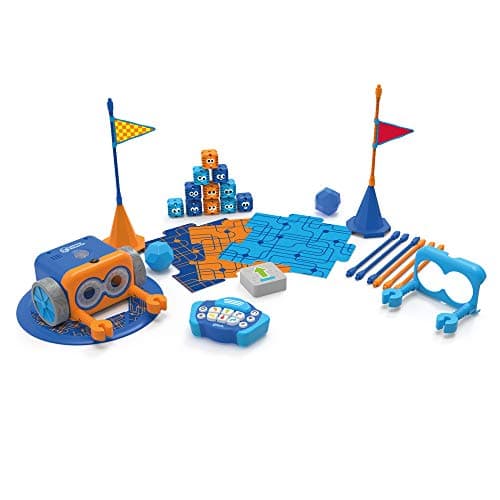 The five-cell reality Botley 2.0 The Coding Robot Activity Set An excellent robot with the highest published cell count on the site — five AAA, not included. | Five and up, once you have bought the batteries | |
| 4 | 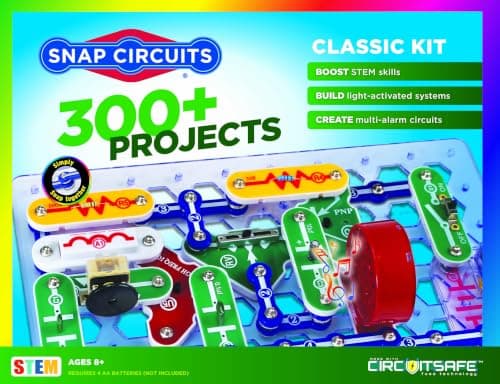 The four-AA case Snap Circuits Classic Four AA cells that power 305 published projects — a genuinely low consumption per hour of use. | Eight and up, and a set that will run for years on them | |
| — | 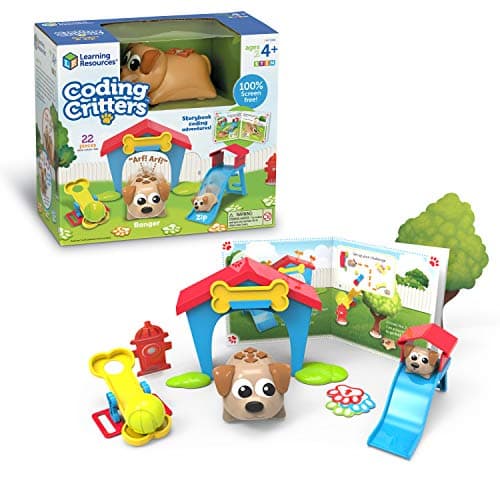 The one to skip Coding Critters Ranger & Zip Battery-powered with a low coding ceiling — the worst combination of the two things this page cares about. | Four, and a different page |
5 picks, including 1 we tell you to skip. Ages shown are the manufacturer’s own rating, not ours.
Every published requirement on this site
The arithmetic
What needs what
| Botley 2.0 | 5 x AAA, not included |
|---|---|
| Code & Go Robot Mouse | 3 x AAA, not included |
| Snap Circuits Classic | 4 x AA, not included |
| Snap Circuits Pro | 4 x AA, not included |
| Chemistry C500 | 1 x 9V, not included |
| My First Lab Duo-Scope | 3 x AA, not included |
| 4M Solar Rover | 1 x AAA, not included |
| Design & Drill | Required, not included |
| Sphero indi, mBot2, LEGO SPIKE hub | Rechargeable — none to buy |
| Gears, KEVA, magnetic tiles, LEGO, all logic games | None ever |
Three kinds of toy, from a battery point of view
None at all. Construction sets, logic games, wooden systems. These have no failure mode and no running cost, which is a genuine and under-valued advantage. A tile set works in a power cut, in a car, and in eight years.
Rechargeable. Robots with built-in lithium cells and USB charging. Cheaper across two years, no recurring purchases, and one new failure mode: flat at the wrong moment with an hour's wait.
Disposable cells. The largest group and the one that causes the problems. Everything here is fine once you have the cells; almost none of it includes them.
What to actually buy
For a household with more than one battery toy, rechargeable AA and AAA cells plus a charger pays for itself quickly and removes the recurring problem. Low-self-discharge cells are the ones worth having — they hold charge for months in a drawer, which ordinary rechargeables do not.
Keep a labeled box with spares of both sizes. The failure mode is rarely not owning batteries; it is not knowing where they are at the moment a child wants the toy.
For gifts posted at a distance, send the cells with the present or choose from the no-battery list. A gear set or a box of linking cubes cannot disappoint on the morning.
Worth knowing before you buy
Button and coin cells are the serious hazard in this category, not AA or AAA. A swallowed button cell can cause severe internal burns within hours, and it is a medical emergency rather than a wait-and-see. Any compartment holding one should be screwed shut.
For ordinary cells the practical rules are: do not mix old and new, do not mix brands or chemistries in one device, and remove cells from anything being put away for months — leaking alkaline cells destroy the contacts and the toy with them.
Lithium packs in rechargeable robots should be charged on a hard surface with the supplied cable, and any pack whose case has swollen or cracked should be retired.
Say the unwelcome thing
Do not assume the batteries are included
Almost nothing in this category includes them, and retailer listings rarely repeat the requirement even when the manufacturer publishes it clearly.
Every product page on this site lists the battery requirement in the specification table for exactly this reason. Check it before wrapping, not after.
What to buy if you want to avoid the problem entirely
- No batteries, three and up: Gears.
- No batteries, five and up: KEVA planks or any logic game.
- Rechargeable robot: Sphero indi.
- Battery toy you want anyway: Botley 2.0, plus five AAA cells in the same order.
See also the grandparent's guide, which covers this among the other distance-buying constraints, and the coding robots roundup.
In full
Every pick, and what is wrong with it
Published specifications only, each linked back to the page it came from. Where a manufacturer publishes nothing, the row says so — we do not fill blanks in.
1. Best with no batteries at all
Gears! Gears! Gears! 100-Piece Deluxe Building Set
Learning Resources · LER9162 · maker rates it 3+
A hundred pieces, a crank handle, and nothing to go flat — ever.
- Pieces
- 100
- Contents
- 46 gears, 26 square pillars, 21 six-way axles, 6 interlocking bases, 1 crank handle, activity guide
- Stated age
- 3+
- Batteries
- None — hand-cranked
Learning Resources publishes 46 gears, 26 square pillars, 21 six-way axles, 6 interlocking bases, a crank handle and an activity guide, rated 3+, with no batteries anywhere in the published contents.
The child is the power source, which is better pedagogically as well as practically. Turn the handle slowly and the machine moves slowly: the relationship between input and output is direct rather than mediated by a switch.
This is the toy that still works on the third Sunday after Christmas, when everything electronic is flat and the shops are shut.
Replay signal
- Open-ended or one-shot
- Open-ended, with immediate cause and effect: turn the handle, the whole thing moves
- Does anything run out
- Nothing runs out
- Room to grow
- Sets from the same line interlock, so a second box doubles the machine
Why we say so: Learning Resources publishes the full 100-piece contents list, the ages 3+ rating and the hand crank. No batteries appear in the published contents, which is why this one still works when everything else in the toy box is flat.
What’s wrong with it
The core idea is grasped quickly, and after that the play is arrangement rather than discovery.
| Pieces | 100 |
|---|---|
| Contents | 46 gears, 26 square pillars, 21 six-way axles, 6 interlocking bases, 1 crank handle, activity guide |
| Stated age | 3+ |
| Batteries | None — hand-cranked |
| Consumables | None |
Every figure above is from Learning Resources, Gears! Gears! Gears! Deluxe Building Set. Blanks are shown as “not published” rather than filled in.
2. Best rechargeable
Sphero indi At-Home Learning Kit
Sphero · indi · maker rates it 4+
Two-plus hours of play per USB charge — the running cost after purchase is nothing.
- Contents
- 1 indi robot, 30 color cards, charging cable, 2 sticker sheets, activity booklet, tape to fix the cards down
- Card mix
- 5 green, 4 yellow, 3 red, 2 purple, 3 teal, 3 orange, 5 blue, 5 pink
- How it is coded
- An on-board color sensor reads the cards; no screen needed
- Play time
- “2+ hours of play on a full charge”, USB charging
Sphero publishes an on-board color sensor as the programming mechanism, 30 color cards, a charging cable and 2+ hours of play on a full charge with USB charging, rated 4 and up.
Over two or three years a rechargeable toy is materially cheaper than a disposable-cell one, and it removes the recurring "we have no AAAs" problem entirely.
The tradeoff is planning. Charge it the night before a birthday rather than on the morning — a rechargeable toy out of the box is frequently not full.
Replay signal
- Open-ended or one-shot
- Very open-ended for the age: the child lays the track out across the whole floor
- Does anything run out
- Nothing runs out; recharges by USB
- Room to grow
- Screen-free cards first, then the same robot accepts block coding in the free app when the child is ready
- Adult required
- Not after setup — the program is the floor, and the child builds it
Why we say so: Sphero publishes the 30-card color breakdown, the on-board color sensor as the programming method, the 2+ hours per charge, and the optional step up to drag-and-drop blocks in Sphero Edu Jr.
What’s wrong with it
A flat robot needs an hour on a cable, and it will be flat exactly when a four-year-old wants it.
| Contents | 1 indi robot, 30 color cards, charging cable, 2 sticker sheets, activity booklet, tape to fix the cards down |
|---|---|
| Card mix | 5 green, 4 yellow, 3 red, 2 purple, 3 teal, 3 orange, 5 blue, 5 pink |
| How it is coded | An on-board color sensor reads the cards; no screen needed |
| Play time | “2+ hours of play on a full charge”, USB charging |
| Optional app | Sphero Edu Jr drag-and-drop blocks |
| Stated age | Ages 4 and up |
Every figure above is from Sphero, indi At-Home Learning Kit. Blanks are shown as “not published” rather than filled in.
3. The five-cell reality
Botley 2.0 The Coding Robot Activity Set
Learning Resources · LER2938 · maker rates it 5+
An excellent robot with the highest published cell count on the site — five AAA, not included.
- Set size
- 78 pieces
- Contents
- Botley 2.0, remote programmer, 2 face plates, 40 coding cards, 6 double-sided boards, 27 obstacle pieces, starter guide
- Maximum program length
- “coding sequences of up to 150 steps”
- Movement
- Six directions, plus 16 coded interactions
Learning Resources publishes a 78-piece set with coding sequences of up to 150 steps, six directions, 16 interactions and 100% screen-free play, rated 5+, requiring five AAA batteries not included.
It is our top coding pick and it comes with the biggest battery caveat we publish. Five is more than most households keep spare.
Buy them with the toy, and buy rechargeable AAAs plus a charger if the household has several battery toys. A robot that will not move on the day it is opened is a bad first impression that is hard to undo.
Replay signal
- Open-ended or one-shot
- Open-ended once the cards are understood — the child builds the maze, not just the program
- Does anything run out
- Nothing runs out except batteries
- Room to grow
- A 150-step ceiling means the challenge scales for years past the first week
- Adult required
- Needed for the first session, then not — there is no app account and nothing to log into
Why we say so: Learning Resources publishes the 78-piece contents, the 150-step maximum sequence, the six directions and 16 interactions, and states the set is 100% screen-free with no tablet or app required.
What’s wrong with it
Five AAA cells. This is the single most common cause of a disappointing first morning in this category.
| Set size | 78 pieces |
|---|---|
| Contents | Botley 2.0, remote programmer, 2 face plates, 40 coding cards, 6 double-sided boards, 27 obstacle pieces, starter guide |
| Maximum program length | “coding sequences of up to 150 steps” |
| Movement | Six directions, plus 16 coded interactions |
| Screen required | None — “100% screen-free play” |
| Batteries | “Requires 5 AAA batteries (not included)” |
| Stated age | 5+ (K-2nd grade) |
Every figure above is from Learning Resources, Botley 2.0 Activity Set. Blanks are shown as “not published” rather than filled in.
4. The four-AA case
Snap Circuits Classic
Elenco · SC-300 · maker rates it 8+
Four AA cells that power 305 published projects — a genuinely low consumption per hour of use.
- Projects
- “Build over 300 exciting projects” — manual covers projects 1-305
- Parts
- “Contains over 60 Snap-Together parts”
- Projects per part
- 5.1 — the highest ratio in the line
- Stated age
- “Ages 8+” and “Not for Children under 3 yrs.”
Elenco publishes over 300 projects with a manual covering 1-305 from over 60 snap-together parts, rated 8+, requiring four AA batteries not included.
Unlike a motorised toy, a circuit kit draws very little for most projects — LEDs and buzzers are undemanding. One set of AAs lasts a long time.
But it is completely dead without them, and there is no fallback mode. Four AAs alongside the box is non-negotiable.
Replay signal
- Open-ended or one-shot
- The sweet spot of the line — enough parts to invent with, cheap enough not to be an event
- Does anything run out
- Nothing runs out
- Room to grow
- 305 published projects is years of Sunday afternoons at one a week
Why we say so: Elenco publishes 305 numbered projects against 60+ parts. Five projects per part is the highest ratio anywhere in the Snap Circuits line, which is the arithmetic reason this is the set to buy rather than the cheap one or the big one.
What’s wrong with it
A circuit kit that cannot be switched on is the worst object in a pile of presents, and it happens constantly.
| Projects | “Build over 300 exciting projects” — manual covers projects 1-305 |
|---|---|
| Parts | “Contains over 60 Snap-Together parts” |
| Projects per part | 5.1 — the highest ratio in the line |
| Stated age | “Ages 8+” and “Not for Children under 3 yrs.” |
| Batteries | “Requires 4 ‘AA’ batteries (not included)” |
| Relationship to SC-100 | Manual includes all SC-100 projects plus 200 new ones |
Every figure above is from Elenco, Snap Circuits Classic. Blanks are shown as “not published” rather than filled in.
Skip this one
Coding Critters Ranger & Zip
Learning Resources · LER3081 · maker rates it 4+
Battery-powered with a low coding ceiling — the worst combination of the two things this page cares about.
- Set size
- 22 pieces
- Screen required
- None — “100% screen-free coding”
- Format
- Interactive pet plus playset and a storybook of coding activities
- Stated age
- Ages 4+
Learning Resources publishes a 22-piece set built around an interactive pet, a playset and a storybook of coding activities, 100% screen-free, rated 4+.
It is a lovely toy for a four-year-old and it is covered on the coding robots page.
On this page it is the skip because of the ratio. If a toy is going to consume cells, it should give a lot back — and a storybook format with no published step ceiling gives less than Botley's 150 steps for similar consumption.
Replay signal
- Open-ended or one-shot
- Half toy, half coding set — the pretend play carries on long after the programming stops
- Does anything run out
- Nothing runs out
- Room to grow
- Little: the coding ceiling here is low by design
- Adult required
- The storybook is read-aloud at four; the pet is not
Why we say so: Learning Resources publishes the 22-piece count, the screen-free format and the storybook-led activity structure. We call the coding ceiling low because the published format is a storybook sequence rather than a programmable step count — compare Botley's published 150-step maximum.
What’s wrong with it
Needs cells and publishes no step ceiling, so you are buying battery consumption for a storybook rather than a programmable system.
| Set size | 22 pieces |
|---|---|
| Screen required | None — “100% screen-free coding” |
| Format | Interactive pet plus playset and a storybook of coding activities |
| Stated age | Ages 4+ |
| Consumables | None |
Every figure above is from Learning Resources, Coding Critters. Blanks are shown as “not published” rather than filled in.
We are not putting a buy button on this one. It is easy enough to find if you want it anyway — but we would rather send you to something that gets played with twice.
Questions people actually ask
Frequently asked
Which STEM toys need batteries?
Most powered ones, and almost none include them. Botley 2.0 publishes five AAA, the Code & Go Robot Mouse three AAA, Snap Circuits Classic and Pro four AA each, the Chem C500 one 9V, and the Duo-Scope microscope three AA — all not included.
Which STEM toys need no batteries at all?
Construction sets, logic games and wooden systems. Gears, KEVA planks, magnetic tiles, LEGO and every single-player puzzle game on this site run on nothing — which means no running cost and no failure mode.
Are rechargeable STEM toys better?
Across two or three years, usually yes — cheaper and no recurring purchases. Sphero indi publishes 2+ hours per USB charge. The one new failure mode is being flat at the wrong moment, so charge it the night before a birthday rather than on the morning.
What battery safety should I know about?
Button and coin cells are the serious hazard, not AA or AAA — a swallowed button cell can cause severe internal burns within hours and is a medical emergency. Any compartment holding one should be screwed shut. For ordinary cells: do not mix old and new, and remove them from anything stored for months.
Sources
Where these figures came from
Every specification on this page traces to one of these. If a manufacturer publishes nothing on a point, the page says so rather than filling the gap.
Read next
Where to go from here
Back to Guides, or read how we pick.