The picks
Logic Puzzle Games for Kids
Every one of these publishes how many challenges are in the box. That number is close to an expiry date, and nobody quotes it.
By Sawyer V. · Published
The short answer
Check the published challenge count before you buy. SmartGames publishes 120 challenges for IQ Puzzler Pro; ThinkFun publishes 60 for Gravity Mazeand Circuit Maze and 40 for Rush Hour Junior. A determined child works through 60 in a couple of weeks, so treat these as excellent second presents rather than main ones.
Block & Beaker earns a commission when you buy through our links, at no cost to you. It never changes a ranking, and we say so plainly when the right answer is the cheaper set, or nothing at all. Full disclosure · How we pick.
At a glance
The picks, ranked
Tap any row to jump to the full reasoning. Prices come live from Amazon where we have them and read “check price” where we don’t — never a number we cannot stand behind today.
| # | Product | Best for | Price |
|---|---|---|---|
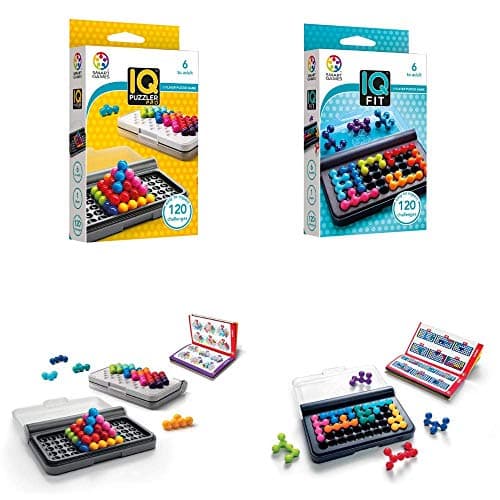
| 1 | Best value by a distance SmartGames IQ Puzzler Pro One hundred and twenty published challenges from twelve pieces, in a case the size of a phone. | Six and up, and anywhere that a small box has to do a lot of work | |
| 2 | 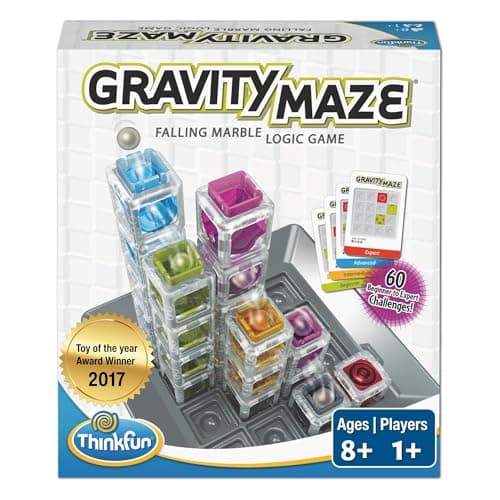 Best physical puzzle ThinkFun Gravity Maze Sixty published challenges where the solution is verified by a marble rather than by a parent. | Eight and up, and a child who wants the answer to fall out of the machine | |
| 3 | 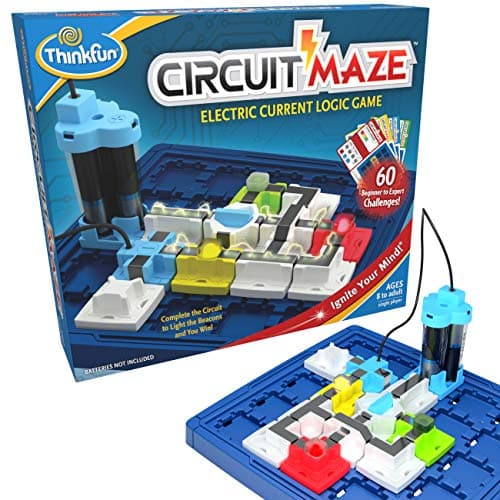 Best crossover into electronics ThinkFun Circuit Maze Sixty challenges with working LEDs, teaching series and parallel before any soldering iron appears. | Eight and up, as a bridge toward real circuits | |
| 4 | 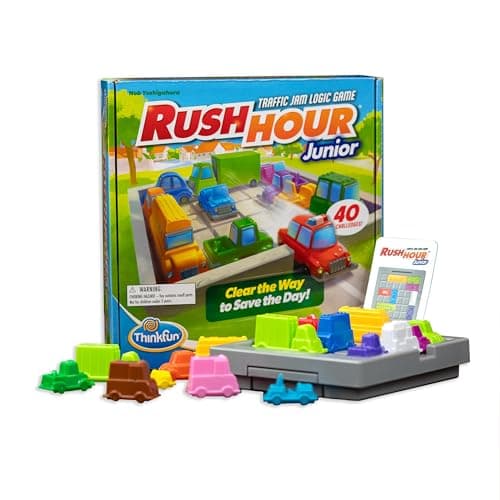 Best for five and six ThinkFun Rush Hour Junior Forty published challenges, a travel bag, and rules a five-year-old grasps in thirty seconds. | Five and up, as a first single-player logic game | |
| — | 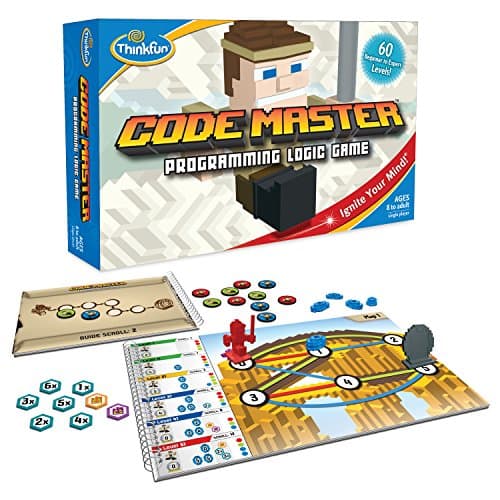 Better as a coding game ThinkFun Code Master Sixty levels that genuinely teach branching and repetition — and it belongs on a different page. | Eight and up, but bought for coding rather than for logic |
5 picks, including 1 we tell you to skip. Ages shown are the manufacturer’s own rating, not ours.
The challenge count is the expiry date
Every game here publishes how many challenges are in the box, and that number is unusually honest — it is a hard count of content rather than a marketing estimate. It is also the single most useful specification in the category, and almost no review quotes it.
The arithmetic
Published challenges, and pieces to make them from
| IQ Puzzler Pro — challenges / pieces | 120 / 12 |
|---|---|
| Gravity Maze — challenges / towers | 60 / 9 |
| Circuit Maze — challenges | 60 |
| Code Master — levels | 60 |
| Rush Hour Junior — challenges / vehicles | 40 / 15 plus the truck |
Set against that: a determined nine-year-old works through 60 challenges in a couple of weeks. That is not a criticism — sixty genuinely hard problems is a good deal — but it is the reason we route people here for a second present rather than a main one.
What these games are unusually good at
They fail cleanly. The marble reaches the target or it does not; the LED lights or it does not. There is no adult judgment in the loop, which makes these unusually good for children who find open-ended play or being corrected stressful.
They are genuinely solo. Most of what this site recommends is better with company. Single-player logic games are designed for a child alone at a table, and that is a real gap in a toy box otherwise full of things that need a playmate.
They travel. Rush Hour Junior publishes a travel bag; IQ Puzzler Pro’s board is its case. A game that leaves the house gets used far more than one that cannot, and that is worth more than a few extra challenge cards.
How to make them last past the cards
This is the part nobody puts in the box, and it costs nothing.
Have the child set challenges. Once the deck is done, the child arranges a starting position and an adult solves it. Designing a puzzle that is hard but possible is harder than solving one, and children take it seriously.
Use the components freely. Gravity Maze’s towers make any marble run the child invents. Nothing in the box suggests it, and it doubles the life of the set.
Time the same challenges again. Re-solving a puzzle under a stopwatch is a different activity from solving it, and it makes a finished deck usable again.
Say the unwelcome thing
Do not buy a logic game as the main present
Forty to 120 published challenges is a school holiday, not a year. Held against a construction set with no finished state at all, the value profile is completely different — and the price often is not.
Buy one alongside something open-ended, and it will get played the weekend the big present is still being figured out. A tile set plus a logic game is a much better pair than either at twice the size.
Which to buy, by age
- Five to seven: Rush Hour Junior. Shortest rules, travel bag, immediate.
- Six and up, best value: IQ Puzzler Pro, 120 challenges in a pocket.
- Eight and up, physical: Gravity Maze, where gravity marks the answer.
- Eight and up, heading toward electronics: Circuit Maze, then Snap Circuits.
For games where the math is the mechanic rather than the theme, see math games. For programming logic at a table, coding board games.
In full
Every pick, and what is wrong with it
Published specifications only, each linked back to the page it came from. Where a manufacturer publishes nothing, the row says so — we do not fill blanks in.
1. Best value by a distance
SmartGames IQ Puzzler Pro
SmartGames · SG455 · maker rates it 6+
One hundred and twenty published challenges from twelve pieces, in a case the size of a phone.
- Challenges
- 120, across 2D and 3D modes
- Contents
- Compact board with a transparent lid, 12 puzzle pieces, challenge booklet with solutions
- Players
- 1
- Batteries
- None
SmartGames publishes 120 challenges across 2D and 3D modes, from a compact board with a transparent lid, 12 puzzle pieces and a challenge booklet with solutions, for ages 6 to adult.
Twelve components generating 120 published problems is the best challenge-per-piece ratio anywhere in this roundup, and it is why this outlasts games that cost more and look more impressive.
The board being the travel case is the other quiet advantage. This is the logic game that goes in a bag, gets played in a waiting room, and therefore gets played at all.
Replay signal
- Open-ended or one-shot
- Finite, but 120 challenges is roughly double what most single-player puzzle games ship with
- Does anything run out
- The booklet ends. The pieces do not
- Room to grow
- The same 12 pieces run 2D and 3D challenge sets, so the difficulty ceiling is well above the entry point
Why we say so: SmartGames publishes 120 challenges across two modes from a single 12-piece set. Twelve pieces generating 120 published problems is the best challenge-per-component ratio of any logic game on this site, and it is the reason this one travels well and lasts.
What’s wrong with it
Twelve pieces of colored plastic looks like nothing under a tree, and it will be opened last.
| Challenges | 120, across 2D and 3D modes |
|---|---|
| Contents | Compact board with a transparent lid, 12 puzzle pieces, challenge booklet with solutions |
| Players | 1 |
| Batteries | None |
| Stated age | Ages 6 to adult |
| Travel case | Yes — the board is the case |
Every figure above is from SmartGames, IQ Puzzler Pro. Blanks are shown as “not published” rather than filled in.
2. Best physical puzzle
ThinkFun Gravity Maze
ThinkFun · 44001006 · maker rates it 8+
Sixty published challenges where the solution is verified by a marble rather than by a parent.
- Challenges
- 60, beginner to expert
- Contents
- Game grid, 9 towers, 1 target piece, 3 marbles, 60 challenge cards
- Players
- 1
- Batteries
- None
ThinkFun publishes 60 challenges from beginner to expert, with a game grid, nine towers, one target piece, three marbles and 60 challenge cards, single-player, no batteries, rated 8+.
The self-verifying solution is what makes this land. The child places the towers, drops the marble, and it either reaches the target or it does not. No adult adjudicates, and no answer card has to be checked.
That is genuinely valuable for a child who finds being corrected difficult — the feedback comes from gravity rather than from a person.
Replay signal
- Open-ended or one-shot
- Finite by design — 60 challenges, and a determined child will finish them
- Does anything run out
- Nothing physically runs out, but the challenge cards do end
- Room to grow
- The towers can be used freely once the cards are done, though nothing in the box prompts that
Why we say so: ThinkFun publishes 60 challenges and a fixed component list. Sixty is a real number with a real end, and single-player puzzle games are the category where that matters most — better to know before you buy it as the main present.
What’s wrong with it
Sixty challenges and then nothing prompts further play. The towers can be used freely, but nothing in the box suggests it.
| Challenges | 60, beginner to expert |
|---|---|
| Contents | Game grid, 9 towers, 1 target piece, 3 marbles, 60 challenge cards |
| Players | 1 |
| Batteries | None |
| Stated age | Ages 8+ |
| Consumables | None |
Every figure above is from ThinkFun, Gravity Maze. Blanks are shown as “not published” rather than filled in.
3. Best crossover into electronics
ThinkFun Circuit Maze
ThinkFun · 1008 · maker rates it 8+
Sixty challenges with working LEDs, teaching series and parallel before any soldering iron appears.
- Stated age
- “age 8 and up”
- Players
- 1
- Format
- Beam-and-token circuit puzzles with real working LEDs
- Batteries
- Required (not included)
ThinkFun publishes 60 challenges from beginner to expert, single player, with real working LEDs, rated age 8 and up, batteries required and not included.
The thing being learned here — that current needs a complete path, and that a branch changes what happens — is exactly what Snap Circuits teaches with real components. Using this first is our routing suggestion rather than a manufacturer claim, but the overlap in content is real.
The LEDs are the verification: the circuit lights or it does not. Same self-checking property as Gravity Maze, applied to electricity.
Replay signal
- Open-ended or one-shot
- Finite challenge deck, but the pieces make a real circuit — free building afterward is possible
- Does anything run out
- Nothing runs out
- Room to grow
- Pairs naturally with a Snap Circuits set as the step from puzzle to real components
Why we say so: ThinkFun publishes the 8+ rating, the 60 challenges and the single-player circuit-puzzle format with working LEDs. The pairing with Snap Circuits is our routing advice and is stated as advice, not as a manufacturer claim.
What’s wrong with it
Requires batteries that are not included, and it is the one game here where a dead cell means the puzzle cannot be checked.
| Stated age | “age 8 and up” |
|---|---|
| Players | 1 |
| Format | Beam-and-token circuit puzzles with real working LEDs |
| Batteries | Required (not included) |
| Challenges | 60, beginner to expert |
Every figure above is from ThinkFun, Circuit Maze. Blanks are shown as “not published” rather than filled in.
4. Best for five and six
ThinkFun Rush Hour Junior
ThinkFun · 76583 · maker rates it 5+
Forty published challenges, a travel bag, and rules a five-year-old grasps in thirty seconds.
- Challenges
- 40, easy to expert
- Contents
- Ice cream truck, 15 blocking vehicles, 40 challenge cards, travel bag
- Players
- 1
- Batteries
- None
ThinkFun publishes 40 challenges from easy to expert, with an ice cream truck, 15 blocking vehicles, 40 challenge cards and a travel bag, single-player, no batteries, rated 5+.
The rules are the shortest of anything on this page: get the truck out, cars only move forward and backward. A five-year-old understands that immediately, and the difficulty then comes entirely from the arrangement rather than from remembering how to play.
After the 40 cards, the grid remains and children reliably invent their own jams — but that is not published as a feature, and it needs someone to suggest it.
Replay signal
- Open-ended or one-shot
- Finite — 40 challenges
- Does anything run out
- The cards end; the grid does not, and children invent their own jams
- Room to grow
- Steps up to the full Rush Hour at 8+, same idea with harder cards
Why we say so: ThinkFun publishes 40 challenges across four difficulty tiers and a travel bag. Forty single-player puzzles is a school holiday, not a year — which is the honest framing for a gift-buyer.
What’s wrong with it
Forty is the lowest challenge count here, and a capable six-year-old will finish them inside a school holiday.
| Challenges | 40, easy to expert |
|---|---|
| Contents | Ice cream truck, 15 blocking vehicles, 40 challenge cards, travel bag |
| Players | 1 |
| Batteries | None |
| Stated age | Ages 5+ |
Every figure above is from ThinkFun, Rush Hour Junior. Blanks are shown as “not published” rather than filled in.
Skip this one
ThinkFun Code Master
ThinkFun · 1950 · maker rates it 8+
Sixty levels that genuinely teach branching and repetition — and it belongs on a different page.
- Levels
- 60, beginner to expert
- Players
- 1
- Format
- Map-based programming logic — sequence the avatar's moves to collect power crystals
- Batteries
- None
ThinkFun publishes 60 levels from beginner to expert, single-player, in a map-based format where the child sequences an avatar’s moves to collect power crystals, rated 8 and up.
It is a good game and we are marking it as the skip on this particular page for one reason: of everything here, it has the least life after its challenge deck. Gravity Maze leaves towers, IQ Puzzler leaves pieces to arrange, Rush Hour leaves a grid. Code Master leaves a book of completed maps.
Bought deliberately as a coding introduction it is worth having, and it is on the coding board games page on those terms.
Replay signal
- Open-ended or one-shot
- Finite — 60 levels, and they are worked through in order
- Does anything run out
- Nothing runs out, but the level book does end
- Room to grow
- The later levels introduce conditionals and loops, so the concept ladder is real rather than cosmetic
Why we say so: ThinkFun publishes 60 levels from beginner to expert and a map-and-sequence format. The concepts the later levels introduce — branching and repetition — are the same two ideas that make a real program, which is why this works as preparation for a screen rather than as a substitute for one.
What’s wrong with it
Sixty levels worked through in order, and once done there is no free-play mode at all. It is a book with pieces.
| Levels | 60, beginner to expert |
|---|---|
| Players | 1 |
| Format | Map-based programming logic — sequence the avatar's moves to collect power crystals |
| Batteries | None |
| Stated age | Ages 8 and up |
Every figure above is from ThinkFun, Code Master. Blanks are shown as “not published” rather than filled in.
We are not putting a buy button on this one. It is easy enough to find if you want it anyway — but we would rather send you to something that gets played with twice.
Questions people actually ask
Frequently asked
How long does a logic puzzle game last?
Read the published challenge count. SmartGames publishes 120 for IQ Puzzler Pro; ThinkFun publishes 60 for Gravity Maze and Circuit Maze and 40 for Rush Hour Junior. A determined child works through 60 in a couple of weeks, so buy one alongside something open-ended rather than as the main present.
What is the best logic game for a 5-year-old?
Rush Hour Junior, which ThinkFun rates 5+. The rules are the shortest here — get the truck out, cars only move forward and backward — so a five-year-old is playing within thirty seconds and the difficulty comes from the puzzle rather than the instructions.
What can we do once the challenge cards are finished?
Three things that cost nothing: have the child design challenges for an adult to solve, use the components freely — Gravity Maze's towers make any marble run — and re-solve old challenges against a stopwatch. None of these is printed in the box.
Are logic games good for children who find open-ended play hard?
Often, yes. Success is defined and self-checking — the marble reaches the target or it does not, the LED lights or it does not — with no adult judgment involved, which some children find far less stressful than a box of parts and an instruction to be creative.
Sources
Where these figures came from
Every specification on this page traces to one of these. If a manufacturer publishes nothing on a point, the page says so rather than filling the gap.
Read next
Where to go from here
Back to Math & Logic, or read how we pick.