The picks
Coding Board Games for Kids
Programming with cardboard: no batteries, no charging, and nothing to go flat on Christmas morning.
By Sawyer V. · Published
The short answer
Robot Turtles works from four and requires an adult to act as the computer — that is the published design, and it is the whole cost. Code Master works solo from eight and publishes 60 levels that introduce branching and repetition. Choose on whether a grown-up will be at the table.
Block & Beaker earns a commission when you buy through our links, at no cost to you. It never changes a ranking, and we say so plainly when the right answer is the cheaper set, or nothing at all. Full disclosure · How we pick.
At a glance
The picks, ranked
Tap any row to jump to the full reasoning. Prices come live from Amazon where we have them and read “check price” where we don’t — never a number we cannot stand behind today.
| # | Product | Best for | Price |
|---|---|---|---|
| 1 | Best solo option ThinkFun Code Master Sixty published levels that build from sequencing to conditionals, with nobody else required. | Eight and up, and a child who plays alone | |
| 2 | Best for four-year-olds ThinkFun Robot Turtles The only genuine coding game at four, and it needs a grown-up to be the computer every single time. | Four and up, in a household where an adult will sit down and play | |
| 3 | 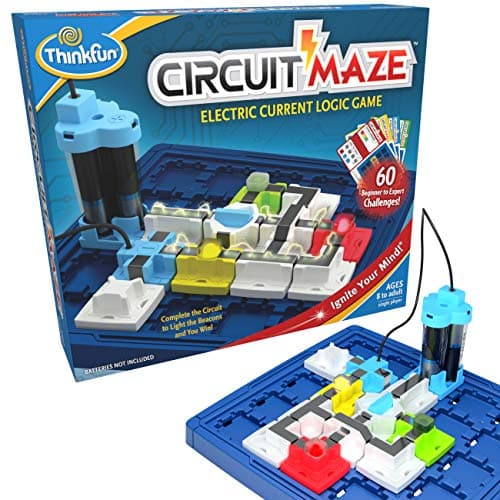 Best for systems thinking ThinkFun Circuit Maze Sixty challenges where the program is a circuit, and the verification is a light coming on. | Eight and up, and a child heading toward electronics | |
| — |  Not a coding game SmartGames IQ Puzzler Pro The best-value logic game here, and there is nothing about programming in it. | Spatial reasoning, on a different page |
4 picks, including 1 we tell you to skip. Ages shown are the manufacturer’s own rating, not ours.
Why cardboard is a real option here
Every coding robot in the category above needs power — five AAA cells for Botley, three for the Robot Mouse, a charge cycle for the rechargeable ones. Every one of them can therefore be unavailable at the moment a child wants it.
Board games cannot go flat. That is not a small advantage: a coding game that works in the car, on a holiday, and on the third Sunday after Christmas when everything else is dead gets played considerably more than one that does not.
What they give up is the reward. A robot that crosses a room and hits its target is more satisfying than moving a cardboard turtle two squares, and for some children that difference is decisive. The honest answer is that these are complements, not substitutes.
The adult-required question
The arithmetic
Who has to be at the table
| Robot Turtles — players | 2-5, including an adult as the computer |
|---|---|
| Code Master — players | 1 |
| Circuit Maze — players | 1 |
| IQ Puzzler Pro — players | 1 |
We are not marking Robot Turtles down for it — the adult-as-computer mechanic is exactly what makes it work at four, because the adult executing instructions literally is the lesson. But it belongs in the headline rather than in the small print, because a household where nobody can sit down for twenty minutes is a household where this game stays in the box.
What these teach that a robot does not
Reading a program before running it. With cards on a table the whole sequence is visible at once and can be revised before anything happens. A robot invites press-and-see.
That instructions are separate from the executor. Robot Turtles makes this explicit — the adult does exactly what the cards say, including when it is wrong. That separation is the core idea of programming and it is unusually hard to convey with a robot, which children read as having intentions of its own.
Turn-taking and explaining. A multiplayer coding game requires a child to say what their program does, and articulating it is where the understanding consolidates.
Say the unwelcome thing
Do not buy this instead of a robot for a five-year-old
At four, Robot Turtles is the right answer because nothing else works at that age. By five or six most children want the thing to move on its own, and a board game will feel like a lesser version of what they have seen.
Buy the board game as a companion to a robot rather than as a substitute for one — it is what gets used when the batteries are flat, which is more often than anyone expects.
What to buy
- Four to six, adult available: Robot Turtles.
- Eight and up, plays alone: Code Master.
- Eight and up, heading to electronics: Circuit Maze.
- Wants a robot: not this page — coding robots.
In full
Every pick, and what is wrong with it
Published specifications only, each linked back to the page it came from. Where a manufacturer publishes nothing, the row says so — we do not fill blanks in.
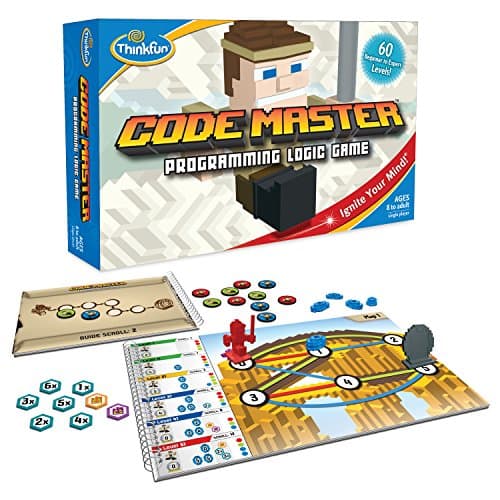
1. Best solo option
ThinkFun Code Master
ThinkFun · 1950 · maker rates it 8+
Sixty published levels that build from sequencing to conditionals, with nobody else required.
- Levels
- 60, beginner to expert
- Players
- 1
- Format
- Map-based programming logic — sequence the avatar's moves to collect power crystals
- Batteries
- None
ThinkFun publishes 60 levels from beginner to expert, single-player, in a map-based format where the child sequences an avatar’s moves to collect power crystals, rated 8 and up, with no batteries.
The concept ladder is the reason to buy it. Early levels are pure sequencing; later ones introduce conditionals and repetition, which are the two ideas that turn a list of instructions into a program. That progression is real rather than cosmetic.
Single-player is the practical advantage over everything else on this page. A child can do this at a kitchen table while an adult cooks, which is where a great deal of actual play happens.
Replay signal
- Open-ended or one-shot
- Finite — 60 levels, and they are worked through in order
- Does anything run out
- Nothing runs out, but the level book does end
- Room to grow
- The later levels introduce conditionals and loops, so the concept ladder is real rather than cosmetic
Why we say so: ThinkFun publishes 60 levels from beginner to expert and a map-and-sequence format. The concepts the later levels introduce — branching and repetition — are the same two ideas that make a real program, which is why this works as preparation for a screen rather than as a substitute for one.
What’s wrong with it
Sixty levels worked through in order and then finished. There is no free-play mode, so the box has a definite end.
| Levels | 60, beginner to expert |
|---|---|
| Players | 1 |
| Format | Map-based programming logic — sequence the avatar's moves to collect power crystals |
| Batteries | None |
| Stated age | Ages 8 and up |
Every figure above is from ThinkFun, Code Master. Blanks are shown as “not published” rather than filled in.
2. Best for four-year-olds
ThinkFun Robot Turtles
ThinkFun · 1900 · maker rates it 4+
The only genuine coding game at four, and it needs a grown-up to be the computer every single time.
- Stated age
- Ages 4 and up
- Players
- 2-5, one of whom is an adult acting as “the computer”
- Batteries
- None
- Format
- Board game teaching programming fundamentals
ThinkFun publishes it for ages 4 and up, for 2-5 players, one of whom is an adult acting as the computer executing the child’s program, with no batteries.
The design is genuinely clever. The child plays instruction cards, the adult moves the turtle exactly as instructed, and when the turtle goes the wrong way the child sees immediately that the instructions were wrong rather than the executor. That is debugging, at four, with no reading required.
The published rules also scale: function cards and obstacles come in as the child improves, so difficulty tracks the child rather than a deck.
We flag the adult requirement prominently because it is the single biggest predictor of whether any toy gets used. An adult-required game is played when an adult is free, which for most families is not often.
Replay signal
- Open-ended or one-shot
- Open-ended, because the adult builds the board — difficulty scales with the child rather than with a deck
- Does anything run out
- Nothing runs out
- Room to grow
- The published rules add function cards and obstacles as the child improves
- Adult required
- Yes, always — an adult plays the computer. That is the design, and it is the whole cost
Why we say so: ThinkFun publishes the 4+ rating and the rule that an adult executes the child's program. An adult being structurally required is the single biggest predictor of whether a toy actually gets used, so it belongs in the headline rather than the small print.
What’s wrong with it
An adult is structurally required, not optional. In a household where that is not reliably available, this game does not get played.
| Stated age | Ages 4 and up |
|---|---|
| Players | 2-5, one of whom is an adult acting as “the computer” |
| Batteries | None |
| Format | Board game teaching programming fundamentals |
| Consumables | None |
Every figure above is from ThinkFun games. Blanks are shown as “not published” rather than filled in.
3. Best for systems thinking
ThinkFun Circuit Maze
ThinkFun · 1008 · maker rates it 8+
Sixty challenges where the program is a circuit, and the verification is a light coming on.
- Stated age
- “age 8 and up”
- Players
- 1
- Format
- Beam-and-token circuit puzzles with real working LEDs
- Batteries
- Required (not included)
ThinkFun publishes 60 challenges from beginner to expert, single-player, with real working LEDs, rated 8 and up.
The connection to coding is genuine even though there is no code here. Series and parallel paths are conditional logic in physical form: current takes this route or that one, and adding a branch changes the outcome. That maps directly onto what a conditional does in a program.
It is also the natural bridge to Snap Circuits — same reasoning, real components, considerably more of them.
Replay signal
- Open-ended or one-shot
- Finite challenge deck, but the pieces make a real circuit — free building afterward is possible
- Does anything run out
- Nothing runs out
- Room to grow
- Pairs naturally with a Snap Circuits set as the step from puzzle to real components
Why we say so: ThinkFun publishes the 8+ rating, the 60 challenges and the single-player circuit-puzzle format with working LEDs. The pairing with Snap Circuits is our routing advice and is stated as advice, not as a manufacturer claim.
What’s wrong with it
Batteries required and not included, and it is not programming in any literal sense — it is the reasoning underneath it.
| Stated age | “age 8 and up” |
|---|---|
| Players | 1 |
| Format | Beam-and-token circuit puzzles with real working LEDs |
| Batteries | Required (not included) |
| Challenges | 60, beginner to expert |
Every figure above is from ThinkFun, Circuit Maze. Blanks are shown as “not published” rather than filled in.
Skip this one
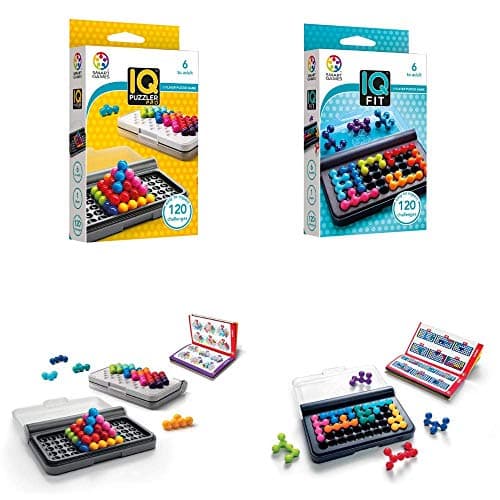
SmartGames IQ Puzzler Pro
SmartGames · SG455 · maker rates it 6+
The best-value logic game here, and there is nothing about programming in it.
- Challenges
- 120, across 2D and 3D modes
- Contents
- Compact board with a transparent lid, 12 puzzle pieces, challenge booklet with solutions
- Players
- 1
- Batteries
- None
SmartGames publishes 120 challenges across 2D and 3D modes from 12 pieces, rated 6 to adult.
It is a genuinely excellent puzzle game and it is not a coding game. Fitting shapes into a tray trains rotation and tessellation; nothing about it involves sequencing, branching or repetition.
If the goal is a great logic present, buy it — it is our top pick on the logic puzzles page. If the goal is specifically programming logic, it will not do that job.
Replay signal
- Open-ended or one-shot
- Finite, but 120 challenges is roughly double what most single-player puzzle games ship with
- Does anything run out
- The booklet ends. The pieces do not
- Room to grow
- The same 12 pieces run 2D and 3D challenge sets, so the difficulty ceiling is well above the entry point
Why we say so: SmartGames publishes 120 challenges across two modes from a single 12-piece set. Twelve pieces generating 120 published problems is the best challenge-per-component ratio of any logic game on this site, and it is the reason this one travels well and lasts.
What’s wrong with it
Included only because it is often bundled into coding gift lists. Packing puzzles are geometry, not sequencing.
| Challenges | 120, across 2D and 3D modes |
|---|---|
| Contents | Compact board with a transparent lid, 12 puzzle pieces, challenge booklet with solutions |
| Players | 1 |
| Batteries | None |
| Stated age | Ages 6 to adult |
| Travel case | Yes — the board is the case |
Every figure above is from SmartGames, IQ Puzzler Pro. Blanks are shown as “not published” rather than filled in.
We are not putting a buy button on this one. It is easy enough to find if you want it anyway — but we would rather send you to something that gets played with twice.
Questions people actually ask
Frequently asked
What is the best coding board game for a 4-year-old?
Robot Turtles, which ThinkFun rates 4 and up. The published rules require an adult to act as the computer executing the child's instruction cards — that mechanic is what makes it work at four, and it is also why it only gets played when a grown-up is free.
Can a child play a coding board game alone?
Code Master, Circuit Maze and IQ Puzzler Pro are all published as single-player. Robot Turtles is published for 2-5 players with an adult acting as the computer, so it cannot be played alone by design.
Do coding board games teach real programming?
They teach the reasoning rather than the syntax. Code Master's 60 published levels build from sequencing into branching and repetition, which are the two ideas that turn a list of instructions into a program. No manufacturer here claims more than that.
Board game or coding robot?
Both, in that order of reliability. Robots give a better reward but need batteries or charge; board games cannot go flat, so they get played in the car, on holiday, and when everything electronic is dead. Buy the board game as a companion rather than a substitute. The coding robot roundup.
Sources
Where these figures came from
Every specification on this page traces to one of these. If a manufacturer publishes nothing on a point, the page says so rather than filling the gap.
Read next
Where to go from here
Back to Math & Logic, or read how we pick.