The picks
Logic Games for 5 Year Olds
Five is the age where most logic games are still a year away. These four publish a rating of five or lower, and the difference between them is who has to sit there.
By Sawyer V. · Published
The short answer
Four products here publish a rating of 5 or lower. Rush Hour Junior is the one a five-year-old can play alone — 40 self-checking challenges, single player, no reading. Mental Blox is the one for two children. Robot Turtles needs an adult to be the computer.
Block & Beaker earns a commission when you buy through our links, at no cost to you. It never changes a ranking, and we say so plainly when the right answer is the cheaper set, or nothing at all. Full disclosure · How we pick.
At a glance
The picks, ranked
Tap any row to jump to the full reasoning. Prices come live from Amazon where we have them and read “check price” where we don’t — never a number we cannot stand behind today.
| # | Product | Best for | Price |
|---|---|---|---|
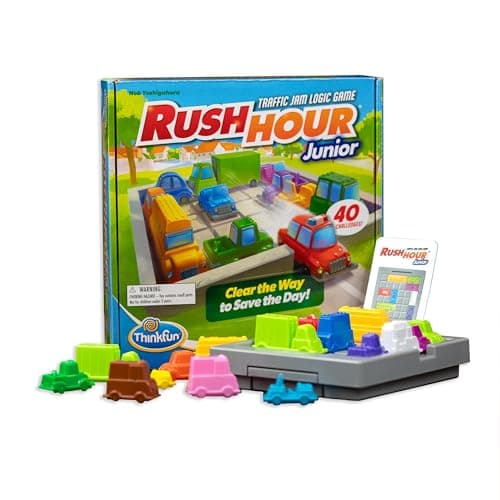
| 1 | Best at five, and best alone ThinkFun Rush Hour Junior 40 graded challenges that check their own answer, in a travel bag. | Five to seven, playing unsupervised | |
| 2 | 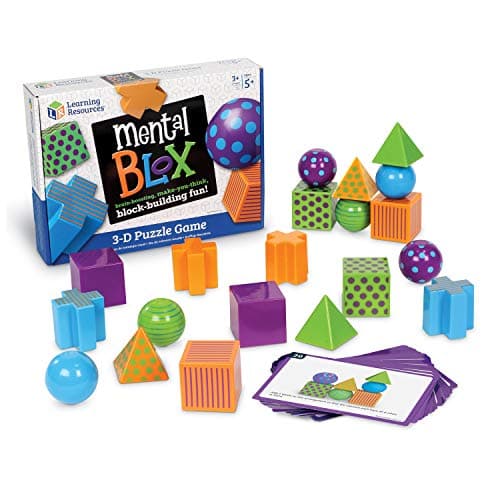 Best for two children Mental Blox Critical Thinking Game 20 chunky blocks and 20 cards built on four shapes and three attributes. | Five to eight, with a sibling or an adult | |
| 3 | Best if an adult will play too ThinkFun Robot Turtles A board game teaching programming fundamentals, for 2-5 players. | Four and up, with a grown-up as the computer | |
| 4 | 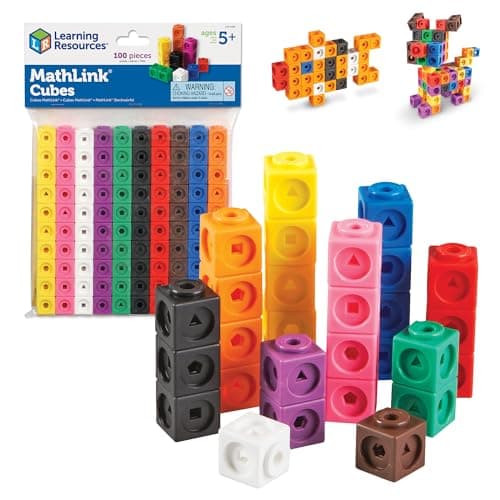 Best open-ended option MathLink Cubes, Set of 100 100 cubes in 10 colors that link on all sides, with shape cut-outs. | Five and up | |
| — | 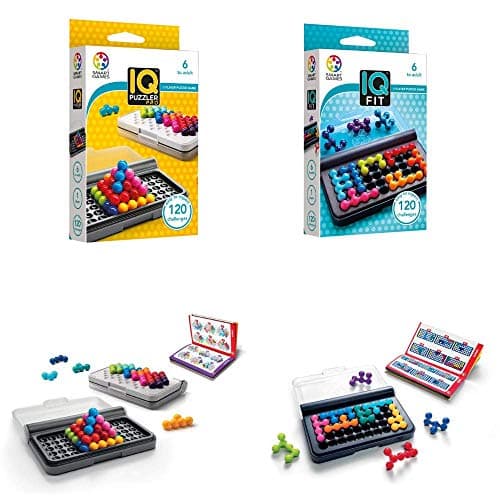 One year away SmartGames IQ Puzzler Pro 120 challenges across 2D and 3D modes, with solutions in the booklet. | Six to adult |
5 picks, including 1 we tell you to skip. Ages shown are the manufacturer’s own rating, not ours.
What the published ratings allow at five
The arithmetic
Logic games, published age and player count
| Robot Turtles | Ages 4 and up — 2-5 players, one of them an adult |
|---|---|
| Rush Hour Junior | Ages 5+ — 1 player, 40 challenges, self-checking |
| Mental Blox | Ages 5+ — 20 blocks, 20 cards, works as a group activity |
| MathLink Cubes | Ages 5 and up — 100 cubes, no cards |
| IQ Puzzler Pro | Ages 6 to adult — 1 player, 120 challenges |
| Kanoodle | Ages 7 and up — 1 player, 200+ puzzles |
| Gravity Maze | Ages 8+ — 1 player, 60 challenges, marbles |
| Code Master | Ages 8 and up — 1 player, 60 levels |
The two questions that decide it
Will an adult be in the room? This is the real fork at five. Rush Hour Junior works without one because the board proves the answer. Robot Turtles requires one by design. Mental Blox and MathLink Cubes work best with one.
Is there a second child? Most logic games at this age are published as single-player, which makes them a bad fit for siblings who want to do the same thing at the same time. Mental Blox and Robot Turtles are the two that handle a table.
What five-year-olds can actually do
Hold a goal in mind. “Get the truck out” can be kept in view across several moves at five, which is why Rush Hour Junior’s published floor is there and not at four.
Follow a sequence somebody else wrote. That is Robot Turtles’ whole mechanic, and it is comfortably within reach at four or five.
Match on more than one attribute at once. Shape and color together is genuinely hard at five and is exactly what Mental Blox publishes.
Not yet: work backwards from a goal. That is what the 6+ and 7+ games require, and it is the reason IQ Puzzler Pro and Kanoodle publish where they do rather than a year or two lower.
Why the good stuff starts at six
It is worth being plain about this, because the gift lists are not. SmartGames publishes IQ Puzzler Pro at 6, Educational Insights publishes Kanoodle at 7, and ThinkFun publishes both Gravity Maze and Code Master at 8.
Those are the games with 120, 200-plus and 60 graded challenges — the ones that occupy a child for a year rather than a fortnight. A five-year-old is one to three years away from all of them, and buying early converts a great game into a shelf ornament.
The honest plan at five is a short game now and a long game later: 40 challenges this birthday, 120 on the next one.
What to do when the 40 challenges run out
They will, and faster than the box implies. Two things extend the life of a single-player logic game at this age.
The first is inventing challenges. On a Rush Hour Junior grid an adult can set a new jam in seconds, and a child who has finished the deck is usually delighted to be given a harder one by a person rather than a card.
The second is letting the child set challenges for the adult. Designing a puzzle requires understanding the rule that makes it solvable, which is a harder and better exercise than solving one — and it costs nothing.
Worth knowing before you buy
So which one
Five, and you want them occupied alone: Rush Hour Junior.
Two children, same table: Mental Blox.
A family game night: Robot Turtles, with an adult as the computer.
An adult who will invent tasks: MathLink Cubes, and the money saved.
Six next birthday: wait for IQ Puzzler Pro and its 120 challenges.
Say the unwelcome thing
Do not buy the 6+ or 7+ game because it lasts longer
It is the defining mistake at this age. A five-year-old handed a 200-puzzle game whose first page is already too hard learns that puzzles are not for them. The published ratings on these games are unusually well calibrated, and a year of waiting costs nothing compared with that.
All four publish no consumables. Nothing to replace, nothing to refill, and every one of them hands down to a younger sibling intact — which is rare in a category where the packaged games are usually card-driven.
Where to go next
Choosing a first logic game covers the decision in more depth, STEM games for one player covers the single-player end, and pattern and sequencing toys covers the skills underneath all of it.
In full
Every pick, and what is wrong with it
Published specifications only, each linked back to the page it came from. Where a manufacturer publishes nothing, the row says so — we do not fill blanks in.
1. Best at five, and best alone
ThinkFun Rush Hour Junior
ThinkFun · 76583 · maker rates it 5+
40 graded challenges that check their own answer, in a travel bag.
- Challenges
- 40, easy to expert
- Contents
- Ice cream truck, 15 blocking vehicles, 40 challenge cards, travel bag
- Players
- 1
- Batteries
- None
ThinkFun publishes 40 challenges across four tiers from easy to expert, an ice cream truck, 15 blocking vehicles, 40 challenge cards and a travel bag, single player, no batteries, rated ages 5+.
Self-checking is why this tops the list. The truck either reaches the exit or it does not, so a five-year-old needs nobody to confirm the answer — which is the difference between a game they can take to another room and one that stalls when an adult is busy.
No reading is the second reason. The goal is visible from the board, so a pre-reader is not excluded. See the Rush Hour Junior review.
Replay signal
- Open-ended or one-shot
- Finite — 40 challenges
- Does anything run out
- The cards end; the grid does not, and children invent their own jams
- Room to grow
- Steps up to the full Rush Hour at 8+, same idea with harder cards
Why we say so: ThinkFun publishes 40 challenges across four difficulty tiers and a travel bag. Forty single-player puzzles is a school holiday, not a year — which is the honest framing for a gift-buyer.
What’s wrong with it
Forty is the shortest published ladder of any logic game here.
| Challenges | 40, easy to expert |
|---|---|
| Contents | Ice cream truck, 15 blocking vehicles, 40 challenge cards, travel bag |
| Players | 1 |
| Batteries | None |
| Stated age | Ages 5+ |
Every figure above is from ThinkFun, Rush Hour Junior. Blanks are shown as “not published” rather than filled in.
2. Best for two children
Mental Blox Critical Thinking Game
Learning Resources · LER9280 · maker rates it 5+
20 chunky blocks and 20 cards built on four shapes and three attributes.
- Blocks
- 20 chunky plastic blocks
- Activity cards
- 20
- Attributes
- Four shapes across three attributes
- Includes
- Activity guide
Learning Resources publishes 20 chunky plastic blocks, 20 activity cards, four shapes across three attributes, an activity guide, no batteries, rated ages 5+.
Nearly every other logic product at this age publishes a single player. This one can be held up for a table, which makes it the pick for siblings close in age or for a classroom corner.
The attribute structure — shape, color and pattern combined — is what lets a card specify a build precisely, and it is the foundation of sorting and classification. See the Mental Blox review.
Replay signal
- Open-ended or one-shot
- The 20 cards end; the blocks then work for free pattern and copy games
- Does anything run out
- Nothing runs out
- Room to grow
- An adult can invent harder arrangements indefinitely — the cards are a starting ladder
Why we say so: Learning Resources publishes 20 blocks and 20 activity cards across four shapes and three attributes. Attributes are the point: sorting by shape, then by color, then by both at once is the first properly logical thing a five-year-old does with a toy.
What’s wrong with it
Usually wants somebody to check the build — it is not self-checking.
| Blocks | 20 chunky plastic blocks |
|---|---|
| Activity cards | 20 |
| Attributes | Four shapes across three attributes |
| Includes | Activity guide |
| Batteries | None |
| Stated age | Ages 5+ |
Every figure above is from Learning Resources, Mental Blox Critical Thinking Game. Blanks are shown as “not published” rather than filled in.
3. Best if an adult will play too
ThinkFun Robot Turtles
ThinkFun · 1900 · maker rates it 4+
A board game teaching programming fundamentals, for 2-5 players.
- Stated age
- Ages 4 and up
- Players
- 2-5, one of whom is an adult acting as “the computer”
- Batteries
- None
- Format
- Board game teaching programming fundamentals
ThinkFun publishes Robot Turtles for ages 4 and up, 2-5 players — one of whom is an adult acting as “the computer” — with no batteries and no consumables, as a board game teaching programming fundamentals.
The lowest published age on this page, and the only one that is explicitly a family game. The adult requirement is published rather than implied, which is unusually honest of the maker.
It is also the clearest introduction to instructions-as-code at this age: the child plays cards, the adult executes them exactly, and the gap between intention and instruction becomes obvious and funny.
Replay signal
- Open-ended or one-shot
- Open-ended, because the adult builds the board — difficulty scales with the child rather than with a deck
- Does anything run out
- Nothing runs out
- Room to grow
- The published rules add function cards and obstacles as the child improves
- Adult required
- Yes, always — an adult plays the computer. That is the design, and it is the whole cost
Why we say so: ThinkFun publishes the 4+ rating and the rule that an adult executes the child's program. An adult being structurally required is the single biggest predictor of whether a toy actually gets used, so it belongs in the headline rather than the small print.
What’s wrong with it
One of the players must be an adult acting as the computer.
| Stated age | Ages 4 and up |
|---|---|
| Players | 2-5, one of whom is an adult acting as “the computer” |
| Batteries | None |
| Format | Board game teaching programming fundamentals |
| Consumables | None |
Every figure above is from ThinkFun games. Blanks are shown as “not published” rather than filled in.
4. Best open-ended option
MathLink Cubes, Set of 100
Learning Resources · LER4285 · maker rates it 5+
100 cubes in 10 colors that link on all sides, with shape cut-outs.
- Cubes
- 100, in 10 colors
- Cube size
- 3/4 inch
- Connection
- Links on all sides, with geometric shape cut-outs for patterning
- Stated age
- Ages 5 and up
Learning Resources publishes 100 cubes in 10 colors, three-quarters of an inch each, linking on all sides with geometric shape cut-outs for patterning, no batteries and no consumables, rated ages 5 and up.
Not a game, which is exactly why it belongs here: patterning, sorting and sequencing are the skills the packaged logic games test, and 100 cubes rehearse them for a fraction of the cost.
The trade is that nothing tells the child what to do. With a willing adult it outlasts everything else on this page. See the MathLink Cubes review.
Replay signal
- Open-ended or one-shot
- Completely open-ended, and unusually cheap for something that is
- Does anything run out
- Nothing runs out
- Room to grow
- The same cubes cover counting at five and volume, arrays and fractions at nine
Why we say so: Learning Resources publishes that the cubes link on all sides with geometric cut-outs. All-sides connection is what turns a counting toy into a building toy — a cube that only joins end to end makes towers, and one that joins on six faces makes arrays, volumes and models.
What’s wrong with it
No cards and no game structure — an adult has to set the tasks.
| Cubes | 100, in 10 colors |
|---|---|
| Cube size | 3/4 inch |
| Connection | Links on all sides, with geometric shape cut-outs for patterning |
| Stated age | Ages 5 and up |
| Batteries | None |
| Consumables | None |
Every figure above is from Learning Resources, MathLink Cubes, Set of 100. Blanks are shown as “not published” rather than filled in.
Skip this one
SmartGames IQ Puzzler Pro
SmartGames · SG455 · maker rates it 6+
120 challenges across 2D and 3D modes, with solutions in the booklet.
- Challenges
- 120, across 2D and 3D modes
- Contents
- Compact board with a transparent lid, 12 puzzle pieces, challenge booklet with solutions
- Players
- 1
- Batteries
- None
SmartGames publishes 120 challenges across 2D and 3D modes, a compact board with a transparent lid, 12 puzzle pieces and a challenge booklet with solutions, single player, rated 6 to adult.
Three times the challenge count of Rush Hour Junior, and one published year too early. Buy it on the sixth birthday, not the fifth.
Replay signal
- Open-ended or one-shot
- Finite, but 120 challenges is roughly double what most single-player puzzle games ship with
- Does anything run out
- The booklet ends. The pieces do not
- Room to grow
- The same 12 pieces run 2D and 3D challenge sets, so the difficulty ceiling is well above the entry point
Why we say so: SmartGames publishes 120 challenges across two modes from a single 12-piece set. Twelve pieces generating 120 published problems is the best challenge-per-component ratio of any logic game on this site, and it is the reason this one travels well and lasts.
What’s wrong with it
Published from 6 — the single most-bought-too-early game at this age.
| Challenges | 120, across 2D and 3D modes |
|---|---|
| Contents | Compact board with a transparent lid, 12 puzzle pieces, challenge booklet with solutions |
| Players | 1 |
| Batteries | None |
| Stated age | Ages 6 to adult |
| Travel case | Yes — the board is the case |
Every figure above is from SmartGames, IQ Puzzler Pro. Blanks are shown as “not published” rather than filled in.
We are not putting a buy button on this one. It is easy enough to find if you want it anyway — but we would rather send you to something that gets played with twice.
Questions people actually ask
Frequently asked
What logic games are published for 5 year olds?
Four here publish 5 or lower: Rush Hour Junior (5+, 40 challenges, single player), Mental Blox (5+, 20 blocks and 20 cards), MathLink Cubes (5 and up, 100 cubes) and Robot Turtles (4 and up, 2-5 players with an adult as the computer).
Which logic game can a 5 year old play alone?
Rush Hour Junior. ThinkFun publishes it as a single-player game with 40 self-checking challenges and no reading required, so nobody has to confirm the answer. STEM games for one player.
Is IQ Puzzler Pro suitable for a 5 year old?
Not on the published rating - SmartGames publishes 6 to adult. Its 120 challenges make it a better buy than Rush Hour Junior's 40, but a year later.
Are there logic games two children can play together?
Mental Blox works as a group activity - a card can be held up for a table - and ThinkFun publishes Robot Turtles for 2-5 players. Almost everything else in the category publishes a single player. STEM toys for groups.
What happens when the 40 challenges are finished?
An adult can set new ones on the same grid in seconds, and letting the child design puzzles for an adult is a harder exercise than solving them. After that, IQ Puzzler Pro publishes 120 challenges from 6 and Kanoodle publishes 200+ from 7. Choosing a first logic game.
Do any of these need batteries?
None of them. ThinkFun publishes no batteries for Rush Hour Junior and Robot Turtles, and Learning Resources publishes none for Mental Blox or MathLink Cubes.
Is Gravity Maze suitable for a five-year-old?
No - ThinkFun publishes 8+, and the set includes marbles. It is three published years away and the small parts are the reason. Gravity Maze review.
Sources
Where these figures came from
Every specification on this page traces to one of these. If a manufacturer publishes nothing on a point, the page says so rather than filling the gap.
Read next
Where to go from here
Back to Math & Logic, or read how we pick.