Single review
MathLink Cubes Review
Reviewed from the manufacturer's published specifications and the arithmetic on them. We have not used it, and we say so.
By Sawyer V. · Published
The short answer
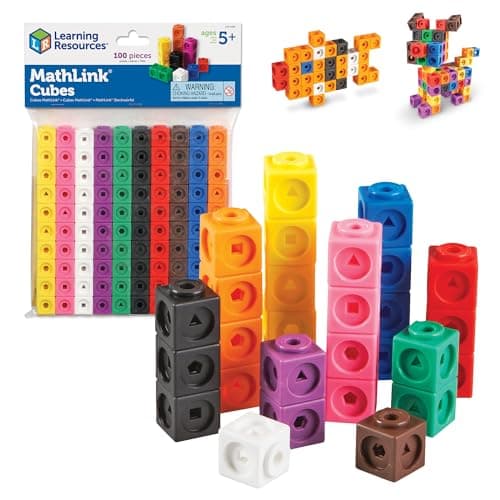
MathLink Cubes publishes 100 cubes in 10 colors, ¾ inch each, linking on all sides with geometric shape cut-outs for patterning, no batteries, no consumables, rated 5 and up. There are no rules in the box, which is both the strength and the catch.
Block & Beaker earns a commission when you buy through our links, at no cost to you. It never changes a ranking, and we say so plainly when the right answer is the cheaper set, or nothing at all. Full disclosure · How we pick.
At a glance
The picks, ranked
Tap any row to jump to the full reasoning. Prices come live from Amazon where we have them and read “check price” where we don’t — never a number we cannot stand behind today.
| # | Product | Best for | Price |
|---|---|---|---|
| 1 | The product MathLink Cubes, Set of 100 Linking on all sides makes these a three-dimensional math manipulative rather than a counting stick. | Five and up, in a household where an adult will join in | |
| 2 | 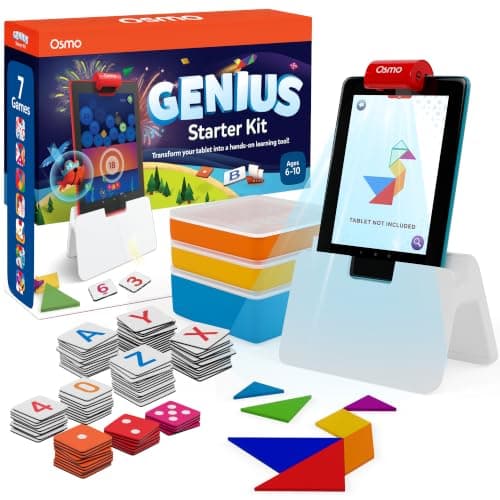 The one that brings its own activities Osmo Genius Starter Kit for iPad Five games including Numbers and Tangram, with the software supplying the structure. | Six to ten, with an iPad free | |
| 3 | 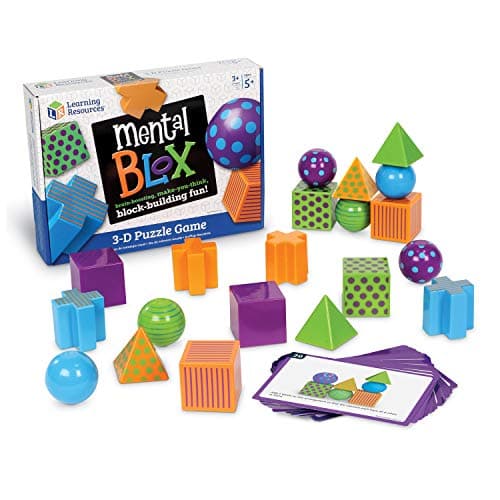 The one with cards Mental Blox Critical Thinking Game 20 chunky blocks and 20 activity cards covering four shapes across three attributes. | Five and up, when the adult wants prompts | |
| — | 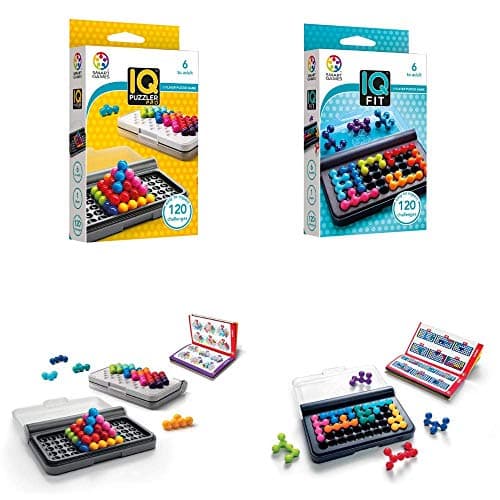 Not a math manipulative SmartGames IQ Puzzler Pro Cross-shopped as an educational purchase and it teaches spatial logic, not arithmetic. | Six and up, as a solo puzzle |
4 picks, including 1 we tell you to skip. Ages shown are the manufacturer’s own rating, not ours.
What we can tell you, and what we cannot
We have not used these. No lab, no samples, no test children, and no star rating on this page or in its structured data.
Published counts, dimensions and linking behavior we can report. How stiff the link is for five-year-old fingers, and whether the cut-outs are deep enough to be useful, we cannot.
The specification that decides it
The arithmetic
MathLink Cubes, Set of 100, published
| Cubes | 100, in 10 colors |
|---|---|
| Cube size | 3/4 inch |
| Connection | Links on all sides |
| Extra | Geometric shape cut-outs for patterning |
| Stated age | Ages 5 and up |
| Batteries | None |
| Consumables | None |
| Published activities | None in the box |
What the numbers mean in practice
All-sides linking is the difference between a manipulative and a counting stick. Arrays for multiplication, cubes for volume, nets for surface area — none of that works if the pieces only join end to end.
One hundred is the right number for arithmetic. It covers place value to a hundred, ten tens, and every times-table array a primary child needs.
Nothing is consumed and nothing is powered. The same box works from five to eleven, which almost nothing else in the math category does.
No turn order means any number of children. Cubes cannot be won and nobody waits, which removes an entire category of sibling argument.
The honest catch
There are no published activities. That is not an oversight — it is what a manipulative is — but it means the purchase only works if somebody supplies the idea.
In a household where a parent will sit down and say “show me eight, now show me eight a different way,” these are the best value on this page. In a household with no time for that, a game with cards will be used more.
Who should skip it
A household wanting something self-directed. Buy a game with published challenges instead.
A child who wants a toy rather than a tool. Cubes are not a present in the way a marble run is.
A household with a toddler. The published rating is 5+, and ¾-inch cubes are firmly small parts.
Say the unwelcome thing
Do not buy these as a gift on their own
As a classroom-style tool bought by a parent who will use them, they are excellent. Wrapped as a birthday present with nothing else, a box of plain cubes reads as homework.
Pair them with something that has rules — see math games.
Where it sits
MathLink Cubes appear in math games, pattern and sequencing toys and math toys by skill.
In full
Every pick, and what is wrong with it
Published specifications only, each linked back to the page it came from. Where a manufacturer publishes nothing, the row says so — we do not fill blanks in.
1. The product
MathLink Cubes, Set of 100
Learning Resources · LER4285 · maker rates it 5+
Linking on all sides makes these a three-dimensional math manipulative rather than a counting stick.
- Cubes
- 100, in 10 colors
- Cube size
- 3/4 inch
- Connection
- Links on all sides, with geometric shape cut-outs for patterning
- Stated age
- Ages 5 and up
Learning Resources publishes 100 cubes in 10 colors at ¾ inch, linking on all sides, with geometric shape cut-outs for patterning, no batteries and no consumables, rated 5 and up.
Linking on all sides is the specification that matters and it is easy to skim past. Cubes that only join end to end make rods — useful for counting and little else. Cubes that join on every face make areas, volumes, arrays and shapes, which is most of primary-school mathematics made physical.
Ten colors is what makes patterning work. A repeating sequence needs enough distinct values to be non-trivial, and ten is comfortably enough for the sorting, grouping and sequencing that precede arithmetic.
Replay signal
- Open-ended or one-shot
- Completely open-ended, and unusually cheap for something that is
- Does anything run out
- Nothing runs out
- Room to grow
- The same cubes cover counting at five and volume, arrays and fractions at nine
Why we say so: Learning Resources publishes that the cubes link on all sides with geometric cut-outs. All-sides connection is what turns a counting toy into a building toy — a cube that only joins end to end makes towers, and one that joins on six faces makes arrays, volumes and models.
What’s wrong with it
No published activities, so without an adult with an idea nothing happens.
| Cubes | 100, in 10 colors |
|---|---|
| Cube size | 3/4 inch |
| Connection | Links on all sides, with geometric shape cut-outs for patterning |
| Stated age | Ages 5 and up |
| Batteries | None |
| Consumables | None |
Every figure above is from Learning Resources, MathLink Cubes, Set of 100. Blanks are shown as “not published” rather than filled in.
2. The one that brings its own activities
Osmo Genius Starter Kit for iPad
Osmo · Genius Starter Kit · maker rates it 6-10
Five games including Numbers and Tangram, with the software supplying the structure.
- Games
- Five — Tangram, Numbers, Words, Newton and Masterpiece
- Contents
- Osmo Base and reflector, 52 Words tiles, 40 Numbers tiles, 7 Tangram pieces, stackable storage
- Screen required
- Yes — an iPad, not included
- Stated age
- Ages 6-10
Osmo publishes five games — Tangram, Numbers, Words, Newton and Masterpiece — with an Osmo Base and reflector, 52 Words tiles, 40 Numbers tiles and 7 Tangram pieces, rated 6-10.
This is the direct trade. Osmo brings structure and needs a tablet; cubes need nothing but an adult with an idea. For a household trying to reduce screens, the cubes win; for one with no time to invent activities, Osmo does.
Replay signal
- Open-ended or one-shot
- Five separate games rather than one, so it degrades gracefully — when one is exhausted, four remain
- Does anything run out
- Nothing physical runs out
- Room to grow
- Numbers and Tangram both scale well past the stated top age; Words does not
- Adult required
- Only to release the iPad, which in most households is the actual constraint
Why we say so: Osmo publishes the five named games and the exact tile counts. Five games in one box is the honest reason this is better value than a single-game Osmo kit, and the iPad requirement is a published dependency rather than an inference.
What’s wrong with it
An iPad is required and not included.
| Games | Five — Tangram, Numbers, Words, Newton and Masterpiece |
|---|---|
| Contents | Osmo Base and reflector, 52 Words tiles, 40 Numbers tiles, 7 Tangram pieces, stackable storage |
| Screen required | Yes — an iPad, not included |
| Stated age | Ages 6-10 |
| Batteries | None in the physical pieces |
Every figure above is from Osmo, Genius Starter Kit. Blanks are shown as “not published” rather than filled in.
3. The one with cards
Mental Blox Critical Thinking Game
Learning Resources · LER9280 · maker rates it 5+
20 chunky blocks and 20 activity cards covering four shapes across three attributes.
- Blocks
- 20 chunky plastic blocks
- Activity cards
- 20
- Attributes
- Four shapes across three attributes
- Includes
- Activity guide
Learning Resources publishes 20 chunky plastic blocks, 20 activity cards, four shapes across three attributes, an activity guide, no batteries, rated 5+.
Same manufacturer, opposite philosophy: cards tell you what to do. If the honest problem is that nobody in the house will invent a cube activity, this solves it.
Replay signal
- Open-ended or one-shot
- The 20 cards end; the blocks then work for free pattern and copy games
- Does anything run out
- Nothing runs out
- Room to grow
- An adult can invent harder arrangements indefinitely — the cards are a starting ladder
Why we say so: Learning Resources publishes 20 blocks and 20 activity cards across four shapes and three attributes. Attributes are the point: sorting by shape, then by color, then by both at once is the first properly logical thing a five-year-old does with a toy.
What’s wrong with it
Twenty cards is a short ladder compared with an open-ended cube set.
| Blocks | 20 chunky plastic blocks |
|---|---|
| Activity cards | 20 |
| Attributes | Four shapes across three attributes |
| Includes | Activity guide |
| Batteries | None |
| Stated age | Ages 5+ |
Every figure above is from Learning Resources, Mental Blox Critical Thinking Game. Blanks are shown as “not published” rather than filled in.
Skip this one
SmartGames IQ Puzzler Pro
SmartGames · SG455 · maker rates it 6+
Cross-shopped as an educational purchase and it teaches spatial logic, not arithmetic.
- Challenges
- 120, across 2D and 3D modes
- Contents
- Compact board with a transparent lid, 12 puzzle pieces, challenge booklet with solutions
- Players
- 1
- Batteries
- None
SmartGames publishes 120 challenges across 2D and 3D modes with 12 puzzle pieces and a solutions booklet, single player, rated 6 to adult.
It is an excellent game and it does something different. A puzzle has answers; a manipulative has uses. A child struggling with number bonds needs the cubes, not the puzzle.
Replay signal
- Open-ended or one-shot
- Finite, but 120 challenges is roughly double what most single-player puzzle games ship with
- Does anything run out
- The booklet ends. The pieces do not
- Room to grow
- The same 12 pieces run 2D and 3D challenge sets, so the difficulty ceiling is well above the entry point
Why we say so: SmartGames publishes 120 challenges across two modes from a single 12-piece set. Twelve pieces generating 120 published problems is the best challenge-per-component ratio of any logic game on this site, and it is the reason this one travels well and lasts.
What’s wrong with it
A fixed set of 120 answers rather than an open tool.
| Challenges | 120, across 2D and 3D modes |
|---|---|
| Contents | Compact board with a transparent lid, 12 puzzle pieces, challenge booklet with solutions |
| Players | 1 |
| Batteries | None |
| Stated age | Ages 6 to adult |
| Travel case | Yes — the board is the case |
Every figure above is from SmartGames, IQ Puzzler Pro. Blanks are shown as “not published” rather than filled in.
We are not putting a buy button on this one. It is easy enough to find if you want it anyway — but we would rather send you to something that gets played with twice.
Questions people actually ask
Frequently asked
What are MathLink Cubes used for?
Counting, place value, patterning, arrays for multiplication, and volume. Learning Resources publishes cubes that link on all sides, which is what makes three-dimensional work possible — cubes that only join end to end make rods and little else.
What age are MathLink Cubes for?
Learning Resources publishes 5 and up, with no stated ceiling. The same 100 cubes stay useful from early counting through to multiplication arrays and volume at ten or eleven.
Do MathLink Cubes come with activities?
No, and that is the honest catch. There are no published activities in the box — it is a manipulative rather than a game. In a household where an adult will sit down and set problems, it is excellent value; where nobody will, a game with cards gets used more.
How many MathLink Cubes do you need?
One hundred is the right number for primary arithmetic — it covers place value to a hundred, ten tens, and every times-table array a child needs. More is only necessary if several children are working at once. Math toys by skill.
Sources
Where these figures came from
Every specification on this page traces to one of these. If a manufacturer publishes nothing on a point, the page says so rather than filling the gap.
Read next
Where to go from here
Back to Reviews, or read how we pick.