Single review
National Geographic Dinosaur Dig Kit Review
Reviewed from National Geographic's published specifications. We have not dug it, and the honest reading of 'two fossils' is below.
By Sawyer V. · Published
The short answer
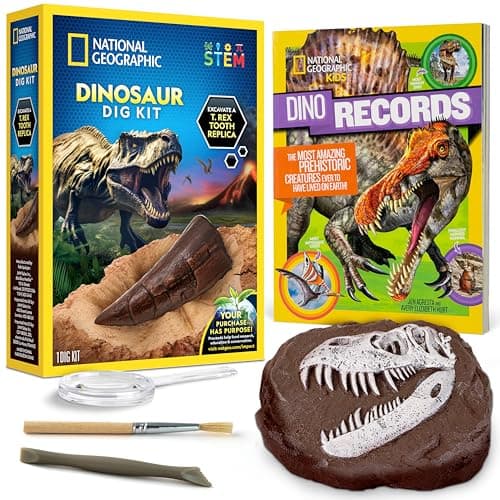
The National Geographic Dinosaur Dig Kit is worth it for the genuine specimen. It publishes two fossils to excavate — a replica T-Rex tooth cast from a real fossil, and genuine dinosaur coprolite published as roughly 50 million years old — in a gypsum-and-clay brick, with digging tools and a learning guide, rated 8+.
Block & Beaker earns a commission when you buy through our links, at no cost to you. It never changes a ranking, and we say so plainly when the right answer is the cheaper set, or nothing at all. Full disclosure · How we pick.
At a glance
The picks, ranked
Tap any row to jump to the full reasoning. Prices come live from Amazon where we have them and read “check price” where we don’t — never a number we cannot stand behind today.
| # | Product | Best for | Price |
|---|---|---|---|
| 1 | The product NATIONAL GEOGRAPHIC Dinosaur Dig Kit A genuine 50-million-year-old specimen at the end of an hour's excavation. | Eight and up, once | |
| 2 | 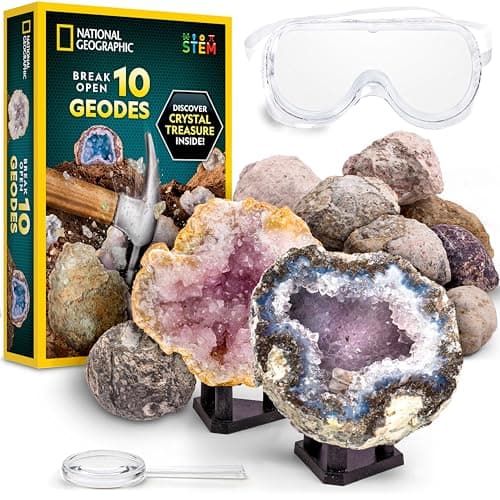 Ten results instead of one NATIONAL GEOGRAPHIC Break Open 10 Premium Geodes 10 hand-selected geodes, 1.25 to 2.25 inches, with goggles and display stands. | Eight and up | |
| 3 | 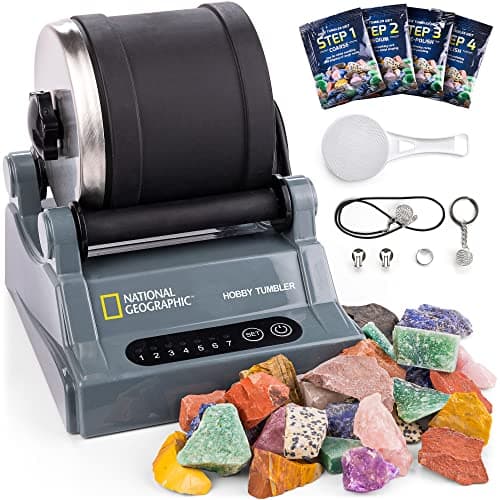 The one that keeps going NATIONAL GEOGRAPHIC Hobby Rock Tumbler Kit A tumbler, four grits, nine rough gemstone types and an automatic timer. | Eight and up, with patience | |
| — | 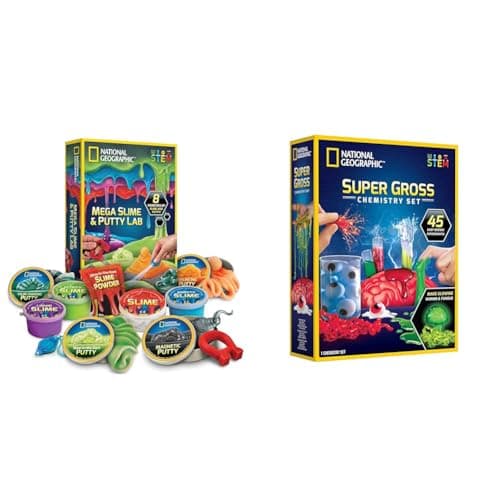 Not the same buyer NATIONAL GEOGRAPHIC Mega Slime Kit & Putty Lab Seven premade putties and one DIY lab in eight tins. | Eight and up |
4 picks, including 1 we tell you to skip. Ages shown are the manufacturer’s own rating, not ours.
What we can tell you, and what we cannot
We have not dug it. No lab, no samples, no test children, and no star rating on this page or in its structured data.
National Geographic publishes what is in the brick, which of the two fossils is genuine, the approximate age of the coprolite, the brick material and the age rating. How long the excavation takes, and how much dust it makes, we cannot tell you.
The specification that decides it
The arithmetic
Nat Geo Dinosaur Dig Kit, published
| Fossils to excavate | 2 — a replica T-Rex tooth, and genuine dinosaur coprolite |
|---|---|
| Coprolite age | Published as roughly 50 million years old |
| Dig brick | Gypsum and clay — published as easier for children to excavate |
| Includes | Digging tools and a full-color learning guide |
| Stated age | 8+ |
| Consumables | Yes — the brick is destroyed to get the fossils out |
What the numbers mean in practice
One use, and the box says so. The brick is destroyed by design. Price this as an experience with two keepsakes rather than as a toy, and the value question answers itself.
Real beats big. A genuine specimen roughly 50 million years old is something a child can take to school; a bigger brick with more plastic replicas is not.
The soft matrix is a feature, not a shortcut. Gypsum and clay means an eight-year-old can actually finish the excavation, which is the difference between a completed project and an abandoned one on a newspaper.
Coprolite is fossilized dung, and that is the selling point. Say it out loud before the wrapping comes off. For most eight-year-olds it is the best fact in the box.
What to do afterwards
The kit ends with two objects and a destroyed brick, so the question is what happens next. Both specimens need somewhere to live: a labeled box or a display shelf turns them from debris into a collection.
If the excavating itself was the appeal rather than the dinosaur, the geode set is the natural follow-on — ten cracks rather than one dig, and every result different. If the fossil was the appeal, a rock tumbler is a machine rather than a one-off.
That is worth deciding in advance, because a child who has just finished a dig asks for another one the same evening.
Worth knowing before you buy
The tools are the limiting factor, not the brick. Published contents are digging tools and a gypsum-and-clay matrix; an old paintbrush and a wooden skewer from the kitchen speed the excavation up considerably.
Who should skip it
Anyone who wants repeat use. The brick is a one-shot. Geodes give ten results; a tumbler runs indefinitely with refills.
Households with a mess limit. There is no low-dust way to excavate gypsum.
Under-eights. The published floor is 8, and the tools are the reason.
Where it sits
This kit appears in dinosaur dig kits, rock and geology kits and gifts for kids who like science.
In full
Every pick, and what is wrong with it
Published specifications only, each linked back to the page it came from. Where a manufacturer publishes nothing, the row says so — we do not fill blanks in.
1. The product
NATIONAL GEOGRAPHIC Dinosaur Dig Kit
National Geographic · JM80215 · maker rates it 8+
A genuine 50-million-year-old specimen at the end of an hour's excavation.
- Fossils to excavate
- 2 — a replica T-Rex tooth cast from a real fossil, and genuine dinosaur coprolite
- Coprolite age
- Published as roughly 50 million years old
- Dig brick
- Gypsum and clay, published as easier for children to excavate
- Includes
- Digging tools and a full-color learning guide
National Geographic publishes two fossils to excavate: a replica T-Rex tooth cast from a real fossil, and genuine dinosaur coprolite published as roughly 50 million years old. The dig brick is gypsum and clay, published as easier for children to excavate, and the kit includes digging tools and a full-color learning guide. Stated age 8+. Consumable — the brick is destroyed to get the fossils out.
Read “two fossils” carefully: one is a replica, one is real. The coprolite — fossilized dung — is the genuine article, and at eight the fact that it is real dinosaur waste is worth more than any model.
The gypsum-and-clay brick is a deliberate choice worth noticing. Harder dig bricks defeat children and end with an adult doing it; a softer matrix is why this one gets finished.
Replay signal
- Open-ended or one-shot
- One-shot: the brick is excavated once and cannot be reset
- Does anything run out
- Yes — two fossils, one dig, then it is a shelf object
- Room to grow
- The coprolite and tooth pair naturally with a magnifier or low-power microscope
- Adult required
- For the mess rather than the safety — this is a dusty activity
Why we say so: National Geographic publishes two fossils in a gypsum-and-clay brick. One brick means one dig, and the honest framing is an afternoon with two keepable objects at the end rather than a science course.
What’s wrong with it
The brick is destroyed to get the fossils out — this is strictly a single use.
| Fossils to excavate | 2 — a replica T-Rex tooth cast from a real fossil, and genuine dinosaur coprolite |
|---|---|
| Coprolite age | Published as roughly 50 million years old |
| Dig brick | Gypsum and clay, published as easier for children to excavate |
| Includes | Digging tools and a full-color learning guide |
| Stated age | 8+ |
| Consumables | Yes — the brick is destroyed to get the fossils out |
Every figure above is from National Geographic toys, Dinosaur Dig Kit. Blanks are shown as “not published” rather than filled in.
2. Ten results instead of one
NATIONAL GEOGRAPHIC Break Open 10 Premium Geodes
National Geographic · NGGEO10 · maker rates it 8+
10 hand-selected geodes, 1.25 to 2.25 inches, with goggles and display stands.
- Geodes
- 10, hand-selected, 1.25 to 2.25 inches across
- Includes
- Safety goggles, magnifying glass, display stands, full-color learning guide
- Stated age
- Manufacturer's minimum age 8 years
- Safety note
- Contains small parts; not for children under 3
National Geographic publishes 10 hand-selected geodes measuring 1.25 to 2.25 inches, with safety goggles, a magnifying glass, display stands and a full-color learning guide, minimum age 8 years, containing small parts and not for children under 3.
Ten moments of discovery against one, and every geode inside is genuinely different. See the geodes review.
Replay signal
- Open-ended or one-shot
- One-shot by design. Ten geodes, ten moments, then it is a bowl of pretty rocks
- Does anything run out
- Yes, definitively — the clearest example on this site of a kit that ends
Why we say so: National Geographic publishes the count as ten natural geodes. Ten single-use items is a finite number, and we would rather say so than let a gift-buyer find out on Christmas afternoon.
What’s wrong with it
Each geode only cracks open once, and a hammer is involved.
| Geodes | 10, hand-selected, 1.25 to 2.25 inches across |
|---|---|
| Includes | Safety goggles, magnifying glass, display stands, full-color learning guide |
| Stated age | Manufacturer's minimum age 8 years |
| Safety note | Contains small parts; not for children under 3 |
| Consumables | Yes — ten geodes, and each one only cracks open once |
Every figure above is from National Geographic toys, Break Open Geodes. Blanks are shown as “not published” rather than filled in.
3. The one that keeps going
NATIONAL GEOGRAPHIC Hobby Rock Tumbler Kit
National Geographic · Hobby Rock Tumbler · maker rates it 8+
A tumbler, four grits, nine rough gemstone types and an automatic timer.
- Includes
- Tumbler, four polishing grits, sifter, learning guide
- Rough gemstones
- Nine types
- Barrel
- Noise-reducing, leak-proof, stainless steel lid
- Controls
- One-touch settings with an automatic shutoff timer
National Geographic publishes a tumbler with four polishing grits, a sifter, a learning guide, nine types of rough gemstones, a noise-reducing leak-proof barrel with a stainless steel lid, one-touch settings with an automatic shutoff timer, and jewelry fastenings. Stated age 8+, with the grits and rough consumable.
The machine is permanent even though the grit is not, and refill grit and rough are widely sold. That makes it the long-term geology purchase.
Replay signal
- Open-ended or one-shot
- Semi-open: the machine is permanent, the grit is not, and rocks from a beach are free
- Does anything run out
- The grits and the supplied gemstones run out; refill grit is sold separately
- Room to grow
- Once the supplied rough is gone, the tumbler works on anything the child collects
- Adult required
- For loading and for the timer; the tumbling itself is unattended
Why we say so: National Geographic publishes four polishing grits, nine gemstone types and an automatic shutoff timer. The machine outliving the grit is what makes this different from a one-shot geology kit — but it runs for days per batch, so it is a patience purchase, not an afternoon one.
What’s wrong with it
The grits are consumable, and each batch takes days.
| Includes | Tumbler, four polishing grits, sifter, learning guide |
|---|---|
| Rough gemstones | Nine types |
| Barrel | Noise-reducing, leak-proof, stainless steel lid |
| Controls | One-touch settings with an automatic shutoff timer |
| Extras | Jewelry fastenings for the polished stones |
| Stated age | 8+ |
| Consumables | Yes — the four grits and the supplied rough are used up |
Every figure above is from National Geographic toys, Hobby Rock Tumbler Kit. Blanks are shown as “not published” rather than filled in.
Skip this one
NATIONAL GEOGRAPHIC Mega Slime Kit & Putty Lab
National Geographic · NGMEGASPL · maker rates it 8+
Seven premade putties and one DIY lab in eight tins.
- Varieties
- 8 in total — 7 premade plus 1 DIY slime lab
- Premade types
- Magnetic putty, fluffy slime, glow-in-the-dark putty, liquid slime, color-changing putty, snotty slime, bouncing putty
- DIY portion
- One glow-in-the-dark slime lab with a stir stick
- Storage
- 8 tins
National Geographic publishes 8 varieties — 7 premade putties and slimes plus 1 DIY glow-in-the-dark slime lab — in 8 tins with a learning guide, rated 8 and up.
Same brand, same shelf, same age. A child who wanted to excavate something will not be satisfied by a tin of ready-made putty.
Replay signal
- Open-ended or one-shot
- The seven premade putties are reusable toys rather than one-shot experiments
- Does anything run out
- Only the DIY lab runs out
- Room to grow
- Magnetic and color-changing putty demonstrate real properties, not just texture
- Adult required
- Not for the premade putties; briefly for the DIY mix
Why we say so: National Geographic publishes seven premade varieties plus one DIY lab. That ratio is the review: most of this kit is a reusable sensory toy with a science label, and one eighth of it is the experiment.
What’s wrong with it
Seven-eighths of it arrives already made.
| Varieties | 8 in total — 7 premade plus 1 DIY slime lab |
|---|---|
| Premade types | Magnetic putty, fluffy slime, glow-in-the-dark putty, liquid slime, color-changing putty, snotty slime, bouncing putty |
| DIY portion | One glow-in-the-dark slime lab with a stir stick |
| Storage | 8 tins |
| Includes | Full-color learning guide |
| Stated age | 8 and up |
| Consumables | Partly — the DIY ingredients are used once; the putties are reusable |
Every figure above is from National Geographic toys, Mega Slime Kit & Putty Lab. Blanks are shown as “not published” rather than filled in.
We are not putting a buy button on this one. It is easy enough to find if you want it anyway — but we would rather send you to something that gets played with twice.
Questions people actually ask
Frequently asked
Is the National Geographic Dinosaur Dig Kit worth it?
For one session, yes - mainly for the genuine specimen. It publishes a replica T-Rex tooth cast from a real fossil plus genuine dinosaur coprolite around 50 million years old, in a gypsum-and-clay brick that is destroyed during the dig.
Are the fossils in the dig kit real?
One of the two is. National Geographic publishes the T-Rex tooth as a replica cast from a real fossil, and the coprolite - fossilized dung - as genuine and roughly 50 million years old.
Can the dig kit be used more than once?
No. The brick is destroyed to get the fossils out, so it is a single use by design. For repeat discovery, the Break Open Geodes set publishes 10 geodes. Dinosaur dig kits.
What age is the dinosaur dig kit for?
National Geographic publishes 8+. The gypsum-and-clay brick is published as easier for children to excavate, which is what makes that age realistic.
Dig kit or geodes?
One dig and two keepsakes against ten cracks and ten different interiors. The geode set publishes 10 hand-selected geodes from 1.25 to 2.25 inches with safety goggles included. Break Open Geodes review.
What is coprolite?
Fossilized dung. National Geographic publishes the specimen in this kit as genuine dinosaur coprolite, roughly 50 million years old - which for most eight-year-olds is the best fact in the box.
Do you keep both fossils?
Yes - the replica T-Rex tooth and the genuine coprolite both survive the dig. The gypsum-and-clay brick they are embedded in does not. Rock and geology kits.
What tools are included?
National Geographic publishes digging tools and a full-color learning guide with the gypsum-and-clay dig brick. A kitchen paintbrush speeds the work up considerably.
Sources
Where these figures came from
Every specification on this page traces to one of these. If a manufacturer publishes nothing on a point, the page says so rather than filling the gap.
Read next
Where to go from here
Back to Reviews, or read how we pick.