Single review
Thames & Kosmos Physics Workshop Review
Reviewed from Thames & Kosmos's published specifications. We have not built it. On this shelf the manual is the product, and this one runs to 104 pages with equations in it.
By Sawyer V. · Published
The short answer
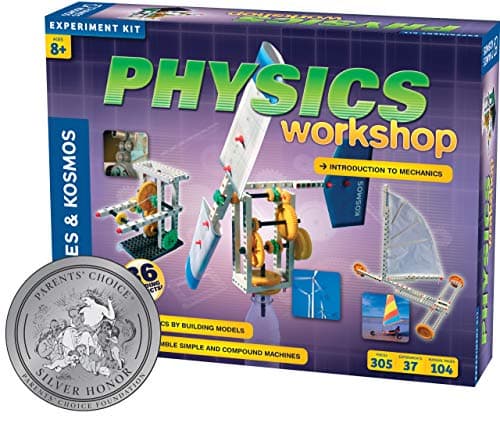
The Thames & Kosmos Physics Workshop is the mechanics kit this site’s physics shelf was missing. The maker publishes 38 models and 37 experiments from 305 pieces across five chapters — gravity and inertia, simple machines, gears and energy transfer, forces at work, centrifugal force — documented in a “104-page full-color manual” containing “fundamental physics equations”. Rated 8+, no batteries, and the published end point is a working pendulum clock.
Block & Beaker earns a commission when you buy through our links, at no cost to you. It never changes a ranking, and we say so plainly when the right answer is the cheaper set, or nothing at all. Full disclosure · How we pick.
At a glance
The picks, ranked
Tap any row to jump to the full reasoning. Prices come live from Amazon where we have them and read “check price” where we don’t — never a number we cannot stand behind today.
| # | Product | Best for | Price |
|---|---|---|---|
| 1 | The product Thames & Kosmos Physics Workshop 38 models and 37 experiments across five chapters, with equations in the manual. | Eight and up, for a child who wants the reason and not just the result | |
| 2 | 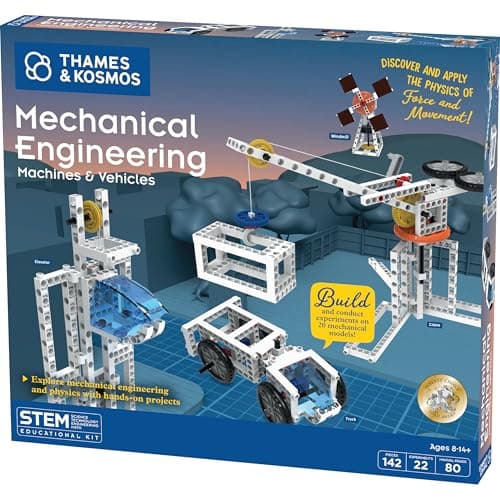 Buy this instead if the child wants machines, not physics Thames & Kosmos Mechanical Engineering: Machines & Vehicles 20 projects plus 22 experiments, building a crane, an elevator, a windmill and an ATV. | Eight to fourteen, for a builder rather than a reader | |
| 3 | 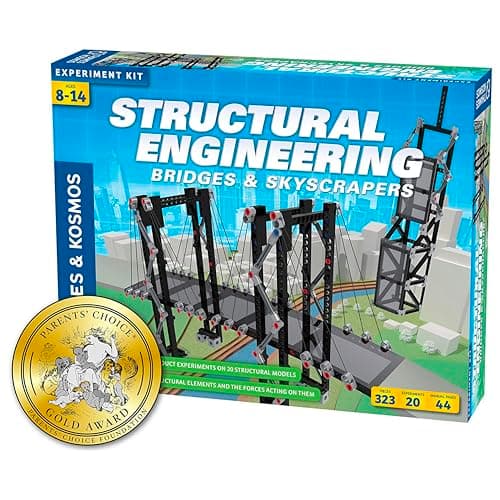 The other engineering branch — things that hold still Thames & Kosmos Structural Engineering: Bridges & Skyscrapers 20 models from 285+ interchangeable pieces, on force, load, compression and tension. | Eight and up, for a child drawn to bridges and towers | |
| 4 | 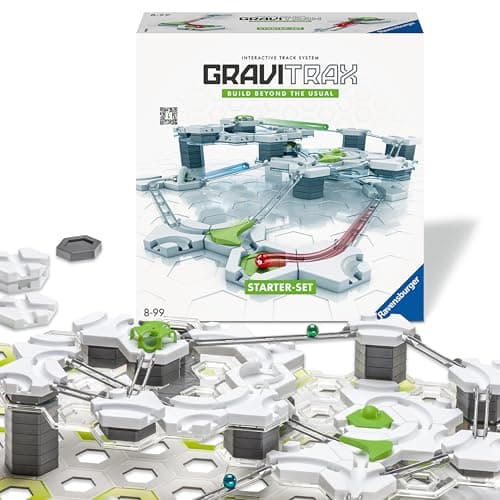 Mechanics with no manual at all GraviTrax Starter Set 122 pieces across 18 element types, including a vortex and a magnetic cannon. | Eight and up, where instructions are the problem rather than the point | |
| — | 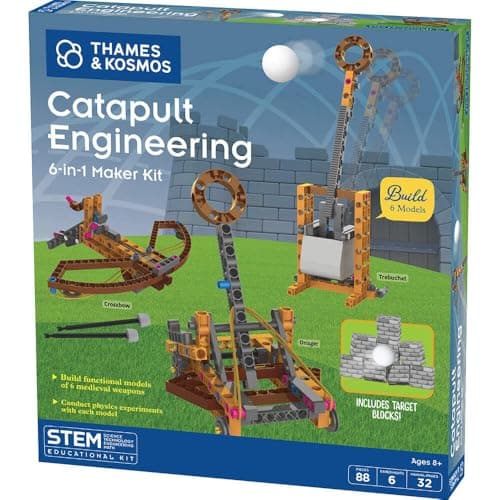 Six models, one mechanism Thames & Kosmos Catapult Engineering Crossbow, reverse-draw crossbow, onager, catapult, trebuchet and ballista. | Eight and up, as a cheap second kit for a child already interested |
5 picks, including 1 we tell you to skip. Ages shown are the manufacturer’s own rating, not ours.
What we can tell you, and what we cannot
We have not built it. No lab, no samples, no test children, and no star rating on this page or in its structured data. Everything below is Thames & Kosmos’s own published information plus arithmetic.
Two limits worth naming. First, the maker’s own site returned HTTP 429 to three spaced requests on the day this was written, so these figures come from Thames & Kosmos’s published listing copy rather than from its product page. That text is the maker’s, and every figure here is quoted from it — but it is a thinner source than we used for the Electricity & Magnetism review, where the maker’s page served a full spec block.
Second, and following from that: the listing publishes that the kit is “aligned with Next Generation Science Standards” without naming which ones. For the Electricity & Magnetism kit we were able to publish all four correlation codes. Here we can only report the claim. We are not going to guess at codes, and a page that lists them without a source is inventing them.
The specification that decides it
The arithmetic
Thames & Kosmos Physics Workshop (625412), published
| Models | 38 |
|---|---|
| Experiments | 37 |
| Piece count | 305 |
| Manual | 104 pages, full color, by Dr. Uwe Wandrey — the longest in this catalog |
| Manual contents | “keyword definitions, real-world examples, data charts, and fundamental physics equations kids actually use” |
| Chapters | 5 — gravity and inertia, simple machines, gears and energy transfer, forces at work, centrifugal force |
| Concepts | Gravity, mass, levers, pulleys, inclined planes, gears, sprockets, chain drives, pendulums, centrifuges |
| Published end point | “a working pendulum clock” |
| Power | None — no motor, no batteries published |
| Standards | “aligned with Next Generation Science Standards” — correlations not named on the listing |
| Award | Parents' Choice Silver Award |
| Stated age | Ages 8 and up |
| Consumables | None |
On this shelf, the manual is the product
It is worth making the argument explicitly, because piece counts are what the category advertises and manuals are what it hides in the specification table.
A construction set with no explanation teaches a child that a pulley makes lifting easier, which they will discover in about four seconds. A manual that prints the mechanical advantage of that pulley — and gives them a data chart to fill in — teaches them that the easing is measurable, and that the measurement is predictable before they lift anything. That is the entire difference between a toy and a physics kit, and it lives in the page count.
The arithmetic
Manual length across this catalog's physics and engineering kits
| T&K Physics Workshop | 104 pages · 38 models, 37 experiments, 305 pieces · equations published |
|---|---|
| T&K Mechanical Engineering | 80 pages · 20 projects, 22 experiments · ages 8-14+ |
| T&K Electricity & Magnetism | 64 pages · 62 experiments, 64 pieces · NGSS codes published |
| T&K Magnetic Science | 48 pages · 33 activities, 42 pieces · no batteries |
| T&K Motors & Generators | 48 pages · 25 experiments from 12 pieces |
| T&K Structural Engineering | 36 pages · 20 models, 285+ pieces · skill level Intermediate |
| T&K Catapult Engineering | 32 pages · 6 models · force, energy, motion, trajectory |
| GraviTrax Starter Set | No manual of explanation at all · 122 pieces, 18 element types |
What the five chapters actually do
They are sequenced, and the maker says so. Thames & Kosmos publishes that each chapter builds on the last, running gravity and inertia, then simple machines, then gears and energy transfer, then forces at work, then centrifugal force. That is roughly the order a physics syllabus uses, and it is not the order a box of parts would suggest.
Simple machines is the chapter that does the work. Levers, pulleys and inclined planes are the three ideas that make every other mechanism legible, and a child who has built and measured all three has the vocabulary for the rest of the kit.
Gears and chain drives is where it stops being a toy. The published concept list names sprockets and chain drives specifically, which is a bicycle — the machine most eight-year-olds own and none of them understand.
And the pendulum clock is the payoff. A clock built from a pendulum, a gear train and an escapement uses every chapter at once. It is the single most convincing thing a mechanics kit can end on, and it is why the 104 pages are worth reading.
Who should skip it
A child who wants to build rather than read. This is the real risk and the page is not going to soften it. 104 pages is a reading commitment, and the cheaper Mechanical Engineering kit builds a crane and an elevator out of the same kind of parts with 24 fewer pages of theory.
Anyone under eight. The published floor is 8+, and the sibling Structural kit publishes “Skill level: Intermediate” for the same age band — this line is not the entry point. For younger children see engineering toys for preschoolers.
A household that already owns a mechanics system. If there is a GraviTrax set or a big K’NEX box in the house, the marginal new thing here is the manual rather than the mechanisms. That may still be worth it — but buy it knowing that is what you are buying.
Anyone buying to specific NGSS codes. The listing claims alignment without naming correlations. If you need the codes, the Electricity & Magnetism kit publishes four of them, and STEM toys for homeschool covers buying to standards generally.
Worth knowing before you buy
Where it sits
Physics Workshop is the mechanics kit missing from physics kits for kids, which argued that most of that shelf is magnetism and used a marble run to cover mechanics. For the electromagnetism half of the same maker’s line, see the Electricity & Magnetism review; for its chemistry line, Chem C500 and CHEM C1000. Across brands, the same question is covered at mechanical toys for kids and engineering toys for kids.
In full
Every pick, and what is wrong with it
Published specifications only, each linked back to the page it came from. Where a manufacturer publishes nothing, the row says so — we do not fill blanks in.
1. The product
Thames & Kosmos Physics Workshop
Thames & Kosmos · 625412 · maker rates it 8+
38 models and 37 experiments across five chapters, with equations in the manual.
- Models
- 38
- Experiments
- 37
- Piece count
- 305
- Manual
- “104-page full-color manual” written by Dr. Uwe Wandrey, with “keyword definitions, real-world examples, data charts, and fundamental physics equations”
Thames & Kosmos publishes 38 models and 37 experiments from a 305-piece kit, structured into five chapters that “progress from gravity and inertia through simple machines, gears and energy transfer, forces at work, and centrifugal force”, each building on the last. The published concept list is gravity, mass, levers, pulleys, inclined planes, gears, sprockets, chain drives, pendulums and centrifuges. Model 625412, rated ages 8 and up, no batteries published as required.
The manual is why this kit is worth a page of its own. Thames & Kosmos publishes it at 104 full-color pages, written by Dr. Uwe Wandrey, with “keyword definitions, real-world examples, data charts, and fundamental physics equations kids actually use”. That last phrase is the one to notice: this is the only kit in this catalog whose manual is published as containing equations at all. Every other kit here explains in words.
Compare the page counts across the maker’s own line and the design intent is obvious. Physics Workshop: 104 pages. Electricity & Magnetism: 64. Mechanical Engineering: 80. Structural Engineering: 36. Catapult Engineering: 32. This is the textbook of the range, and the 305 pieces exist to illustrate it rather than the other way round.
The published end point is good too: “from first experiment to working pendulum clock”. A pendulum clock is the correct destination for a mechanics kit in the same way a loudspeaker is for an electromagnetism one — it is a real machine whose working a child can trace back through every chapter that came before it.
The honest drawbacks. One hundred and four pages is a reading commitment, and a child who opened the box to build will find chapter two slow. It is also the mid-to-upper price band for this shelf, and the maker publishes NGSS alignment on the listing without naming the correlations — see below.
Replay signal
- Open-ended or one-shot
- 38 models, then 305 reusable parts — the system builds things the manual does not show
- Does anything run out
- Nothing runs out; no batteries and no consumables
- Room to grow
- Five published chapters that build on each other, ending at a working pendulum clock
Why we say so: Thames & Kosmos publishes 38 models and 37 experiments from 305 pieces, structured into five chapters that progress from gravity to centrifugal force, documented in a 104-page manual containing actual physics equations. The manual is the product here: it is the only one in this catalog with equations in it, and at 104 pages it is longer than any other kit's by a wide margin.
What’s wrong with it
104 pages is a lot of reading. A child who wants to build and not read will stall in chapter two.
| Models | 38 |
|---|---|
| Experiments | 37 |
| Piece count | 305 |
| Manual | “104-page full-color manual” written by Dr. Uwe Wandrey, with “keyword definitions, real-world examples, data charts, and fundamental physics equations” |
| Chapters | 5 — “gravity and inertia through simple machines, gears and energy transfer, forces at work, and centrifugal force”, each building on the last |
| Concepts covered | “gravity, mass, levers, pulleys, inclined planes, gears, sprockets, chain drives, pendulums, centrifuges” |
| Published end point | “from first experiment to working pendulum clock” |
| Standards | Published as “aligned with Next Generation Science Standards”; the listing does not state which correlations |
| Award published | Parents' Choice Silver Award |
| Batteries | None published as required |
| Stated age | Ages 8 and up |
| Consumables | None |
Every figure above is from Thames & Kosmos, Physics Workshop (625412) — published listing copy. Blanks are shown as “not published” rather than filled in.
2. Buy this instead if the child wants machines, not physics
Thames & Kosmos Mechanical Engineering: Machines & Vehicles
Thames & Kosmos · 625419 · maker rates it 8-14+
20 projects plus 22 experiments, building a crane, an elevator, a windmill and an ATV.
- Building projects
- 20
- Supplemental experiments
- 22
- Models named
- “a tightrope walker, elevator, crane, windmill, all-wheel drive ATV, and more”
- Topics covered
- “forces, gravity, weight, simple machines, storing and converting energy, momentum and gears, physics in the solar system”
Thames & Kosmos publishes 20 building projects and 22 supplemental experiments with an 80-page full-color manual, on a “durable, reusable building system” whose components combine and reconfigure. The named models are a tightrope walker, an elevator, a crane, a windmill and an all-wheel drive ATV. Topics published: forces, gravity, weight, simple machines, storing and converting energy, momentum and gears, physics in the solar system. Rated 8-14+.
The named models are the whole difference. A crane, an elevator and a windmill are machines a child has watched working in the world, and building one is a different motivation from building an apparatus that demonstrates centrifugal force. For a child who asked for something to make, this is the better buy at a lower price.
What it gives up is the explanation. Eighty pages against 104, and nothing published about equations. See mechanical toys for kids, which covers this question across brands.
Replay signal
- Open-ended or one-shot
- 20 published projects, then a reconfigurable system
- Does anything run out
- Nothing runs out
- Room to grow
- Published as combining and reconfiguring into further models
Why we say so: Thames & Kosmos publishes 20 building projects plus 22 supplemental experiments with an 80-page manual, aimed at 8-14+. The named models are the tell: a crane, an elevator, a windmill and an all-wheel-drive ATV are machines a child has seen working in the world, which is a different proposition from a physics kit built around abstractions.
What’s wrong with it
20 projects against 38, and an 80-page manual with no equations published.
| Building projects | 20 |
|---|---|
| Supplemental experiments | 22 |
| Models named | “a tightrope walker, elevator, crane, windmill, all-wheel drive ATV, and more” |
| Topics covered | “forces, gravity, weight, simple machines, storing and converting energy, momentum and gears, physics in the solar system” |
| Manual | “80-page, full-color experiment manual” |
| System | “Durable, reusable building system” — components combine and reconfigure |
| Stated age | “Kids ages 8-14+” |
| Batteries | None published as required |
| Consumables | None |
Every figure above is from Thames & Kosmos, Mechanical Eng: Machines & Vehicles (625419) — published listing copy. Blanks are shown as “not published” rather than filled in.
3. The other engineering branch — things that hold still
Thames & Kosmos Structural Engineering: Bridges & Skyscrapers
Thames & Kosmos · 625414 · maker rates it 8+
20 models from 285+ interchangeable pieces, on force, load, compression and tension.
- Models
- “20 different models that each teach about force, load, compression, tension and more”
- Piece count
- “Over 285 interchangeable building pieces”
- Manual
- “36-page, illustrated experiment manual and Assembly guide”
- Skill level
- Published as “Intermediate”
Thames & Kosmos publishes 20 models “that each teach about force, load, compression, tension and more” from “over 285 interchangeable building pieces”, with a 36-page illustrated experiment manual and an assembly guide. Skill level published as Intermediate, rated 8+.
Worth putting beside the Physics Workshop because the piece counts are close — 285+ against 305 — and the manuals are not. That gap is not a shortfall: a bridge that stands up is its own proof, and a structure needs less explaining than a centrifuge. Statics is the branch of physics you can see.
Buy it for a child who draws buildings. See structural engineering toys, where this site covers the same question with wooden planks and K’NEX.
Replay signal
- Open-ended or one-shot
- 20 models, then 285+ interchangeable pieces that build structures the manual does not
- Does anything run out
- Nothing runs out
- Room to grow
- The published interchangeability is the growth — the parts are a system, not a model
Why we say so: Thames & Kosmos publishes 20 models from over 285 interchangeable pieces, each teaching force, load, compression and tension, in a 36-page manual. Note the ratio against the Physics Workshop: a similar piece count and a manual a third the length, because a bridge that stands is its own proof and needs less explaining than a centrifuge.
What’s wrong with it
A 36-page manual — a third of Physics Workshop's, for a similar piece count.
| Models | “20 different models that each teach about force, load, compression, tension and more” |
|---|---|
| Piece count | “Over 285 interchangeable building pieces” |
| Manual | “36-page, illustrated experiment manual and Assembly guide” |
| Skill level | Published as “Intermediate” |
| Stated age | Ages 8+ |
| Batteries | None published as required |
| Consumables | None |
Every figure above is from Thames & Kosmos, Structural Eng: Bridges & Skyscrapers (625414) — published listing copy. Blanks are shown as “not published” rather than filled in.
4. Mechanics with no manual at all
GraviTrax Starter Set
Ravensburger · 27597 · maker rates it 8+
122 pieces across 18 element types, including a vortex and a magnetic cannon.
- Pieces
- 122
- Construction elements
- 18 types, including base plates, height tiles, curves, junctions, switches, tracks, a vortex, a launch pad and a magnetic cannon
- Marbles
- 6
- Stated age
- 8 and up
Ravensburger publishes 122 pieces across 18 construction element types — including switches, a vortex, a launch pad and a magnetic cannon — with 6 marbles and 9 included track designs, rated 8 and up.
It is the honest opposite of this review’s subject and the reason it is here. GraviTrax teaches gravity, momentum and energy conversion by consequence: build the drop too shallow and the marble stops. Physics Workshop teaches the same ideas by explanation, with the equations printed.
Neither is better. A household that has watched one child abandon a manual-led kit should look hard at the one with no manual. See the GraviTrax review and physics kits for kids.
Replay signal
- Open-ended or one-shot
- Open-ended once the nine included designs are done — the system is a construction kit, not a puzzle with an answer
- Does anything run out
- Nothing runs out
- Room to grow
- Ravensburger publishes a large expansion range built to enlarge the same system
Why we say so: Ravensburger publishes the 122-piece count, the 18 construction-element types, the nine included track designs and an expansion range designed to extend the same track system.
What’s wrong with it
No experiments, no explanations, no equations. The physics is implicit and unnamed.
| Pieces | 122 |
|---|---|
| Construction elements | 18 types, including base plates, height tiles, curves, junctions, switches, tracks, a vortex, a launch pad and a magnetic cannon |
| Marbles | 6 |
| Stated age | 8 and up |
| Track designs included | 9 |
| Consumables | None |
Every figure above is from Ravensburger, GraviTrax Starter Set. Blanks are shown as “not published” rather than filled in.
Skip this one
Thames & Kosmos Catapult Engineering
Thames & Kosmos · 550056 · maker rates it 8+
Crossbow, reverse-draw crossbow, onager, catapult, trebuchet and ballista.
- Models
- 6
- Models named
- “crossbow, reverse-draw crossbow, onager, catapult, trebuchet, and ballista”
- Manual
- “32-page, full-color illustrated manual” with assembly instructions plus experiments on “force, energy, motion, and trajectory”
- Projectiles
- “soft foam balls and foam-tipped projectiles”; components “designed to allow only the included projectiles to be inserted”
Thames & Kosmos publishes six models — “crossbow, reverse-draw crossbow, onager, catapult, trebuchet, and ballista” — with a 32-page full-color manual covering assembly plus experiments on “force, energy, motion, and trajectory”. It publishes soft foam balls and foam-tipped projectiles, with components “designed to allow only the included projectiles to be inserted”, cardboard target blocks, and a box that transforms into a castle. Rated 8+.
It is the skip against this review’s subject, on arithmetic rather than quality. Six models and 32 pages against 38 models and 104 pages, on a single mechanism — stored energy released as trajectory. As the one physics kit in a house it is far too narrow.
Where it genuinely earns a place: it is the cheapest kit in the line by a distance, and the projectile engineering is thoughtful — the maker publishes that the components accept only the supplied foam, which closes off the obvious misuse before a parent has to. Bought as the second kit, for a child who already liked the first, it is a good purchase.
Replay signal
- Open-ended or one-shot
- Six published models on one mechanism. Narrow by design
- Does anything run out
- Nothing runs out
- Room to grow
- None published beyond the six models
Why we say so: Thames & Kosmos publishes six models — crossbow, reverse-draw crossbow, onager, catapult, trebuchet and ballista — with a 32-page manual covering force, energy, motion and trajectory. The projectile engineering is the detail worth knowing: the components are published as designed to accept only the supplied foam, which is the maker closing off the obvious misuse before a parent has to.
What’s wrong with it
Six models and a 32-page manual — the narrowest kit in the line, on one idea.
| Models | 6 |
|---|---|
| Models named | “crossbow, reverse-draw crossbow, onager, catapult, trebuchet, and ballista” |
| Manual | “32-page, full-color illustrated manual” with assembly instructions plus experiments on “force, energy, motion, and trajectory” |
| Projectiles | “soft foam balls and foam-tipped projectiles”; components “designed to allow only the included projectiles to be inserted” |
| Also included | Cardboard target blocks, and a box that “transforms into a castle kids can color” |
| Stated age | Ages 8+ |
| Batteries | None published as required |
| Consumables | None published — the projectiles are reusable foam |
Every figure above is from Thames & Kosmos, Catapult Engineering (550056) — published listing copy. Blanks are shown as “not published” rather than filled in.
We are not putting a buy button on this one. It is easy enough to find if you want it anyway — but we would rather send you to something that gets played with twice.
Questions people actually ask
Frequently asked
Is the Thames & Kosmos Physics Workshop worth it?
Yes, for a child who wants the reason rather than just the result. The maker publishes 38 models and 37 experiments from 305 pieces across five sequenced chapters, documented in a 104-page manual that contains real physics equations - the only kit manual in this catalog published as having equations at all. Rated 8+, no batteries.
How many pages is the Physics Workshop manual?
104, full color, written by Dr. Uwe Wandrey. Thames & Kosmos publishes it as including "keyword definitions, real-world examples, data charts, and fundamental physics equations kids actually use". For comparison, the same maker publishes 80 pages for Mechanical Engineering, 64 for Electricity & Magnetism and 36 for Structural Engineering.
What does the Physics Workshop actually build?
38 models across five chapters - gravity and inertia, simple machines, gears and energy transfer, forces at work, and centrifugal force. The published concept list names levers, pulleys, inclined planes, gears, sprockets, chain drives, pendulums and centrifuges, and the maker describes the progression as running "from first experiment to working pendulum clock".
What age is it for?
Ages 8 and up, published by Thames & Kosmos. Treat that as a floor rather than a target: the sibling Structural Engineering kit publishes "Skill level: Intermediate" at the same age band, and 104 pages of manual is a real reading commitment. Buying above the age rating.
Is it NGSS aligned?
The listing says it is "aligned with Next Generation Science Standards" but does not name which correlations, and we will not guess at codes we cannot see. If buying to specific standards matters, the same maker's Electricity & Magnetism kit publishes four correlation codes outright. Electricity & Magnetism review.
Should I buy this or the Mechanical Engineering kit?
Physics Workshop if the child wants to understand; Mechanical Engineering if they want to build. The maker publishes 38 models and a 104-page manual for the first, and 20 projects plus 22 experiments with an 80-page manual for the second - but the second names a crane, an elevator, a windmill and an all-wheel-drive ATV, which are machines a child has actually seen working. Mechanical toys for kids.
Does it need batteries?
No. Thames & Kosmos publishes no battery requirement and no powered function - every mechanism in the kit is driven by hand or by gravity, which is also why nothing in it can stop working. Battery guide for STEM toys.
Sources
Where these figures came from
Every specification on this page traces to one of these. If a manufacturer publishes nothing on a point, the page says so rather than filling the gap.
- Thames & Kosmos, Physics Workshop (625412) — published listing copy
- Thames & Kosmos, Mechanical Eng: Machines & Vehicles (625419) — published listing copy
- Thames & Kosmos, Structural Eng: Bridges & Skyscrapers (625414) — published listing copy
- Thames & Kosmos, Catapult Engineering (550056) — published listing copy
- Ravensburger, GraviTrax Starter Set
Read next
Where to go from here
Back to Reviews, or read how we pick.