Single review
Thames & Kosmos Structural Engineering Review
Reviewed from Thames & Kosmos's published specifications. We have not built it. The interesting figure is the one that looks like a weakness: a 36-page manual, where the mechanics kit needs 104.
By Sawyer V. · Published
The short answer
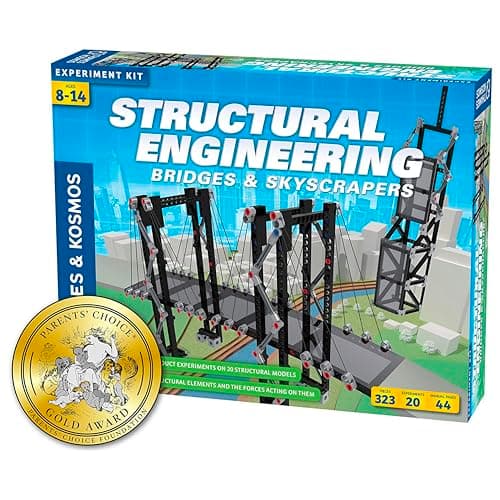
Thames & Kosmos Structural Engineering: Bridges & Skyscrapers is the kit this site’s structural-engineering page was missing. The maker publishes 20 models “that each teach about force, load, compression, tension and more”, built from “over 285 interchangeable building pieces”, with a 36-page illustrated experiment manual plus a separate assembly guide. Skill level published as Intermediate, rated 8+, no batteries. The short manual is a feature, not a shortfall — and the reason is below.
Block & Beaker earns a commission when you buy through our links, at no cost to you. It never changes a ranking, and we say so plainly when the right answer is the cheaper set, or nothing at all. Full disclosure · How we pick.
At a glance
The picks, ranked
Tap any row to jump to the full reasoning. Prices come live from Amazon where we have them and read “check price” where we don’t — never a number we cannot stand behind today.
| # | Product | Best for | Price |
|---|---|---|---|
| 1 | The product Thames & Kosmos Structural Engineering: Bridges & Skyscrapers 20 models from 285+ interchangeable pieces, on force, load, compression and tension. | Eight and up, for a child who draws buildings and bridges | |
| 2 | 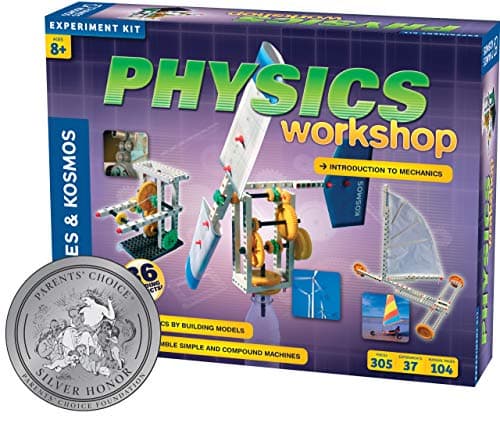 The sibling that explains instead of showing Thames & Kosmos Physics Workshop 38 models and 37 experiments from 305 pieces, with a 104-page manual. | Eight and up, for a child who wants the equation as well as the result | |
| 3 | 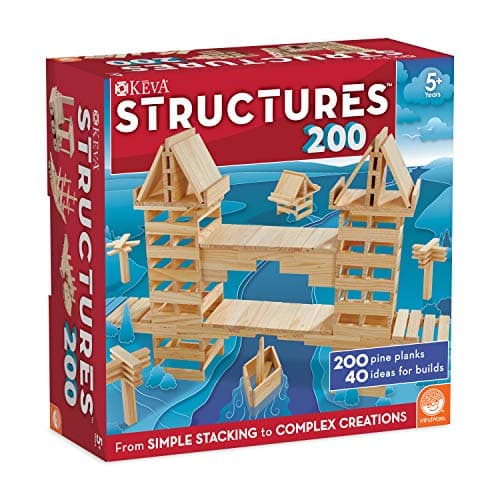 The opposite philosophy — no connectors at all KEVA Structures 200 Plank Set 200 precision-cut pine planks held up by nothing but gravity, plus a 24-page idea booklet. | Five and up, where instructions are the problem rather than the point | |
| 4 | 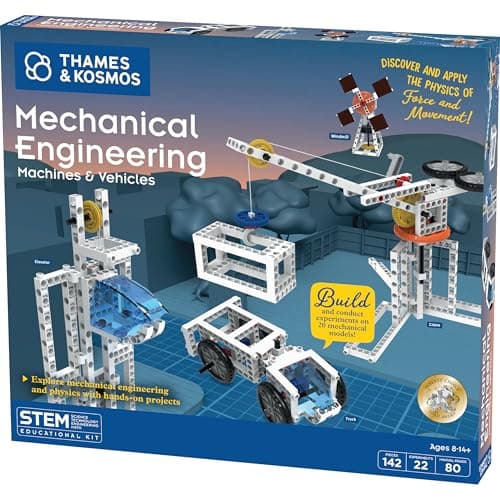 The other engineering branch — things that move Thames & Kosmos Mechanical Engineering: Machines & Vehicles 20 projects and 22 experiments building a crane, an elevator, a windmill and an ATV. | Eight to fourteen, for a child drawn to machines rather than buildings | |
| — | 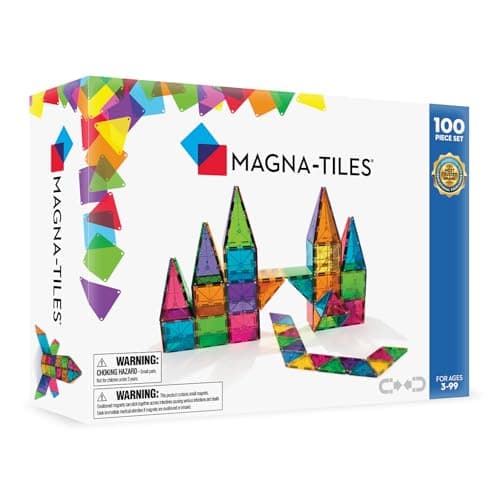 Cannot span a gap, by design MAGNA-TILES Classic 100-Piece Set 100 shapes: 50 small squares, 4 large, and 46 triangles in three types. | Three and up, as one of the best building toys there is — for a different question |
5 picks, including 1 we tell you to skip. Ages shown are the manufacturer’s own rating, not ours.
What we can tell you, and what we cannot
We have not built it. No lab, no samples, no test children, and no star rating on this page or in its structured data. Everything below is Thames & Kosmos’s own published information plus arithmetic.
Two limits, both worth stating. The maker publishes “over 285 interchangeable building pieces” and no breakdown of what they are — no beam count, no connector count, no panel count. On a construction system that is the figure a buyer most wants, and we are not going to estimate it. And `thamesandkosmos.com` returned HTTP 429 to this machine again, on the first and earliest request of the day, so these figures come from the manufacturer’s published listing copy rather than its product page. That copy is Thames & Kosmos’s own text, but it is thinner than the maker’s page: it is why there is no NGSS correlation list here, and no manual download link.
The specification that decides it
The arithmetic
T&K Structural Engineering: Bridges & Skyscrapers (625414), published
| Models | 20, “that each teach about force, load, compression, tension and more” |
|---|---|
| Pieces | “Over 285 interchangeable building pieces” — no breakdown published |
| Manual | 36 pages, illustrated — plus a separate assembly guide |
| Skill level | Published as “Intermediate” |
| Forces named on the box | Force, load, compression, tension |
| Power | None — no batteries published |
| Box | 13.1 x 11.6 x 1.8 in; 1 lb |
| Stated age | Ages 8+ |
| Consumables | None |
| NGSS correlations | Not available — the listing does not publish them and the maker's page was unreachable |
Why the short manual is the right manual
It looks like the weak spot on the spec sheet and it is the most interesting thing about the kit, so it is worth the space.
Statics is the one branch of physics that shows you its own answer. A bridge either carries the load or it sags; a tower either stands or it is on the floor. The feedback is immediate, unambiguous and requires no instrument, no stopwatch and no adult to confirm it. A child who adds a diagonal brace and watches a wobbling square become rigid has just learned what a truss is, and no paragraph was involved.
Mechanics is not like that. A centrifuge spinning at the right speed looks identical to one spinning at the wrong speed; a gear train that is turning tells you nothing about its ratio. That is why Thames & Kosmos publishes 104 pages with equations for the Physics Workshop and 36 for this one. The page count is tracking how much of each subject is invisible.
The arithmetic
Manual length against piece count, across the same maker's line
| Physics Workshop | 305 pieces · 104 pages · mechanics, with equations |
|---|---|
| Mechanical Engineering | 20 projects + 22 experiments · 80 pages · machines |
| Electricity & Magnetism | 64 pieces · 64 pages · invisible fields |
| Structural Engineering | 285+ pieces · 36 pages + assembly guide · statics |
| Catapult Engineering | 6 models · 32 pages · one mechanism |
| KEVA Structures 200 | 200 planks · 24-page idea booklet · no connectors at all |
| Magna-Tiles Classic 100 | 100 shapes · no manual — published as needing none |
The question that actually decides this purchase
Not the piece count. Can the joint carry tension?
Every building toy can do compression — stack things and gravity does the rest. Planks, blocks, tiles and bricks all make towers. What separates a construction toy from a structures kit is whether two parts can be pulled apart without coming apart, because that is what a truss member, a suspension cable and a skyscraper’s frame all have to do.
Rigid connectors: yes. The T&K kit’s interchangeable pieces lock together, which is why 20 published models can include spans rather than only stacks.
Friction and gravity: no. KEVA publishes “no glue or connectors … just gravity”. Superb for towers and cantilevers, structurally incapable of a tension member.
Magnets: deliberately no. Magna-Tiles publishes magnets chosen so children can “easily pull apart” the tiles. That is a safety and frustration decision, and it is also a structural ceiling.
Which is why the answer to “we already have loads of building toys” is usually still yes. A house can own 500 discs, 200 planks and 100 tiles and own nothing that spans a gap.
Who should skip it
A child under eight, or one new to construction sets. The published skill level is Intermediate, which is the maker saying this is not a starting point. For a first set see the best first building set.
Anyone who wanted open-ended building. Twenty models with an assembly guide is a guided product. KEVA publishes 200 identical planks and a booklet of ideas, and building blocks covers that end.
A child who wants things to move. Structures resist motion by definition. The same maker’s Mechanical Engineering kit publishes a crane, an elevator and a windmill in the same price band.
Anyone buying to published standards. No NGSS correlations are available for this kit from either source we can reach. The Electricity & Magnetism kit publishes four codes outright if that is the requirement.
Worth knowing before you buy
Where it sits
This kit belongs on structural engineering toys, which until now covered the subject entirely with general construction sets. Its siblings are reviewed at Physics Workshop and Electricity & Magnetism; the broader categories are engineering toys for kids and physics kits for kids. For the age above this one, see engineering toys for teens.
In full
Every pick, and what is wrong with it
Published specifications only, each linked back to the page it came from. Where a manufacturer publishes nothing, the row says so — we do not fill blanks in.
1. The product
Thames & Kosmos Structural Engineering: Bridges & Skyscrapers
Thames & Kosmos · 625414 · maker rates it 8+
20 models from 285+ interchangeable pieces, on force, load, compression and tension.
- Models
- “20 different models that each teach about force, load, compression, tension and more”
- Piece count
- “Over 285 interchangeable building pieces”
- Manual
- “36-page, illustrated experiment manual and Assembly guide”
- Skill level
- Published as “Intermediate”
Thames & Kosmos publishes 20 different models “that each teach about force, load, compression, tension and more”, “over 285 interchangeable building pieces”, and a “36-page, illustrated experiment manual and Assembly guide” — two documents, not one. Skill level is published as “Intermediate”. Model 625414, rated ages 8+, 13.1 x 11.6 x 1.8 inches at 1 lb, with no batteries published as required.
The four nouns in that first bullet are the whole product: force, load, compression, tension. Those are the complete vocabulary of statics, and a kit that names them on the box is telling you it is about why structures stand rather than about what you can make. Compare the six sets on this site’s structural engineering toys page: all six are good, and not one of them names a force.
“Interchangeable” is the second word doing real work. 285+ pieces that all connect to each other means the 20 published models are a starting set rather than a ceiling — the child who finishes the suspension bridge has the parts to try their own, which is the difference between a model kit and a system.
The honest drawbacks. The maker publishes the piece total and no breakdown, so we cannot tell you how many beams or connectors you get — and on a construction system that is the figure a buyer would most like. The manual is also genuinely short at 36 pages, which is the subject of the next section, and the published “Intermediate” skill level means this is not a first building set.
Replay signal
- Open-ended or one-shot
- 20 models, then 285+ interchangeable pieces that build structures the manual does not
- Does anything run out
- Nothing runs out
- Room to grow
- The published interchangeability is the growth — the parts are a system, not a model
Why we say so: Thames & Kosmos publishes 20 models from over 285 interchangeable pieces, each teaching force, load, compression and tension, in a 36-page manual. Note the ratio against the Physics Workshop: a similar piece count and a manual a third the length, because a bridge that stands is its own proof and needs less explaining than a centrifuge.
What’s wrong with it
A 36-page manual, and the maker publishes no piece breakdown — only the total.
| Models | “20 different models that each teach about force, load, compression, tension and more” |
|---|---|
| Piece count | “Over 285 interchangeable building pieces” |
| Manual | “36-page, illustrated experiment manual and Assembly guide” |
| Skill level | Published as “Intermediate” |
| Stated age | Ages 8+ |
| Batteries | None published as required |
| Consumables | None |
Every figure above is from Thames & Kosmos, Structural Eng: Bridges & Skyscrapers (625414) — published listing copy. Blanks are shown as “not published” rather than filled in.
2. The sibling that explains instead of showing
Thames & Kosmos Physics Workshop
Thames & Kosmos · 625412 · maker rates it 8+
38 models and 37 experiments from 305 pieces, with a 104-page manual.
- Models
- 38
- Experiments
- 37
- Piece count
- 305
- Manual
- “104-page full-color manual” written by Dr. Uwe Wandrey, with “keyword definitions, real-world examples, data charts, and fundamental physics equations”
Thames & Kosmos publishes 38 models and 37 experiments from 305 pieces across five sequenced chapters, documented in a “104-page full-color manual” by Dr. Uwe Wandrey containing “fundamental physics equations”. Parents’ Choice Silver Award, rated 8+.
This is the comparison that explains the review’s whole argument. Nearly the same quantity of plastic — 305 pieces against 285+ — and nearly three times the manual. The mechanics kit needs that length because a centrifuge does not explain itself; the structures kit does not, because a bridge that holds does.
Buy the Physics Workshop for a child who asks why, and this one for a child who wants to find out by loading it until it fails. See the Physics Workshop review.
Replay signal
- Open-ended or one-shot
- 38 models, then 305 reusable parts — the system builds things the manual does not show
- Does anything run out
- Nothing runs out; no batteries and no consumables
- Room to grow
- Five published chapters that build on each other, ending at a working pendulum clock
Why we say so: Thames & Kosmos publishes 38 models and 37 experiments from 305 pieces, structured into five chapters that progress from gravity to centrifugal force, documented in a 104-page manual containing actual physics equations. The manual is the product here: it is the only one in this catalog with equations in it, and at 104 pages it is longer than any other kit's by a wide margin.
What’s wrong with it
104 pages is a reading commitment, and a builder will stall in chapter two.
| Models | 38 |
|---|---|
| Experiments | 37 |
| Piece count | 305 |
| Manual | “104-page full-color manual” written by Dr. Uwe Wandrey, with “keyword definitions, real-world examples, data charts, and fundamental physics equations” |
| Chapters | 5 — “gravity and inertia through simple machines, gears and energy transfer, forces at work, and centrifugal force”, each building on the last |
| Concepts covered | “gravity, mass, levers, pulleys, inclined planes, gears, sprockets, chain drives, pendulums, centrifuges” |
| Published end point | “from first experiment to working pendulum clock” |
| Standards | Published as “aligned with Next Generation Science Standards”; the listing does not state which correlations |
| Award published | Parents' Choice Silver Award |
| Batteries | None published as required |
| Stated age | Ages 8 and up |
| Consumables | None |
Every figure above is from Thames & Kosmos, Physics Workshop (625412) — published listing copy. Blanks are shown as “not published” rather than filled in.
3. The opposite philosophy — no connectors at all
KEVA Structures 200 Plank Set
KEVA Planks · Structures 200 · maker rates it 5+
200 precision-cut pine planks held up by nothing but gravity, plus a 24-page idea booklet.
- Planks
- 200, solid pine, precision-cut to identical dimensions
- Plank size
- About 4 1/2 in long x 3/4 in wide x 1/4 in thick
- Connectors
- None — planks stack with no glue, clips or notches
- Includes
- Idea booklet
KEVA publishes 200 precision-cut pine planks with “no glue or connectors … just gravity and imagination”, a 24-page full-color idea booklet, and interchangeability with Kapla and other KEVA planks. It publishes that “narrow towers can reach the ceiling” and “cantilevers can balance beyond belief”. Rated 5 and up.
It is the honest alternative and a genuinely great toy, and it teaches exactly half of this subject. Friction and gravity hold a KEVA tower up, so a child learns balance, center of mass and cantilever intuitively — the compression half of statics.
What it cannot do is tension. A stack of loose planks has no joint that resists being pulled apart, so there is no truss and no suspension span. That is not a criticism; it is the defining limit of the format, and it is precisely the half the T&K kit adds. See the KEVA review.
Replay signal
- Open-ended or one-shot
- As open-ended as construction gets — every plank is identical, so nothing constrains the build but balance
- Does anything run out
- Nothing runs out, and wood does not break the way plastic clips do
- Room to grow
- The same planks are used in adult-level structural challenges; there is no ceiling
Why we say so: The manufacturer publishes that the planks are precision-cut to identical dimensions and use no connectors of any kind. Identical, connector-free pieces is why this set has no upper age limit: the difficulty comes entirely from what the child attempts, not from what the box permits.
What’s wrong with it
Nothing holds together. A knock takes the whole structure down, and there is no span.
| Planks | 200, solid pine, precision-cut to identical dimensions |
|---|---|
| Plank size | About 4 1/2 in long x 3/4 in wide x 1/4 in thick |
| Connectors | None — planks stack with no glue, clips or notches |
| Includes | Idea booklet |
| Stated age | 5 and up |
| Consumables | None |
Every figure above is from KEVA Planks, Structures 200 Plank Set. Blanks are shown as “not published” rather than filled in.
4. The other engineering branch — things that move
Thames & Kosmos Mechanical Engineering: Machines & Vehicles
Thames & Kosmos · 625419 · maker rates it 8-14+
20 projects and 22 experiments building a crane, an elevator, a windmill and an ATV.
- Building projects
- 20
- Supplemental experiments
- 22
- Models named
- “a tightrope walker, elevator, crane, windmill, all-wheel drive ATV, and more”
- Topics covered
- “forces, gravity, weight, simple machines, storing and converting energy, momentum and gears, physics in the solar system”
Thames & Kosmos publishes 20 building projects and 22 supplemental experiments with an 80-page full-color manual, on a “durable, reusable building system”. Named models include a tightrope walker, an elevator, a crane, a windmill and an all-wheel drive ATV. Rated 8-14+.
Worth putting beside this review because the two kits are the same price band, the same brand and the same published age, and they teach opposite halves of engineering: structures resist motion, machines produce it.
A crane is the interesting overlap — it is a machine that is also a structure, and it is in this kit rather than the structures one. See mechanical toys for kids.
Replay signal
- Open-ended or one-shot
- 20 published projects, then a reconfigurable system
- Does anything run out
- Nothing runs out
- Room to grow
- Published as combining and reconfiguring into further models
Why we say so: Thames & Kosmos publishes 20 building projects plus 22 supplemental experiments with an 80-page manual, aimed at 8-14+. The named models are the tell: a crane, an elevator, a windmill and an all-wheel-drive ATV are machines a child has seen working in the world, which is a different proposition from a physics kit built around abstractions.
What’s wrong with it
Nothing in it stands still. If the interest is buildings, this is the wrong branch.
| Building projects | 20 |
|---|---|
| Supplemental experiments | 22 |
| Models named | “a tightrope walker, elevator, crane, windmill, all-wheel drive ATV, and more” |
| Topics covered | “forces, gravity, weight, simple machines, storing and converting energy, momentum and gears, physics in the solar system” |
| Manual | “80-page, full-color experiment manual” |
| System | “Durable, reusable building system” — components combine and reconfigure |
| Stated age | “Kids ages 8-14+” |
| Batteries | None published as required |
| Consumables | None |
Every figure above is from Thames & Kosmos, Mechanical Eng: Machines & Vehicles (625419) — published listing copy. Blanks are shown as “not published” rather than filled in.
Skip this one
MAGNA-TILES Classic 100-Piece Set
Magna-Tiles · 4300 · maker rates it 3-99 years
100 shapes: 50 small squares, 4 large, and 46 triangles in three types.
- Pieces
- 100
- Shape mix
- 50 squares, 4 large squares, 20 equilateral triangles, 11 right triangles, 15 isosceles triangles
- Stated age
- “3-99 Years”
- Material
- “Food-grade, non-toxic MABS plastic that are free from BPAs, phthalates, and latex”
Magna-Tiles publishes 100 translucent geometric shapes — 4 large squares, 50 small squares, 20 equilateral, 11 right and 15 isosceles triangles — in food-grade MABS plastic, with a signature lattice that “prevents cracking” and “fastening rivets” that keep the magnets secure. Published for ages 3-99 and “designed for kids to enjoy, without instructions or adult assistance”.
It is the skip here and this is not a knock on the product — this site recommends Magna-Tiles more than almost anything else it covers. It is the skip because of one line the maker publishes: the magnets are “selected with kids in mind, letting them easily pull apart tiles for safe, frustration-free building”.
Read that as a structural specification and it settles the question. A joint engineered to release under a small pull cannot carry tension, and tension is half of what holds a bridge up. Magnetic tiles make superb towers, enclosures and roofs — all compression — and they cannot be made to span a gap, which is exactly what a child who asked for a bridge kit wants to do.
Buy it deliberately, for what it is. See the Magna-Tiles Classic review and magnetic tiles compared.
Replay signal
- Open-ended or one-shot
- Open-ended — there is no finished state to reach
- Does anything run out
- Nothing runs out
- Room to grow
- Every set combines with every other Magna-Tiles set
Why we say so: Magna-Tiles publishes the full 100-piece shape breakdown, lists no consumable parts, and states that “all pieces are compatible with and complementary to all other MAGNA-TILES sets.”
What’s wrong with it
The maker publishes magnets kids can “easily pull apart”. A joint that releases cannot carry tension.
| Pieces | 100 |
|---|---|
| Shape mix | 50 squares, 4 large squares, 20 equilateral triangles, 11 right triangles, 15 isosceles triangles |
| Stated age | “3-99 Years” |
| Material | “Food-grade, non-toxic MABS plastic that are free from BPAs, phthalates, and latex” |
| Magnet retention | Signature lattice plus “fastening rivets keep magnets safe and secure” |
| Consumables | None |
Every figure above is from Magna-Tiles, Classic 100-Piece Set. Blanks are shown as “not published” rather than filled in.
We are not putting a buy button on this one. It is easy enough to find if you want it anyway — but we would rather send you to something that gets played with twice.
Questions people actually ask
Frequently asked
Is the Thames & Kosmos Structural Engineering kit worth it?
Yes, for a child drawn to bridges and buildings. The maker publishes 20 models that each teach force, load, compression and tension, built from over 285 interchangeable pieces, with a 36-page illustrated manual plus a separate assembly guide, rated 8+. It is the only kit in this catalog that names the forces of statics on the box.
Why is the manual only 36 pages?
Because statics shows its own answer. A bridge carries the load or it sags, and a braced square stops wobbling the moment the diagonal goes in - no instrument, no stopwatch, no adult needed to confirm it. The same maker publishes 104 pages for its mechanics kit, because a centrifuge at the wrong speed looks exactly like one at the right speed. Physics Workshop review.
How many pieces are in it, and what are they?
Thames & Kosmos publishes "over 285 interchangeable building pieces" and does not publish a breakdown - no beam, connector or panel counts. That is a real gap on a construction system, and we are not going to estimate it.
What age is it for?
Ages 8+, and the maker also publishes a skill level of "Intermediate" - which is it saying this is not a first construction set. For a starting set, a plank or brick system is the better entry. The best first building set.
We already have lots of building toys. Do we need this one?
Probably yes, and the test is one question: can the joint carry tension? KEVA publishes "no glue or connectors, just gravity", and Magna-Tiles publishes magnets children can "easily pull apart". Both make excellent towers and neither can make a span. A house can own 200 planks and 100 tiles and own nothing that bridges a gap.
Should I buy this or the Mechanical Engineering kit?
Same brand, same published age, same price band, opposite halves of engineering. Structural Engineering publishes 20 models on force, load, compression and tension; Mechanical Engineering publishes 20 projects plus 22 experiments building a crane, an elevator, a windmill and an all-wheel-drive ATV. Buildings or machines - that is the whole decision. Mechanical toys for kids.
Is it NGSS aligned?
Unknown, and we will not guess. The listing does not publish correlations and the maker's own page was unreachable from here. If buying to specific standards matters, the same maker's Electricity & Magnetism kit publishes four correlation codes outright. Electricity & Magnetism review.
Sources
Where these figures came from
Every specification on this page traces to one of these. If a manufacturer publishes nothing on a point, the page says so rather than filling the gap.
- Thames & Kosmos, Structural Eng: Bridges & Skyscrapers (625414) — published listing copy
- Thames & Kosmos, Physics Workshop (625412) — published listing copy
- Thames & Kosmos, Mechanical Eng: Machines & Vehicles (625419) — published listing copy
- MindWare, KEVA Structures 200 Plank Set
- Magna-Tiles, Classic 100-Piece Set
Read next
Where to go from here
Back to Reviews, or read how we pick.