Single review
Thames & Kosmos Electricity & Magnetism Review
Reviewed from Thames & Kosmos's published specifications. We have not built it. The review turns on one line most buyers never reach: what the last three experiments actually make.
By Sawyer V. · Published
The short answer
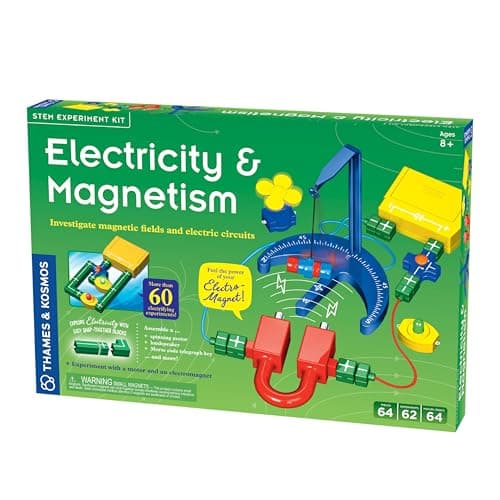
The Thames & Kosmos Electricity & Magnetism kit is the one physics kit on this site that treats electricity and magnetism as a single subject. The maker publishes 62 experiments from 64 pieces with a 64-page large-format manual, rated 8+, on 2 AA batteries — and the sequence ends by building three working devices: “a loudspeaker, an electromagnetic relay switch, and a morse code telegraph key”. It is the only product in this catalog with published NGSS correlations.
Block & Beaker earns a commission when you buy through our links, at no cost to you. It never changes a ranking, and we say so plainly when the right answer is the cheaper set, or nothing at all. Full disclosure · How we pick.
At a glance
The picks, ranked
Tap any row to jump to the full reasoning. Prices come live from Amazon where we have them and read “check price” where we don’t — never a number we cannot stand behind today.
| # | Product | Best for | Price |
|---|---|---|---|
| 1 | The product Thames & Kosmos Electricity & Magnetism 62 experiments ending in a loudspeaker, a relay switch and a morse telegraph key. | Eight and up, as the single physics purchase if there is only going to be one | |
| 2 | 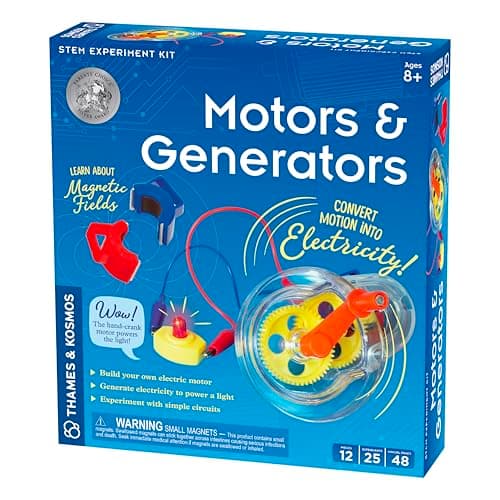 The cheaper sibling with the wider grade span Thames & Kosmos Motors & Generators 25 experiments from 12 pieces, around a transparent motor that reverses into a generator. | Eight and up, or a younger child working with an adult | |
| 3 | 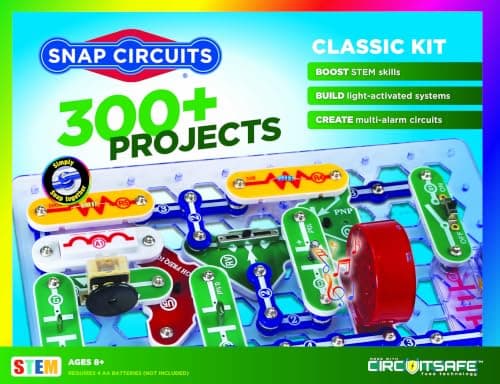 The other route — building rather than explaining Snap Circuits Classic 60+ parts and a manual covering projects 1 to 305. | Eight and up, for a child who wants to make things rather than understand one thing | |
| 4 | 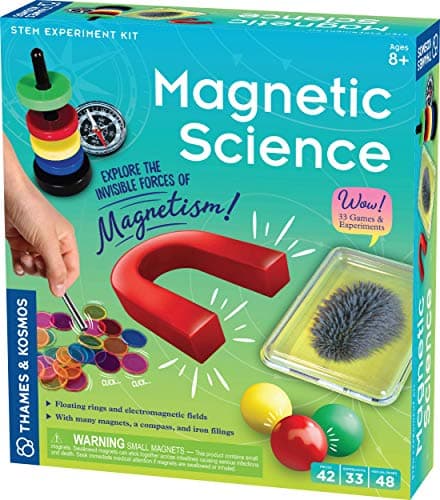 Half the subject, and no batteries at all Thames & Kosmos Magnetic Science 33 activities from 42 pieces, with the iron filings sealed in a transparent box. | Eight and up, where nothing in the box may need power | |
| — | 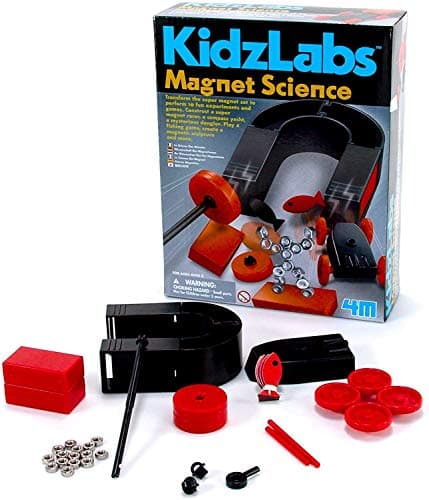 The mis-buy if you wanted the electricity too 4M Magnet Science 10 experiments and games built around a horseshoe magnet and a wand. | Eight and up, as a small gift or a test of whether the interest is real |
5 picks, including 1 we tell you to skip. Ages shown are the manufacturer’s own rating, not ours.
What we can tell you, and what we cannot
We have not built it. No lab, no samples, no test children, and no star rating on this page or in its structured data. Everything below is Thames & Kosmos’s own published information plus arithmetic.
Three things to be precise about. The maker publishes 62 experiments but not a list of what each one is, so beyond the named topics and the three final builds we cannot tell you what experiment 30 is — though unusually for this category, a full manual PDF is published for download, so you can read it before buying. The product was released in 2012 and nothing about that matters except that the physics has not changed; this is the same kit it has always been. And on 2026-10-25 the maker’s site returned HTTP 429 to three spaced requests for the Magnetic Science page, so we did not capture whether that kit publishes NGSS correlations, and this page claims nothing about it either way.
The specification that decides it
The arithmetic
Thames & Kosmos Electricity & Magnetism (620417), published
| Experiments | 62 |
|---|---|
| Piece count | 64 |
| Manual | 64 pages, full color, 11.5 x 8.25 in — large format |
| Final builds | 3 — “a loudspeaker, an electromagnetic relay switch, and a morse code telegraph key” |
| Circuits covered | Series and parallel, push buttons, on-off switches, motor plus 2 switches and up to 3 bulbs |
| Magnetism covered | Magnetic materials, poles, magnetizing metal, iron filings, a magnetic pendulum, a compass |
| Assembly | “simple plug-and-socket connectors” — brightly colored, uniquely shaped, diagram-led |
| Batteries | 2 x AA, required, not included |
| Product dimensions | 16.8 x 11.5 x 2.1 in; 2.4 lb |
| Stated age | Ages 8+; the listing adds “Skill Level: Intermediate” |
| Award | Parents' Choice Gold Award Winner |
| NGSS correlations | 3-PS2-3, 3-PS2-4, MS-PS2-5, MS-PS4-3 |
| Downloads | Full manual (PDF) and hi-res images (ZIP), both published |
| Year released | 2012 |
Why MS-PS4-3 is the most informative line on the page
Thames & Kosmos publishes four NGSS correlations for this kit, and three of them are the ones you would expect from anything with magnets in it: 3-PS2-3 and 3-PS2-4 Forces and Interactions, and MS-PS2-5 Motion and Stability. The fourth is different. MS-PS4-3 is “Waves and Their Applications in Technologies for Information Transfer” — a communications standard, not a forces one.
Read it against the ending and the kit’s design intent becomes legible. A loudspeaker turns a current into sound. A relay switch lets one circuit control another. A morse telegraph key sends a message down a wire. Those are the three technologies that made long-distance communication possible, and the maker aligned the kit to the standard that covers them because that is genuinely where the 62 experiments are heading.
That matters for a buyer in a practical way. It tells you this is not a kit of disconnected party tricks with a plastic motor at the end — the sequence has a destination, and a child who finishes it has built the guts of a telephone, a computer switch and a telegraph. It is also the single most useful thing to know when deciding between this and a 305-project circuit set, because Snap Circuits publishes no standards list and no end point at all.
This is the only product in this catalog with published NGSS correlations at all, which is worth saying plainly: most toy makers do not publish standards alignment, and a maker that does is making a claim it can be held to.
The grade gap, and when the cheaper kit is the better buy
Now the awkward part of the same list, because it runs both ways. The published correlations are third grade and then middle school. There is nothing at fourth or fifth grade, which is precisely where a lot of households start looking at physics kits.
The sibling kit fills exactly that gap. Thames & Kosmos publishes eight correlations for Motors & Generators: 3-PS2-3 and 3-PS2-4, then 4-PS3-2 and 4-PS3-4 Energy, then K-2-ETS1-1 and K-2-ETS1-2 Engineering Design, then MS-PS2-3 and MS-PS2-5. Kindergarten through middle school, including the fourth-grade energy standards this kit does not claim.
So the honest recommendation splits. If you are buying for a curious eight-to-twelve-year old and want one kit that goes somewhere, the Electricity & Magnetism set is the better object and this page recommends it. If you are a homeschooler working to a fourth-grade energy unit, the published list says Motors & Generators is the kit aligned to it — at a fraction of the price. See STEM toys for homeschool.
Who should skip it
A child who wants to build rather than understand. Sixty-two experiments with a page of explanation each is a reading-adjacent activity. Snap Circuits Classic publishes 305 projects and gets a child assembling in minutes.
Anyone under eight. The published floor is 8+ and the listing adds “Skill Level: Intermediate”, which is the maker telling you this is not the entry point. See buying above the age rating.
Anyone whose child is interested in magnets specifically. Half this kit would go unused. Magnetic Science publishes 33 activities with no batteries, and 4M publishes 10 in the lowest price band.
A household with no clear table. At 16.8 x 11.5 inches with 64 loose components and a large-format manual to keep open, this is not a lap kit or a car kit. See what else a science kit needs.
Worth knowing before you buy
Where it sits
This kit is the lead pick on physics kits for kids, where it sits against the rest of the shelf including both sibling kits and the mechanics option. The same maker’s chemistry line is reviewed at Chem C500 and CHEM C1000. For the building route instead of the explaining route, see Snap Circuits: every set compared; for where this leads at thirteen, Arduino kits for kids and science kits for teens.
In full
Every pick, and what is wrong with it
Published specifications only, each linked back to the page it came from. Where a manufacturer publishes nothing, the row says so — we do not fill blanks in.
1. The product
Thames & Kosmos Electricity & Magnetism
Thames & Kosmos · 620417 · maker rates it 8+
62 experiments ending in a loudspeaker, a relay switch and a morse telegraph key.
- Experiments
- 62
- Piece count
- 64
- Manual
- 64 pages, full color
- Circuits covered
- “Build series and parallel circuits to light up a light bulb”; push buttons and on-off switches; “circuits that include a spinning motor, two switches, and up to three light bulbs”
Thames & Kosmos publishes 62 experiments from a 64-piece kit with a 64-page full-color manual at 11.5 x 8.25 inches, rated ages 8+, on 2 AA batteries, at 16.8 x 11.5 x 2.1 inches and 2.4 lb. Released 2012, SKU 620417, and a Parents’ Choice Gold Award winner. The published sequence runs from series and parallel circuits lighting a bulb, through push buttons and on-off switches, to “circuits that include a spinning motor, two switches, and up to three light bulbs”, then through magnetic-material tests, poles, magnetizing a metal, iron filings, a magnetic pendulum and a compass.
Then it ends somewhere almost no kit in this category ends. After “a series of experiments with a sturdy electromagnet”, the maker says the child puts everything together “to good use by constructing a loudspeaker, an electromagnetic relay switch, and a morse code telegraph key”. Three working devices, not three demonstrations — and that is the single best reason to buy this kit rather than a cheaper magnetism set.
The connector detail is worth knowing before clicking, because the word “blocks” invites the wrong comparison. Thames & Kosmos publishes that “the electrical blocks fit together with simple plug-and-socket connectors” and that they are brightly colored with unique shapes so assembly diagrams are easy to follow. That is not the same system as Snap Circuits, which snaps onto a grid. Neither needs soldering; they are different objects.
The large-format manual is the quiet advantage. At 11.5 x 8.25 inches it is roughly double the page area of the 5.5 x 8.25 inch manuals in the sibling kits, which on a product whose whole value is explanation means bigger diagrams and more room per experiment. Sixty-four pages across 62 experiments is about a page each.
Honest drawbacks, three of them. It is the largest and most expensive box in the Thames & Kosmos physics line and wants a clear table rather than a lap. The two AA cells are published as required and not included. And the published NGSS list jumps from third grade straight to middle school, which is covered below.
Replay signal
- Open-ended or one-shot
- 62 experiments, then a box of snap-together circuit blocks that still make circuits
- Does anything run out
- Nothing runs out except the two AA cells
- Room to grow
- The published arc runs from one bulb to a working loudspeaker and relay, which is a genuine ladder rather than 62 variations
Why we say so: Thames & Kosmos publishes 62 experiments from 64 pieces with a 64-page manual, and publishes the end point: a loudspeaker and an electromagnetic relay built from the same blocks that started with a single bulb. It is the only kit in this catalog that covers electricity and magnetism as one subject rather than two, which is the point the maker's own title makes.
What’s wrong with it
The biggest box and highest price band in the line, 2 AA cells not included, and a published NGSS gap at grades 4-5.
| Experiments | 62 |
|---|---|
| Piece count | 64 |
| Manual | 64 pages, full color |
| Circuits covered | “Build series and parallel circuits to light up a light bulb”; push buttons and on-off switches; “circuits that include a spinning motor, two switches, and up to three light bulbs” |
| Magnetism covered | Which materials are magnetic, magnetic poles, magnetizing a metal, iron filings to “make invisible magnetic fields visible”, a magnetic pendulum, a compass and Earth's magnetic field |
| Final builds | Three, after “a series of experiments with a sturdy electromagnet”: “a loudspeaker, an electromagnetic relay switch, and a morse code telegraph key” |
| Assembly | “The electrical blocks fit together with simple plug-and-socket connectors” — brightly colored, uniquely shaped, assembled from diagrams. No soldering |
| Manual format | 11.5 x 8.25 in — large format, against 5.5 x 8.25 in for the sibling kits |
| NGSS correlations | Published by the maker: 3-PS2-3 and 3-PS2-4 Forces and Interactions, MS-PS2-5 Motion and Stability, MS-PS4-3 Waves and Their Applications in Technologies for Information Transfer |
| Award published | Parents' Choice Gold Award Winner |
| Batteries | 2 x AA, published as required |
| Product dimensions | 16.8 x 11.5 x 2.1 in; 2.4 lb |
| Stated age | Ages 8+; the listing adds “Skill Level: Intermediate” |
| Year released | 2012 |
| Consumables | None beyond batteries |
Every figure above is from Thames & Kosmos, Electricity & Magnetism (620417). Blanks are shown as “not published” rather than filled in.
2. The cheaper sibling with the wider grade span
Thames & Kosmos Motors & Generators
Thames & Kosmos · 665036 · maker rates it 8+
25 experiments from 12 pieces, around a transparent motor that reverses into a generator.
- Experiments
- 25
- Piece count
- 12 — the lowest in this catalog
- Manual
- 48 pages, published by the maker; the Amazon listing says 48 in its title and “60-page” in a bullet, so we use the maker's figure
- The motor
- “made of transparent plastic to show how the inside components work”; runs on battery power, then “reconfigure the device to work in reverse as a hand-crank electric generator”
Thames & Kosmos publishes 25 experiments from 12 pieces with a 48-page manual, rated 8+, on 2 AA batteries. The motor is published as transparent “to show how the inside components work”, and the kit has the child reconfigure it “to work in reverse as a hand-crank electric generator”. Awards published: 2013 Parents’ Choice Silver and 2013 Creative Child Top Toy of the Year.
Its published NGSS list is genuinely broader: 3-PS2-3 and 3-PS2-4, 4-PS3-2 and 4-PS3-4 Energy, K-2-ETS1-1 and K-2-ETS1-2 Engineering Design, and MS-PS2-3 and MS-PS2-5. Eight correlations spanning kindergarten to middle school, against four on the kit above. For a homeschool buyer working to standards that is the more flexible purchase, and it costs a fraction as much.
What it does not do is finish anything. There is no loudspeaker and no telegraph key at the end — it explains one machine extremely well and stops. See physics kits for kids, where both sit side by side.
Replay signal
- Open-ended or one-shot
- One device, 25 published configurations of it. Not open-ended, and not meant to be
- Does anything run out
- Nothing runs out except the two AA cells
- Room to grow
- The hand-crank reconfiguration is the growth: the same 12 pieces run forwards as a motor and backwards as a generator
Why we say so: Thames & Kosmos publishes 25 experiments from 12 pieces — the highest experiment-to-piece ratio in this catalog by a wide margin — around a single transparent motor that also works in reverse. Twelve pieces sounds like nothing until you notice the kit is not trying to build 25 things; it is trying to explain one thing 25 ways.
What’s wrong with it
One device and twelve pieces. Nothing to construct, and a builder will be bored within an hour.
| Experiments | 25 |
|---|---|
| Piece count | 12 — the lowest in this catalog |
| Manual | 48 pages, published by the maker; the Amazon listing says 48 in its title and “60-page” in a bullet, so we use the maker's figure |
| The motor | “made of transparent plastic to show how the inside components work”; runs on battery power, then “reconfigure the device to work in reverse as a hand-crank electric generator” |
| Covered | How a motor converts electricity into motion and a generator converts motion into electricity; the force of magnetism; “how magnetic fields relate to electric current” |
| Circuits | “simple circuits consisting of the motor or generator, wires, and a light bulb” |
| NGSS correlations | Published by the maker: 3-PS2-3 and 3-PS2-4 Forces and Interactions, 4-PS3-2 and 4-PS3-4 Energy, K-2-ETS1-1 and K-2-ETS1-2 Engineering Design, MS-PS2-3 and MS-PS2-5 Motion and Stability — a wider grade span than the Electricity & Magnetism kit |
| Awards published | 2013 Parents' Choice Silver Award; 2013 Creative Child Top Toy of the Year |
| Batteries | 2 x AA, published as required |
| Product dimensions | 10 x 11 x 2.5 in; 1 lb |
| Stated age | Ages 8+; the listing adds “Grades 3-6” |
| Year released | 2012 |
| Consumables | None beyond batteries |
Every figure above is from Thames & Kosmos, Motors & Generators (665036). Blanks are shown as “not published” rather than filled in.
3. The other route — building rather than explaining
Snap Circuits Classic
Elenco · SC-300 · maker rates it 8+
60+ parts and a manual covering projects 1 to 305.
- Projects
- “Build over 300 exciting projects” — manual covers projects 1-305
- Parts
- “Contains over 60 Snap-Together parts”
- Projects per part
- 5.1 — the highest ratio in the line
- Stated age
- “Ages 8+” and “Not for Children under 3 yrs.”
Elenco publishes “over 300 exciting projects” from “over 60 Snap-Together parts” with a manual covering projects 1-305, on 4 AA batteries, rated ages 8+ and “not for children under 3 yrs”.
This is the real alternative and the choice is not about quality. Snap Circuits optimizes for building: 305 numbered projects, parts that snap to a grid, and a child who will be assembling something within four minutes of opening the box. The Thames & Kosmos kit optimizes for explanation: 62 experiments that accumulate into three devices and a manual with room to say why.
Buy Snap Circuits for a child who asks “what can I make”, and this kit for one who asks “how does that work”. See the Snap Circuits Classic review and circuit kits for kids.
Replay signal
- Open-ended or one-shot
- The sweet spot of the line — enough parts to invent with, cheap enough not to be an event
- Does anything run out
- Nothing runs out
- Room to grow
- 305 published projects is years of Sunday afternoons at one a week
Why we say so: Elenco publishes 305 numbered projects against 60+ parts. Five projects per part is the highest ratio anywhere in the Snap Circuits line, which is the arithmetic reason this is the set to buy rather than the cheap one or the big one.
What’s wrong with it
Breadth without a thesis. 305 projects and no published end point, no standards list and no final device.
| Projects | “Build over 300 exciting projects” — manual covers projects 1-305 |
|---|---|
| Parts | “Contains over 60 Snap-Together parts” |
| Projects per part | 5.1 — the highest ratio in the line |
| Stated age | “Ages 8+” and “Not for Children under 3 yrs.” |
| Batteries | “Requires 4 ‘AA’ batteries (not included)” |
| Relationship to SC-100 | Manual includes all SC-100 projects plus 200 new ones |
Every figure above is from Elenco, Snap Circuits Classic. Blanks are shown as “not published” rather than filled in.
4. Half the subject, and no batteries at all
Thames & Kosmos Magnetic Science
Thames & Kosmos · 665050 · maker rates it 8+
33 activities from 42 pieces, with the iron filings sealed in a transparent box.
- Activities
- 33 — the maker's word is “experiments and games”
- Piece count
- 42
- Manual
- 48 pages, published by the maker; the Amazon listing says “60-page”, so we use the maker's figure
- Covered
- Which materials are magnetic, magnetic poles and fields, “how Earth behaves like one giant magnet”, compasses and finding north
Thames & Kosmos publishes 33 activities from 42 pieces with a 48-page manual, batteries published as “N/A”, rated 8+. The published coverage is magnetic materials, poles and fields, “how Earth behaves like one giant magnet”, compasses, and building an electromagnet.
It is the same maker’s cheaper answer to half this subject, and the sealed iron filings are a real advantage over loose ones. If the budget is the constraint and the child is drawn to magnets specifically, it is a defensible purchase.
It is not, though, a smaller version of the kit above. There is no loudspeaker, no relay and no telegraph key, because those need the electricity half. We were not able to capture its NGSS status — see the note below.
Replay signal
- Open-ended or one-shot
- 33 activities and then the magnets are still magnets — a permanent toolkit
- Does anything run out
- Nothing runs out, and no batteries are required at all
- Room to grow
- Limited by subject: this is magnetism only, with one electromagnet as the bridge
Why we say so: Thames & Kosmos publishes 33 activities from 42 pieces with no batteries required, and publishes the iron filings as sealed in a transparent box. That last detail is the one worth paying for — loose iron filings are the component every magnetism kit loses in the first week, and sealing them is the difference between a demonstration that works in March and one that does not.
What’s wrong with it
Magnetism only. One electromagnet is the entire electricity content.
| Activities | 33 — the maker's word is “experiments and games” |
|---|---|
| Piece count | 42 |
| Manual | 48 pages, published by the maker; the Amazon listing says “60-page”, so we use the maker's figure |
| Covered | Which materials are magnetic, magnetic poles and fields, “how Earth behaves like one giant magnet”, compasses and finding north |
| Iron filings | Supplied “in an enclosed transparent box” rather than loose |
| Electromagnet | Published as included — “Build an electromagnet to learn how electricity relates to magnetism” |
| Batteries | Published as “N/A” — none required |
| Product dimensions | 10 x 11 x 2.5 in; 1.4 lbs |
| Stated age | Ages 8+ |
| Year released | 2016 |
| Consumables | None |
Every figure above is from Thames & Kosmos, Magnetic Science (665050). Blanks are shown as “not published” rather than filled in.
Skip this one
4M Magnet Science
4M · 00-03291 · maker rates it 8+
10 experiments and games built around a horseshoe magnet and a wand.
- Experiments
- 10 — published as “10 fun experiments and games”
- Pieces
- Over 25, per the listing; 4M publishes no piece count
- Named builds
- “a super magnet racer, a compass yacht, a mysterious dangler”, a fishing game and “a magnetic sculpture”
- Range
- KidzLabs, item 00-03291
4M publishes 10 experiments and games in its KidzLabs Magnet Science set, item 00-03291, naming a super magnet racer, a compass yacht, a mysterious dangler, a fishing game and a magnetic sculpture. Rated ages 8 and up, no batteries required.
It is the skip here for one reason and it is a pricing illusion rather than a quality problem. This is the cheapest thing on the shelf that says magnets on the front, and a parent who came looking for a physics kit can easily come home with it. Ten experiments against 62, no electricity at all, and no final device.
Where it is genuinely right: as a stocking-sized gift, or when you do not yet know whether the interest is real and do not want to spend the price of the kit above finding out. Bought in that spirit it is a good purchase. See small STEM gifts that travel.
Replay signal
- Open-ended or one-shot
- Ten experiments, then a super magnet and a wand that keep working
- Does anything run out
- Nothing runs out
- Room to grow
- None published — this is an introduction, not a system
Why we say so: 4M publishes 10 experiments and games built around a horseshoe magnet and a wand, and names the five that matter: racer, compass yacht, dangler, fishing game, sculpture. Ten is a small number and the price band is the lowest on this page, which makes it the right first magnet kit and the wrong only one.
What’s wrong with it
Ten experiments, magnetism only, no manual page count and no standards published.
| Experiments | 10 — published as “10 fun experiments and games” |
|---|---|
| Pieces | Over 25, per the listing; 4M publishes no piece count |
| Named builds | “a super magnet racer, a compass yacht, a mysterious dangler”, a fishing game and “a magnetic sculpture” |
| Range | KidzLabs, item 00-03291 |
| Item size | 17 x 22 x 6 cm, published by 4M |
| Batteries | None published as required |
| Stated age | Ages 8 years and up |
| Awards published | Hong Kong Awards for Industries Consumer Product Design 2015; Good Toy Guide 2013; Parents' Choice Recommended 2011 |
| Consumables | None |
Every figure above is from 4M, Magnet Science (KidzLabs 00-03291). Blanks are shown as “not published” rather than filled in.
We are not putting a buy button on this one. It is easy enough to find if you want it anyway — but we would rather send you to something that gets played with twice.
Questions people actually ask
Frequently asked
Is the Thames & Kosmos Electricity & Magnetism kit worth it?
Yes, as the single physics purchase if there is only going to be one. The maker publishes 62 experiments from 64 pieces with a 64-page large-format manual at 8+, and the sequence ends by building three working devices - a loudspeaker, an electromagnetic relay switch and a morse code telegraph key. Most kits in this category end when the experiments run out.
What do you actually build with it?
Thames & Kosmos names three final builds: "a loudspeaker, an electromagnetic relay switch, and a morse code telegraph key", constructed after a series of experiments with a sturdy electromagnet. Before that the published sequence covers series and parallel circuits, switches, a spinning motor with up to three bulbs, magnetic poles, iron filings, a magnetic pendulum and a compass.
What age is it for?
Ages 8+, published by Thames & Kosmos, and the listing adds "Skill Level: Intermediate" - which is the maker saying this is not the entry point in its own line. The published NGSS correlations run from third grade to middle school. Buying above the age rating.
Does it meet NGSS standards?
Thames & Kosmos publishes four correlations: 3-PS2-3 and 3-PS2-4 Forces and Interactions, MS-PS2-5 Motion and Stability, and MS-PS4-3 Waves and Their Applications in Technologies for Information Transfer. That last one is a communications standard, and it is there because the kit ends with a loudspeaker, a relay and a telegraph key. It is the only product in this catalog with published NGSS correlations.
Is this the same thing as Snap Circuits?
No. Thames & Kosmos publishes "simple plug-and-socket connectors" for its blocks; Snap Circuits snaps onto a plastic grid. Neither needs soldering. The deeper difference is intent: Elenco publishes 305 numbered projects optimized for building, and this kit publishes 62 experiments optimized for explaining, ending in three devices. Snap Circuits Classic review.
Should I buy this or Motors & Generators?
Depends whether you are buying to a standard. This kit is the better single object - 62 experiments ending in three devices. But Motors & Generators publishes eight NGSS correlations spanning K-2 Engineering Design through middle school, including the fourth-grade energy standards this kit does not claim, at a fraction of the price. For a homeschool fourth-grade energy unit, the cheaper kit is the aligned one. Physics kits for kids.
Does it need batteries?
Yes - 2 x AA, published as required and not included. The sibling Magnetic Science kit publishes batteries as "N/A", so if nothing in the box may need power, that is the one to look at. Battery guide for STEM toys.
Sources
Where these figures came from
Every specification on this page traces to one of these. If a manufacturer publishes nothing on a point, the page says so rather than filling the gap.
Read next
Where to go from here
Back to Reviews, or read how we pick.