The picks
Screen-Free STEM Gifts
On a toy box, screen-free can mean no screen ever, a screen for setup, or a tablet game with wooden pieces. Only the first one is what you are buying.
By Sawyer V. · Published
The short answer
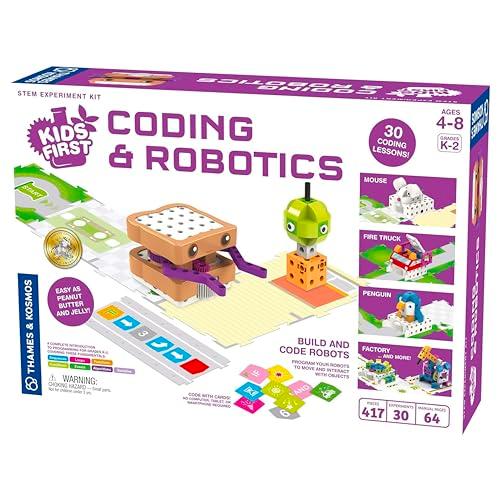
Buy on the published requirement, not the word on the front. Kids First Coding & Robotics is the only product in this catalog whose maker publishes “no software, apps, or smart devices required” alongside a 64-page manual and six storylines — coding, with nothing to plug in. For a smaller budget, ThinkFun Gravity Maze publishes 60 challenges and no batteries at all.
Block & Beaker earns a commission when you buy through our links, at no cost to you. It never changes a ranking, and we say so plainly when the right answer is the cheaper set, or nothing at all. Full disclosure · How we pick.
At a glance
The picks, ranked
Tap any row to jump to the full reasoning. Prices come live from Amazon where we have them and read “check price” where we don’t — never a number we cannot stand behind today.
| # | Product | Best for | Price |
|---|---|---|---|
| 1 | Best overall — coding with nothing to plug in Thames & Kosmos Kids First Coding & Robotics Unplugged coding: six storylines, a 64-page manual, and seven named computing concepts up to variables. | Grades K-2, in a household that has decided against another app | |
| 2 | Best value — 60 challenges and no batteries ThinkFun Gravity Maze A marble logic game with 60 graded challenges, nine towers and a target piece. | Eight and up, solo, at a table or on a plane | Sold direct by ThinkFun → Not stocked on Amazon. This link goes to the maker and we earn nothing on it. |
| 3 | 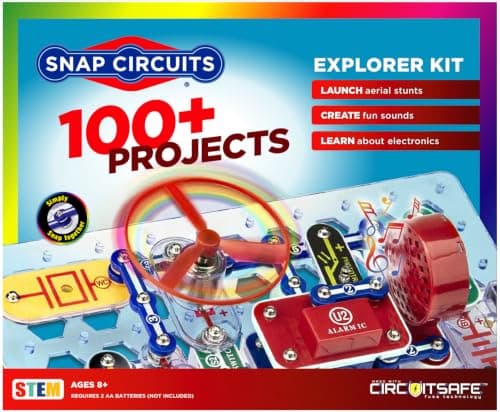 Best real electronics with no screen anywhere Snap Circuits Jr. Over 100 projects from 30 snap-together parts, including an FM radio and a burglar alarm. | Eight and up, for a child who wants to build something that makes a noise | |
| 4 | 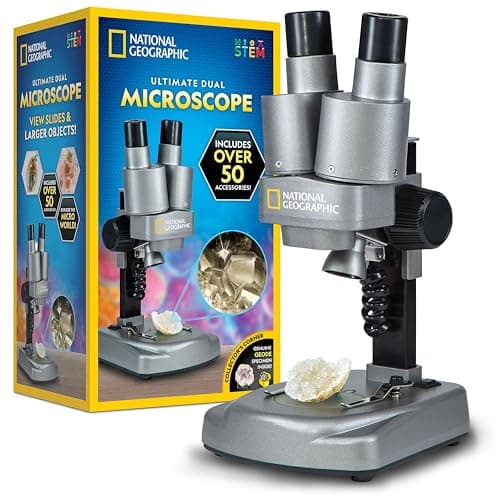 Best real instrument NATIONAL GEOGRAPHIC Dual LED Student Microscope 20x and 50x optical glass, upper and lower LED lighting, and 50+ accessories. | Eight and up, where the screen-free alternative should be a lens | |
| 5 | 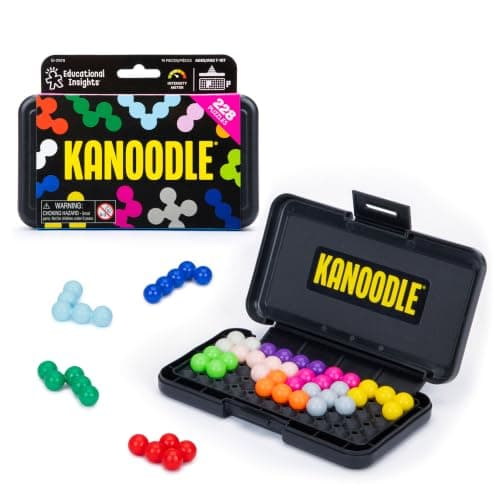 Most puzzles in a pocket Kanoodle 200+ puzzles across flat 2D and 3D pyramid formats, in a case that is also the board. | Seven and up, for a child who needs something in a bag | |
| 6 | 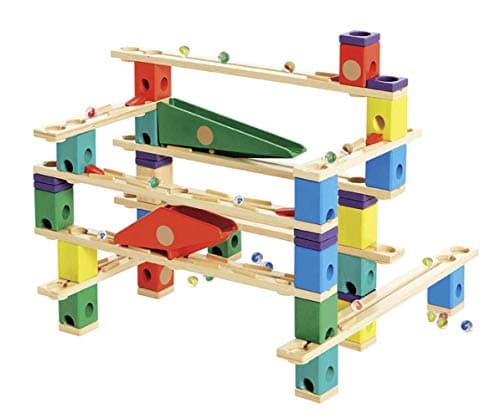 Best for a long floor afternoon Quadrilla Wooden Marble Run: Vertigo 134 pieces of birch and rubber wood - 84 track and block pieces, 50 marbles. | Four and up, where the screen-free gift should take up the whole rug | |
| — | 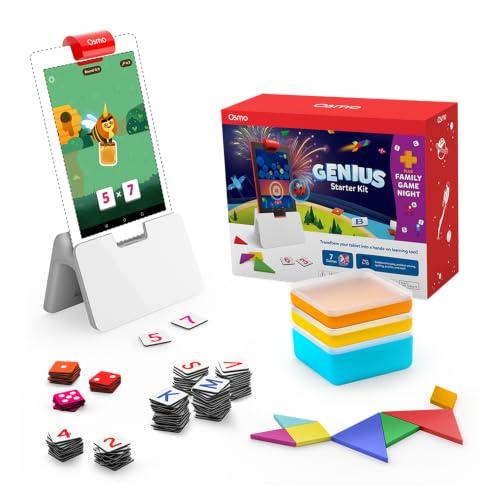 Not screen-free, whatever the pieces suggest Osmo Genius Starter Kit for iPad Five games with physical tiles - Tangram, Numbers, Words, Newton and Masterpiece. | Six to ten, in a household that wants a better tablet hour |
7 picks, including 1 we tell you to skip. Ages shown are the manufacturer’s own rating, not ours.
The three published states
The arithmetic
What each box actually requires
| T&K Kids First Coding & Robotics | “no software, apps, or smart devices required!” 64-page manual, 6 storylines. Grades K-2 |
|---|---|
| ThinkFun Gravity Maze | No batteries at all. 60 challenges, 1 player. Ages 8+ |
| Snap Circuits Jr. | Batteries required. 100+ projects, 30 parts, no tools. Ages 8+ |
| NatGeo Dual LED Microscope | LED lighting, no screen. 20x and 50x glass, 50+ accessories. Ages 8+ |
| Kanoodle | No batteries. 200+ puzzles, 2D and 3D. Ages 7+ |
| Quadrilla Vertigo | No power of any kind. 134 pieces, 50 marbles, wood. Ages 4+ |
| Osmo Genius Starter Kit | An iPad is REQUIRED and not included. 5 games. Ages 6-10 |
Why the label on the box is not the answer
“Screen-free” is a marketing word and “required” is not. The sentence worth finding on any box is the requirements line. Osmo publishes “iPad not included”; Thames & Kosmos publishes “no software, apps, or smart devices required”. Those two statements are checkable and the front of the box is not.
Watch for the setup-only screen. A middle category exists: toys that work on their own but need an app once, to pair or update. They are a reasonable compromise and they are not the same as a product with no app at all — which is the distinction our rechargeable versus battery coding toys page runs into repeatedly.
And no power at all is a category of its own. Gravity Maze, Kanoodle and the Quadrilla run have no batteries between them. Nothing to charge means nothing to be flat on the day it is wanted — the quiet reason these are the sets that stay in use. Our battery guide covers how often that ends a toy.
Screen-free by age
Three to five: the wooden marble run, and tiles. Published at 4+ and 3+ respectively, both are entirely physical. See STEM toys for 4-year-olds.
Six to eight: this is the band the Kids First coding set is built for, and where Kanoodle’s 7+ rating lands. Logic games and unplugged coding both work here.
Nine and up: real instruments and real electronics — the microscope and the circuit kit. The honest note is that a teenager’s screen-free options narrow, and the ones that hold are the ones that produce something: see science kits for teens.
Say the unwelcome thing
Do not buy a tablet toy to solve a tablet problem
Physical pieces in front of a camera, blocks that drive a character, a board that needs an app to score: all of these are good products and none of them reduces screen time, because the screen is where the game happens. The test is published on every box in this category — if a tablet or phone appears in the requirements, the toy is a controller for a screen. Buy one when you want a better screen hour and be honest with yourself that it is a screen hour.
So which one
One gift, and it should teach coding anyway: Kids First Coding & Robotics — the only “no apps required” coding box here.
Best value: ThinkFun Gravity Maze, 60 challenges, no batteries.
Real electronics, no screen: Snap Circuits Jr., including a working FM radio.
A real instrument: the National Geographic Dual LED microscope.
Something for a bag: Kanoodle, 200+ puzzles in a case.
A whole-floor afternoon: Quadrilla Vertigo, 134 wooden pieces and 50 marbles.
Where to go next
Screen-free coding toys is the coding shelf sorted on the same question, STEM toys and screen time is the argument rather than the list, and gifts for kids who love video games is the page for the opposite household.
In full
Every pick, and what is wrong with it
Published specifications only, each linked back to the page it came from. Where a manufacturer publishes nothing, the row says so — we do not fill blanks in.
1. Best overall — coding with nothing to plug in
Thames & Kosmos Kids First Coding & Robotics
Thames & Kosmos · 567012 · maker rates it Grades K-2 — no numeric age published
Unplugged coding: six storylines, a 64-page manual, and seven named computing concepts up to variables.
- Screens required
- “Unplugged: no software, apps, or smart devices required!”
- Manual
- “the 64-page, full-color experiment manual”
- Content
- “six different storylines are included, each with a series of model-building and coding lessons”
- Concepts
- “Sequences, Loops, Functions, Conditions, Events, Algorithms, Variables” — published by name
Thames & Kosmos publishes “Unplugged: no software, apps, or smart devices required!”, a 64-page full-color experiment manual, six storylines each with model-building and coding lessons, and names the concepts covered: sequences, loops, functions, conditions, events, algorithms and variables. Published for grades K-2 with no numeric age, and a Parents’ Choice Gold Award.
That published list is why this leads. Variables and conditions are usually where a screen appears, because the usual way to teach them is a drag-and-drop editor on a tablet; this is the one box in this catalog that claims them with no device in the room. Our screen-free coding toys page covers the robots that take the same approach with a physical control pad.
Two honest limits. A 64-page manual at grades K-2 means a reading adult for the first few sessions, and the box is the priciest thing on this page. In exchange, six storylines is six separate builds rather than one.
Replay signal
- Open-ended or one-shot
- Six published storylines with model-building in each, so the same parts build a different problem six times
- Does anything run out
- Nothing runs out
- Room to grow
- Seven named computing concepts, from sequences to variables, inside one box
- Adult required
- A reader is needed for a K-2 child working through a 64-page manual
Why we say so: Thames & Kosmos publishes “no software, apps, or smart devices required” alongside a 64-page manual and six storylines. Everything else on this site that teaches variables needs a screen somewhere; this is the one whose maker states in writing that it does not.
What’s wrong with it
The most expensive pick here, and a K-2 child needs an adult to read the manual.
| Screens required | “Unplugged: no software, apps, or smart devices required!” |
|---|---|
| Manual | “the 64-page, full-color experiment manual” |
| Content | “six different storylines are included, each with a series of model-building and coding lessons” |
| Concepts | “Sequences, Loops, Functions, Conditions, Events, Algorithms, Variables” — published by name |
| Stated age | “Grades K-2”. No numeric age is published |
| Award | “Parents' Choice Gold Award Winner” |
| Product dimensions | 16.8 x 11.5 x 3.2 in; 5.2 lb |
| Consumables | None published beyond the robot's batteries |
Every figure above is from Thames & Kosmos, Kids First Coding & Robotics (567012) — manufacturer's published listing copy; the set is not in the current catalog on thamesandkosmos.com. Blanks are shown as “not published” rather than filled in.
2. Best value — 60 challenges and no batteries
ThinkFun Gravity Maze
ThinkFun · 44001006 · maker rates it 8+
A marble logic game with 60 graded challenges, nine towers and a target piece.
- Challenges
- 60, beginner to expert
- Contents
- Game grid, 9 towers, 1 target piece, 3 marbles, 60 challenge cards
- Players
- 1
- Batteries
- None
ThinkFun publishes 60 challenges from beginner to expert, a game grid, nine towers, one target piece, three marbles and 60 challenge cards, for one player, with no batteries, at ages 8 and up.
“Batteries: none” is the entire reason this is the value pick. There is no charging, no pairing, no account and no app update that breaks it — and a logic game whose difficulty is printed on 60 numbered cards is the most durable kind of screen-free product there is.
See the full review, and logic puzzle games for kids for the rest of the shelf — this is the category where screen-free is the default rather than the exception.
Replay signal
- Open-ended or one-shot
- Finite by design — 60 challenges, and a determined child will finish them
- Does anything run out
- Nothing physically runs out, but the challenge cards do end
- Room to grow
- The towers can be used freely once the cards are done, though nothing in the box prompts that
Why we say so: ThinkFun publishes 60 challenges and a fixed component list. Sixty is a real number with a real end, and single-player puzzle games are the category where that matters most — better to know before you buy it as the main present.
What’s wrong with it
Sixty challenges is finite, and the marbles are small and get lost.
| Challenges | 60, beginner to expert |
|---|---|
| Contents | Game grid, 9 towers, 1 target piece, 3 marbles, 60 challenge cards |
| Players | 1 |
| Batteries | None |
| Stated age | Ages 8+ |
| Consumables | None |
Every figure above is from ThinkFun, Gravity Maze. Blanks are shown as “not published” rather than filled in.
Not stocked on Amazon. This link goes to the maker and we earn nothing on it.
3. Best real electronics with no screen anywhere
Snap Circuits Jr.
Elenco · SC-100 · maker rates it 8+
Over 100 projects from 30 snap-together parts, including an FM radio and a burglar alarm.
- Projects
- Over 100
- Parts
- 30
- Projects per part
- 3.3
- Stated age
- Ages 8+
Elenco publishes over 100 projects from 30 parts — among them an FM radio, an AM radio, a digital voice recorder, a burglar alarm and a doorbell — with parts that “require no tools and ensure correct connections”, at ages 8 and up.
A working FM radio built by a child, with no screen and no app, is about as close to the point of this list as a product gets. The output is a physical object doing a real thing in the room.
Full specifications are in the review, and Snap Circuits compared places it against the bigger sets in the line.
Replay signal
- Open-ended or one-shot
- Semi-open. The manual is a ladder, but 30 parts is enough vocabulary to go off-book
- Does anything run out
- Nothing runs out
- Room to grow
- Every SC-100 project is reprinted in the SC-300 manual, so the step up loses nothing
Why we say so: Elenco publishes over 100 projects from 30 parts, and publishes that the SC-300 manual contains all of the SC-100 projects plus 200 more. That overlap is what makes the upgrade path a genuine upgrade rather than a re-buy.
What’s wrong with it
Batteries are required, and the project book is a ladder rather than an open box.
| Projects | Over 100 |
|---|---|
| Parts | 30 |
| Projects per part | 3.3 |
| Stated age | Ages 8+ |
| Projects include | FM radio, AM radio, digital voice recorder, burglar alarm, doorbell |
| Tools needed | None — snap-together parts “require no tools and ensure correct connections” |
| Consumables | None |
Every figure above is from Elenco, Snap Circuits Jr. 100 Experiments. Blanks are shown as “not published” rather than filled in.
4. Best real instrument
NATIONAL GEOGRAPHIC Dual LED Student Microscope
National Geographic · Dual LED Student Microscope · maker rates it 8+
20x and 50x optical glass, upper and lower LED lighting, and 50+ accessories.
- Magnifications
- 20x and 50x, from two sets of optical glass lenses
- Lighting
- Upper and lower LED
- Accessories
- 50+ pieces, including 10 prepared slides, blank slides and covers, tweezers, eye-dropper and a mini geode
- Weight
- 2.6 lb
Blue Marble publishes 20x and 50x magnifications from two sets of optical glass lenses, upper and lower LED lighting, and over 50 accessories including ten prepared slides, blank slides and covers, tweezers, an eye-dropper and a mini geode. Rated 8+.
An optical microscope is the purest screen-free science object: the image exists in glass and light, and there is nothing to connect it to. A child looking at pond water has an afternoon that no app was involved in.
Two magnifications is the honest limit at this price — see microscopes for kids for what more money buys, and the full review.
Replay signal
- Open-ended or one-shot
- Open-ended, and the low magnification is the reason — 20x is where insects and leaves look extraordinary
- Does anything run out
- The 10 prepared slides run out; blank slides and the garden do not
- Room to grow
- Limited on magnification, generous on subject matter
Why we say so: National Geographic publishes 20x and 50x with upper and lower LED lighting. Low magnification plus top lighting is a deliberate design for looking at whole objects rather than slides, which for a child under about ten is a far better first microscope than a 1000x compound scope they cannot focus.
What’s wrong with it
Two magnifications only, and slide preparation is where the adult time goes.
| Magnifications | 20x and 50x, from two sets of optical glass lenses |
|---|---|
| Lighting | Upper and lower LED |
| Accessories | 50+ pieces, including 10 prepared slides, blank slides and covers, tweezers, eye-dropper and a mini geode |
| Weight | 2.6 lb |
| Stated age | 8+ |
Every figure above is from National Geographic toys, Dual LED Student Microscope. Blanks are shown as “not published” rather than filled in.
5. Most puzzles in a pocket
Kanoodle
Educational Insights · Kanoodle · maker rates it 7+
200+ puzzles across flat 2D and 3D pyramid formats, in a case that is also the board.
- Puzzles
- 200+
- Formats
- Two — flat 2D puzzles and 3D pyramids
- Pieces
- Connected-bead puzzle pieces
- Players
- 1
Educational Insights publishes 200-plus puzzles across two formats — flat 2D puzzles and 3D pyramids — for one player, with no batteries, at ages 7 and up. The board is the case.
Two hundred puzzles is roughly three times what a typical single-player logic game ships with, and it is the cheapest thing on this page. For a household trying to get through a long journey or a wet week without a tablet, it is the single highest-value purchase here.
See the full review and STEM games for one player.
Replay signal
- Open-ended or one-shot
- Finite, but 200+ published puzzles is the largest count on this site
- Does anything run out
- Nothing runs out; the booklet is long enough to feel endless
- Room to grow
- 2D first, then the 3D pyramid set, which is a genuine step in difficulty
Why we say so: Educational Insights publishes 200-plus puzzles across 2D and 3D formats from one small case. Two hundred is roughly three times what a typical single-player logic game ships with, which is why this one survives a long car journey and a wet week.
What’s wrong with it
Single player, and the pieces are small enough to lose one.
| Puzzles | 200+ |
|---|---|
| Formats | Two — flat 2D puzzles and 3D pyramids |
| Pieces | Connected-bead puzzle pieces |
| Players | 1 |
| Batteries | None |
| Stated age | Ages 7 and up |
Every figure above is from Educational Insights, Kanoodle. Blanks are shown as “not published” rather than filled in.
6. Best for a long floor afternoon
Quadrilla Wooden Marble Run: Vertigo
Hape · E6009 · maker rates it 4+
134 pieces of birch and rubber wood - 84 track and block pieces, 50 marbles.
- Total pieces
- 134
- Track and block pieces
- 84
- Marbles
- 50
- Materials
- Birch and rubber wood
Hape publishes 134 pieces for Quadrilla Vertigo — 84 track and block pieces and 50 marbles — in birch and rubber wood, including straightaway rails, three spiral funnels and a seesaw, at ages 4 and above.
It earns a place on a screen-free list for the thing a screen cannot do: it is loud, physical and visible from across the room, so other people in the house join in. Fifty marbles is enough for two children to run races.
See the full review, wooden marble runs, and marble runs for older kids if the child is past eight.
Replay signal
- Open-ended or one-shot
- Open-ended, and the wooden blocks work as plain blocks when nobody wants a marble run
- Does anything run out
- Nothing runs out
- Room to grow
- Quadrilla sets combine, and the blocks are the standard the whole system is built on
Why we say so: Hape publishes the 84 track pieces plus 50 marbles, the wood species and the named action pieces. Wood matters here for a specific reason rather than a sentimental one: the blocks are heavy enough that a tall run does not need a base plate to stay standing.
What’s wrong with it
Wooden marble runs are heavy, loud and need a flat floor.
| Total pieces | 134 |
|---|---|
| Track and block pieces | 84 |
| Marbles | 50 |
| Materials | Birch and rubber wood |
| Includes | Straightaway rails, three spiral funnels, a seesaw |
| Stated age | 4 and above |
Every figure above is from Hape, Quadrilla Vertigo. Blanks are shown as “not published” rather than filled in.
Skip this one
Osmo Genius Starter Kit for iPad
Osmo · Genius Starter Kit · maker rates it 6-10
Five games with physical tiles - Tangram, Numbers, Words, Newton and Masterpiece.
- Games
- Five — Tangram, Numbers, Words, Newton and Masterpiece
- Contents
- Osmo Base and reflector, 52 Words tiles, 40 Numbers tiles, 7 Tangram pieces, stackable storage
- Screen required
- Yes — an iPad, not included
- Stated age
- Ages 6-10
Osmo publishes five games — Tangram, Numbers, Words, Newton and Masterpiece — with an Osmo Base and reflector, 52 Words tiles, 40 Numbers tiles and seven Tangram pieces, at ages 6-10, and publishes that a screen is required: an iPad, not included.
It is the skip on this page for a simple reason. The wooden and plastic tiles make it look like the answer to a screen problem, and the published requirement says the opposite — without a tablet in front of the base, nothing in the box does anything.
That is not a criticism of the product. It appears as a pick on our logic-puzzle page and on coding gifts, where the buyer has already accepted a tablet. It simply cannot be the gift when the point of the gift is no screen.
Replay signal
- Open-ended or one-shot
- Five separate games rather than one, so it degrades gracefully — when one is exhausted, four remain
- Does anything run out
- Nothing physical runs out
- Room to grow
- Numbers and Tangram both scale well past the stated top age; Words does not
- Adult required
- Only to release the iPad, which in most households is the actual constraint
Why we say so: Osmo publishes the five named games and the exact tile counts. Five games in one box is the honest reason this is better value than a single-game Osmo kit, and the iPad requirement is a published dependency rather than an inference.
What’s wrong with it
Osmo publishes an iPad as required and it is not included. The screen is the product.
| Games | Five — Tangram, Numbers, Words, Newton and Masterpiece |
|---|---|
| Contents | Osmo Base and reflector, 52 Words tiles, 40 Numbers tiles, 7 Tangram pieces, stackable storage |
| Screen required | Yes — an iPad, not included |
| Stated age | Ages 6-10 |
| Batteries | None in the physical pieces |
Every figure above is from Osmo, Genius Starter Kit. Blanks are shown as “not published” rather than filled in.
We are not putting a buy button on this one. It is easy enough to find if you want it anyway — but we would rather send you to something that gets played with twice.
Questions people actually ask
Frequently asked
What is the best screen-free STEM gift?
Thames & Kosmos Kids First Coding & Robotics, if coding is wanted: it is the only product in this catalog whose maker publishes "no software, apps, or smart devices required", alongside a 64-page manual, six storylines and seven named computing concepts up to variables, for grades K-2. On a smaller budget, ThinkFun Gravity Maze publishes 60 challenges and no batteries.
Can you teach coding without a screen?
Yes, and two products here publish how. Kids First Coding & Robotics is unplugged by design - the program is built physically rather than typed - and the screen-free robots on our coding page use a physical control pad instead of a tablet. What you lose is the text editor, which is where a screen becomes unavoidable later on. Screen-free coding toys.
Is Osmo screen-free?
No. Osmo publishes an iPad as a requirement and does not include one: the physical tiles sit in front of the tablet camera and the game runs on the screen. It is a good tablet product - it appears as a pick on our coding and logic pages - but it cannot be the gift when the point of the gift is no screen.
Which STEM toys need no batteries at all?
On this page, three. ThinkFun publishes no batteries for Gravity Maze, Educational Insights publishes none for Kanoodle, and Hape's Quadrilla Vertigo is 134 pieces of birch and rubber wood with no power of any kind. Snap Circuits Jr. and the microscope both need batteries; nothing here needs an app. Battery guide for STEM toys.
What screen-free gift works for a 4-year-old?
Quadrilla Vertigo is published at ages 4 and above - 84 track and block pieces plus 50 marbles, in wood, with nothing electronic in the box. Most of the rest of this list publishes 7 or 8 and up, so for a preschooler the marble run and magnetic tiles are the two real options. STEM toys for 4-year-olds.
Do screen-free toys hold a child's attention as long?
The published counts are the honest answer: 200+ puzzles in Kanoodle, 60 graded challenges in Gravity Maze, 100+ projects in Snap Circuits Jr., six storylines in the coding set. None of them refreshes itself the way an app does, which is the trade - and none of them stops working when a battery dies or an account expires.
Sources
Where these figures came from
Every specification on this page traces to one of these. If a manufacturer publishes nothing on a point, the page says so rather than filling the gap.
Read next
Where to go from here
Back to Gift Guides, or read how we pick.