The picks
Best Science Kits Under $25
Twenty-five dollars buys a real science kit in this category. It does not buy a lot of chances to pick the wrong one, so the ranking here is on how many times a kit can be run - not on the experiment count printed on the box.
By Sawyer V. · Published
The short answer
Buy the Kids First Science Laboratory — it is the only kit here whose contents are tools rather than chemicals, so it is still usable after the first experiment. If the child wants one spectacular thing instead, the National Geographic Volcano Science Kit publishes enough material for multiple eruptions, and Magnetic Science runs forever because magnets do not get used up.
Block & Beaker earns a commission when you buy through our links, at no cost to you. It never changes a ranking, and we say so plainly when the right answer is the cheaper set, or nothing at all. Full disclosure · How we pick.
At a glance
The picks, ranked
Tap any row to jump to the full reasoning. Prices come live from Amazon where we have them and read “check price” where we don’t — never a number we cannot stand behind today.
| # | Product | Best for | Price |
|---|---|---|---|
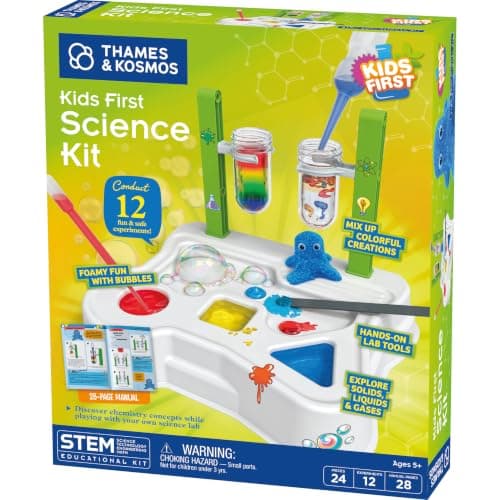
| 1 | Best overall under $25 — the one with real tools in it Kids First Science Laboratory Published as a set of laboratory tools, which is the only thing in this price band that does not get used up. | Four and up, as a first kit that is still there next spring | |
| 2 | 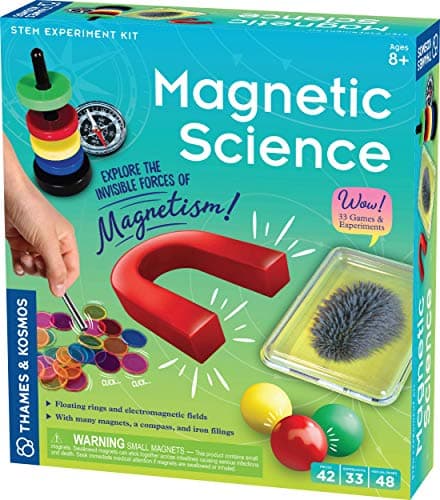 Most re-runnable — nothing in the box is consumed Thames & Kosmos Magnetic Science Magnets, iron filings and a 32-page manual: no part of it is used up by being used. | Eight and up, where the point is to understand a force rather than make a mess | |
| 3 | 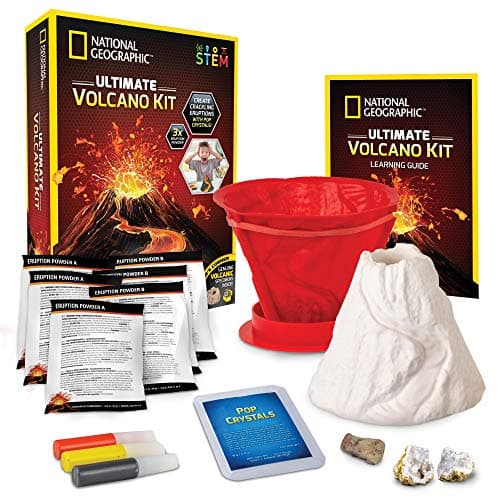 Best single spectacle NATIONAL GEOGRAPHIC Volcano Science Kit A build-and-erupt kit with published material for more than one eruption. | Six and up, for the kit that has to work on the first try | |
| 4 | 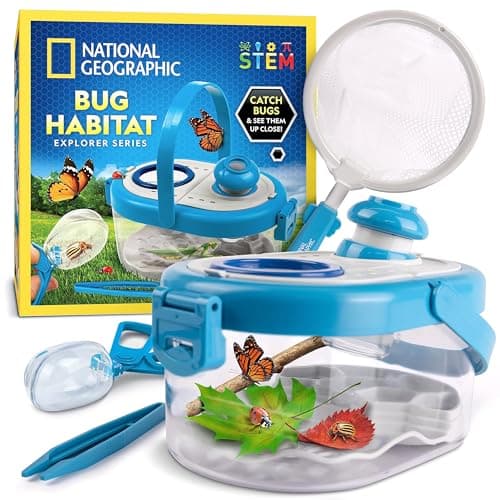 Best for a child who wants to go outside NATIONAL GEOGRAPHIC Bug Catcher Kit A field kit rather than a box kit - the specimens come from the garden and cost nothing. | Five and up, in a house where the science has to leave the table | |
| 5 | 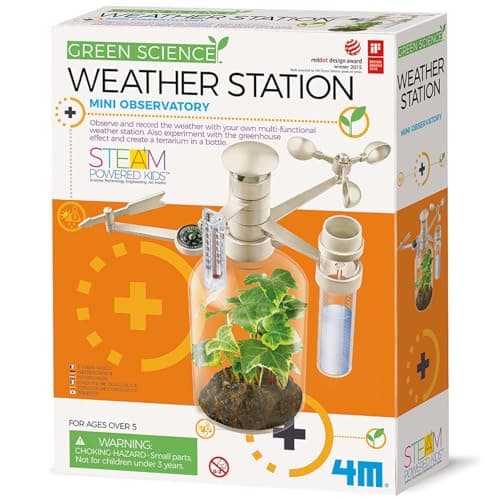 Longest-running project 4M Weather Station Kit Instruments the child builds and then reads every day, which is a habit rather than an afternoon. | Eight and up, for a child who likes recording things | |
| 6 | 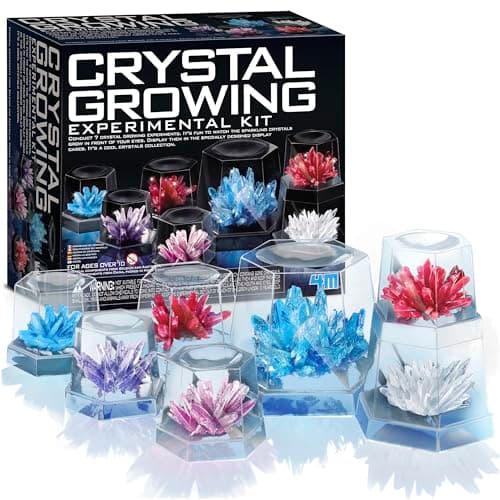 Best result you can keep 4M Crystal Growing Experiment Kit A grown crystal is the one science-kit output that survives as an object. | Ten and up, for a child who can wait several days | |
| — | 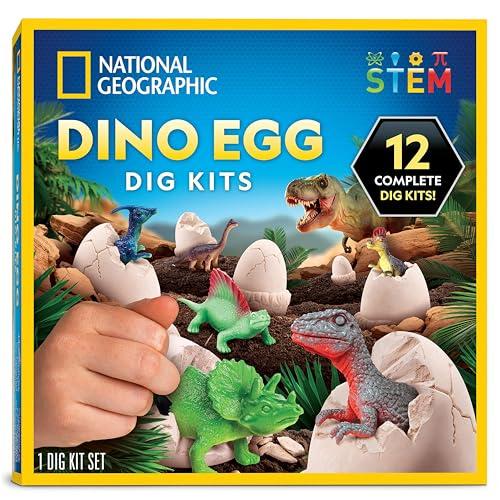 The one to skip at this price NATIONAL GEOGRAPHIC Dinosaur Dig Kit with 12 Dino Eggs Twelve dig eggs, each destroyed by the thing it is for. | A child who wants twelve of the same ten-minute activity |
7 picks, including 1 we tell you to skip. Ages shown are the manufacturer’s own rating, not ours.
What twenty-five dollars actually buys
The arithmetic
Under-$25 science kits: what is in the box, and what survives using it
| Kids First Science Laboratory | Tools. Nothing consumable. Reusable indefinitely |
|---|---|
| Magnetic Science | Magnets and a manual. Nothing consumable |
| Volcano Science Kit | Permanent model, consumable eruption chemistry |
| Bug Catcher Kit | Equipment. The specimens are free and outdoors |
| 4M Weather Station | Instruments the child builds. Produces daily readings |
| 4M Crystal Growing | Single-use chemistry, permanent crystal |
| Dino Dig Kit, 12 eggs | 12 plaster eggs. All consumed |
Why the experiment count on the box is the wrong number
A “50 experiments” claim usually counts steps, not sessions. Mixing two powders and then mixing the same two powders with water is published as two experiments. Neither is repeatable once the sachet is empty.
The number that predicts a second use is the consumable ratio. Work out what is left when the booklet is finished. If the answer is “a plastic tray”, the kit had one afternoon in it regardless of what the box claimed.
Tools beat chemicals at this price. That is specifically a budget argument: at $60 a kit can afford both. Under $25, a maker chooses, and the ones that chose equipment are the ones still in use at Easter. Our general experiment-kit roundup covers the shelf without a price cap.
Which of these suits a December gift
It has to do something on the day: the volcano, or the glow-in-the-dark T. Rex dissection kit from our glow kits page.
It has to last past the holidays: the science laboratory, Magnetic Science or the weather station.
There are two children and one budget: the bug catcher and the crystal kit together still come in under fifty dollars.
Worth knowing before you buy
Say the unwelcome thing
Do not buy a 100-experiment mega kit on the number alone
Under $25 the experiment count and the amount of material in the box are in direct tension: a maker fitting a hundred activities into that price is fitting a hundred very small quantities. A kit with eight experiments and enough reagent to repeat them is the better buy almost every time, and the makers that do this publish quantities rather than counts.
Where to go next
Science experiment kits is the category without the price cap, first science kits sorts the same shelf by whether it is a child’s first, and glow-in-the-dark science kits is the December version of this question.
In full
Every pick, and what is wrong with it
Published specifications only, each linked back to the page it came from. Where a manufacturer publishes nothing, the row says so — we do not fill blanks in.
1. Best overall under $25 — the one with real tools in it
Kids First Science Laboratory
Thames & Kosmos · Kids First Science Laboratory · maker rates it 3-6+
Published as a set of laboratory tools, which is the only thing in this price band that does not get used up.
- Contents
- 24 large plastic scientific tools, described as durable, reusable and easy to handle
- Experiment cards
- 10, double-sided
- Stated age
- 3 to 6+
- Chemicals included
- None — experiments use household materials
Thames & Kosmos publishes the Kids First Science Laboratory as equipment rather than as a sequence of experiments: the box is the lab, and the booklet is a starting set of things to do with it.
That distinction is the whole argument for this pick at this price. A $20 chemistry kit is mostly consumable powder — once it has been mixed, the box is cardboard. Tools are not consumable, so the second month depends only on whether anyone suggests an experiment, and the internet is full of them.
It is also the pick our first science kits page leads with for the same reason, and the review has the full published contents.
Replay signal
- Open-ended or one-shot
- The 20 card sides are a starting ladder; the tools then work on anything in the kitchen
- Does anything run out
- Nothing in the box runs out, because nothing in the box is consumed
- Room to grow
- The same tools carry into any household-materials experiment for years
- Adult required
- Yes at three, less so at five. The cards are picture-led but the setup is not
Why we say so: Thames & Kosmos publishes 24 reusable tools and no chemicals. A preschool science kit with no consumables in it is unusual, and it is the reason this one survives past its first fortnight when kit-of-the-week alternatives do not.
What’s wrong with it
The tools need an adult to suggest what to do with them once the booklet is finished.
| Contents | 24 large plastic scientific tools, described as durable, reusable and easy to handle |
|---|---|
| Experiment cards | 10, double-sided |
| Stated age | 3 to 6+ |
| Chemicals included | None — experiments use household materials |
| Consumables | None in the box |
Every figure above is from Thames & Kosmos, Kids First range. Blanks are shown as “not published” rather than filled in.
2. Most re-runnable — nothing in the box is consumed
Thames & Kosmos Magnetic Science
Thames & Kosmos · 665050 · maker rates it 8+
Magnets, iron filings and a 32-page manual: no part of it is used up by being used.
- Activities
- 33 — the maker's word is “experiments and games”
- Piece count
- 42
- Manual
- 48 pages, published by the maker; the Amazon listing says “60-page”, so we use the maker's figure
- Covered
- Which materials are magnetic, magnetic poles and fields, “how Earth behaves like one giant magnet”, compasses and finding north
Thames & Kosmos publishes Magnetic Science as a set of experiments built around magnets and a manual. Full published specifications are in our physics kits roundup.
Of everything under $25 on this page, this is the one with the highest number of runs per dollar, because a magnet is still a magnet in March. The experiments can be repeated exactly, which matters more than it sounds: a child who wants to show someone else what they found can only do that with a kit that still works.
The trade is excitement. See volcano kits if the brief is “something has to happen”.
Replay signal
- Open-ended or one-shot
- 33 activities and then the magnets are still magnets — a permanent toolkit
- Does anything run out
- Nothing runs out, and no batteries are required at all
- Room to grow
- Limited by subject: this is magnetism only, with one electromagnet as the bridge
Why we say so: Thames & Kosmos publishes 33 activities from 42 pieces with no batteries required, and publishes the iron filings as sealed in a transparent box. That last detail is the one worth paying for — loose iron filings are the component every magnetism kit loses in the first week, and sealing them is the difference between a demonstration that works in March and one that does not.
What’s wrong with it
No bang. Nothing erupts, nothing changes color, and some children want that.
| Activities | 33 — the maker's word is “experiments and games” |
|---|---|
| Piece count | 42 |
| Manual | 48 pages, published by the maker; the Amazon listing says “60-page”, so we use the maker's figure |
| Covered | Which materials are magnetic, magnetic poles and fields, “how Earth behaves like one giant magnet”, compasses and finding north |
| Iron filings | Supplied “in an enclosed transparent box” rather than loose |
| Electromagnet | Published as included — “Build an electromagnet to learn how electricity relates to magnetism” |
| Batteries | Published as “N/A” — none required |
| Product dimensions | 10 x 11 x 2.5 in; 1.4 lbs |
| Stated age | Ages 8+ |
| Year released | 2016 |
| Consumables | None |
Every figure above is from Thames & Kosmos, Magnetic Science (665050). Blanks are shown as “not published” rather than filled in.
3. Best single spectacle
NATIONAL GEOGRAPHIC Volcano Science Kit
National Geographic · Volcano Science Kit · maker rates it 8+
A build-and-erupt kit with published material for more than one eruption.
- Includes
- Plaster, volcano mold, paints and paintbrush, eruption powder, learning guide
- Rock specimens
- 2 — a geode and a pumice sample
- Mold
- Published as reusable, so the volcano survives repeat eruptions
- Eruptions
- Eruption powder for multiple eruptions; the powder is the consumable
National Geographic publishes the Volcano Science Kit as a plaster model plus eruption chemistry, with enough for multiple eruptions. The review has the figures.
This is the honest counterweight to the tools argument. A seven-year-old who has never had a science kit wants the first one to do something visible, and a box of beakers does not. The volcano does, reliably, on the day it is opened.
Buy it knowing what it is: the model is permanent, the chemistry is not. Our volcano kits page covers the category and what to refill it with.
Replay signal
- Open-ended or one-shot
- Semi-open: the built volcano is permanent, the eruptions are not
- Does anything run out
- The eruption powder runs out; household bicarbonate and vinegar do not
- Room to grow
- Once the supplied powder is gone the same volcano erupts on kitchen ingredients
- Adult required
- Published as requiring adult supervision; the build stage involves wet plaster
Why we say so: National Geographic publishes a reusable mold and eruption powder for multiple eruptions. A reusable volcano is the difference between a single afternoon and a prop that keeps working on kitchen-cupboard chemistry.
What’s wrong with it
The eruption chemistry is consumable, and the model is the same model every time.
| Includes | Plaster, volcano mold, paints and paintbrush, eruption powder, learning guide |
|---|---|
| Rock specimens | 2 — a geode and a pumice sample |
| Mold | Published as reusable, so the volcano survives repeat eruptions |
| Eruptions | Eruption powder for multiple eruptions; the powder is the consumable |
| Stated age | 8 years and up, adult supervision published |
| Consumables | Yes — plaster and eruption powder |
Every figure above is from National Geographic toys, Volcano Science Kit. Blanks are shown as “not published” rather than filled in.
4. Best for a child who wants to go outside
NATIONAL GEOGRAPHIC Bug Catcher Kit
National Geographic · Bug Catcher Kit · maker rates it 4+
A field kit rather than a box kit - the specimens come from the garden and cost nothing.
- Habitat
- Clear bug habitat with a removable base
- Viewers
- Latching lid with two magnified viewers — one fixed, one movable
- Tools
- Scissor-style bug catcher, net, tweezers
- Includes
- Learning guide
National Geographic publishes the Bug Catcher Kit as collection equipment: containers, a viewer and tools. The review has the published contents, and outdoor nature kits covers the category.
The economics here are the best on the page. The consumable in a bug kit is insects, and insects are free. A child who takes to it has an unlimited supply of new material without another purchase, which no chemistry kit at any price can offer.
In a December buying window the caveat is honest: it is a spring and summer kit that will sit for a few months. That is still better value than a kit finished on Boxing Day.
Replay signal
- Open-ended or one-shot
- Completely open-ended for the age — the garden restocks it
- Does anything run out
- Nothing runs out
- Room to grow
- Pairs naturally with a low-power microscope when the child wants a closer look
- Adult required
- For the catch-and-release rule; not for the looking
Why we say so: National Geographic publishes a habitat with two magnified viewers, a scissor catcher, a net and tweezers, rated 4+. The scissor catcher is the specification worth noticing: it lets a four-year-old pick up an insect without crushing it, which is the difference between a nature kit and a lesson about being gentle.
What’s wrong with it
Needs somewhere to go, which in late December may be a limitation.
| Habitat | Clear bug habitat with a removable base |
|---|---|
| Viewers | Latching lid with two magnified viewers — one fixed, one movable |
| Tools | Scissor-style bug catcher, net, tweezers |
| Includes | Learning guide |
| Stated age | 4+ |
| Consumables | None — the specimens are outside and free |
Every figure above is from National Geographic toys, Bug Catcher Kit. Blanks are shown as “not published” rather than filled in.
5. Longest-running project
4M Weather Station Kit
4M · 4573 · maker rates it 8+
Instruments the child builds and then reads every day, which is a habit rather than an afternoon.
- Instruments built
- 4 — wind vane, anemometer, thermometer and rain gauge
- Contents
- Thermometer and support arm, two support-column halves, rain gauge arm, funnel, plastic tube, wind vane and arm, compass, anemometer arm, cups, hub, spindles, cap screws, instructions
- Assembled size
- About 8.5 in x 4.75 in
- Extra experiment
- A greenhouse-effect terrarium using a recycled bottle
4M publishes the Weather Station as instruments the child assembles — the specifications are in the review and the category is covered on weather science kits.
This is the only kit under $25 whose output is a dataset. Once built, it produces a reading every morning, and a child who starts a chart in December has something that is still running at Easter. That is a fundamentally different retention profile from a one-afternoon kit.
Be realistic about the assembly: a 4M kit is cardboard and plastic parts the child puts together, not a finished instrument out of the box.
Replay signal
- Open-ended or one-shot
- Genuinely open-ended: the weather supplies new data every single day
- Does anything run out
- Nothing runs out
- Room to grow
- Readings become a record; the interest scales into charting and comparison
- Adult required
- For the build, which is fiddly; not for the daily readings
Why we say so: 4M publishes four working instruments and a full parts list. Once built, nothing is consumed and the sky restocks the experiment daily — which makes this one of the few science kits with no published ending.
What’s wrong with it
The build is the fun part for some children and the chore for others.
| Instruments built | 4 — wind vane, anemometer, thermometer and rain gauge |
|---|---|
| Contents | Thermometer and support arm, two support-column halves, rain gauge arm, funnel, plastic tube, wind vane and arm, compass, anemometer arm, cups, hub, spindles, cap screws, instructions |
| Assembled size | About 8.5 in x 4.75 in |
| Extra experiment | A greenhouse-effect terrarium using a recycled bottle |
| Stated age | 8 and up (a Green Science version is rated 5+) |
| Consumables | None — the instruments are permanent |
Every figure above is from 4M, Weather Station Kit (4573). Blanks are shown as “not published” rather than filled in.
6. Best result you can keep
4M Crystal Growing Experiment Kit
4M · 5557 · maker rates it 10+
A grown crystal is the one science-kit output that survives as an object.
- Experiments
- 7 crystal-growing experiments
- Contents
- 3 bags of crystal compound, 3 bags of seeding mixture, stirring bowl and spoon, 7 display bases, 7 display covers, 7 ring templates
- Stated age
- 10 years and up
- Consumables
- Yes — the compound is the whole product
4M publishes the Crystal Growing Experiment Kit with its own chemistry and a display base. See the review and crystal growing kits.
The argument for a consumable kit is the object at the end. A crystal sits on a shelf for years, and a child who grew it will tell you how. Slime does not do that, and nor does a volcano.
Set expectations on the wait. The crystal takes days, which is the point and also the risk: nothing visible happens on Christmas morning.
Replay signal
- Open-ended or one-shot
- One-shot, seven times over
- Does anything run out
- Definitively. Three bags of compound, and when they are gone the kit is a set of display cases
Why we say so: 4M publishes three bags of crystal compound across seven experiments. That is the arithmetic that decides this purchase: it is seven results, spread over weeks because crystals take days to grow, and then it is finished. Excellent as an event; poor as the main present.
What’s wrong with it
The growing solution is strictly single-use, and the wait kills it for some children.
| Experiments | 7 crystal-growing experiments |
|---|---|
| Contents | 3 bags of crystal compound, 3 bags of seeding mixture, stirring bowl and spoon, 7 display bases, 7 display covers, 7 ring templates |
| Stated age | 10 years and up |
| Consumables | Yes — the compound is the whole product |
| Time per experiment | Days, not minutes — crystals grow on their own schedule |
Every figure above is from 4M, Crystal Growing Experiment Kit. Blanks are shown as “not published” rather than filled in.
Skip this one
NATIONAL GEOGRAPHIC Dinosaur Dig Kit with 12 Dino Eggs
National Geographic · NGDINODIG12 · maker rates it Not published
Twelve dig eggs, each destroyed by the thing it is for.
- Digs
- 12 dino-shaped dig bricks, one dinosaur figure inside each
- Species
- “6 different dinosaur species hidden inside the 12 eggs”
- Sharing
- “enough individually-wrapped dino eggs and digging tools to share with friends and classmates”
- Guide
- A full-color learning guide for identifying what comes out
National Geographic publishes the Dinosaur Dig Kit with 12 Dino Eggs exactly as described: twelve plaster eggs to chip open, each containing a figure. The dig-kit review covers the class.
It is the skip here on the page’s own test. Twelve eggs sounds like twelve activities and is really one activity twelve times, and when the twelfth is chipped open there is nothing left but figures. Compare that with magnets, which are the same on day two hundred.
It is not a bad product. For a party bag or a rainy weekend with cousins it is a good product — see dinosaur dig kits. It is simply the worst use of twenty-five dollars on this particular page.
Replay signal
- Open-ended or one-shot
- No — 12 identical short digs with a known set of outcomes
- Does anything run out
- Every one of the 12 bricks is consumed, and there is no refill
- Room to grow
- Twelve figures from six species is a collection of sorts, and it is complete on day one
Why we say so: Blue Marble publishes 12 individually-wrapped bricks and states in writing that the kit is made to share with classmates. That is a party activity described by its own maker, which is why this site treats it as one rather than as the present.
What’s wrong with it
Every unit of value in the box is consumed, and all twelve are the same activity.
| Digs | 12 dino-shaped dig bricks, one dinosaur figure inside each |
|---|---|
| Species | “6 different dinosaur species hidden inside the 12 eggs” |
| Sharing | “enough individually-wrapped dino eggs and digging tools to share with friends and classmates” |
| Guide | A full-color learning guide for identifying what comes out |
| Stated age | Not published by Blue Marble |
| Availability | “AMAZON EXCLUSIVE” |
| Consumables | All 12 bricks. Nothing is reusable except the figures |
Every figure above is from National Geographic toys (Blue Marble) — brand site; per-product figures from the manufacturer's published listing copy. Blanks are shown as “not published” rather than filled in.
We are not putting a buy button on this one. It is easy enough to find if you want it anyway — but we would rather send you to something that gets played with twice.
Questions people actually ask
Frequently asked
What is the best science kit under $25?
The Thames & Kosmos Kids First Science Laboratory. It is published as a set of laboratory tools rather than a sequence of experiments, so nothing in the box is used up - which at this price is the difference between a kit used once and a kit still in the cupboard in spring. Kids First Science Laboratory review.
Are cheap science kits worth it?
Under $25 the good ones are the ones that bought equipment instead of chemicals. A kit of tools, magnets or collection gear can be run again; a kit of powders cannot. The price band is not the problem - what the maker chose to spend it on is.
What science kit does something straight away?
The National Geographic Volcano Science Kit. It is a plaster model plus eruption chemistry published with enough material for more than one eruption, so it produces a visible result on the day it is opened, which a tools-based kit does not. Volcano science kits.
How many experiments should a science kit have?
Fewer than the box claims is normal. A published experiment count often counts steps rather than sessions, and under $25 a hundred activities means a hundred very small quantities. Look instead for what is left in the box after the booklet is finished.
What is a good science kit for a 5 year old under $25?
The National Geographic Bug Catcher Kit if there is a garden, because the specimens are free and outdoors, or the Kids First Science Laboratory, which Thames & Kosmos publishes from age four. Both are equipment rather than consumable chemistry. STEM toys for 5-year-olds.
Sources
Where these figures came from
Every specification on this page traces to one of these. If a manufacturer publishes nothing on a point, the page says so rather than filling the gap.
Read next
Where to go from here
Back to Science Kits, or read how we pick.