The picks
STEM Gifts for Kids Who Love Space
A space gift either projects the sky, models it, or looks at the real one. The third kind needs a clear night, a dark garden and an adult - which is why it is not first on this list.
By Sawyer V. · Published
The short answer
Buy the one that works on the night it is unwrapped. The Thames & Kosmos Planetarium Projector publishes 32 images across four disks and star maps for both hemispheres, runs off USB with no batteries, and needs nothing but a dark bedroom — which is why it leads over a telescope in December. The Celestron FirstScope is the real instrument at 76mm, and it needs a clear sky.
Block & Beaker earns a commission when you buy through our links, at no cost to you. It never changes a ranking, and we say so plainly when the right answer is the cheaper set, or nothing at all. Full disclosure · How we pick.
At a glance
The picks, ranked
Tap any row to jump to the full reasoning. Prices come live from Amazon where we have them and read “check price” where we don’t — never a number we cannot stand behind today.
| # | Product | Best for | Price |
|---|---|---|---|
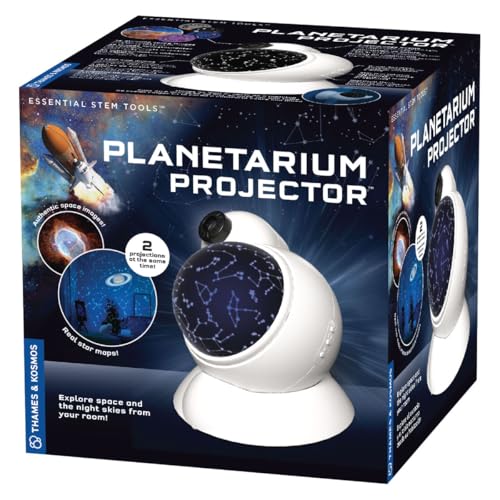
| 1 | Best overall — the only one that works on a cloudy night T&K Essential STEM Tools: Planetarium Projector Two projectors in one: a rotating star-map dome for both hemispheres, plus 32 cataloged space images. | Eight and up, in a bedroom, with no outdoor trip required | |
| 2 | 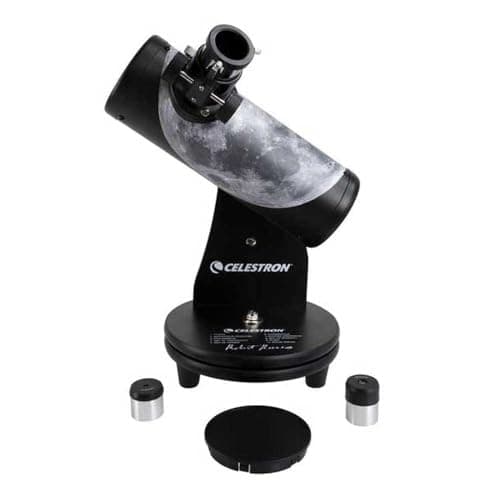 Best real telescope to start with Celestron FirstScope Telescope 76mm aperture on a tabletop Dobsonian mount, with 15x and 75x eyepieces. | A household with a dark spot outside and an adult who will go out in it | |
| 3 | 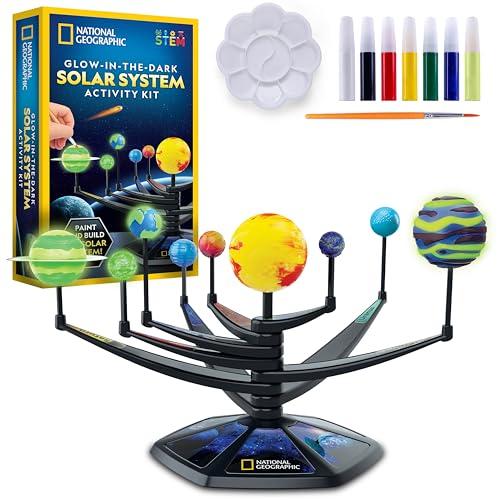 Best for a long afternoon and a shelf afterward NATIONAL GEOGRAPHIC Glow-in-the-Dark Solar System Model All eight planets plus the sun to build and paint, with glow-in-the-dark accent paint and movable arms. | Eight to twelve, for a child who would rather make the planets than find them | |
| 4 | 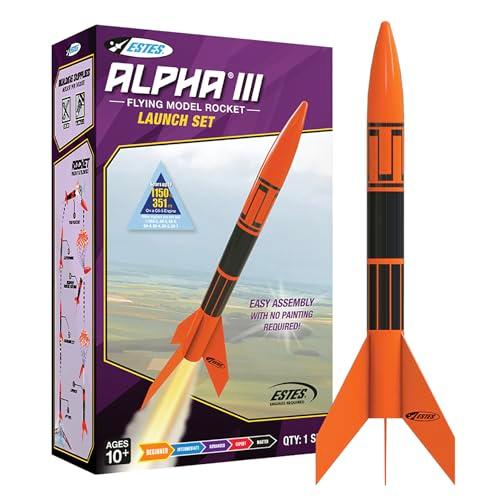 Best for a child who wants something to actually launch Estes Alpha III Launch Set A one-hour build that flies to a published 1,150 feet, with the launch pad and controller in the box. | Ten and up, with an adult, a field and a second purchase | |
| 5 | 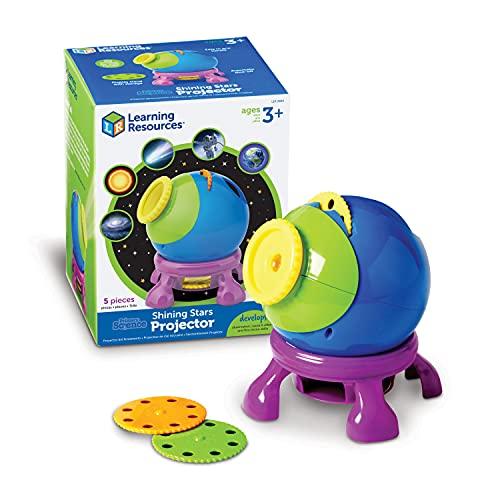 Best under five Learning Resources Primary Science Shining Stars Projector Three discs, 24 images, a 10-foot throw, and a published age of 3 and up. | Three and up, where the point is a ceiling full of stars at bedtime | |
| — | 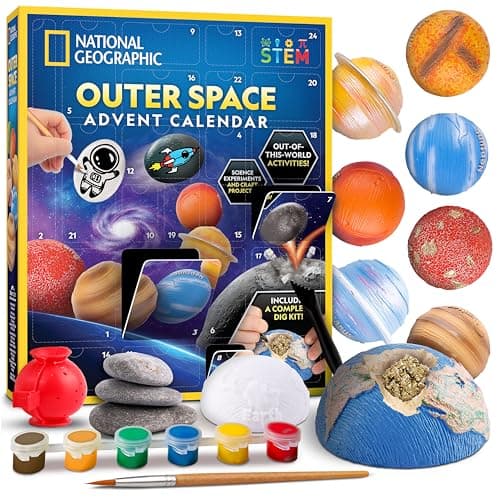 Not the space present NATIONAL GEOGRAPHIC Space Advent Calendar 24 days of crafts: 8 magnet-backed planets to paint and named constellation stickers. | December only, as a countdown rather than as the gift |
6 picks, including 1 we tell you to skip. Ages shown are the manufacturer’s own rating, not ours.
The three kinds of space gift
The arithmetic
What each kind needs before it works
| Projector — T&K Planetarium | A dark room. 32 images, both hemispheres, USB power, no batteries. Ages 8+ |
|---|---|
| Projector — LR Shining Stars | A dark room. 3 discs, 24 images, 10-ft throw. Ages 3+. Battery type not published |
| Model — NatGeo Solar System | A table and an afternoon. 8 planets + sun, 6 paints + glow paint. Ages 8-12 |
| Telescope — Celestron FirstScope | A clear night and an adult. 76mm aperture, 15x and 75x. Age not published |
| Rocket — Estes Alpha III | A field, an adult, engines sold separately. 1,150 ft, 12-in chute. Ages 10+ |
| Calendar — NatGeo Space Advent | December, starting on the 1st. 24 craft days, 8 planet magnets. Age not published |
Why the projector beats the telescope as a gift
A telescope is a better object and a worse present. We say that as a site with a whole telescope page: the FirstScope at 76mm is a genuine instrument and the Moon through it is a real experience. It also needs a cloudless night, a spot away from streetlights, and an adult willing to stand in a cold garden for twenty minutes.
Count the usable nights. A bedroom projector works on every one of them. Thames & Kosmos publishes a nightlight mode with an auto-off timer, which is a product designed to be used daily rather than occasionally — and a toy used daily is the entire thesis of this site.
The two are not alternatives in the long run. The projector names constellations; the telescope finds them. A child who learns Orion off a ceiling has somewhere to point a telescope later, which is the right order to buy them in.
What “loves space” usually means at each age
Three to five: it is the pictures. Planets are shapes and colors, and a ceiling full of stars is the whole gift. The Learning Resources projector is rated 3+ and nothing else here is.
Six to nine: it is the names and the facts. This is the band where the 32 cataloged images and the fact poster land, and where a child will tell you which planet has the most moons. The Thames & Kosmos projector and the solar system model both sit here.
Ten and up: it is doing something. Looking at the real sky, or launching something and recovering it. The FirstScope and the Alpha III are both published for this band — the rocket explicitly at 10+. See STEM toys for 10-year-olds and STEM gifts for teens for the wider shelf at that age.
Worth knowing before you buy
So which one
One gift, any household: the Thames & Kosmos Planetarium Projector — 32 images, both hemispheres, no batteries.
They want to see the real thing: the Celestron FirstScope, 76mm, and plan an evening for it.
They would rather make it: the glow-in-the-dark Solar System Model, eight planets and six paints.
Ten or older, and an adult is in: the Estes Alpha III launch set — order engines at the same time.
Under five: the Shining Stars projector, rated 3 and up.
Say the unwelcome thing
Do not buy a nebula lamp and call it a space gift
The large category of ceiling “galaxy projectors” sold for bedrooms publishes no star maps, no constellations and no educational content at all — the images are decorative patterns rather than the sky. They are perfectly good mood lighting. The difference is published and easy to check before you buy: look for named constellations and a hemisphere, as the Thames & Kosmos set lists, and if neither appears in the specification you are buying a lamp.
Where to go next
Telescopes for kids compares the FirstScope against bigger instruments, gifts for kids who like science covers the wider shelf, and the dinosaur list is the other interest-led page in this hub.
In full
Every pick, and what is wrong with it
Published specifications only, each linked back to the page it came from. Where a manufacturer publishes nothing, the row says so — we do not fill blanks in.
1. Best overall — the only one that works on a cloudy night
T&K Essential STEM Tools: Planetarium Projector
Thames & Kosmos · 678004 · maker rates it 8+
Two projectors in one: a rotating star-map dome for both hemispheres, plus 32 cataloged space images.
- Projectors
- Two in one — “a rotating star map dome that projects astronomically accurate maps of the stars” plus a second image projector
- Star maps
- “star maps for both the northern and southern hemispheres are included”
- Image disks
- 4 disks, 8 images each, 32 total — “all eight planets, eight human-made space objects like rockets and satellites, and eight extragalactic phenomena like nebula and galaxies”
- Nightlight mode
- Auto-off after 15, 30 or 60 minutes
Thames & Kosmos publishes two projectors in one housing: a rotating star-map dome that casts “astronomically accurate maps of the stars”, with maps for both the northern and southern hemispheres, and a second projector that throws 32 images from four disks — eight planets, eight human-made objects such as rockets and satellites, and eight extragalactic objects including nebulae and galaxies. Ages 8+, nine pieces, a 6-page manual, 6.5 inches cubed.
The specification that puts this first is the power line. Thames & Kosmos publishes a USB cable and “Batteries Required: N/A”. Every projector toy we have read the specs for runs on AAs, and the published failure mode of a battery-powered bedroom toy is a flat compartment in February — see our battery guide for how often that ends a toy’s life.
The nightlight mode with a 15, 30 or 60-minute auto-off is the other reason this keeps getting switched on: it is a bedtime object, and bedtime happens every day. A telescope happens on the clear evenings when an adult is free, which in December is a shorter list than it sounds.
Both hemispheres is a real inclusion rather than a marketing line. A child who rotates to the southern map is looking at a sky they cannot see from home, which is a geography lesson the box does not advertise. Full published specifications, and how it compares with the Smithsonian unit and the $30 galaxy projectors, are in the full review.
Replay signal
- Open-ended or one-shot
- Not open-ended in the build sense — this is an instrument, and what varies is the sky it shows
- Does anything run out
- Nothing runs out: long-life LEDs and a USB cable, no batteries to replace
- Room to grow
- Two hemispheres plus 32 cataloged images, so the same object answers a different question each night
- Adult required
- None after the first setup — the nightlight timer is built for bedtime, unsupervised
Why we say so: Thames & Kosmos publishes both hemispheres' star maps, 32 images across four disks, and a USB power cable with “Batteries Required: N/A”. The power line is the retention fact: the usual failure for a projector toy is a dead battery compartment, and this one does not have one.
What’s wrong with it
It is a projector, not an instrument. Nothing here is the actual sky, and the resolution of a ceiling is the resolution of a ceiling.
| Projectors | Two in one — “a rotating star map dome that projects astronomically accurate maps of the stars” plus a second image projector |
|---|---|
| Star maps | “star maps for both the northern and southern hemispheres are included” |
| Image disks | 4 disks, 8 images each, 32 total — “all eight planets, eight human-made space objects like rockets and satellites, and eight extragalactic phenomena like nebula and galaxies” |
| Nightlight mode | Auto-off after 15, 30 or 60 minutes |
| Power | USB power cable. “Batteries Required: N/A” |
| Piece count | 9 |
| Manual | 6 pages, plus a color educational poster |
| Product dimensions | 6.5 x 6.5 x 6.5 in; 1.2 lb |
| Consumables | None — LED lights, and no battery compartment |
Every figure above is from Thames & Kosmos, Essential STEM Tools: Planetarium Projector (678004). Blanks are shown as “not published” rather than filled in.
2. Best real telescope to start with
Celestron FirstScope Telescope
Celestron · 21024 · maker rates it Not published
76mm aperture on a tabletop Dobsonian mount, with 15x and 75x eyepieces.
- Aperture
- “76mm (2.99″)”
- Focal length
- “300mm (12″)”
- Focal ratio
- “f/3.95”
- Eyepiece 1
- 20mm, 15x magnification
Celestron publishes a 76mm (2.99 inch) aperture, a 300mm focal length, f/3.95, and two eyepieces giving 15x and 75x on a table-top Dobsonian stand. It publishes no age rating, calling it “an ideal entry level astronomical telescope”.
Aperture is the only telescope number that matters for a beginner, because it is how much light the instrument collects. At 76mm this shows the Moon’s craters and the four big moons of Jupiter, and that is the honest ceiling — a child expecting the Hubble photographs from the image disks above will be disappointed by a real telescope, and it is worth saying so before the box is opened.
The tabletop Dobsonian mount is why this is the telescope we would hand a child rather than a tripod refractor: there is no tripod to fight, the whole thing sits on a garden table, and aiming it is pushing it. See the full review and telescopes for kids, which compares it against the bigger StarSense and the Gskyer refractor.
Replay signal
- Open-ended or one-shot
- Open-ended in the most literal sense: the sky changes every month whether anyone touches it or not
- Does anything run out
- Nothing runs out
- Room to grow
- Standard eyepieces, so it accepts better ones later without replacing the telescope
- Adult required
- Finding the first object usually needs an adult; after that a tabletop Dobsonian is genuinely child-operable
Why we say so: Celestron publishes the 76mm aperture, 300mm focal length, f/3.95 ratio and both eyepiece magnifications. The table-top Dobsonian mount is the published design, and it is why a child can aim this one without a tripod fight.
What’s wrong with it
Celestron publishes no age rating, and finding the first object almost always takes an adult.
| Aperture | “76mm (2.99″)” |
|---|---|
| Focal length | “300mm (12″)” |
| Focal ratio | “f/3.95” |
| Eyepiece 1 | 20mm, 15x magnification |
| Eyepiece 2 | 4mm, 75x magnification |
| Mount | “Dobsonian style stand”, table-top |
| Stated age | Not published — Celestron calls it “an ideal entry level astronomical telescope” |
Every figure above is from Celestron, FirstScope Telescope. Blanks are shown as “not published” rather than filled in.
3. Best for a long afternoon and a shelf afterward
NATIONAL GEOGRAPHIC Glow-in-the-Dark Solar System Model
National Geographic · NGSOLARSYS · maker rates it 8-12
All eight planets plus the sun to build and paint, with glow-in-the-dark accent paint and movable arms.
- Bodies modeled
- “all 8 planets and the sun”
- Included
- “6 vibrant paint colors, glow-in-the-dark accent paint, brush, palette, fun decals, and a poster with solar system facts”
- Adjustability
- “movable arms allow kids to set up and rearrange their solar system display”
- Stated age
- “Ages 8-12”
Blue Marble publishes all eight planets and the sun, six paint colors plus a glow-in-the-dark accent paint, a brush, a palette, decals and a fact poster, with movable arms so the planets can be rearranged. Rated ages 8-12.
This is the pick for the child who draws the solar system rather than searches for it. The published movable arms matter more than they look: a fixed orrery is a model of one moment, and arms that move let a child set the planets in a line, which is the first thing any of them tries.
Be clear about what it is. Six paints get used up, and after the build the published use is “space bedroom decor”. That is a legitimate gift — it is just a different one from the projector above, which gets switched on again every night. Buy this as the activity and the projector as the object.
Replay signal
- Open-ended or one-shot
- One finished model — the open part is the painting, and it happens once
- Does anything run out
- The six paints and the glow paint are used up on the build
- Room to grow
- The movable arms are the only thing that changes after assembly; the published use after that is room decor
Why we say so: Blue Marble publishes eight planets plus the sun, six paints and a glow-in-the-dark accent paint. That is a kit with a finished state, which is why it sits on a gift list rather than a list of things that get replayed: what lasts is the object on the shelf, not the activity.
What’s wrong with it
It finishes. The paints are used up and the model is decor from day two onward.
| Bodies modeled | “all 8 planets and the sun” |
|---|---|
| Included | “6 vibrant paint colors, glow-in-the-dark accent paint, brush, palette, fun decals, and a poster with solar system facts” |
| Adjustability | “movable arms allow kids to set up and rearrange their solar system display” |
| Stated age | “Ages 8-12” |
| Product dimensions | 12.0 x 7.1 x 2.4 in boxed; 0.65 lb |
| Year released | 2024 |
| Consumables | The paints. The model itself is permanent |
Every figure above is from National Geographic toys (Blue Marble) — brand site; per-product figures from the manufacturer's published listing copy. Blanks are shown as “not published” rather than filled in.
4. Best for a child who wants something to actually launch
Estes Alpha III Launch Set
Estes · 1427 · maker rates it 10+
A one-hour build that flies to a published 1,150 feet, with the launch pad and controller in the box.
- Projected altitude
- “up to 1150 feet”
- Recovery
- “a bright 12 inch parachute”, high-visibility orange
- Build
- “a one piece molded fin unit”, “basic household tools and glue”, and about an hour from opening the box to launch-ready
- Launch system
- Included — Porta-Pad II launch pad and Electron Beam launch controller
Estes publishes a projected altitude of up to 1,150 feet, a 12-inch high-visibility orange parachute, a one-piece molded fin unit, and about an hour from opening the box to launch-ready with basic household tools and glue. The Porta-Pad II launch pad and Electron Beam controller are included. Rated 10+.
Read the second published list before buying: engines (eight designations from 1/2A6-2 to C6-7), starters, recovery wadding and four AA batteries are all sold separately. This is the one gift on this page that is not complete in the box, and a ten-year-old who unwraps a rocket that cannot fly until a second order arrives is the specific disappointment to avoid. Order the engines at the same time.
The pad and controller being reusable is what makes it good value anyway: the expensive part is bought once, and the recurring cost is an engine. Estes publishes that the rocket is designed for use with the National Association of Rocketry safety code, including a 15-foot standoff, which tells you plainly that this is a supervised outdoor activity rather than a bedroom toy.
Replay signal
- Open-ended or one-shot
- The airframe is fixed, the flying is not — the pad and controller are reusable with every engine class listed
- Does anything run out
- An engine, a starter and recovery wadding are consumed on every single launch
- Room to grow
- Eight published engine designations on one airframe, so the same rocket flies to different altitudes
- Adult required
- Yes, and the maker says so — the NAR safety code, a launch site and a 15-foot standoff are published requirements
Why we say so: Estes publishes a 1,150-foot altitude, a 12-inch parachute and a reusable pad and controller, and publishes separately that engines, starters and wadding are not included. Those two facts are the whole purchase: the box is a one-hour build plus a reusable launch system, and every flight after the first one costs money.
What’s wrong with it
Engines, starters, wadding and four AA batteries are all sold separately, and every flight consumes an engine.
| Projected altitude | “up to 1150 feet” |
|---|---|
| Recovery | “a bright 12 inch parachute”, high-visibility orange |
| Build | “a one piece molded fin unit”, “basic household tools and glue”, and about an hour from opening the box to launch-ready |
| Launch system | Included — Porta-Pad II launch pad and Electron Beam launch controller |
| Sold separately | Engines (1/2A6-2, A8-3, A8-5, B4-4, B6-4, B6-6, C6-5 or C6-7), starters, recovery wadding and 4 AA batteries |
| Stated age | “Ages 10+” |
| Safety | “designed to be used with the NAR (National Association of Rocketry) model-rocket safety code”; stand back at least 15 ft |
| Consumables | One engine, one starter and wadding per flight |
Every figure above is from Estes Rockets, Alpha III Launch Set (001427). Blanks are shown as “not published” rather than filled in.
5. Best under five
Learning Resources Primary Science Shining Stars Projector
Learning Resources · LER2830 · maker rates it 3+
Three discs, 24 images, a 10-foot throw, and a published age of 3 and up.
- Projection
- “vivid images of stars, planets, and space scenes up to 10 feet away”
- Image discs
- “3 discs with 24 colorful images”
- Stand
- “Use on the go or set in the stand for full-room viewing”, plus a storage base
- Stated age
- “kids ages 3 and up”
Learning Resources publishes a projector that throws “vivid images of stars, planets, and space scenes up to 10 feet away”, three discs carrying 24 images, a stand for full-room viewing and a storage base, rated ages 3 and up.
The age rating is the reason it is here. Almost everything else on this page starts at eight, and a three-year-old who is currently obsessed with planets cannot use any of it — see buying above the age rating for why we do not fudge that. For a preschooler this is the whole category.
Twenty-four images is a small library, and that is the honest limit: by seven or eight a child will have seen all of them and will want the hemispheres and the planet names from the Thames & Kosmos projector instead. Learning Resources also publishes no battery type or count, which on a product for three-year-olds is a gap worth knowing about before Christmas morning. Our STEM toys for 3-year-olds page covers what else is genuinely rated that low.
Replay signal
- Open-ended or one-shot
- Fixed content — 24 published images, and that is the set
- Does anything run out
- Nothing physical, but the battery type and count are not published
- Room to grow
- Rated 3 and up with no published upper bound; the ceiling does not get harder
- Adult required
- None for use. An adult loads the batteries
Why we say so: Learning Resources publishes three discs, 24 images, a 10-foot throw and an age of 3 and up. Twenty-four fixed images is a small library, and that is exactly why this is the pick for a preschooler rather than for an eight-year-old who will want the hemispheres and the planet names.
What’s wrong with it
Twenty-four fixed images is the whole library, and Learning Resources does not publish which batteries it needs.
| Projection | “vivid images of stars, planets, and space scenes up to 10 feet away” |
|---|---|
| Image discs | “3 discs with 24 colorful images” |
| Stand | “Use on the go or set in the stand for full-room viewing”, plus a storage base |
| Stated age | “kids ages 3 and up” |
| Product dimensions | 8.5 x 6.7 x 6.6 in; 1.1 lb |
| Consumables | Batteries. Learning Resources publishes neither the type nor the count |
Every figure above is from Learning Resources, Primary Science Shining Stars Projector (LER2830) — manufacturer's published listing copy; learningresources.com returned HTTP 403 to this VM. Blanks are shown as “not published” rather than filled in.
Skip this one
NATIONAL GEOGRAPHIC Space Advent Calendar
National Geographic · NGSPACEADVENT · maker rates it Not published
24 days of crafts: 8 magnet-backed planets to paint and named constellation stickers.
- Days
- 24 — “crafts, science experiments, and hands-on discoveries”
- Planets
- 8 magnet-backed planet models to paint
- Constellations
- Glow-in-the-dark stickers for “Canis Major, Ursa Major, Ursa Minor, Orion, and starscapes”
- Specimen
- A pyrite specimen excavated from an Earth-shaped dig brick
Blue Marble publishes 24 days of crafts and experiments including eight magnet-backed planet models to paint, glow-in-the-dark stickers for Canis Major, Ursa Major, Ursa Minor and Orion, a pyrite specimen in an Earth-shaped dig brick, two bouncy balls to make and three celestial bodies molded with agar powder. No age rating is published.
It is the skip here and not because it is bad. On our STEM advent calendar page it is the one we would pick for a space-minded child, and it holds up on that list. The problem is the job it is being asked to do on this one: a calendar is a structure for December that has to start on the first and is worth nothing on the 26th, so it cannot be the space present. The paints and agar powder are consumed, and what survives is eight fridge magnets and a ceiling of stickers.
If both are in the budget, the calendar is the countdown and one of the five picks above is the present. If only one is, buy the present.
Replay signal
- Open-ended or one-shot
- A 24-day sequence with a finished state, like every calendar in the category
- Does anything run out
- Yes — the craft materials are single-use
- Room to grow
- The 8 painted planet magnets and the glow stickers stay on a fridge and a ceiling afterwards
Why we say so: Blue Marble publishes 8 magnet-backed planets, named constellation sticker sets and a pyrite dig brick. This is the one calendar here whose output is decoration rather than a collection or a set of results, which makes it the right pick for a child who already has the rocks.
What’s wrong with it
It has an expiry date, the craft materials are single-use, and Blue Marble publishes no age rating.
| Days | 24 — “crafts, science experiments, and hands-on discoveries” |
|---|---|
| Planets | 8 magnet-backed planet models to paint |
| Constellations | Glow-in-the-dark stickers for “Canis Major, Ursa Major, Ursa Minor, Orion, and starscapes” |
| Specimen | A pyrite specimen excavated from an Earth-shaped dig brick |
| Also included | 2 space-themed bouncy balls to make, and 3 celestial bodies molded with agar powder |
| Stated age | Not published by the manufacturer |
| Consumables | Yes — the paints, agar powder and bouncy-ball mix are used up |
Every figure above is from National Geographic toys (Blue Marble), Space Advent Calendar — published listing copy. Blanks are shown as “not published” rather than filled in.
We are not putting a buy button on this one. It is easy enough to find if you want it anyway — but we would rather send you to something that gets played with twice.
Questions people actually ask
Frequently asked
What is the best gift for a kid who loves space?
The Thames & Kosmos Essential STEM Tools Planetarium Projector, for most households. Thames & Kosmos publishes two projectors in one unit, star maps for both hemispheres, 32 images across four disks, USB power with no batteries required, and a nightlight auto-off timer, rated ages 8 and up. It works in a bedroom on any night, which a telescope does not.
Is a telescope a good gift for a child?
It is a good object that needs the right household. The Celestron FirstScope publishes a 76mm aperture, a 300mm focal length and 15x and 75x eyepieces on a tabletop Dobsonian mount, which is genuinely child-operable - but it needs a clear night, a dark spot and usually an adult to find the first object. Celestron publishes no age rating for it. Telescopes for kids.
What space gift works for a 3-year-old?
The Learning Resources Primary Science Shining Stars Projector is the one with a published age of 3 and up: three discs, 24 images, and a 10-foot throw. Almost everything else in the space category publishes 8+, including both the solar system model (8-12) and the Thames & Kosmos projector (8+). STEM toys for 3-year-olds.
Does a model rocket kit include everything you need?
No, and Estes publishes exactly what is missing. The Alpha III launch set includes the rocket parts, parachute, Porta-Pad II launch pad and Electron Beam controller; engines, starters, recovery wadding and four AA batteries are sold separately. Order the engines with the set, or the rocket cannot fly on the day it is unwrapped.
How high does the Estes Alpha III fly?
Estes publishes a projected altitude of up to 1,150 feet (351 m), recovered on a 12-inch high-visibility orange parachute. It is compatible with eight published engine designations from 1/2A6-2 to C6-7, so the same airframe flies to different altitudes depending on which engine is loaded.
Is a space advent calendar a good space present?
It is a good December and a poor present. Blue Marble's Space Advent Calendar publishes 24 craft and experiment days, eight magnet-backed planets to paint and named constellation stickers, but the structure expires on 25 December and the paints and agar powder are used up. Buy it as the countdown alongside the present, not instead of it. STEM advent calendars.
Projector or solar system model?
Projector if you want something switched on again every night; model if you want an afternoon at the table and an object on a shelf. The published difference is consumables: the Thames & Kosmos projector lists none and runs on USB, while the National Geographic model includes six paints plus glow paint that are used up during the build.
Sources
Where these figures came from
Every specification on this page traces to one of these. If a manufacturer publishes nothing on a point, the page says so rather than filling the gap.
- Thames & Kosmos, Essential STEM Tools: Planetarium Projector (678004)
- Estes Rockets, Alpha III Launch Set (001427)
- Celestron, FirstScope Telescope (21024)
- National Geographic toys (Blue Marble) — brand site; per-product figures from published listing copy
- Learning Resources — brand site; Shining Stars Projector (LER2830) figures from published listing copy
Read next
Where to go from here
Back to Gift Guides, or read how we pick.