The picks
Best Star Projectors for Kids
Half the things sold as star projectors are planetariums and half are mood lamps. They cost about the same, and only one of them teaches a child a constellation.
By Sawyer V. · Published
The short answer
For a child who wants to learn the sky, buy the Thames & Kosmos Planetarium Projector — it is published as an astronomy set rather than as decor. For a room that needs a night light first and astronomy second, the Lexibook NLJ180 publishes two named constellation domes and a motorized sweep, and the Sega Homestar Original is the real planetarium if the budget stretches.
Block & Beaker earns a commission when you buy through our links, at no cost to you. It never changes a ranking, and we say so plainly when the right answer is the cheaper set, or nothing at all. Full disclosure · How we pick.
At a glance
The picks, ranked
Tap any row to jump to the full reasoning. Prices come live from Amazon where we have them and read “check price” where we don’t — never a number we cannot stand behind today.
| # | Product | Best for | Price |
|---|---|---|---|
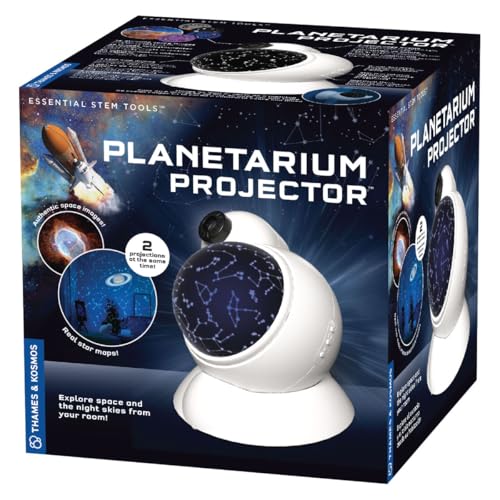
| 1 | Best overall — the one published as astronomy T&K Essential STEM Tools: Planetarium Projector An Essential STEM Tools astronomy set, not a decor product that happens to show stars. | Eight and up, where the point is to recognize something in the actual sky | |
| 2 | 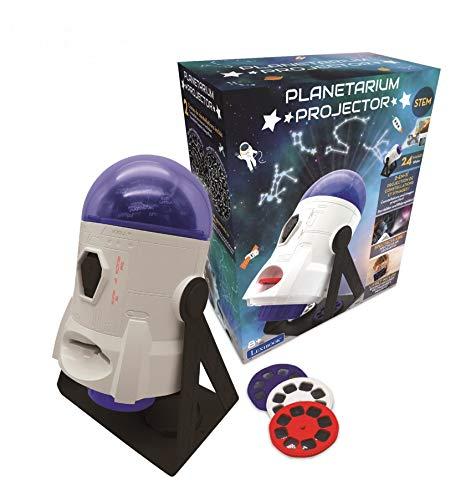 Best under $25 — named constellations Lexibook Planetarium Projector NLJ180 Two constellation domes, a motorized 360-degree sweep and 24 space images on the flip side. | Six and up, as a bedroom light that is also a lesson | |
| 3 | 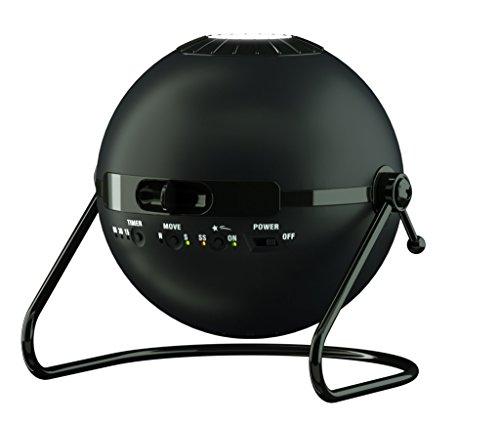 Best image quality — a real home planetarium Sega Toys Homestar Original Home Planetarium A 3-watt LED, adjustable focus and a published library of more than thirty optional discs. | A household that wants the ceiling to look like the sky looks from a dark field | |
| 4 | 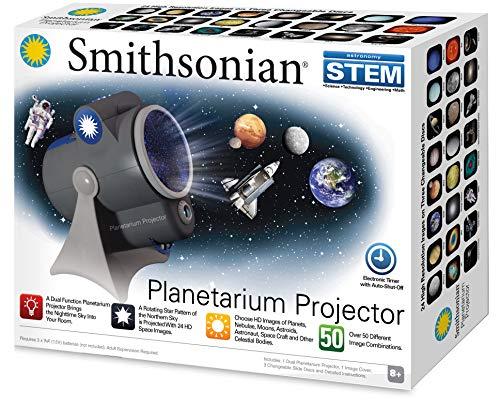 Best dual-purpose unit Smithsonian Optics Room Planetarium and Dual Projector A room planetarium and a dual projector in one body, under fifty dollars. | Eight and up, where one device has to be both a night light and a slide show | |
| 5 | 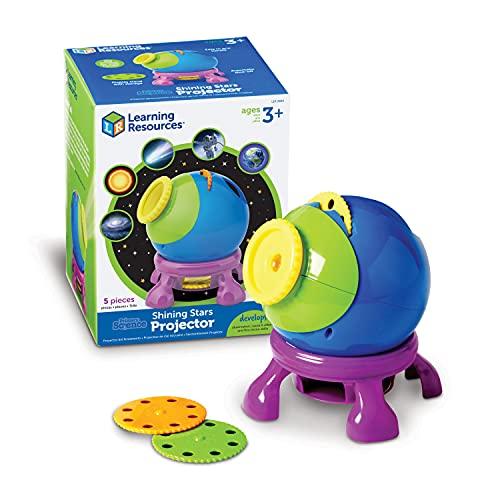 Best for under six Learning Resources Primary Science Shining Stars Projector A Primary Science projector built for small hands rather than for optical fidelity. | Three to six, where the projector has to survive being handled | |
| — | 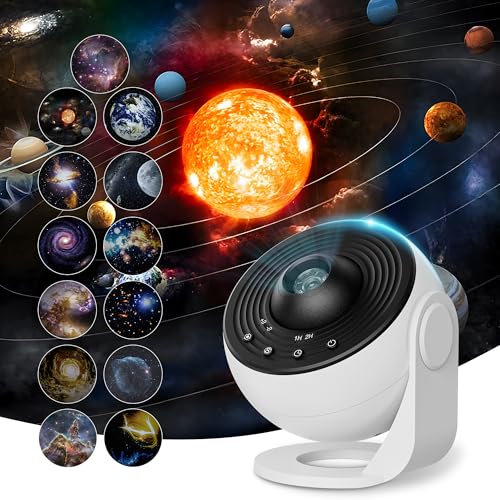 The one to skip if the goal is astronomy MuliVid Galaxy Projector Pro, 13-in-1 Thirteen HD discs of named astronomical objects, and no star map of any kind. | A teenager who wants the room to look good, which is a different purchase |
6 picks, including 1 we tell you to skip. Ages shown are the manufacturer’s own rating, not ours.
Planetarium or light show: what each one publishes
The arithmetic
Star projectors: what is actually on the ceiling
| T&K Planetarium Projector | Astronomy set. Published as a STEM tool |
|---|---|
| Lexibook NLJ180 | 2 constellation domes, named. Plus 24 space images |
| Sega Homestar Original | Real star field. 3W LED. 30+ optional discs |
| Smithsonian Room Planetarium | Rotating star field plus an image projector |
| LR Shining Stars | Simple star field. Preschool build |
| MuliVid Galaxy Projector Pro | 13 image discs. No star map published |
Why this is a November purchase
The sky is available at bedtime for the first time all year. In late November it is fully dark well before a child goes to bed, so a constellation learned on the ceiling can be checked against the window the same evening. In June it cannot.
A projector is a night light that gets switched on every night. That is the retention argument and it is unusual in this category: most STEM products compete for a weekend afternoon, and this one has a slot in the routine already.
It is still useful in January. Winter is the best constellation season in the northern hemisphere — Orion, Taurus and the Pleiades are all up — so a December projector has two clear months of matching ceiling to sky ahead of it.
What to check before buying any of them
Focus. If no focal ring or focus control is published, assume the image at ceiling distance is soft. The Lexibook and the Sega both publish one; most sub-$30 units do not.
Timer. A projector with no auto-off runs all night. The Sega and the MuliVid publish timers; check before buying for a child who falls asleep with it on.
Power. Mains and USB units are brighter and never go flat; battery units can be carried into a tent. Neither is wrong, but a dim battery unit in a bright room is the usual disappointment.
Worth knowing before you buy
Say the unwelcome thing
Do not buy a nebula projector expecting a constellation
The large category of galaxy and aurora projectors is honest about what it is — most makers call it room decor — but the product photography makes it look like astronomy. If the maker publishes a disc count and no constellation names, the ceiling will show a beautiful image of somewhere a child cannot point at. Buy that on purpose or buy a planetarium instead.
Where to go next
Telescopes for kids is the next step for a child who starts naming things, gifts for kids who love space is the wider shelf, and glow-in-the-dark science kits is the other thing that only works after dark.
In full
Every pick, and what is wrong with it
Published specifications only, each linked back to the page it came from. Where a manufacturer publishes nothing, the row says so — we do not fill blanks in.
1. Best overall — the one published as astronomy
T&K Essential STEM Tools: Planetarium Projector
Thames & Kosmos · 678004 · maker rates it 8+
An Essential STEM Tools astronomy set, not a decor product that happens to show stars.
- Projectors
- Two in one — “a rotating star map dome that projects astronomically accurate maps of the stars” plus a second image projector
- Star maps
- “star maps for both the northern and southern hemispheres are included”
- Image disks
- 4 disks, 8 images each, 32 total — “all eight planets, eight human-made space objects like rockets and satellites, and eight extragalactic phenomena like nebula and galaxies”
- Nightlight mode
- Auto-off after 15, 30 or 60 minutes
Thames & Kosmos publish this in their Essential STEM Tools line as an astronomy set for exploring the night sky. The full published specification is in the review.
The reason it leads is the framing, and the framing is not marketing: a projector designed as a teaching instrument shows the sky as it is, which means a child can look at the ceiling, then look out of the window, and find the same shape. No galaxy lamp can do that, because the thing on its ceiling is not above the house.
Pair it with a first telescope when the interest sticks — see telescopes for kids and gifts for kids who love space.
Replay signal
- Open-ended or one-shot
- Not open-ended in the build sense — this is an instrument, and what varies is the sky it shows
- Does anything run out
- Nothing runs out: long-life LEDs and a USB cable, no batteries to replace
- Room to grow
- Two hemispheres plus 32 cataloged images, so the same object answers a different question each night
- Adult required
- None after the first setup — the nightlight timer is built for bedtime, unsupervised
Why we say so: Thames & Kosmos publishes both hemispheres' star maps, 32 images across four disks, and a USB power cable with “Batteries Required: N/A”. The power line is the retention fact: the usual failure for a projector toy is a dead battery compartment, and this one does not have one.
What’s wrong with it
Less dramatic on a ceiling than a nebula projector, because a real star field is mostly small dots.
| Projectors | Two in one — “a rotating star map dome that projects astronomically accurate maps of the stars” plus a second image projector |
|---|---|
| Star maps | “star maps for both the northern and southern hemispheres are included” |
| Image disks | 4 disks, 8 images each, 32 total — “all eight planets, eight human-made space objects like rockets and satellites, and eight extragalactic phenomena like nebula and galaxies” |
| Nightlight mode | Auto-off after 15, 30 or 60 minutes |
| Power | USB power cable. “Batteries Required: N/A” |
| Piece count | 9 |
| Manual | 6 pages, plus a color educational poster |
| Product dimensions | 6.5 x 6.5 x 6.5 in; 1.2 lb |
| Consumables | None — LED lights, and no battery compartment |
Every figure above is from Thames & Kosmos, Essential STEM Tools: Planetarium Projector (678004). Blanks are shown as “not published” rather than filled in.
2. Best under $25 — named constellations
Lexibook Planetarium Projector NLJ180
Lexibook · NLJ180 · maker rates it Not published
Two constellation domes, a motorized 360-degree sweep and 24 space images on the flip side.
- Constellation domes
- “2 constellation domes are included to project the constellations and learn their names”
- Rotation
- “The motorized 360-degree constellations projection”
- Second mode
- “Flip the unit and discover space exploration through 24 striking images”
- Focus
- “Sharpness guaranteed thanks to the built-in focal ring”
Lexibook publishes “2 constellation domes … to project the constellations and learn their names”, a “motorized 360-degree constellations projection”, a built-in focal ring, and a second mode: “Flip the unit and discover space exploration through 24 striking images”.
Named constellations at this price is the find. Most projectors under $25 publish a number of discs and no star map, and the difference is whether a child learns Orion or just likes the blue one.
The focal ring is worth noticing too: without one, a projected star field at ceiling distance is a smear, and that is the single most common reason one of these ends up in a cupboard.
Replay signal
- Open-ended or one-shot
- Fixed content — two domes and 24 images, which is what there is
- Does anything run out
- Nothing runs out
- Room to grow
- No expansion discs are published for this model
Why we say so: Lexibook publishes two named constellation domes, a motorized 360-degree sweep and a focal ring. Named constellations are the line that matters: it is the difference between a light show and something a child can match against an actual window.
What’s wrong with it
Two domes is a small sky, and the listing publishes no age rating at all.
| Constellation domes | “2 constellation domes are included to project the constellations and learn their names” |
|---|---|
| Rotation | “The motorized 360-degree constellations projection” |
| Second mode | “Flip the unit and discover space exploration through 24 striking images” |
| Focus | “Sharpness guaranteed thanks to the built-in focal ring” |
| Surfaces | “Works on most surfaces: … projections on your ceilings or walls” |
| Stated age | Not published on the listing |
| Consumables | None published; no battery type is stated |
Every figure above is from Lexibook, Planetarium Projector (NLJ180) — published listing copy. Blanks are shown as “not published” rather than filled in.
3. Best image quality — a real home planetarium
Sega Toys Homestar Original Home Planetarium
Sega Toys · Homestar Original · maker rates it Not published
A 3-watt LED, adjustable focus and a published library of more than thirty optional discs.
- Light source
- “3-watt white LED technology”
- Discs
- “2 realistic discs and poster included - 30+ optional discs available for purchase”
- Controls
- “timer, adjustable angle and focus”
- Brighter model
- The maker says so on this listing itself: “Also look for brighter and better Sega Homestar FLUX”
Sega Toys publishes “3-watt white LED technology, timer, adjustable angle and focus”, with “2 realistic discs and poster included - 30+ optional discs available for purchase”.
The disc library is what separates this from everything else on the page. A projector with two fixed images is a novelty by February; one with a catalog behind it is a thing the child chooses what to do with, which is the Replay Signal in one sentence.
Sega is unusually straight about its own range — the listing itself points at the brighter Homestar FLUX. If the room cannot be made properly dark, that honesty is worth acting on.
Replay signal
- Open-ended or one-shot
- Fixed content, but the published 30+ disc library is a real expansion path
- Does anything run out
- Nothing runs out
- Room to grow
- “30+ optional discs available for purchase” is the only published disc library here
Why we say so: Sega Toys publishes a 3-watt LED, an adjustable focus and a library of more than thirty optional discs. The disc library is the retention argument: a projector with two images is a novelty, and one with a catalog behind it is something a child chooses what to do with.
What’s wrong with it
The most expensive pick here, and the maker says on its own listing that the FLUX model is brighter.
| Light source | “3-watt white LED technology” |
|---|---|
| Discs | “2 realistic discs and poster included - 30+ optional discs available for purchase” |
| Controls | “timer, adjustable angle and focus” |
| Brighter model | The maker says so on this listing itself: “Also look for brighter and better Sega Homestar FLUX” |
| Stated age | Not published |
| Consumables | None; discs are optional purchases, not refills |
Every figure above is from Sega Toys, Homestar Original — published listing copy. Blanks are shown as “not published” rather than filled in.
4. Best dual-purpose unit
Smithsonian Optics Room Planetarium and Dual Projector
Smithsonian · 52331 · maker rates it 8+
A room planetarium and a dual projector in one body, under fifty dollars.
- Projectors
- “A Dual Function Planetarium Projector brings the Nighttime Sky into your room”
- Star map
- “A Rotating Star Pattern of the Northern Sky” — the northern hemisphere only; no southern map published
- Images
- “24 HD Space images” across “4 changeable slide discs” — “Planets, Nebulae, Moons, Astronaut, Space Craft and Other Celestial Bodies”
- Combinations
- “Over 50 different image combinations”
The Smithsonian Optics Room Planetarium and Dual Projector is published as a two-function unit. The maker publishes a “Dual Function Planetarium Projector” with “Over 50 different image combinations”, 360-degree motorized rotation, an auto-shutoff timer and an age of 8 and up; the figures sit beside the others in the Planetarium Projector review.
The case for it is practical rather than romantic. A single device that is a night light every evening and a space lesson on Saturdays gets switched on far more often than a specialist instrument kept in a box.
Expect neither mode to be as good as a single-purpose unit at the same price. That is the trade and it is a reasonable one for a shared bedroom.
Replay signal
- Open-ended or one-shot
- Fixed content — 24 published images and one hemisphere of sky
- Does anything run out
- Nothing physical, but the batteries do, and the maker publishes neither type nor count
- Room to grow
- “Over 50 different image combinations” from four discs is the published ceiling; there is no expansion range
- Adult required
- None after the batteries are in
Why we say so: Smithsonian publishes a rotating star pattern of the northern sky, 24 HD images across four discs and 360-degree motorized rotation at ages 8 and up. The motor is the real difference from its rivals — the sky turns on its own rather than being turned by hand — and the published battery line is the real cost of it.
What’s wrong with it
A compromise at both jobs, and a compromise is what two modes in one housing usually is.
| Projectors | “A Dual Function Planetarium Projector brings the Nighttime Sky into your room” |
|---|---|
| Star map | “A Rotating Star Pattern of the Northern Sky” — the northern hemisphere only; no southern map published |
| Images | “24 HD Space images” across “4 changeable slide discs” — “Planets, Nebulae, Moons, Astronaut, Space Craft and Other Celestial Bodies” |
| Combinations | “Over 50 different image combinations” |
| Rotation | “360-degree motorized rotation” |
| Timer | “Auto shutoff/electric timer”, and it can be used as a nightlight |
| Power | “Batteries not included”. The maker does not publish the type or count |
| Stated age | “Age 8 and Up” |
| Product dimensions | 10 x 10 x 7 in; 1.9 lb |
| Consumables | Batteries |
Every figure above is from Smithsonian (NSI International), Optics Room Planetarium and Dual Projector (52331) — manufacturer's published listing copy. Blanks are shown as “not published” rather than filled in.
5. Best for under six
Learning Resources Primary Science Shining Stars Projector
Learning Resources · LER2830 · maker rates it 3+
A Primary Science projector built for small hands rather than for optical fidelity.
- Projection
- “vivid images of stars, planets, and space scenes up to 10 feet away”
- Image discs
- “3 discs with 24 colorful images”
- Stand
- “Use on the go or set in the stand for full-room viewing”, plus a storage base
- Stated age
- “kids ages 3 and up”
Learning Resources publish the Primary Science Shining Stars Projector in their preschool range, with “vivid images of stars, planets, and space scenes up to 10 feet away” and an age of 3 and up. The figures sit beside the others in the Planetarium Projector review.
For a four-year-old the relevant specification is not the star map — it is that the thing can be picked up, carried around and dropped. This one is designed for that and the planetarium-grade units are not.
Do not expect astronomy from it. It makes a bedroom ceiling into a sky, which at four is the entire requirement. Our STEM toys for 5-year-olds page has the rest of the shelf at that age.
Replay signal
- Open-ended or one-shot
- Fixed content — 24 published images, and that is the set
- Does anything run out
- Nothing physical, but the battery type and count are not published
- Room to grow
- Rated 3 and up with no published upper bound; the ceiling does not get harder
- Adult required
- None for use. An adult loads the batteries
Why we say so: Learning Resources publishes three discs, 24 images, a 10-foot throw and an age of 3 and up. Twenty-four fixed images is a small library, and that is exactly why this is the pick for a preschooler rather than for an eight-year-old who will want the hemispheres and the planet names.
What’s wrong with it
A simple star field with no constellation naming and no focus control.
| Projection | “vivid images of stars, planets, and space scenes up to 10 feet away” |
|---|---|
| Image discs | “3 discs with 24 colorful images” |
| Stand | “Use on the go or set in the stand for full-room viewing”, plus a storage base |
| Stated age | “kids ages 3 and up” |
| Product dimensions | 8.5 x 6.7 x 6.6 in; 1.1 lb |
| Consumables | Batteries. Learning Resources publishes neither the type nor the count |
Every figure above is from Learning Resources, Primary Science Shining Stars Projector (LER2830) — manufacturer's published listing copy; learningresources.com returned HTTP 403 to this VM. Blanks are shown as “not published” rather than filled in.
Skip this one
MuliVid Galaxy Projector Pro, 13-in-1
MuliVid · UGL24110601_WH_PRO · maker rates it Not published
Thirteen HD discs of named astronomical objects, and no star map of any kind.
- Discs
- “13 different HD galaxy discs, including the Solar System, Earth, Moon, Virgo Supercluster, Centaurus A, Black Hole, Antennae Galaxies, Wormhole, the Milky Way, Mystic Mountain, Sharpless 2-308, Small Magellanic Cloud, and Laniakea Supercluster”
- Star map
- None published. There is no hemisphere, no named constellation set and no rotating sky map — the discs are images
- Projection
- “projection distance of 1.5 to 16 feet (the optimal projection distance is 9.84 feet)”, covering “135 to 754 square feet”
- Rotation
- “360° rotation feature allows users to easily change the projection angle”
MuliVid publishes “13 different HD galaxy discs, including the Solar System, Earth, Moon, Virgo Supercluster, Centaurus A, Black Hole, Antennae Galaxies, Wormhole, the Milky Way, Mystic Mountain, Sharpless 2-308, Small Magellanic Cloud, and Laniakea Supercluster”, with a projection distance of 1.5 to 16 feet, 360-degree rotation and a timer. No hemisphere, no named constellation set and no rotating sky map appear anywhere.
Every one of those subjects is real, and the images are genuinely of them. But a wormhole disc is a picture, and the Laniakea Supercluster is not visible from a bedroom window on any night. This is a photograph of the universe on the ceiling, not a map of the sky.
As decor it is good and it is honestly described — the maker calls it room decor and publishes no age rating. It is the skip only because of the question this page asks.
Replay signal
- Open-ended or one-shot
- Fixed content — 13 published discs, and nothing to do with them but look
- Does anything run out
- Nothing runs out; it is USB powered
- Room to grow
- None published. There is no expansion range and no activity
- Adult required
- None
Why we say so: MuliVid publishes 13 image discs by name and publishes no star map, no hemisphere and no age rating. The named subjects are real astronomical objects, which is why this reads as an astronomy product — but a Wormhole disc and a Laniakea Supercluster disc are pictures of the universe, not a map of the sky a child can check against a window.
What’s wrong with it
Nothing on the ceiling corresponds to anything a child can find out of the window.
| Discs | “13 different HD galaxy discs, including the Solar System, Earth, Moon, Virgo Supercluster, Centaurus A, Black Hole, Antennae Galaxies, Wormhole, the Milky Way, Mystic Mountain, Sharpless 2-308, Small Magellanic Cloud, and Laniakea Supercluster” |
|---|---|
| Star map | None published. There is no hemisphere, no named constellation set and no rotating sky map — the discs are images |
| Projection | “projection distance of 1.5 to 16 feet (the optimal projection distance is 9.84 feet)”, covering “135 to 754 square feet” |
| Rotation | “360° rotation feature allows users to easily change the projection angle” |
| Timer | Auto-off after 1 or 2 hours, defaulting to 4 hours if unset |
| Power | USB-C powered; a cable is included |
| Stated age | Not published. The maker markets it as “room decor” for “kids, teen girls, and adults” |
| Consumables | None |
Every figure above is from MuliVid, Galaxy Projector Pro (UGL24110601_WH_PRO) — manufacturer's published listing copy. Blanks are shown as “not published” rather than filled in.
We are not putting a buy button on this one. It is easy enough to find if you want it anyway — but we would rather send you to something that gets played with twice.
Questions people actually ask
Frequently asked
What is the best star projector for kids?
The Thames & Kosmos Planetarium Projector, because it is published as an astronomy set rather than as room decor. That means what appears on the ceiling corresponds to the real sky, so a child can look up, then look out of the window, and find the same shape. T&K Planetarium Projector review.
What is the difference between a star projector and a galaxy projector?
A star projector shows a map of the night sky, usually from a dome or disc with named constellations. A galaxy projector shows images - nebulae, planets, light effects - that are real subjects but are not positioned as they appear overhead. One teaches the sky; the other decorates a room.
Are star projectors good for learning astronomy?
Only the ones that publish constellations by name. A projector that lists thirteen discs by subject is showing photographs; one that publishes two constellation domes is showing a map. The second kind can be checked against a window, which is where the learning happens.
What age is a star projector for?
Most makers in this category publish no age at all, which is itself informative. The preschool-built units from Learning Resources suit three to six; the planetarium-grade projectors with focus rings and disc libraries suit eight and up, because focusing one is the skill.
Do star projectors need a dark room?
Yes, and that is the most common disappointment. A 3-watt unit in a room with a streetlight outside shows very little. Check the published projection distance and light output, and expect to need blackout curtains for anything fainter than the brightest models.
Sources
Where these figures came from
Every specification on this page traces to one of these. If a manufacturer publishes nothing on a point, the page says so rather than filling the gap.
Read next
Where to go from here
Back to Science Kits, or read how we pick.