The picks
Best Microscopes for Kids Under $100
Under a hundred dollars the number on the box stops meaning anything useful. What still means something is where the light comes from, and whether there is anything to look at when the box is opened.
By Sawyer V. · Published
The short answer
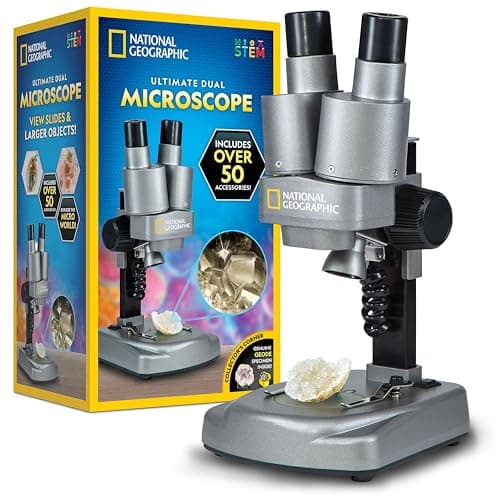
The National Geographic Dual LED Student Microscope is the best instrument under $100 and the one a child keeps using. For half that, the National Geographic 400x kit publishes light from above and below plus eighteen specimens, and the BEAVERLAB Finder is the pick if two people want to look at the same thing at once.
Block & Beaker earns a commission when you buy through our links, at no cost to you. It never changes a ranking, and we say so plainly when the right answer is the cheaper set, or nothing at all. Full disclosure · How we pick.
At a glance
The picks, ranked
Tap any row to jump to the full reasoning. Prices come live from Amazon where we have them and read “check price” where we don’t — never a number we cannot stand behind today.
| # | Product | Best for | Price |
|---|---|---|---|
| 1 | Best overall under $100 NATIONAL GEOGRAPHIC Dual LED Student Microscope A real compound microscope with both lighting directions, at the top of this price band. | Ten and up, as the instrument a serious child does not outgrow in a year | |
| 2 | 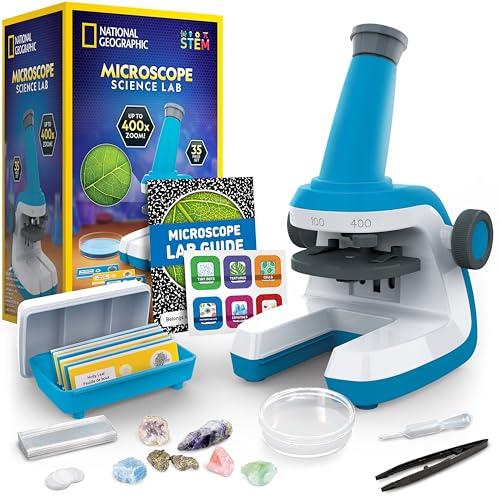 Best value — eighteen specimens in the box NATIONAL GEOGRAPHIC Microscope for Kids, Up to 400x 400x, lights above and below, and eighteen specimens including six blanks to prepare. | Six and up, where the kit has to be usable the minute it is unwrapped | |
| 3 | 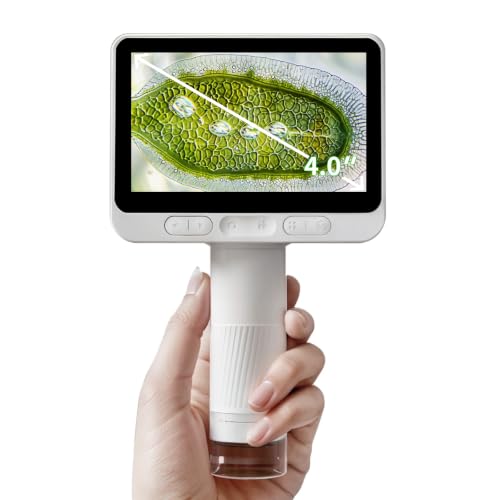 Best for two children at once BEAVERLAB Finder 4.0-inch Handheld Digital Microscope A 4-inch screen, 100X-1600X and 1080p capture, so what the child found can be saved. | Any age that can hold it - the screen means nobody has to take turns | |
| 4 | 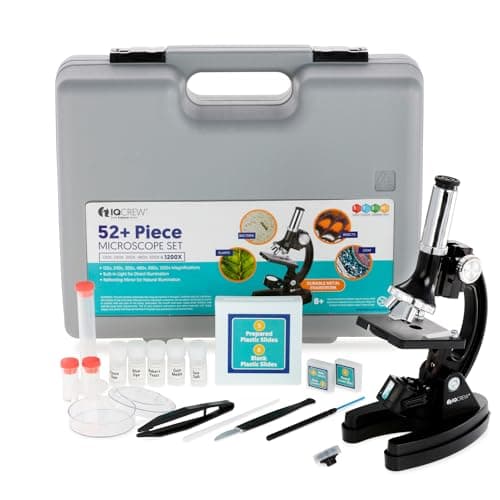 Cheapest real compound microscope AmScope 120X-1200X Beginner Microscope Kit A 120X-1200X compound instrument with a kit of accessories, under forty dollars. | Eight and up, where the budget is tight and the optics still have to be real | |
| 5 | 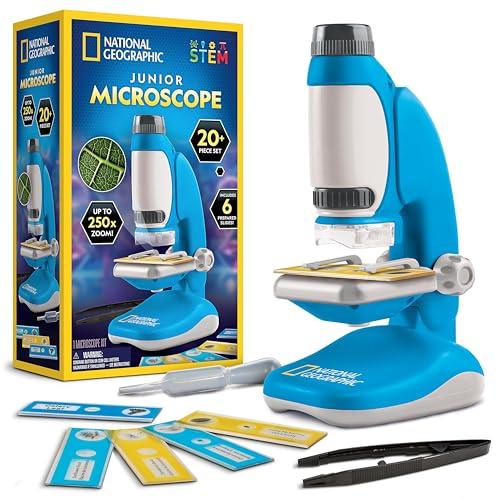 Best for under eight NATIONAL GEOGRAPHIC Junior Microscope Science Kit, 250x 50x-250x with a head that detaches from the stand, plus twelve slides. | A younger child who will take it outside rather than sit at a desk | |
| — | 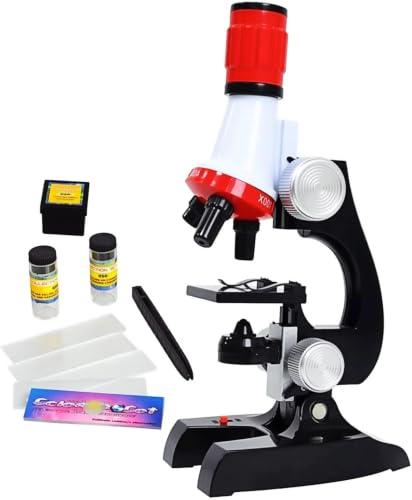 The one to skip Little World Beginner Microscope Kit, 100X/400X/1200X 1200X on the box, one LED, no published optics and two different age bands in one listing. | Nobody, at this price, once the published figures are read side by side |
6 picks, including 1 we tell you to skip. Ages shown are the manufacturer’s own rating, not ours.
The three published figures that decide this
The arithmetic
Kids microscopes under $100: lighting, ceiling and what is in the box
| NatGeo Dual LED Student | Compound. Light above and below. The instrument of the group |
|---|---|
| NatGeo 400x kit | Up to 400x. Light above and below. 18 specimens, 6 blank |
| BEAVERLAB Finder | 100X-1600X digital. 4-inch screen. 8 lights. No slides |
| AmScope M30 kit | 120X-1200X compound. Accessory kit. Ages 8+ |
| NatGeo Junior | 50x-250x. Light above and below. Detachable head. 12 slides |
| Little World 1200X | 100X/400X/1200X. One LED. Optics not published |
Why light from above matters more than magnification
Transmitted light — from below — is for prepared slides. Thin, translucent, factory-mounted things. Every microscope here has it, because it is the cheap one to build.
Reflected light — from above — is for everything else. A coin, a scab, a dead wasp, the weave of a sleeve. This is the list a child actually brings to a microscope, and an instrument without a top light cannot show any of it.
That is the whole reason “Dual LED” appears in a product name. It is a one-dollar component that doubles the number of things the instrument is for, and it is the first thing cut below about thirty dollars. See microscope versus telescope if the decision is still open.
What 1200X on a box really means
Magnification is free; resolution is not. Any instrument can be given a higher-power eyepiece. Whether it resolves anything new at that power depends on the objective, which is the part makers at this price do not publish.
Higher power means a darker, shallower image. At the top step a child is looking at a dim blur that will not hold focus, and the usual conclusion is that microscopes are boring.
400x is where a school microscope lives for a reason. It resolves plant cells, protozoa and the structures in a prepared slide, and it stays bright enough to find them. Treat anything above it as a specification, not a setting.
Worth knowing before you buy
Say the unwelcome thing
Do not buy on the magnification number
Two instruments on this page publish 1200X or more and neither is the best pick here. The figure costs a maker nothing to print and tells a buyer nothing about whether the image at that power is usable. The specifications worth paying for are the ones that are expensive to provide: a second light source, a real objective turret, and specimens in the box.
Where to go next
Microscopes for kids is the category without the cap, microscopes for teens is the older end including instruments well above $100, and lab tools for kids covers the slides, stains and tweezers that make any of them usable.
In full
Every pick, and what is wrong with it
Published specifications only, each linked back to the page it came from. Where a manufacturer publishes nothing, the row says so — we do not fill blanks in.
1. Best overall under $100
NATIONAL GEOGRAPHIC Dual LED Student Microscope
National Geographic · Dual LED Student Microscope · maker rates it 8+
A real compound microscope with both lighting directions, at the top of this price band.
- Magnifications
- 20x and 50x, from two sets of optical glass lenses
- Lighting
- Upper and lower LED
- Accessories
- 50+ pieces, including 10 prepared slides, blank slides and covers, tweezers, eye-dropper and a mini geode
- Weight
- 2.6 lb
National Geographic publishes the Dual LED Student Microscope with both reflected and transmitted lighting and a compound optical train. The figures are in the review.
Dual LED is the specification that matters and the one cheap instruments cut. Light from below goes through a thin prepared slide; light from above lets a child look at a coin, a feather or a fly’s wing. An instrument with only one of those can only do half of microscopy.
It is the pick our general microscope page and microscopes for teens both carry, and at $100 it is the ceiling of this page rather than a compromise.
Replay signal
- Open-ended or one-shot
- Open-ended, and the low magnification is the reason — 20x is where insects and leaves look extraordinary
- Does anything run out
- The 10 prepared slides run out; blank slides and the garden do not
- Room to grow
- Limited on magnification, generous on subject matter
Why we say so: National Geographic publishes 20x and 50x with upper and lower LED lighting. Low magnification plus top lighting is a deliberate design for looking at whole objects rather than slides, which for a child under about ten is a far better first microscope than a 1000x compound scope they cannot focus.
What’s wrong with it
The most expensive pick here, and a child who only wanted to look at a leaf did not need it.
| Magnifications | 20x and 50x, from two sets of optical glass lenses |
|---|---|
| Lighting | Upper and lower LED |
| Accessories | 50+ pieces, including 10 prepared slides, blank slides and covers, tweezers, eye-dropper and a mini geode |
| Weight | 2.6 lb |
| Stated age | 8+ |
Every figure above is from National Geographic toys, Dual LED Student Microscope. Blanks are shown as “not published” rather than filled in.
2. Best value — eighteen specimens in the box
NATIONAL GEOGRAPHIC Microscope for Kids, Up to 400x
National Geographic · NGMICROST · maker rates it 6+
400x, lights above and below, and eighteen specimens including six blanks to prepare.
- Magnification
- “Up to 400x”, across “Three levels of magnification”
- Lighting
- “lights above and below” — reflected and transmitted, which is the useful pair
- Specimens included
- “6 prepared plant slides … along with 6 rocks and minerals, and 6 blank slides to prepare at home”
- Tools
- “a pipette, specimen dish, tweezers, and easy-to-follow instructions”
National Geographic publishes “Up to 400x” across three magnification levels, “lights above and below”, and “6 prepared plant slides … along with 6 rocks and minerals, and 6 blank slides to prepare at home”, plus a pipette, specimen dish and tweezers.
The six blanks are the figure to buy on. A microscope with only prepared slides is a viewer: the child looks at six factory specimens and is finished. Blanks turn it into an instrument, because the next specimen is whatever is in the garden.
Large focus knobs and a soft-touch eyepiece are published as the usability features, and at six years old they are the difference between a focused image and a frustrated child. See lab tools for kids for what else a young scientist needs.
Replay signal
- Open-ended or one-shot
- Six blank slides mean the child can mount anything from the garden, which is where the second week comes from
- Does anything run out
- Blank slides run out; everything else is reusable
- Room to grow
- 400x is the top of its published range, so a committed child outgrows it
- Adult required
- None published; the large focus knobs are specified as the reason
Why we say so: National Geographic publishes 400x, light from both above and below, and eighteen specimens including six blanks. Lighting from above is what lets a child look at a coin or an insect wing rather than only at a factory-prepared slide, and that is the difference between a microscope used twice and one used all winter.
What’s wrong with it
400x is the ceiling, so a committed twelve-year-old will want more within a year.
| Magnification | “Up to 400x”, across “Three levels of magnification” |
|---|---|
| Lighting | “lights above and below” — reflected and transmitted, which is the useful pair |
| Specimens included | “6 prepared plant slides … along with 6 rocks and minerals, and 6 blank slides to prepare at home” |
| Tools | “a pipette, specimen dish, tweezers, and easy-to-follow instructions” |
| Controls | “Large focus knobs, a soft-touch eyepiece, and an adjustable platform” |
| Stated age | “Ages 6+” |
| Consumables | The 6 blank slides; prepared slides and rocks are permanent |
Every figure above is from National Geographic / Blue Marble, Microscope for Kids (NGMICROST) — published listing copy. Blanks are shown as “not published” rather than filled in.
3. Best for two children at once
BEAVERLAB Finder 4.0-inch Handheld Digital Microscope
BEAVERLAB · DDL-M2 · maker rates it Not published
A 4-inch screen, 100X-1600X and 1080p capture, so what the child found can be saved.
- Magnification
- “a resolution range of 100X-1600X”
- Screen
- “a 4.0" IPS display screen and 1080P high-definition imaging”
- Capture
- “a 2MP CMOS chips, allow you to capture full HD videos and photos in 1920x1080 resolution”
- Transfer
- “a built-in hotspot” for sending images to a phone
BEAVERLAB publishes a 4.0-inch IPS screen, “a resolution range of 100X-1600X”, a 2MP sensor capturing 1920x1080 stills and video, eight adjustable lights and a built-in hotspot for sending images to a phone.
A screen changes the social shape of the thing. An eyepiece is strictly one child at a time, and the second child waits; a screen means a parent can see what is being described, which is most of what makes a microscope session last longer than four minutes.
Buy slides with it. The listing publishes no specimens, so budget for a prepared-slide set or the session ends after the first fingertip.
Replay signal
- Open-ended or one-shot
- No slide stage to be tied to — it is pointed at whatever is in front of the child
- Does anything run out
- Nothing runs out, and nothing is included to run out of either
- Room to grow
- The capture and transfer features give it a second life as a camera
- Adult required
- None published
Why we say so: BEAVERLAB publishes a 4-inch screen, 100X-1600X, 1080p capture and a built-in hotspot. A screen changes who uses it: two children can look at the same thing at once, and a photograph of what they found survives the session, which an eyepiece-only instrument cannot do.
What’s wrong with it
No slides are published as included, so there is nothing to look at on day one.
| Magnification | “a resolution range of 100X-1600X” |
|---|---|
| Screen | “a 4.0" IPS display screen and 1080P high-definition imaging” |
| Capture | “a 2MP CMOS chips, allow you to capture full HD videos and photos in 1920x1080 resolution” |
| Transfer | “a built-in hotspot” for sending images to a phone |
| Lighting | “8 adjustable lights” |
| Stated age | Not published. Marketed for “boys girls” with no band given |
| Consumables | None; no slides are published as included |
Every figure above is from BEAVERLAB, Finder 4.0-inch Microscope (DDL-M2) — published listing copy. Blanks are shown as “not published” rather than filled in.
4. Cheapest real compound microscope
AmScope 120X-1200X Beginner Microscope Kit
AmScope · M30-ABS-KT2 · maker rates it 8+
A 120X-1200X compound instrument with a kit of accessories, under forty dollars.
- Magnifications
- Six levels — 120x, 240x, 300x, 480x, 600x and 1200x
- Frame
- Metal arm, with stage clips
- Lighting
- Built-in LED plus a reflecting mirror
- Extras
- Rotating color filter wheel; 52-piece accessory kit
AmScope publishes the M30-ABS-KT2 as a 120X-1200X compound microscope sold with a beginner accessory kit, for ages 8 and up. The review has the published figures, and it is a pick on microscopes for teens.
What AmScope gets right at this price is that it is a microscope company: the body is a real compound stand with a real objective turret, not a toy shape with a lens in it.
Treat the top of the published range as a specification rather than a working setting. At 1200X on a sub-$40 instrument the field is dark and shallow; 120X and 400X are where a child will actually spend the afternoon.
Replay signal
- Open-ended or one-shot
- Open-ended — specimens are free and infinite
- Does anything run out
- The prepared slides in the accessory kit run out; blank slides do not
- Room to grow
- 1200x is well past what a child needs and past what the optics comfortably resolve, but the metal frame will outlast the interest
Why we say so: AmScope publishes six magnification levels, a metal arm and a 70 x 65 mm stage. Treat the top magnification with skepticism — at 1200x an entry-level objective delivers a large, dim, blurry image — and buy this for the metal frame and the usable lower range instead.
What’s wrong with it
Upper magnifications on any instrument at this price are dim, and that is physics rather than a defect.
| Magnifications | Six levels — 120x, 240x, 300x, 480x, 600x and 1200x |
|---|---|
| Frame | Metal arm, with stage clips |
| Lighting | Built-in LED plus a reflecting mirror |
| Extras | Rotating color filter wheel; 52-piece accessory kit |
| Stage | 70 x 65 mm |
| Shipping weight | 6 lb — AmScope publishes no product weight |
| Stated age | “For ages 8+” |
Every figure above is from AmScope, M30-ABS-KT2 microscope. Blanks are shown as “not published” rather than filled in.
5. Best for under eight
NATIONAL GEOGRAPHIC Junior Microscope Science Kit, 250x
National Geographic · RTMICROJR · maker rates it Not published — the listing says “beginner”
50x-250x with a head that detaches from the stand, plus twelve slides.
- Magnification
- “The zoom dial allows magnification from 50x-250x”
- Lighting
- “lights above and below”
- Dual use
- A “Handheld Mini Attachment” — the head detaches for use away from the stand
- Specimens included
- “6 prepared slides … along with 6 blank slides to prepare at home”
National Geographic publishes a zoom dial from 50x to 250x, lights above and below, a “Handheld Mini Attachment” so the head comes off the stand, and six prepared plus six blank slides.
The detachable head is the pick. A six-year-old does not want to carry a specimen to the microscope; they want to take the microscope to the thing in the garden, and a fixed stand is what ends that session.
Read the ceiling honestly. 250x is enough to see cell walls in an onion skin and not enough for much beyond that, so this is a first instrument rather than a lasting one. Our science kits by age page has the wider ladder.
Replay signal
- Open-ended or one-shot
- The detachable head is the open-ended part — it goes to whatever the child found outside
- Does anything run out
- Blank slides run out
- Room to grow
- 250x is a low ceiling; this is a first instrument rather than a lasting one
Why we say so: National Geographic publishes a 50x-250x zoom, both lighting directions, and a head that comes off the stand. For a child under eight, a detachable 250x head gets pointed at a leaf on the kitchen table, which is more microscopy than a 1200x instrument they cannot focus.
What’s wrong with it
250x is a low ceiling, and the listing publishes no age band at all.
| Magnification | “The zoom dial allows magnification from 50x-250x” |
|---|---|
| Lighting | “lights above and below” |
| Dual use | A “Handheld Mini Attachment” — the head detaches for use away from the stand |
| Specimens included | “6 prepared slides … along with 6 blank slides to prepare at home” |
| Tools | “a pipette, tweezers, easy-to-follow instructions, and a lab guide” |
| Stated age | Not published. The listing calls it a “Beginner STEM Toy” |
| Consumables | The 6 blank slides |
Every figure above is from National Geographic / Blue Marble, Junior Microscope Science Kit (RTMICROJR) — published listing copy. Blanks are shown as “not published” rather than filled in.
Skip this one
Little World Beginner Microscope Kit, 100X/400X/1200X
Little World · XWJ-1200-001 · maker rates it 5-7 and 8-12 (both bands appear in the same listing)
1200X on the box, one LED, no published optics and two different age bands in one listing.
- Magnification
- “100X, 400X, and 1200X magnification levels”
- Head
- “monocular viewing head with LED light”
- Lighting
- One LED. No second light source is published
- Specimens included
- “prepared slides to dissection tools” — no count is published for either
Little World publishes “100X, 400X, and 1200X magnification levels” and a “monocular viewing head with LED light” — one light. No objective specification, no numerical aperture and no slide count appear anywhere in the listing, and the age band is given as both “5-7” and “8-12”.
One light source is the disqualifying figure, not the price. With illumination only from below, every opaque specimen — a coin, a leaf, a bug — is a silhouette, which removes most of what a child wants to look at.
For a few dollars more the National Geographic Junior publishes both lighting directions, twelve slides and a detachable head. That is the comparison that makes this the skip.
Replay signal
- Open-ended or one-shot
- Limited — one light source and an unpublished slide count
- Does anything run out
- The prepared slides are finite and no count is given
- Room to grow
- None published
Why we say so: Little World publishes three magnification steps up to 1200X and one LED, and publishes nothing about the objectives that would have to deliver it. On a toy optical train the top step is where the image goes dim and soft, so the number on the box is the step a child stops using — and the listing gives two different age bands for the same instrument.
What’s wrong with it
The headline number is unsupported by anything else the maker publishes.
| Magnification | “100X, 400X, and 1200X magnification levels” |
|---|---|
| Head | “monocular viewing head with LED light” |
| Lighting | One LED. No second light source is published |
| Specimens included | “prepared slides to dissection tools” — no count is published for either |
| Optics | Not published. No objective specification, no numerical aperture and no lens material appear |
| Stated age | “ages 5-7 and 8-12” — the listing gives both bands at once |
| Batteries | “2 AA batteries required, not included” |
Every figure above is from Little World, Beginner Microscope Kit (XWJ-1200-001) — published listing copy. Blanks are shown as “not published” rather than filled in.
We are not putting a buy button on this one. It is easy enough to find if you want it anyway — but we would rather send you to something that gets played with twice.
Questions people actually ask
Frequently asked
What is the best kids microscope under $100?
The National Geographic Dual LED Student Microscope. It is a compound instrument with both reflected and transmitted lighting, which is what lets a child look at opaque objects as well as prepared slides - and that is the specification cheaper instruments drop. Dual LED Student Microscope review.
Is 1200x magnification good for a kids microscope?
It is a number rather than a capability. Magnification is cheap to add; resolution depends on the objective lens, which makers at this price do not publish. At the top step the image is dim and will not hold focus, so 400x is where a school microscope sensibly lives.
Do kids microscopes need lights above and below?
Yes, if the child is going to look at anything that is not a prepared slide. Light from below passes through thin translucent specimens; light from above is what shows a coin, a feather or an insect. An instrument with only the bottom light can do half of microscopy.
Is a digital microscope better than an eyepiece one for kids?
It is better for sharing and worse for optics. A screen lets two people look at once and saves a photograph of what was found, which keeps a session going; a compound eyepiece instrument at the same price has better glass. The BEAVERLAB Finder is the screen pick here.
What age is a microscope suitable for?
Makers publish 6 and up for the kits with large focus knobs and plastic slides, and 8 and up for compound instruments with glass slides. The limiting skill is focusing, not interest - which is why a detachable-head model suits a younger child better than a bigger stand. Science kits by age.
Sources
Where these figures came from
Every specification on this page traces to one of these. If a manufacturer publishes nothing on a point, the page says so rather than filling the gap.
Read next
Where to go from here
Back to Science Kits, or read how we pick.