The picks
Logic Games for 7 and 8 Year Olds
Three years of waiting end here. Every game with a published challenge count above a hundred becomes available at seven or eight.
By Sawyer V. · Published
The short answer
Kanoodle is the pick at seven: Educational Insights publishes 200+ puzzles at ages 7 and up, across flat 2D layouts and 3D pyramids. At eight, Gravity Maze adds 60 challenges with real marbles and Code Master adds 60 levels of programming logic. IQ Puzzler Pro publishes 120 challenges from 6 and is the one that works at both ages.
Block & Beaker earns a commission when you buy through our links, at no cost to you. It never changes a ranking, and we say so plainly when the right answer is the cheaper set, or nothing at all. Full disclosure · How we pick.
At a glance
The picks, ranked
Tap any row to jump to the full reasoning. Prices come live from Amazon where we have them and read “check price” where we don’t — never a number we cannot stand behind today.
| # | Product | Best for | Price |
|---|---|---|---|
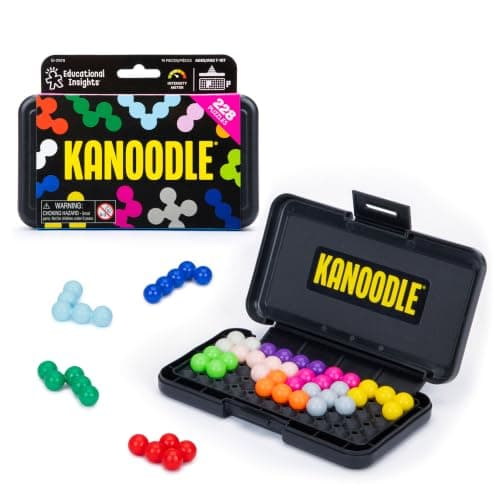
| 1 | Highest published challenge count Kanoodle 200+ published puzzles across two formats — flat 2D layouts and 3D pyramids. | Seven and up, including in a car | |
| 2 | 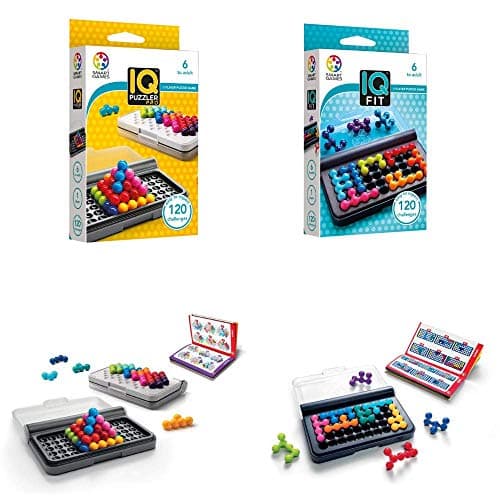 Best at both ages SmartGames IQ Puzzler Pro 120 challenges across 2D and 3D, in a board that is also the travel case. | Seven and eight, and then well past both | |
| 3 | 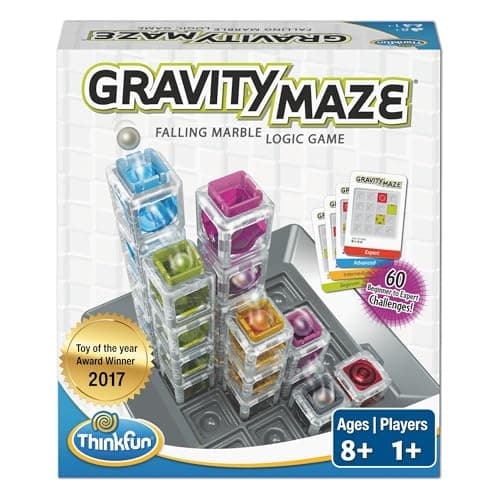 Best at eight, and the most physical ThinkFun Gravity Maze 60 graded challenges where the marble either reaches the target or does not. | Eight and up, for a child who wants to see it work | |
| 4 | 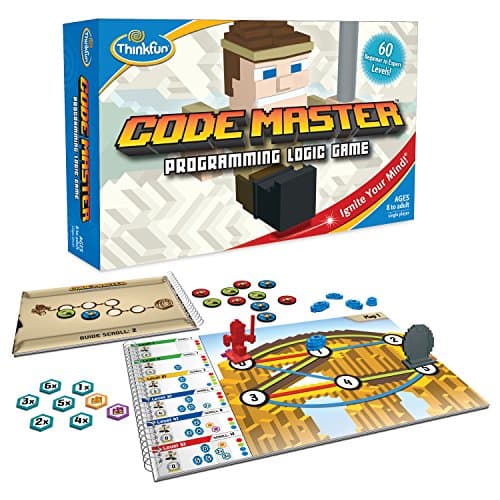 Best crossover into coding ThinkFun Code Master 60 levels that teach sequencing, loops and conditionals without a screen. | Eight and nine, with no device involved | |
| — | 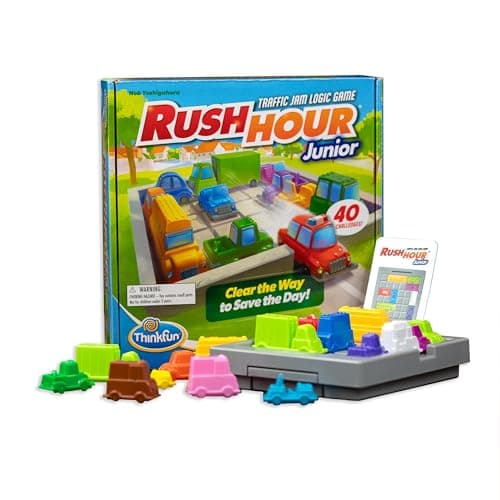 Two years behind them ThinkFun Rush Hour Junior 40 self-checking challenges in a travel bag — the right game at five. | Five to seven |
5 picks, including 1 we tell you to skip. Ages shown are the manufacturer’s own rating, not ours.
What unlocks at seven and eight
The arithmetic
Logic games: published age and published challenge count
| Rush Hour Junior | Ages 5+ — 40 challenges, self-checking, 1 player |
|---|---|
| Mental Blox | Ages 5+ — 20 blocks, 20 cards, works as a group activity |
| MathLink Cubes | Ages 5 and up — 100 cubes, no cards at all |
| IQ Puzzler Pro | Ages 6 to adult — 120 challenges, 2D and 3D |
| Kanoodle | Ages 7 and up — 200+ puzzles, 2D and 3D |
| Gravity Maze | Ages 8+ — 60 challenges, 9 towers, 3 marbles |
| Code Master | Ages 8 and up — 60 levels, loops and conditionals |
| Circuit Maze | Ages 8+ — 60 challenges, real circuits |
What a seven-year-old can do that a five-year-old cannot
Work backwards from the goal. This is the skill the 6+ and 7+ games are built on and the reason they publish where they do. Kanoodle and IQ Puzzler Pro both require looking at an empty space and asking which piece could possibly fill it, rather than trying pieces until one fits.
Hold a plan through several moves. Gravity Maze needs a tower placed now for a reason that only pays off two towers later. Five cannot do that reliably; eight can.
Tolerate being stuck. The published difficulty ladders at this age are steep on purpose. A seven-year-old will leave a puzzle out overnight and come back to it, which is why a 200-challenge game does not simply become 200 defeats.
The number to compare, and the number to ignore
Compare published challenge counts. It is the one figure every maker in this category states and it maps directly onto how long the game lasts: 40, 60, 120, 200+. At seven or eight you are choosing between a few weeks and a couple of years.
Ignore how much plastic is in the box. IQ Puzzler Pro publishes twelve puzzle pieces and 120 challenges; Kanoodle publishes connected-bead pieces in one small case and 200+ puzzles. In this category the content is the challenge booklet, not the component count.
Check whether it proves itself. Gravity Maze needs no answer key because the marble is the answer. SmartGames publishes solutions inside IQ Puzzler Pro’s challenge booklet, which is convenient for a parent and a temptation for a child.
Two children, same table
Almost everything on this page publishes a single player, which is a real limitation if there are siblings close in age. The two ways around it:
Buy one and take turns on the challenge card. It works better here than in most categories, because a challenge has one setup and a visible result — two children can argue about where a tower goes productively.
Or buy the group-capable game. Learning Resources publishes Mental Blox at 5+ with 20 blocks and 20 cards and describes it working as a group activity, which is the exception in a category of solo puzzles. See gifts for siblings to share.
Worth knowing before you buy
So which one
They are seven, one game, make it last: Kanoodle and its 200+ puzzles.
You are not sure how far ahead they are: IQ Puzzler Pro, published 6 to adult.
They need to see it work rather than be told: Gravity Maze, from eight.
They are heading towards coding: Code Master, from eight.
There are two of them: Mental Blox handles a table, and MathLink Cubes handles any number of children at once.
Say the unwelcome thing
Do not buy the Junior edition at seven or eight
It is stocked beside the standard edition, costs a little less and publishes a fifth of the challenges. Rush Hour Junior publishes 40 challenges at 5+ against Kanoodle’s 200+ at 7+ — and the Junior is an excellent game for a five-year-old, which is exactly why it is still on the shelf. At seven and eight the published floor is behind you and the only thing worth paying for is the ceiling.
Where to go next
Logic games for 5 year olds is the rung below, choosing a first logic game covers the decision from scratch, and STEM games for one player covers the single-player end in depth.
In full
Every pick, and what is wrong with it
Published specifications only, each linked back to the page it came from. Where a manufacturer publishes nothing, the row says so — we do not fill blanks in.
1. Highest published challenge count
Kanoodle
Educational Insights · Kanoodle · maker rates it 7+
200+ published puzzles across two formats — flat 2D layouts and 3D pyramids.
- Puzzles
- 200+
- Formats
- Two — flat 2D puzzles and 3D pyramids
- Pieces
- Connected-bead puzzle pieces
- Players
- 1
Educational Insights publishes Kanoodle at ages 7 and up with 200+ puzzles across two formats — flat 2D puzzles and 3D pyramids — connected-bead puzzle pieces, one player, and no batteries.
Two hundred is the largest published challenge count of any logic game on this site and it is the reason seven matters: nothing available at five or six comes close, and a 200-puzzle game bought at seven is still being finished at nine.
Two formats is the quiet reason it keeps being replayed. The 3D pyramids are a genuine step up rather than more of the same, so the second half of the booklet is still unfamiliar after the first half is done. See the Kanoodle review and Kanoodle against IQ Puzzler Pro.
Replay signal
- Open-ended or one-shot
- Finite, but 200+ published puzzles is the largest count on this site
- Does anything run out
- Nothing runs out; the booklet is long enough to feel endless
- Room to grow
- 2D first, then the 3D pyramid set, which is a genuine step in difficulty
Why we say so: Educational Insights publishes 200-plus puzzles across 2D and 3D formats from one small case. Two hundred is roughly three times what a typical single-player logic game ships with, which is why this one survives a long car journey and a wet week.
What’s wrong with it
Published for one player only, so it is no help when two children want the same thing.
| Puzzles | 200+ |
|---|---|
| Formats | Two — flat 2D puzzles and 3D pyramids |
| Pieces | Connected-bead puzzle pieces |
| Players | 1 |
| Batteries | None |
| Stated age | Ages 7 and up |
Every figure above is from Educational Insights, Kanoodle. Blanks are shown as “not published” rather than filled in.
2. Best at both ages
SmartGames IQ Puzzler Pro
SmartGames · SG455 · maker rates it 6+
120 challenges across 2D and 3D, in a board that is also the travel case.
- Challenges
- 120, across 2D and 3D modes
- Contents
- Compact board with a transparent lid, 12 puzzle pieces, challenge booklet with solutions
- Players
- 1
- Batteries
- None
SmartGames publishes 120 challenges across 2D and 3D modes, a compact board with a transparent lid, 12 puzzle pieces and a challenge booklet with solutions, for one player, with no batteries, rated ages 6 to adult.
The only game here whose published range starts below seven and runs to adult, which makes it the safe answer when you are buying for a seven-year-old and do not know how far ahead they are. The 2D challenges are approachable at six; the 3D ones are not trivial for an adult.
Published 6 to adult is also the cleanest example of a rating that is a floor rather than a target. See the IQ Puzzler Pro review.
Replay signal
- Open-ended or one-shot
- Finite, but 120 challenges is roughly double what most single-player puzzle games ship with
- Does anything run out
- The booklet ends. The pieces do not
- Room to grow
- The same 12 pieces run 2D and 3D challenge sets, so the difficulty ceiling is well above the entry point
Why we say so: SmartGames publishes 120 challenges across two modes from a single 12-piece set. Twelve pieces generating 120 published problems is the best challenge-per-component ratio of any logic game on this site, and it is the reason this one travels well and lasts.
What’s wrong with it
Solutions are printed in the booklet, in the same box as the puzzles.
| Challenges | 120, across 2D and 3D modes |
|---|---|
| Contents | Compact board with a transparent lid, 12 puzzle pieces, challenge booklet with solutions |
| Players | 1 |
| Batteries | None |
| Stated age | Ages 6 to adult |
| Travel case | Yes — the board is the case |
Every figure above is from SmartGames, IQ Puzzler Pro. Blanks are shown as “not published” rather than filled in.
3. Best at eight, and the most physical
ThinkFun Gravity Maze
ThinkFun · 44001006 · maker rates it 8+
60 graded challenges where the marble either reaches the target or does not.
- Challenges
- 60, beginner to expert
- Contents
- Game grid, 9 towers, 1 target piece, 3 marbles, 60 challenge cards
- Players
- 1
- Batteries
- None
ThinkFun publishes 60 challenges from beginner to expert, a game grid, 9 towers, 1 target piece, 3 marbles and 60 challenge cards, for one player, with no batteries, rated ages 8+.
Self-proving is what sets this apart at eight. There is no answer to check: the marble arrives at the target or it does not, so the child needs nobody in the room and gets an unambiguous result every attempt.
It is also the only game here where the solution is a three-dimensional structure rather than a flat arrangement, which is a genuinely different skill. See the Gravity Maze review and spatial reasoning toys.
Replay signal
- Open-ended or one-shot
- Finite by design — 60 challenges, and a determined child will finish them
- Does anything run out
- Nothing physically runs out, but the challenge cards do end
- Room to grow
- The towers can be used freely once the cards are done, though nothing in the box prompts that
Why we say so: ThinkFun publishes 60 challenges and a fixed component list. Sixty is a real number with a real end, and single-player puzzle games are the category where that matters most — better to know before you buy it as the main present.
What’s wrong with it
Three marbles and a published 8+ rating. Not a floor toy in a house with a toddler.
| Challenges | 60, beginner to expert |
|---|---|
| Contents | Game grid, 9 towers, 1 target piece, 3 marbles, 60 challenge cards |
| Players | 1 |
| Batteries | None |
| Stated age | Ages 8+ |
| Consumables | None |
Every figure above is from ThinkFun, Gravity Maze. Blanks are shown as “not published” rather than filled in.
4. Best crossover into coding
ThinkFun Code Master
ThinkFun · 1950 · maker rates it 8+
60 levels that teach sequencing, loops and conditionals without a screen.
- Levels
- 60, beginner to expert
- Players
- 1
- Format
- Map-based programming logic — sequence the avatar's moves to collect power crystals
- Batteries
- None
ThinkFun publishes 60 levels from beginner to expert, a single player, map-based programming logic in which the player sequences an avatar’s moves to collect power crystals, and no batteries, rated ages 8 and up.
This is a logic game that happens to be the cheapest coding purchase on the site. The published levels introduce loops and conditionals by difficulty rather than by explanation, which is exactly how a child meets them in a block editor later.
Eight is the published floor and it is accurate here rather than cautious — the early levels are not watered down, so a seven-year-old often stalls. See the Code Master review and coding board games.
Replay signal
- Open-ended or one-shot
- Finite — 60 levels, and they are worked through in order
- Does anything run out
- Nothing runs out, but the level book does end
- Room to grow
- The later levels introduce conditionals and loops, so the concept ladder is real rather than cosmetic
Why we say so: ThinkFun publishes 60 levels from beginner to expert and a map-and-sequence format. The concepts the later levels introduce — branching and repetition — are the same two ideas that make a real program, which is why this works as preparation for a screen rather than as a substitute for one.
What’s wrong with it
Sixty levels and then it is over. There is no expansion.
| Levels | 60, beginner to expert |
|---|---|
| Players | 1 |
| Format | Map-based programming logic — sequence the avatar's moves to collect power crystals |
| Batteries | None |
| Stated age | Ages 8 and up |
Every figure above is from ThinkFun, Code Master. Blanks are shown as “not published” rather than filled in.
Skip this one
ThinkFun Rush Hour Junior
ThinkFun · 76583 · maker rates it 5+
40 self-checking challenges in a travel bag — the right game at five.
- Challenges
- 40, easy to expert
- Contents
- Ice cream truck, 15 blocking vehicles, 40 challenge cards, travel bag
- Players
- 1
- Batteries
- None
ThinkFun publishes 40 challenges across four tiers from easy to expert, an ice cream truck, 15 blocking vehicles, 40 challenge cards and a travel bag, for a single player, with no batteries, rated ages 5+.
An excellent game on the wrong page, and the specific mistake this page exists to prevent. The Junior edition is the version stocked beside the others and it publishes a fifth of Kanoodle’s challenge count; bought at eight it is over before the holiday is.
If the shelf has a Junior and a standard edition side by side at seven or eight, buy the standard one. See logic games for 5 year olds, where this is the top pick.
Replay signal
- Open-ended or one-shot
- Finite — 40 challenges
- Does anything run out
- The cards end; the grid does not, and children invent their own jams
- Room to grow
- Steps up to the full Rush Hour at 8+, same idea with harder cards
Why we say so: ThinkFun publishes 40 challenges across four difficulty tiers and a travel bag. Forty single-player puzzles is a school holiday, not a year — which is the honest framing for a gift-buyer.
What’s wrong with it
Forty challenges, published at 5+. At eight it is finished in a weekend.
| Challenges | 40, easy to expert |
|---|---|
| Contents | Ice cream truck, 15 blocking vehicles, 40 challenge cards, travel bag |
| Players | 1 |
| Batteries | None |
| Stated age | Ages 5+ |
Every figure above is from ThinkFun, Rush Hour Junior. Blanks are shown as “not published” rather than filled in.
We are not putting a buy button on this one. It is easy enough to find if you want it anyway — but we would rather send you to something that gets played with twice.
Questions people actually ask
Frequently asked
What is the best logic game for a 7 year old?
Kanoodle. Educational Insights publishes it at ages 7 and up with 200+ puzzles across two formats, flat 2D layouts and 3D pyramids - the highest published challenge count of any logic game here, and the reason seven is the age it becomes worth buying. Kanoodle review.
What logic games are published for 8 year olds?
ThinkFun publishes Gravity Maze at 8+ with 60 challenges, Code Master at 8 and up with 60 levels, and Circuit Maze at 8+ with 60 challenges. Kanoodle (7 and up) and IQ Puzzler Pro (6 to adult) are both still well within range at eight.
Kanoodle or IQ Puzzler Pro for a 7 year old?
Kanoodle if you want the most puzzles - 200+ against 120. IQ Puzzler Pro if you are unsure how far ahead the child is, because SmartGames publishes it as 6 to adult, so the easy end is genuinely easy and the 3D end is not trivial for a grown-up. Kanoodle vs IQ Puzzler Pro.
Should I buy Rush Hour Junior for an 8 year old?
No. ThinkFun publishes 40 challenges at ages 5+, which is a fifth of Kanoodle's count. The Junior edition is the right game at five and the standard mis-buy at eight, because it sits on the shelf next to games with three to five times the content. Logic games for 5 year olds.
Which logic game does not need an adult?
Gravity Maze, because it proves itself - ThinkFun publishes 9 towers, a target piece and 3 marbles, and the marble either reaches the target or does not. SmartGames publishes solutions inside IQ Puzzler Pro's challenge booklet, which works unaided but is also available to look up.
Can two children play these together?
Most publish a single player. Learning Resources publishes Mental Blox at 5+ with 20 blocks and 20 cards and describes it working as a group activity, and MathLink Cubes (100 cubes, 5 and up) suits any number of children at once. Gifts for siblings to share.
Does the piece count tell you how good a logic game is?
No. IQ Puzzler Pro publishes twelve puzzle pieces and 120 challenges; Kanoodle publishes connected-bead pieces and 200+ puzzles. The content in this category is the challenge booklet, so the published challenge count is the figure that predicts how long the game lasts.
Sources
Where these figures came from
Every specification on this page traces to one of these. If a manufacturer publishes nothing on a point, the page says so rather than filling the gap.
Read next
Where to go from here
Back to Math & Logic, or read how we pick.