Single review
Sphero indi Review
Reviewed from the manufacturer's published specifications and the arithmetic on them. We have not used it, and we say so.
By Sawyer V. · Published
The short answer
Sphero indi publishes an on-board color sensor as its programming mechanism, 30 color cards with a stated color breakdown, 2+ hours of play per charge over USB, and optional drag-and-drop block coding in the free Sphero Edu Jr app, rated 4 and up. The published upgrade path is what nothing else in this category offers.
Block & Beaker earns a commission when you buy through our links, at no cost to you. It never changes a ranking, and we say so plainly when the right answer is the cheaper set, or nothing at all. Full disclosure · How we pick.
At a glance
The picks, ranked
Tap any row to jump to the full reasoning. Prices come live from Amazon where we have them and read “check price” where we don’t — never a number we cannot stand behind today.
| # | Product | Best for | Price |
|---|---|---|---|
| 1 | The product Sphero indi At-Home Learning Kit Screen-free color-card programming that grows into real block coding without buying a second robot. | Four to eight, in a household that wants a coding path later | |
| 2 | 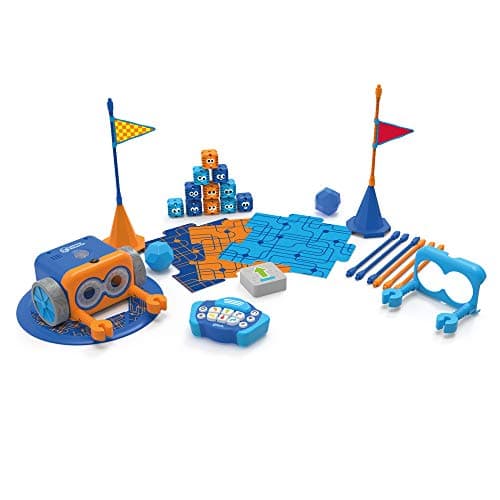 The higher ceiling Botley 2.0 The Coding Robot Activity Set A published 150-step maximum program, which is the highest in screen-free coding. | Five and up, with no screen path wanted | |
| 3 | 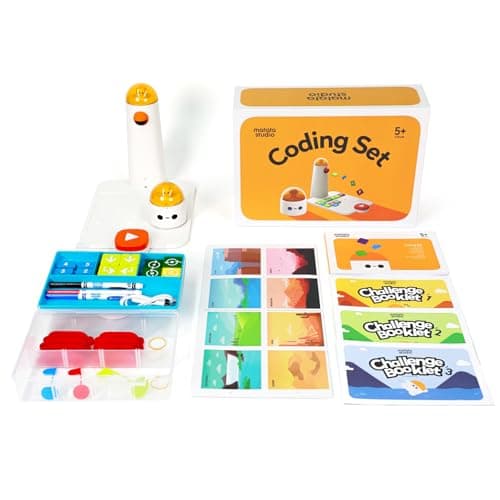 The rechargeable no-app option MatataStudio (Matatalab) Coding Set Published as screen-free, app-free and internet-free, with rechargeable cells throughout. | A household that wants zero screens and zero batteries | |
| — | Not a robot ThinkFun Robot Turtles Regularly recommended alongside coding robots, and it needs a grown-up at the table. | Four, with an adult who will play |
4 picks, including 1 we tell you to skip. Ages shown are the manufacturer’s own rating, not ours.
What we can tell you, and what we cannot
We have not driven this robot. No lab, no samples, no test children, and no star rating here or in the structured data.
Published mechanisms, card counts, charge times and upgrade paths we can report. Whether the color sensor copes with a patterned rug, and how the cards survive being taped down twenty times, we cannot.
The specification that decides it
The arithmetic
Sphero indi At-Home Learning Kit, published
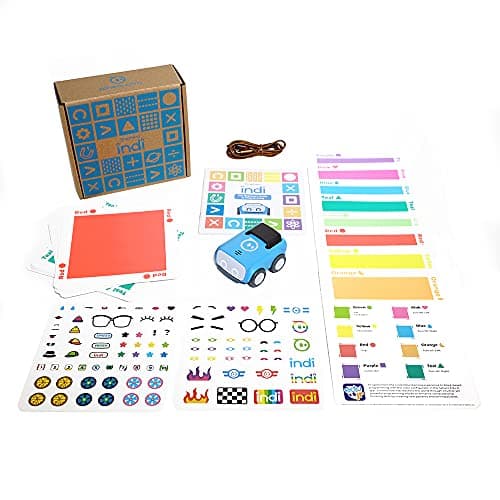
| Contents | 1 robot, 30 color cards, charging cable, 2 sticker sheets, activity booklet, tape |
|---|---|
| Card mix | 5 green, 4 yellow, 3 red, 2 purple, 3 teal, 3 orange, 5 blue, 5 pink |
| How it is coded | On-board color sensor — no screen needed |
| Play time | 2+ hours on a full charge, USB |
| Optional app | Sphero Edu Jr, drag-and-drop blocks |
| Stated age | Ages 4 and up |
| Disposable batteries | None |
What the numbers mean in practice
Rechargeable removes the category’s worst failure mode. Coding robots die on AAA cells nobody has. USB charging means the robot is flat for an hour rather than until somebody goes shopping.
Thirty cards is a small number that behaves like a large one. The program is a physical route across a room, so the same thirty cards make a different puzzle in every layout.
The tape in the box is a warning. Sphero includes it because loose cards slide. Plan for a floor that can be taped, or expect the setup to be the least fun part.
Who should skip it
A household with no floor to spare. This is a room-scale toy. On a small rug it becomes a very short program.
Anyone who wants the highest ceiling and no screen, ever. Botley’s published 150-step maximum is the bigger number, and it never asks for a device.
Worth knowing before you buy
The kit includes tape for fixing cards to the floor. Test it on an inconspicuous patch first — the published instruction is to secure the cards, not which surfaces will survive it.
Where it sits
indi appears in the coding robots roundup, in screen-free coding toys and on the four-year-old page. For what comes after it, see from coding toy to real code.
In full
Every pick, and what is wrong with it
Published specifications only, each linked back to the page it came from. Where a manufacturer publishes nothing, the row says so — we do not fill blanks in.
1. The product
Sphero indi At-Home Learning Kit
Sphero · indi · maker rates it 4+
Screen-free color-card programming that grows into real block coding without buying a second robot.
- Contents
- 1 indi robot, 30 color cards, charging cable, 2 sticker sheets, activity booklet, tape to fix the cards down
- Card mix
- 5 green, 4 yellow, 3 red, 2 purple, 3 teal, 3 orange, 5 blue, 5 pink
- How it is coded
- An on-board color sensor reads the cards; no screen needed
- Play time
- “2+ hours of play on a full charge”, USB charging
Sphero publishes the card mix precisely: 5 green, 4 yellow, 3 red, 2 purple, 3 teal, 3 orange, 5 blue and 5 pink. The robot reads colors with an on-board sensor, so the program is the floor.
That mechanism is why this works at four. There is nothing to read and no interface to learn — a child lays a path, and the consequences are immediate and physical.
The published second act is what makes it a longer purchase than its rivals. When cards stop being interesting, the same hardware accepts drag-and-drop block coding in the free Sphero Edu Jr app. Most screen-free robots simply end.
Replay signal
- Open-ended or one-shot
- Very open-ended for the age: the child lays the track out across the whole floor
- Does anything run out
- Nothing runs out; recharges by USB
- Room to grow
- Screen-free cards first, then the same robot accepts block coding in the free app when the child is ready
- Adult required
- Not after setup — the program is the floor, and the child builds it
Why we say so: Sphero publishes the 30-card color breakdown, the on-board color sensor as the programming method, the 2+ hours per charge, and the optional step up to drag-and-drop blocks in Sphero Edu Jr.
What’s wrong with it
Programming means laying and taping 30 cards across a floor, which is a real commitment in a tidy house.
| Contents | 1 indi robot, 30 color cards, charging cable, 2 sticker sheets, activity booklet, tape to fix the cards down |
|---|---|
| Card mix | 5 green, 4 yellow, 3 red, 2 purple, 3 teal, 3 orange, 5 blue, 5 pink |
| How it is coded | An on-board color sensor reads the cards; no screen needed |
| Play time | “2+ hours of play on a full charge”, USB charging |
| Optional app | Sphero Edu Jr drag-and-drop blocks |
| Stated age | Ages 4 and up |
Every figure above is from Sphero, indi At-Home Learning Kit. Blanks are shown as “not published” rather than filled in.
2. The higher ceiling
Botley 2.0 The Coding Robot Activity Set
Learning Resources · LER2938 · maker rates it 5+
A published 150-step maximum program, which is the highest in screen-free coding.
- Set size
- 78 pieces
- Contents
- Botley 2.0, remote programmer, 2 face plates, 40 coding cards, 6 double-sided boards, 27 obstacle pieces, starter guide
- Maximum program length
- “coding sequences of up to 150 steps”
- Movement
- Six directions, plus 16 coded interactions
Learning Resources publishes 78 pieces, sequences up to 150 steps, six directions of movement and 16 coded interactions, 100% screen-free, rated 5+.
Botley is the better buy if you never want a screen involved. indi is the better buy if you think a screen is eventually coming and would rather it arrived on a robot the child already trusts.
Replay signal
- Open-ended or one-shot
- Open-ended once the cards are understood — the child builds the maze, not just the program
- Does anything run out
- Nothing runs out except batteries
- Room to grow
- A 150-step ceiling means the challenge scales for years past the first week
- Adult required
- Needed for the first session, then not — there is no app account and nothing to log into
Why we say so: Learning Resources publishes the 78-piece contents, the 150-step maximum sequence, the six directions and 16 interactions, and states the set is 100% screen-free with no tablet or app required.
What’s wrong with it
Five AAA batteries, not included, and no published upgrade to block or text coding.
| Set size | 78 pieces |
|---|---|
| Contents | Botley 2.0, remote programmer, 2 face plates, 40 coding cards, 6 double-sided boards, 27 obstacle pieces, starter guide |
| Maximum program length | “coding sequences of up to 150 steps” |
| Movement | Six directions, plus 16 coded interactions |
| Screen required | None — “100% screen-free play” |
| Batteries | “Requires 5 AAA batteries (not included)” |
| Stated age | 5+ (K-2nd grade) |
Every figure above is from Learning Resources, Botley 2.0 Activity Set. Blanks are shown as “not published” rather than filled in.
3. The rechargeable no-app option
MatataStudio (Matatalab) Coding Set
MatataStudio · Coding Set · maker rates it 4+
Published as screen-free, app-free and internet-free, with rechargeable cells throughout.
- Contents
- Robot car, command tower, control board, 37 coding blocks, 8 obstacles, 3 flags, 3 challenge booklets, nature map
- Screen required
- None — “screen-free, app-free and internet-free”
- Literacy required
- None — blocks use “intuitive graphic symbols” and directional language
- Power
- Rechargeable — 500 mAh cell in the robot, 2000 mAh in the command tower, USB-C
MatataStudio publishes intuitive graphic symbols requiring no literacy, a 500 mAh cell in the robot and 2000 mAh in the command tower over USB-C, rated 4 to 9.
Between the two rechargeable options, indi is simpler and Matatalab is more expressive. Both remove the AAA problem that dogs this category.
Replay signal
- Open-ended or one-shot
- Semi-open: three challenge booklets first, then free building on the map
- Does anything run out
- Nothing runs out, and it recharges rather than eating AAAs
- Room to grow
- Add-on sets extend the same command tower into music and drawing
- Adult required
- No reading needed, so a four-year-old can set up a run unaided
Why we say so: MatataStudio publishes the full contents list, the rechargeable cell capacities, and states the blocks use graphic symbols so no literacy is required.
What’s wrong with it
A command tower plus blocks is more equipment to store and set up than a pack of cards.
| Contents | Robot car, command tower, control board, 37 coding blocks, 8 obstacles, 3 flags, 3 challenge booklets, nature map |
|---|---|
| Screen required | None — “screen-free, app-free and internet-free” |
| Literacy required | None — blocks use “intuitive graphic symbols” and directional language |
| Power | Rechargeable — 500 mAh cell in the robot, 2000 mAh in the command tower, USB-C |
| Stated age | Ages 4 to 9 |
Every figure above is from MatataStudio, Coding Set. Blanks are shown as “not published” rather than filled in.
Skip this one
ThinkFun Robot Turtles
ThinkFun · 1900 · maker rates it 4+
Regularly recommended alongside coding robots, and it needs a grown-up at the table.
- Stated age
- Ages 4 and up
- Players
- 2-5, one of whom is an adult acting as “the computer”
- Batteries
- None
- Format
- Board game teaching programming fundamentals
Robot Turtles teaches the same sequencing ideas as a board game, with no batteries and nothing to charge. It is genuinely good.
It is also published as requiring an adult to act as the computer, which makes it a different product from a robot a child can use alone on a wet Tuesday. Adult-needed is one of the four things we check, and here it is not a caveat but the format.
Replay signal
- Open-ended or one-shot
- Open-ended, because the adult builds the board — difficulty scales with the child rather than with a deck
- Does anything run out
- Nothing runs out
- Room to grow
- The published rules add function cards and obstacles as the child improves
- Adult required
- Yes, always — an adult plays the computer. That is the design, and it is the whole cost
Why we say so: ThinkFun publishes the 4+ rating and the rule that an adult executes the child's program. An adult being structurally required is the single biggest predictor of whether a toy actually gets used, so it belongs in the headline rather than the small print.
What’s wrong with it
Published as 2-5 players, one of whom is an adult acting as the computer.
| Stated age | Ages 4 and up |
|---|---|
| Players | 2-5, one of whom is an adult acting as “the computer” |
| Batteries | None |
| Format | Board game teaching programming fundamentals |
| Consumables | None |
Every figure above is from ThinkFun games. Blanks are shown as “not published” rather than filled in.
We are not putting a buy button on this one. It is easy enough to find if you want it anyway — but we would rather send you to something that gets played with twice.
Questions people actually ask
Frequently asked
Does Sphero indi need an app?
No. Sphero publishes an on-board color sensor as the programming mechanism, so the robot is fully usable with the 30 color cards and no device at all. The Sphero Edu Jr block-coding app is published as optional and free.
What age is Sphero indi for?
Sphero publishes ages 4 and up. It works that early because programming means laying colored cards on the floor — there is nothing to read and no interface to learn.
How long does Sphero indi last on a charge?
Sphero publishes 2+ hours of play on a full charge, over USB. There are no disposable batteries, which removes the most common reason a coding robot sits unused. The battery guide.
Sphero indi or Botley 2.0?
Botley publishes the higher ceiling — sequences up to 150 steps — and never involves a screen. indi publishes a path onto real block coding using the same robot. Buy Botley to keep screens out; buy indi if a screen is coming anyway and you would rather buy one robot than two.
Sources
Where these figures came from
Every specification on this page traces to one of these. If a manufacturer publishes nothing on a point, the page says so rather than filling the gap.
Read next
Where to go from here
Back to Reviews, or read how we pick.