Single review
National Geographic Gemstone Advent Calendar Review
Reviewed from Blue Marble's published specifications. We have not opened one. It is the only advent calendar we can find with a consumable count of zero — and the only one with no published age at all.
By Sawyer V. · Published
The short answer
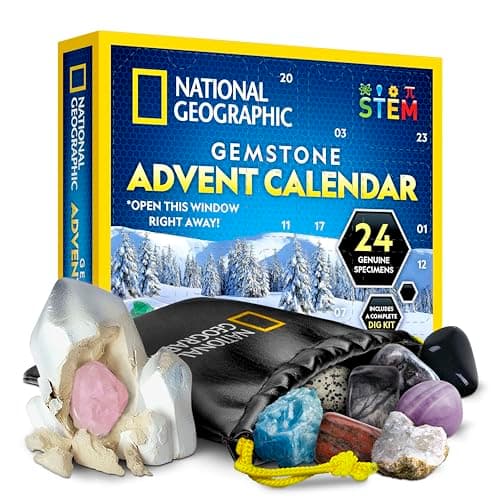
The National Geographic Gemstone Advent Calendar is the advent calendar to buy when the gift should still exist in June. Blue Marble publishes 24 polished gemstones — naming agate, green aventurine, hematite, sodalite, turquenite, tiger’s eye and blue calcite — five jewelry settings, a collector’s pouch, and a final-day rose quartz excavated from a mini dig brick. It publishes no experiment and, unusually, no age rating. Consumable count: zero, which is unique in this category.
Block & Beaker earns a commission when you buy through our links, at no cost to you. It never changes a ranking, and we say so plainly when the right answer is the cheaper set, or nothing at all. Full disclosure · How we pick.
At a glance
The picks, ranked
Tap any row to jump to the full reasoning. Prices come live from Amazon where we have them and read “check price” where we don’t — never a number we cannot stand behind today.
| # | Product | Best for | Price |
|---|---|---|---|
| 1 | The product NATIONAL GEOGRAPHIC Gemstone Advent Calendar 24 polished stones, 5 jewelry settings, a pouch and a final-day rose quartz dig. | A child who already collects things, in a house with no toddler on the floor | |
| 2 | 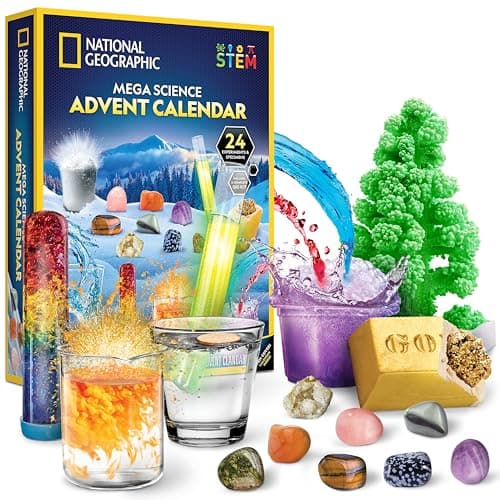 Buy this instead if there should be something to do NATIONAL GEOGRAPHIC Science Advent Calendar 13 experiments plus 11 named specimens, a pouch, and a final-day pyrite dig. | Eight to twelve, for a child who wants to open a box and then do something | |
| 3 | 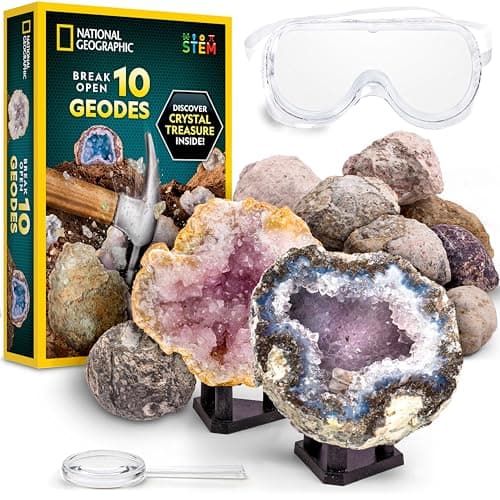 The better first rock collection NATIONAL GEOGRAPHIC Break Open 10 Premium Geodes 10 hand-selected geodes with goggles, a magnifier, display stands and a learning guide. | Eight and up, for a child who has never owned a specimen | |
| 4 | 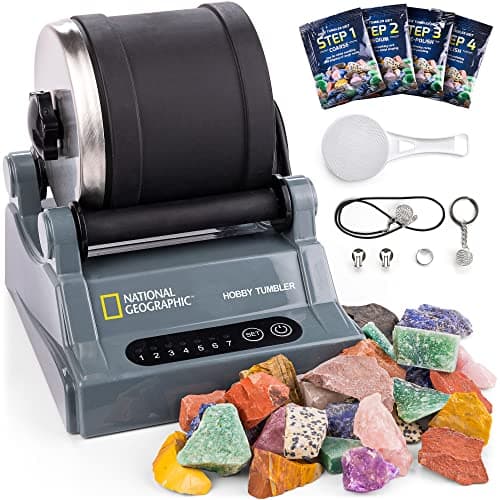 Where a stone collection goes next NATIONAL GEOGRAPHIC Hobby Rock Tumbler Kit A tumbler, four polishing grits, nine types of rough gemstone and jewelry fastenings. | Eight and up, once the child wants to make the stones rather than receive them | |
| — | 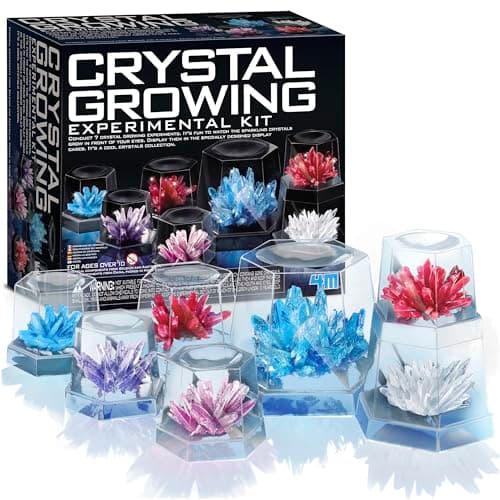 Grown crystals are not a stone collection 4M Crystal Growing Experiment Kit 7 crystal-growing experiments with display bases, covers and ring templates. | Ten and up, as a genuinely good and completely different purchase |
5 picks, including 1 we tell you to skip. Ages shown are the manufacturer’s own rating, not ours.
What we can tell you, and what we cannot
We have not opened one. No lab, no samples, no test children, and no star rating on this page or in its structured data. Everything below is Blue Marble’s own published information plus arithmetic.
Three things to be precise about, and the first is unusual enough to be the most useful sentence here. Blue Marble publishes this product as an Amazon exclusive, which means there is no maker product page behind it — natgeotoys.com carries the brand but not this item. Everything published about it is the listing, and the listing does not state an age. That is why we cite a brand site rather than a product page in the sources, and it is almost certainly why people search for “national geographic advent calendar instructions” and “instructions pdf”: there is no manual to download because the product does not have one.
Second, the stone list is published as a sample, not an inventory. Blue Marble names seven species “and more”, so we can tell you seven of the twenty-four and not the rest. Any page claiming the full list is guessing. Third, no piece dimensions or stone sizes are published, so we cannot tell you how big the stones are — which matters for the safety question below, and we are not going to estimate it.
The specification that decides it
The arithmetic
National Geographic Gemstone Advent Calendar, published
| Days | 24 |
|---|---|
| Gemstones | 24 polished — agate, green aventurine, hematite, sodalite, turquenite, tiger's eye, blue calcite “and more” |
| Final day | Rose quartz, excavated from a mini dig brick |
| Permanent objects | 25 stones, plus 5 jewelry settings and a pouch |
| Consumed on the day | 0 — nothing in the box is used up |
| Experiments | None published |
| Learning guide | None published |
| Stated age | Not published by the manufacturer |
| Stone dimensions | Not published |
| Distribution | “Blue Marble has developed this product exclusively for Amazon” |
| Maker | Blue Marble / JMW Sales under the National Geographic brand |
What the numbers mean in practice
Zero consumables is rare enough to be the whole argument. This site’s organizing question is whether a thing keeps getting picked up, and most December products answer it badly by construction: a calendar is designed to be finished. Twenty-five stones in a pouch are still twenty-five stones in a pouch at Easter.
Twenty-four is also a lot of stones at once. That cuts both ways. It is more specimens than the Science calendar’s eleven and more than the ten geodes in the Break Open set — but they arrive one a day with no context, and a child who does not already care about rocks will have a pile rather than a collection by the 12th. This is a calendar for a child with an existing interest.
The dig brick is well placed and slightly oversold. Putting the only excavation on the 24th is good sequencing — the one activity needing real time lands on the morning that has it. But it is one brick and one rose quartz, and the published comparison is the Break Open set’s ten geodes, each of which is also a thing you open.
Five jewelry settings is the most under-described part of the box. Blue Marble publishes the count and nothing else: no type, no size, no material. For a product whose main after-December use is making jewelry, that is thin, and we are not going to fill it in. Treat five settings as five, and assume the stones that fit them are whichever ones happen to fit.
And the missing age rating is a real omission, not a formality. Every other National Geographic product in this catalog publishes one — 8-12 for the Science calendar, 8+ for the rock tumbler, 8+ for the geodes with an explicit “not for children under 3”. This product publishes none, and it contains two dozen small polished stones.
Who should skip it
Any house with a child who still mouths things. This is the clearest skip on the page and it is not about the owner. Twenty-four small stones distributed over three weeks, in the month a living-room floor is at its worst, with no published age rating and no published stone size. Wait a year.
Anyone who wanted the child to do science in December. There is none here, by design. The Science calendar publishes 13 experiments and the Thames & Kosmos calendar publishes 24.
A child starting from no interest in rocks at all. Twenty-four handed-over stones is the wrong introduction. Ten geodes you crack open yourself is the right one.
Anyone buying after the first few days of December. A 24-door structure started on the 10th is fifteen stones handed over at once, which is a bag of rocks rather than a countdown. See STEM advent calendars for the deadline this category has and the rest of the shelf.
Worth knowing before you buy
Where it sits
The calendar belongs in STEM advent calendars, where it is the zero-consumables pick, beside the National Geographic Science calendar and the Thames & Kosmos Vol. 4 review. The collection it builds leads to rock and geology kits and the rock tumbler; the gift framing is at Christmas STEM gifts and gifts for a child who has everything, which is the shelf this one genuinely suits.
In full
Every pick, and what is wrong with it
Published specifications only, each linked back to the page it came from. Where a manufacturer publishes nothing, the row says so — we do not fill blanks in.
1. The product
NATIONAL GEOGRAPHIC Gemstone Advent Calendar
National Geographic · NGGEMADVENT · maker rates it Not published
24 polished stones, 5 jewelry settings, a pouch and a final-day rose quartz dig.
- Days
- 24
- Gemstones
- 24 polished stones — “agate, green aventurine, hematite, sodalite, turquenite, tiger's eye, blue calcite and more”
- Final day
- Rose quartz excavated from a mini dig brick
- Jewelry settings
- 5 — “so kids can create their own special jewelry with their new gemstones”
Blue Marble publishes 24 polished gemstones, naming agate, green aventurine, hematite, sodalite, turquenite, tiger’s eye and blue calcite among them; five jewelry settings “so kids can create their own special jewelry with their new gemstones”; a collector’s pouch; and on the final day a rose quartz the child unearths from a mini dig brick “just like a real geologist”. It is published as an Amazon exclusive.
Count the objects rather than the doors and the product gets clearer. Twenty-four stones plus the rose quartz is 25 permanent things, and the five settings and the pouch are six more. Nothing in the box is used up, mixed, grown or spent — which makes this the only calendar in the category with a consumable count of zero, and the only one that passes this site’s own test for whether a thing keeps getting picked up.
The named stones matter more than the number. A named specimen can be looked up, written on a card and told apart from the one beside it; an unnamed one is gravel. Seven species named on the listing is enough for a child to start sorting by something other than color, which is the moment a bag of stones becomes a collection.
The jewelry settings are the published after-December use and they are the reason this is not simply a bag of stones with a cardboard front. Five is a small number — it is five pieces of jewelry, not twenty-four — but it gives the collection somewhere to go on 26 December, which is the day most advent calendars stop being interesting.
The honest drawbacks are two and both are real. There is no science to do: Blue Marble publishes no experiment, no activity and no learning guide for this product. And there is no published age, which on 24 small polished stones is a gap rather than an oversight — see the safety note below.
Replay signal
- Open-ended or one-shot
- Not open-ended, but nothing is used up either — 24 objects that stay objects
- Does anything run out
- Nothing runs out
- Room to grow
- Five jewelry settings and a pouch are the published after-December use
Why we say so: Blue Marble publishes 24 polished gemstones, a final-day rose quartz dig brick, five jewelry settings and a collector's pouch, and publishes no experiment at all. That makes this the only calendar in this group with a zero consumable count — and the reason it belongs beside the geology shelf rather than the chemistry one.
What’s wrong with it
No experiments at all, and Blue Marble publishes no age rating for a box of 24 small stones.
| Days | 24 |
|---|---|
| Gemstones | 24 polished stones — “agate, green aventurine, hematite, sodalite, turquenite, tiger's eye, blue calcite and more” |
| Final day | Rose quartz excavated from a mini dig brick |
| Jewelry settings | 5 — “so kids can create their own special jewelry with their new gemstones” |
| Also included | Collector's pouch |
| Experiments | None — this is a specimen calendar, not an experiment calendar |
| Stated age | Not published by the manufacturer |
| Consumables | None — every one of the 24 days is a permanent object |
Every figure above is from National Geographic toys (Blue Marble), Gemstone Advent Calendar — published listing copy. Blanks are shown as “not published” rather than filled in.
2. Buy this instead if there should be something to do
NATIONAL GEOGRAPHIC Science Advent Calendar
National Geographic · NGSCIADVENT2 · maker rates it 8-12
13 experiments plus 11 named specimens, a pouch, and a final-day pyrite dig.
- Days
- 24
- Experiments
- 13 — “selected 13 incredible experiments from our science kits”
- Specimens
- 11 fossils and gemstones — “carnelian, chevron amethyst, snowflake obsidian, gastropod, geode, tiger's eye, and more”
- Final day
- A pyrite (fool's gold) specimen excavated from a mini dig brick
Blue Marble publishes 24 days split into 13 experiments “selected from our science kits” and 11 fossils and gemstones — carnelian, chevron amethyst, snowflake obsidian, a gastropod, a geode and tiger’s eye among them — with a storage pouch and a final-day pyrite specimen in a mini dig brick. Rated ages 8-12.
This is the direct alternative from the same maker and the decision between them is one question long: does the child want to own something each morning or do something. The Science calendar does both and therefore does each less — eleven specimens against twenty-four.
It also publishes an age band, 8-12, which this one does not. In a household weighing the two, that alone is worth something. See the Science calendar review.
Replay signal
- Open-ended or one-shot
- A 24-day structure with a published end date — this is an event, not a toy
- Does anything run out
- Yes — 13 of the 24 days are consumable experiments
- Room to grow
- The specimens and the pouch become a rock collection that outlives December
Why we say so: Blue Marble publishes 13 experiments and 11 specimens plus a final-day pyrite dig, which is the only split in this category that leaves something behind. Read the ratio rather than the day count: twelve of the twenty-four days hand over a permanent object, and that is the difference between a calendar and a box of twenty-four afternoons.
What’s wrong with it
Thirteen of the 24 doors are consumed on the day, and the experiments repeat the maker's own kits.
| Days | 24 |
|---|---|
| Experiments | 13 — “selected 13 incredible experiments from our science kits” |
| Specimens | 11 fossils and gemstones — “carnelian, chevron amethyst, snowflake obsidian, gastropod, geode, tiger's eye, and more” |
| Final day | A pyrite (fool's gold) specimen excavated from a mini dig brick |
| Experiments named | “hiding/revealing a secret message, making a test tube glow, floating coins, growing a colorful crystal tree” |
| Also included | Storage pouch for the specimen collection |
| Box wordmark | The box reads “Mega Science Advent Calendar” and carries a “24 experiments & specimens” badge; the listing title is “Science Advent Calendar”. Same product, model NGSCIADVENT2 |
| Stated age | Ages 8-12 |
| Consumables | Yes — the 13 experiments are single-use; the specimens are not |
Every figure above is from National Geographic toys (Blue Marble), Science Advent Calendar — published listing copy. Blanks are shown as “not published” rather than filled in.
3. The better first rock collection
NATIONAL GEOGRAPHIC Break Open 10 Premium Geodes
National Geographic · NGGEO10 · maker rates it 8+
10 hand-selected geodes with goggles, a magnifier, display stands and a learning guide.
- Geodes
- 10, hand-selected, 1.25 to 2.25 inches across
- Includes
- Safety goggles, magnifying glass, display stands, full-color learning guide
- Stated age
- Manufacturer's minimum age 8 years
- Safety note
- Contains small parts; not for children under 3
National Geographic publishes 10 hand-selected geodes between 1.25 and 2.25 inches across, with safety goggles, a magnifying glass, display stands and a full-color learning guide, rated 8+ with a published small-parts warning.
Worth putting beside the calendar because it answers the same want in the opposite order. A geode is a closed rock that the child opens; the calendar is an open box that hands over finished stones. For a first collection the geode wins, because cracking one is an event and being handed a polished stone is not.
The published learning guide is the other difference, and it is the thing the Gemstone calendar does not have at all. Buy the calendar for a child who already collects, and the geodes for the child who does not yet. See the Break Open Geodes review and rock and geology kits.
Replay signal
- Open-ended or one-shot
- One-shot by design. Ten geodes, ten moments, then it is a bowl of pretty rocks
- Does anything run out
- Yes, definitively — the clearest example on this site of a kit that ends
Why we say so: National Geographic publishes the count as ten natural geodes. Ten single-use items is a finite number, and we would rather say so than let a gift-buyer find out on Christmas afternoon.
What’s wrong with it
Each geode cracks open exactly once. Ten moments and then it is a display shelf.
| Geodes | 10, hand-selected, 1.25 to 2.25 inches across |
|---|---|
| Includes | Safety goggles, magnifying glass, display stands, full-color learning guide |
| Stated age | Manufacturer's minimum age 8 years |
| Safety note | Contains small parts; not for children under 3 |
| Consumables | Yes — ten geodes, and each one only cracks open once |
Every figure above is from National Geographic toys, Break Open Geodes. Blanks are shown as “not published” rather than filled in.
4. Where a stone collection goes next
NATIONAL GEOGRAPHIC Hobby Rock Tumbler Kit
National Geographic · Hobby Rock Tumbler · maker rates it 8+
A tumbler, four polishing grits, nine types of rough gemstone and jewelry fastenings.
- Includes
- Tumbler, four polishing grits, sifter, learning guide
- Rough gemstones
- Nine types
- Barrel
- Noise-reducing, leak-proof, stainless steel lid
- Controls
- One-touch settings with an automatic shutoff timer
National Geographic publishes a tumbler with four polishing grits, a sifter and a learning guide, nine types of rough gemstone, a noise-reducing leak-proof barrel with a stainless steel lid, one-touch controls with an automatic shutoff timer, and jewelry fastenings for the finished stones. Rated 8+.
It is the honest second purchase after a calendar like this one, and it closes the loop the calendar opens: the child who spent December being handed polished stones finds out in January that polishing is four grit stages and several weeks of machine time.
Both products publish jewelry fastenings, which is Blue Marble pointing at the same destination twice. See the rock tumbler review.
Replay signal
- Open-ended or one-shot
- Semi-open: the machine is permanent, the grit is not, and rocks from a beach are free
- Does anything run out
- The grits and the supplied gemstones run out; refill grit is sold separately
- Room to grow
- Once the supplied rough is gone, the tumbler works on anything the child collects
- Adult required
- For loading and for the timer; the tumbling itself is unattended
Why we say so: National Geographic publishes four polishing grits, nine gemstone types and an automatic shutoff timer. The machine outliving the grit is what makes this different from a one-shot geology kit — but it runs for days per batch, so it is a patience purchase, not an afternoon one.
What’s wrong with it
The four grits and the supplied rough are used up, and the machine runs for days at a time.
| Includes | Tumbler, four polishing grits, sifter, learning guide |
|---|---|
| Rough gemstones | Nine types |
| Barrel | Noise-reducing, leak-proof, stainless steel lid |
| Controls | One-touch settings with an automatic shutoff timer |
| Extras | Jewelry fastenings for the polished stones |
| Stated age | 8+ |
| Consumables | Yes — the four grits and the supplied rough are used up |
Every figure above is from National Geographic toys, Hobby Rock Tumbler Kit. Blanks are shown as “not published” rather than filled in.
Skip this one
4M Crystal Growing Experiment Kit
4M · 5557 · maker rates it 10+
7 crystal-growing experiments with display bases, covers and ring templates.
- Experiments
- 7 crystal-growing experiments
- Contents
- 3 bags of crystal compound, 3 bags of seeding mixture, stirring bowl and spoon, 7 display bases, 7 display covers, 7 ring templates
- Stated age
- 10 years and up
- Consumables
- Yes — the compound is the whole product
4M publishes 7 crystal-growing experiments with 3 bags of crystal compound, 3 bags of seeding mixture, a stirring bowl and spoon, and 7 display bases, covers and ring templates, rated 10 years and up, with each experiment taking days rather than minutes.
It is the skip on this page for a specific confusion worth naming: a shelf of glittering things in display cases looks like the same gift, and it is not. Grown crystals are a chemistry result. Gemstones are objects that came out of the ground. A child who wanted a rock collection and received seven grown crystals has been given something good and something else.
The consumable count is the clean way to see it. 4M publishes the compound as the whole product — when it is gone the kit is finished and the display cases are empty furniture. The calendar publishes 24 objects that are still 24 objects in June.
It is also published at 10 and up, which is four or five years above where this calendar gets bought. Both can be right purchases; they are not substitutes. See the 4M Crystal Growing review and crystal growing kits.
Replay signal
- Open-ended or one-shot
- One-shot, seven times over
- Does anything run out
- Definitively. Three bags of compound, and when they are gone the kit is a set of display cases
Why we say so: 4M publishes three bags of crystal compound across seven experiments. That is the arithmetic that decides this purchase: it is seven results, spread over weeks because crystals take days to grow, and then it is finished. Excellent as an event; poor as the main present.
What’s wrong with it
The compound is the whole product and it is used up. Published 10+, against this calendar's nothing.
| Experiments | 7 crystal-growing experiments |
|---|---|
| Contents | 3 bags of crystal compound, 3 bags of seeding mixture, stirring bowl and spoon, 7 display bases, 7 display covers, 7 ring templates |
| Stated age | 10 years and up |
| Consumables | Yes — the compound is the whole product |
| Time per experiment | Days, not minutes — crystals grow on their own schedule |
Every figure above is from 4M, Crystal Growing Experiment Kit. Blanks are shown as “not published” rather than filled in.
We are not putting a buy button on this one. It is easy enough to find if you want it anyway — but we would rather send you to something that gets played with twice.
Questions people actually ask
Frequently asked
Is the National Geographic Gemstone Advent Calendar worth it?
Yes, for a child who already collects things. Blue Marble publishes 24 polished gemstones, five jewelry settings, a collector's pouch and a final-day rose quartz dig brick, and publishes no experiment at all. That gives it a consumable count of zero - unique in the advent category - so the gift still exists in June.
What gemstones are in the National Geographic advent calendar?
Blue Marble names seven of the twenty-four: agate, green aventurine, hematite, sodalite, turquenite, tiger's eye and blue calcite, followed by "and more". The remaining stones are not published, so any full list is a guess. The final day is a rose quartz the child excavates from a mini dig brick.
What age is the Gemstone Advent Calendar for?
Blue Marble publishes no age rating for it, which is unusual - every other National Geographic product in this catalog publishes one, including 8-12 for the Science calendar and 8+ with "not for children under 3" for the Break Open Geodes. On a box containing 24 small polished stones, treat the absence as a reason for caution rather than permission. How to read a toy box.
Does the Gemstone Advent Calendar have any experiments?
No. Blue Marble publishes no experiment, no activity and no learning guide for this product - it is a specimen calendar. If the child should have something to do each morning, the Science calendar publishes 13 experiments among its 24 doors and Thames & Kosmos Vol. 4 publishes 24. STEM advent calendars compared.
Why is there no instruction manual for this advent calendar?
Because there is nothing to instruct. Blue Marble publishes it as an Amazon exclusive with no maker product page, no experiments and no learning guide, so no manual exists to download. Each door contains a finished polished stone; the only step is the final-day dig brick.
Should I buy this or the geode kit for a first rock collection?
The geodes, for a child who does not collect yet. National Geographic publishes 10 hand-selected geodes of 1.25 to 2.25 inches with safety goggles, a magnifier, display stands and a learning guide at 8+ - and cracking one open is an event. Being handed a finished stone is not. Buy the calendar for a child whose interest already exists. Break Open Geodes review.
What do you do with the gemstones after December?
Blue Marble publishes five jewelry settings and a collector's pouch as the intended use, though it publishes nothing about the settings' type, size or material. The natural next purchase is a tumbler - National Geographic publishes four grit stages and nine types of rough gemstone for its Hobby Rock Tumbler, which turns receiving polished stones into making them. Hobby Rock Tumbler review.
Sources
Where these figures came from
Every specification on this page traces to one of these. If a manufacturer publishes nothing on a point, the page says so rather than filling the gap.
Read next
Where to go from here
Back to Reviews, or read how we pick.