Single review
Celestron StarSense Explorer DX 130AZ Review
Reviewed from the manufacturer's published specifications and the arithmetic on them. We have not used it, and we say so.
By Sawyer V. · Published
The short answer
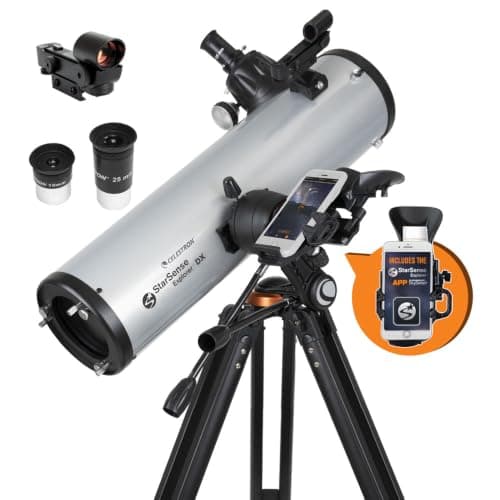
The Celestron StarSense Explorer DX 130AZ publishes 130 mm aperture, 650 mm focal length, f/5, a Newtonian reflector on an altazimuth mount with slow-motion controls, and the StarSense smartphone app that identifies where the telescope is pointing. Celestron publishes no stated age. The app is the specification that matters.
Block & Beaker earns a commission when you buy through our links, at no cost to you. It never changes a ranking, and we say so plainly when the right answer is the cheaper set, or nothing at all. Full disclosure · How we pick.
At a glance
The picks, ranked
Tap any row to jump to the full reasoning. Prices come live from Amazon where we have them and read “check price” where we don’t — never a number we cannot stand behind today.
| # | Product | Best for | Price |
|---|---|---|---|
| 1 | The product Celestron StarSense Explorer DX 130AZ 130 mm of aperture plus an app that removes the one step that ends most first telescope nights. | A family where nobody knows the night sky | |
| 2 | 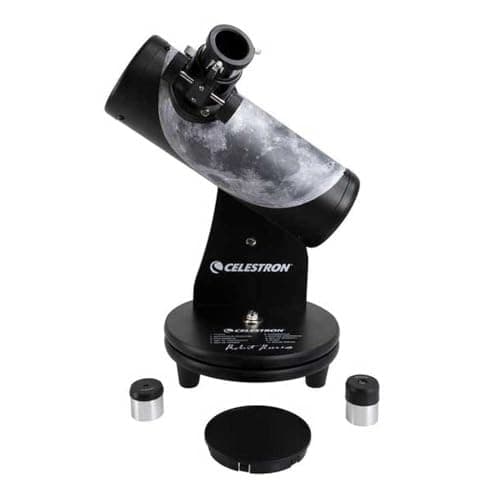 The simpler one Celestron FirstScope Telescope 76 mm on a stable table-top Dobsonian mount, with nothing to charge or install. | A first telescope with an adult already interested in the sky | |
| 3 | 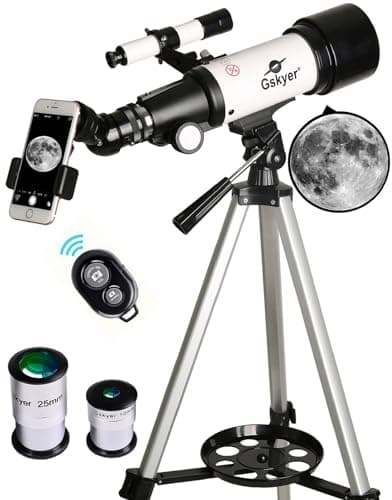 The portable refractor Gskyer AZ70400 Refractor Telescope 70 mm at f/5.7 with a finder scope, smartphone adapter and carry bag. | A household that travels to darker skies | |
| — | The instrument that gets used more My First Lab Duo-Scope Microscope Works indoors, in daylight, in any weather, with no conditions to coincide. | Most children, honestly | Sold direct by My First Lab → Not stocked on Amazon. This link goes to the maker and we earn nothing on it. |
4 picks, including 1 we tell you to skip. Ages shown are the manufacturer’s own rating, not ours.
What we can tell you, and what we cannot
We have not observed through this telescope. No lab, no samples, no test children, and no star rating on this page or in its structured data.
Published optics, mount design and app function we can report and reason about. How well the app performs under real light pollution, and how sharp the supplied eyepieces are, we cannot.
The specification that decides it
The arithmetic
StarSense Explorer DX 130AZ, published
| Aperture | 130 mm (5.1 in) |
|---|---|
| Focal length | 650 mm |
| Focal ratio | f/5 |
| Optical design | Newtonian reflector |
| Finding aid | StarSense app — phone identifies the sky and directs you |
| Mount | Altazimuth with slow-motion controls |
| Stated age | Not published |
| Consumables | None |
What the numbers mean in practice
130 mm is a real step up from a beginner scope. Light gathering scales with aperture area, so 130 mm collects substantially more than 76 mm. That shows up as brighter, steadier images rather than as bigger ones.
f/5 is a wide, forgiving focal ratio. It gives a wider field at a given eyepiece, which makes locating objects easier — helpful even with the app doing the pointing.
A phone is now a dependency. That is the trade. The app is the product’s reason to exist, and it means a charged phone is part of the equipment list on a cold night.
No published age rating means you judge readiness. We will not invent one. This is a full-size instrument that an adult sets up; a child can absolutely use it, but not carry or align it alone.
Worth knowing before you buy
Never point this or any telescope at the Sun and never leave a child alone with one in daylight. A Newtonian concentrates enormous heat at the eyepiece; solar observation requires purpose-made front-mounted filters, and eye damage is immediate and permanent.
Who should skip it
A household that will not go outside on cold clear nights. No specification fixes this, and the best telescope in the world is worse than a microscope that gets used.
Anyone wanting something a child can carry and set up alone. The table-top FirstScope is far more child-operable.
A buyer who does not want a phone involved. The app is the main reason to choose this model; without using it, you are paying for aperture alone.
Say the unwelcome thing
Do not buy a telescope for a child who has not asked for one
Telescopes have the widest gap on this site between how good a gift they sound and how often they get used. Four conditions have to coincide — darkness, clear sky, a stable spot, a willing adult — and in most households they rarely do.
If the interest in space is real but the conditions are not, microscope or telescope first sets out the honest alternative.
Where it sits
The StarSense is the top pick in telescopes for kids and appears in microscope or telescope first.
In full
Every pick, and what is wrong with it
Published specifications only, each linked back to the page it came from. Where a manufacturer publishes nothing, the row says so — we do not fill blanks in.
1. The product
Celestron StarSense Explorer DX 130AZ
Celestron · 22461 · maker rates it Not published
130 mm of aperture plus an app that removes the one step that ends most first telescope nights.
- Aperture
- 130 mm (5.1 in)
- Focal length
- 650 mm
- Focal ratio
- f/5
- Optical design
- Newtonian reflector
Celestron publishes 130 mm (5.1 in) aperture, 650 mm focal length, f/5, a Newtonian reflector design, an altazimuth mount with slow-motion controls, and the StarSense app which identifies the sky and directs you where to move.
The app is not a gimmick and it is worth being specific about why. The single most common way a first telescope fails is that nobody can find anything — the sky is large, objects are faint, and a beginner sweeping blindly gives up in twenty minutes. StarSense removes that step by working out where the tube is pointing and telling you which way to nudge it.
The 130 mm aperture is genuinely capable. It gathers meaningfully more light than the 76 mm FirstScope, which is the difference between Jupiter’s moons as points and beginning to see banding.
Slow-motion controls are the third useful published detail. They let you track an object as the Earth turns without knocking it out of view, which at higher magnification is otherwise constant.
Replay signal
- Open-ended or one-shot
- Open-ended — the sky is the consumable and it restocks itself
- Does anything run out
- Nothing runs out
- Room to grow
- Standard eyepieces; 130 mm gathers enough light for planets and brighter deep-sky objects
- Adult required
- Much less than a normal telescope. The published point of StarSense is that the phone does the finding
Why we say so: Celestron publishes 130 mm of aperture at 650 mm focal length, f/5, with a smartphone app that identifies where the telescope is pointing. The app is the specification that matters for a family: not finding anything is what ends most first telescope nights, and this removes that step.
What’s wrong with it
Large, needs a phone, and no stated age is published so the buyer has to judge readiness.
| Aperture | 130 mm (5.1 in) |
|---|---|
| Focal length | 650 mm |
| Focal ratio | f/5 |
| Optical design | Newtonian reflector |
| Finding aid | StarSense smartphone app — the phone identifies the sky and directs you |
| Mount | Altazimuth with slow-motion controls |
| Stated age | Not published |
Every figure above is from Celestron, StarSense Explorer DX 130AZ. Blanks are shown as “not published” rather than filled in.
2. The simpler one
Celestron FirstScope Telescope
Celestron · 21024 · maker rates it Not published
76 mm on a stable table-top Dobsonian mount, with nothing to charge or install.
- Aperture
- “76mm (2.99″)”
- Focal length
- “300mm (12″)”
- Focal ratio
- “f/3.95”
- Eyepiece 1
- 20mm, 15x magnification
Celestron publishes 76 mm aperture, 300 mm focal length, f/3.95, with 20 mm and 4 mm eyepieces giving 15x and 75x, on a Dobsonian-style table-top stand.
Cheaper, smaller, and it needs someone who can point it. If an adult in the household already finds the Moon and Jupiter without help, the extra cost of StarSense buys less.
Replay signal
- Open-ended or one-shot
- Open-ended in the most literal sense: the sky changes every month whether anyone touches it or not
- Does anything run out
- Nothing runs out
- Room to grow
- Standard eyepieces, so it accepts better ones later without replacing the telescope
- Adult required
- Finding the first object usually needs an adult; after that a tabletop Dobsonian is genuinely child-operable
Why we say so: Celestron publishes the 76mm aperture, 300mm focal length, f/3.95 ratio and both eyepiece magnifications. The table-top Dobsonian mount is the published design, and it is why a child can aim this one without a tripod fight.
What’s wrong with it
No finding aid at all, so an adult who knows the sky is effectively required.
| Aperture | “76mm (2.99″)” |
|---|---|
| Focal length | “300mm (12″)” |
| Focal ratio | “f/3.95” |
| Eyepiece 1 | 20mm, 15x magnification |
| Eyepiece 2 | 4mm, 75x magnification |
| Mount | “Dobsonian style stand”, table-top |
| Stated age | Not published — Celestron calls it “an ideal entry level astronomical telescope” |
Every figure above is from Celestron, FirstScope Telescope. Blanks are shown as “not published” rather than filled in.
3. The portable refractor
Gskyer AZ70400 Refractor Telescope
Gskyer · AZ70400 · maker rates it Not published
70 mm at f/5.7 with a finder scope, smartphone adapter and carry bag.
- Aperture
- 70 mm
- Focal length
- 400 mm
- Focal ratio
- f/5.7
- Eyepieces
- Two, giving 16x and 40x
Gskyer publishes 70 mm aperture, 400 mm focal length, f/5.7, two eyepieces giving 16x and 40x, a maximum of 120x with the supplied 3x Barlow, a 5x24 finder scope, smartphone adapter, wireless shutter remote and carry bag.
The carry bag is a real feature — light pollution limits a telescope more than aperture does, and a scope you can drive somewhere dark outperforms a bigger one you cannot move.
Replay signal
- Open-ended or one-shot
- Open-ended, and the carry bag means it goes where the sky is darker
- Does anything run out
- Nothing runs out
- Room to grow
- 16x and 40x are the useful range; the 120x figure is optimistic on 70 mm of aperture
Why we say so: Gskyer publishes 70 mm at 400 mm focal length with 16x and 40x eyepieces. Treat the 120x maximum with caution — 70 mm of aperture cannot resolve detail at that power, so the two supplied eyepieces are the range you will actually use.
What’s wrong with it
The published 120x maximum is optimistic on 70 mm — the 16x and 40x eyepieces are the real range.
| Aperture | 70 mm |
|---|---|
| Focal length | 400 mm |
| Focal ratio | f/5.7 |
| Eyepieces | Two, giving 16x and 40x |
| Maximum magnification | 120x, with the supplied 3x Barlow |
| Optical design | Refractor on an altazimuth mount |
| Extras | 5x24 finder scope, smartphone adapter, wireless shutter remote, carry bag |
Every figure above is from Gskyer, 70mm astronomical refractor telescope. Blanks are shown as “not published” rather than filled in.
Skip this one
My First Lab Duo-Scope Microscope
My First Lab · MFL-06 · maker rates it 9+
Works indoors, in daylight, in any weather, with no conditions to coincide.
- Magnifications
- 40x, 100x and 400x, from a 10x eyepiece with 4x, 10x and 40x objectives
- Optics
- Real optical glass lenses
- Lighting
- Dual LED, above and below the stage
- Slides included
- 5 blank, 1 concavity (well), 4 prepared
My First Lab publishes 40x, 100x and 400x, real optical glass, dual LED lighting above and below the stage and five blank slides, rated 9 and older.
We flag this on every telescope page because it is the honest comparison. A telescope needs darkness, a clear sky, a stable outdoor surface and an adult, all at once. A microscope needs a table.
Buy the telescope when the child has asked for one specifically and an adult wants to be outside too. StarSense makes that adult’s job far easier, which is exactly what it is for.
Replay signal
- Open-ended or one-shot
- Genuinely open-ended, unusually so for a science purchase — the world is the consumable
- Does anything run out
- The four prepared slides run out; the five blanks and everything in the garden do not
- Room to grow
- Light from above as well as below means it works on rocks, leaves and insects, not only on slides
Why we say so: The manufacturer publishes the dual-LED lighting, the blank-slide count and the real-glass optics. Blank slides plus top lighting is what turns a microscope from four pictures into a thing you point at whatever you found outside.
What’s wrong with it
It is not astronomy.
| Magnifications | 40x, 100x and 400x, from a 10x eyepiece with 4x, 10x and 40x objectives |
|---|---|
| Optics | Real optical glass lenses |
| Lighting | Dual LED, above and below the stage |
| Slides included | 5 blank, 1 concavity (well), 4 prepared |
| Stated age | Ages 9 and older |
| Batteries | 3 x AA (not included) |
| Weight | 1.95 lb |
Every figure above is from My First Lab, Duo-Scope MFL-06. Blanks are shown as “not published” rather than filled in.
We are not putting a buy button on this one. It is easy enough to find if you want it anyway — but we would rather send you to something that gets played with twice.
Questions people actually ask
Frequently asked
How does the Celestron StarSense app work?
Celestron publishes it as a smartphone app that identifies where the telescope is pointing and directs you where to move. It removes the step that ends most first telescope nights — a beginner sweeping the sky blindly usually finds nothing and gives up within about twenty minutes.
What age is the StarSense DX 130AZ for?
Celestron publishes no stated age, so we will not invent one. It is a full-size instrument an adult sets up; a child can use it comfortably once it is standing, but not carry or align it alone.
Is 130mm aperture good for a beginner telescope?
It is a real step up. Light gathering scales with aperture area, so 130mm collects substantially more than the 76mm of an entry-level scope — which shows up as brighter, steadier images rather than bigger ones. Combined with f/5 it also gives a wide, forgiving field.
StarSense or the cheaper FirstScope?
It depends on whether anyone in the household can already find things in the sky. FirstScope publishes 76mm on a stable table-top Dobsonian and needs someone who can point it. StarSense publishes 130mm plus an app that does the pointing, which is what a family with no astronomer actually needs. FirstScope review.
Sources
Where these figures came from
Every specification on this page traces to one of these. If a manufacturer publishes nothing on a point, the page says so rather than filling the gap.
Read next
Where to go from here
Back to Reviews, or read how we pick.