Guide and picks
Things to Build With Magnetic Tiles
The set is already bought. This is what to do with it when nobody has touched it for a fortnight.
By Sawyer V. · Published
The short answer
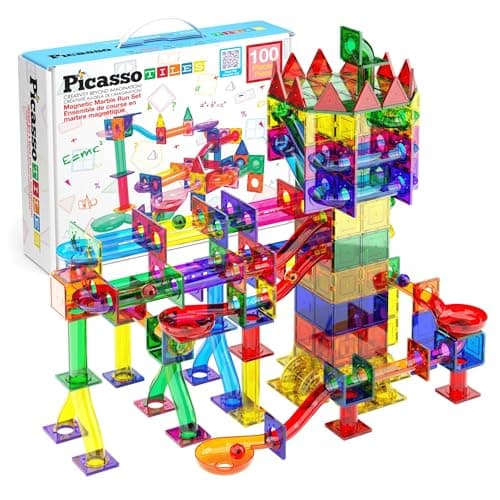
When a tile set goes quiet, the fix is almost never more tiles. Give the tiles a job instead: a marble run pack turns the collection into a machine with a success condition, and it costs less than another hundred tiles while restarting interest far more reliably.
Block & Beaker earns a commission when you buy through our links, at no cost to you. It never changes a ranking, and we say so plainly when the right answer is the cheaper set, or nothing at all. Full disclosure · How we pick.
At a glance
The picks, ranked
Tap any row to jump to the full reasoning. Prices come live from Amazon where we have them and read “check price” where we don’t — never a number we cannot stand behind today.
| # | Product | Best for | Price |
|---|---|---|---|
| 1 | Best way to restart a quiet set PicassoTiles 100 Piece Marble Run Building Set Turns an existing collection into a marble run — a job, rather than more of the same. | Any household with tiles that nobody has touched for weeks | |
| 2 | Best new shapes Magformers Basic 62-Piece Set Twelve pentagons, which make domes and spheres that square-and-triangle sets cannot build. | A collection that is all squares and triangles | |
| 3 | Best for narrative builds CONNETIX Rainbow Creative Pack, 100 Pieces Doors, windows and fences, which turn a structure into a place with someone in it. | A child whose interest has moved from towers to stories | |
| — | 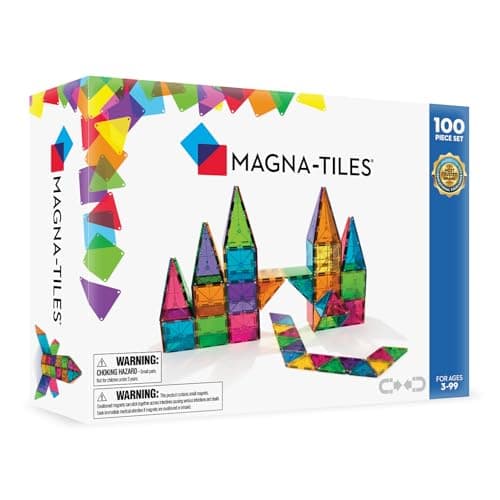 The one not to buy again MAGNA-TILES Classic 100-Piece Set Still the best first tile set, and the least effective thing to add to a set that has gone quiet. | A household with no tiles yet — not one topping up |
4 picks, including 1 we tell you to skip. Ages shown are the manufacturer’s own rating, not ours.
Ten things to build, with the tile count each needs
These are worked out from published tile dimensions rather than prescribed by any manufacturer, and the counts are approximate. The point of listing them is that most children build the first two and stop, because nobody suggested the rest.
The arithmetic
Builds, and roughly what they cost in tiles
| A simple four-wall enclosure | 16-20 tiles |
|---|---|
| The same with a pitched roof | 24-32 |
| A two-story house with a roof | about 55 |
| A cube you can put things inside | 6 large squares |
| A pyramid that closes at the top | 4 equilateral triangles plus a base |
| A garage with a ramp | 30-40, needs right triangles |
| A tunnel long enough to drive a car through | 20-24 |
| A tower as tall as the child | 60-80, depending on tile size |
| A dome | Needs pentagons — impossible with squares and triangles |
| A working marble run | Needs a marble run pack |
Five things to try that are not builds
Build to a constraint. “Make something taller than this book using only triangles.” Constraints produce more inventive building than open instructions, reliably.
Build in the window. Translucent tiles against daylight are a completely different object, and it is the cheapest way to make an old set look new.
Build for someone. A house for a specific toy, sized to fit it. The constraint is real and the child cares about the outcome.
Build something that has to survive. A structure a marble rolls through, or a bridge that has to hold a book. Testing to destruction is engineering, and children take it seriously.
Copy a real building. Look at a photograph and try to make it. This is much harder than it sounds and it is the activity most likely to interest an eight-year-old who has decided tiles are for younger children.
Why sets go quiet, and what actually restarts them
A tile set usually goes quiet for one of two reasons, and they need different fixes.
The child has run out of ideas. The fix is a constraint or a challenge, not more material. This is free, and the suggestions above are most of it.
The set has run out of possibilities. This is a real limit: a hundred squares and triangles genuinely cannot make a curved surface or a working marble run. The fix is new shapes or a new function, and that costs money — but much less than doubling the collection.
The diagnostic question: has the child stopped building, or stopped building anything new? If they are still building the same castle, they need a challenge. If they have stopped entirely, they need something the set cannot currently do.
Say the unwelcome thing
Do not buy more of the same tiles
It is the instinctive purchase and it is the least effective one. Going from 100 tiles to 200 lets a child build a bigger version of what they were already building, which is not what stalled.
A marble run pack, a set with pentagons, or a box with doors and windows costs the same or less and changes what is possible. Novelty is the constraint past a hundred pieces; volume is not.
Where to go next
If you are still choosing a first set, the magnetic tiles roundup and the three-way brand comparison are the pages you want. If the child has genuinely outgrown tiles, marble runs and other construction systems are the natural next steps.
In full
Every pick, and what is wrong with it
Published specifications only, each linked back to the page it came from. Where a manufacturer publishes nothing, the row says so — we do not fill blanks in.
1. Best way to restart a quiet set
PicassoTiles 100 Piece Marble Run Building Set
PicassoTiles · PTG100 · maker rates it 3+
Turns an existing collection into a marble run — a job, rather than more of the same.
- Pieces
- 100
- Stated age
- Ages 3+
- Includes
- Magnetic tiles plus steel-weighted marbles
- Material
- “BPA-free and non-toxic” with a smooth-edge protective design
PicassoTiles publishes 100 pieces including magnetic tiles and steel-weighted marbles, rated 3+, in BPA-free non-toxic material with smooth edges.
The reason this works better than more tiles is that it changes what the tiles are for. A tile wall is decorative and gets knocked down; a tile wall that has to get a marble from the top to the floor is a problem, and problems get returned to.
It also uses the tiles already in the house rather than replacing them, which is both cheaper and more interesting than doubling a collection.
Replay signal
- Open-ended or one-shot
- Open-ended in two directions at once — it is a tile set and a marble run
- Does anything run out
- Nothing runs out
- Room to grow
- Slots into an existing tile collection rather than replacing it
Why we say so: PicassoTiles publishes the 100-piece count, the ages 3+ rating and the steel-weighted marbles. The two-formats-in-one point follows from the published contents.
What’s wrong with it
Steel marbles in a house with a toddler is a supervision commitment, and they go missing quickly.
| Pieces | 100 |
|---|---|
| Stated age | Ages 3+ |
| Includes | Magnetic tiles plus steel-weighted marbles |
| Material | “BPA-free and non-toxic” with a smooth-edge protective design |
| Standards named | Not published |
| Consumables | None, though loose marbles are the part that goes missing |
Every figure above is from PicassoTiles, Magnetic Tile Marble Run Building Set (100 pieces). Blanks are shown as “not published” rather than filled in.
2. Best new shapes
Magformers Basic 62-Piece Set
Magformers · 63070 · maker rates it 3+
Twelve pentagons, which make domes and spheres that square-and-triangle sets cannot build.
- Pieces
- 62
- Shape mix
- 30 squares, 20 triangles, 12 pentagons
- Stated age
- 3+
- Magnets
- Neodymium rare-earth magnets that rotate inside the frame, so pieces “always attract”
Magformers publishes 30 squares, 20 triangles and 12 pentagons, rated 3+, with neodymium magnets that rotate so pieces always attract, and names CE, ASTM and EN71 compliance.
The pentagons are the reason to add this rather than more of what is already there. Five-sided pieces let a structure curve — a dome, a ball, a geodesic shape — none of which is possible with squares and triangles alone.
Twelve pentagons is enough to close a dome, which is the specific build most likely to make a child pick the whole collection up again.
Replay signal
- Open-ended or one-shot
- Open-ended, and the pentagons allow curved and domed builds that square-and-triangle sets cannot make
- Does anything run out
- Nothing runs out
- Room to grow
- Compatible with all Magformers shapes and accessories
Why we say so: Magformers publishes the 30/20/12 shape split, names CE, ASTM and EN71 compliance, and states compatibility with all Magformers shapes and accessories. The rotating magnets are a published design feature.
What’s wrong with it
Sixty-two pieces is below the hundred-piece threshold, so it only makes sense as an addition.
| Pieces | 62 |
|---|---|
| Shape mix | 30 squares, 20 triangles, 12 pentagons |
| Stated age | 3+ |
| Magnets | Neodymium rare-earth magnets that rotate inside the frame, so pieces “always attract” |
| Standards named | CE, ASTM and EN71 |
| Consumables | None |
Every figure above is from Magformers, Designer 62-piece set. Blanks are shown as “not published” rather than filled in.
3. Best for narrative builds
CONNETIX Rainbow Creative Pack, 100 Pieces
Connetix · Rainbow Creative Pack 100 pc · maker rates it 3+
Doors, windows and fences, which turn a structure into a place with someone in it.
- Pieces
- 100
- Stated age
- “Recommended for builders aged 3+”
- Material
- “non-toxic, BPA and phthalate-free ABS plastic”
- Construction
- “ultrasonically sealed and riveted for extra safety”
Connetix publishes a 100-piece pack for builders aged 3+, in non-toxic BPA and phthalate-free ABS, ultrasonically sealed and riveted, including window and door pieces, fences and a travel bag.
Architectural pieces do the same job as a marble run in a different direction. A building with a door has a resident, and a build with a resident survives the afternoon.
The fences are underrated: they enclose an area without walling it, which is what a farm, a zoo or a car park needs.
Replay signal
- Open-ended or one-shot
- Open-ended, and the window, door and fence pieces push play toward buildings rather than abstract towers
- Does anything run out
- Nothing runs out
- Room to grow
- Connetix publishes ball-run and expansion packs that attach to the same tiles
Why we say so: Connetix publishes the age rating, the material and the ultrasonic-seal-plus-rivet construction, and sells ball-run packs built for the same tiles.
What’s wrong with it
No published shape breakdown, so you do not know the square-to-triangle ratio you are adding.
| Pieces | 100 |
|---|---|
| Stated age | “Recommended for builders aged 3+” |
| Material | “non-toxic, BPA and phthalate-free ABS plastic” |
| Construction | “ultrasonically sealed and riveted for extra safety” |
| Includes | Window and door pieces, fences, and a travel bag |
| Consumables | None |
Every figure above is from Connetix, Rainbow Creative Pack 100 pc. Blanks are shown as “not published” rather than filled in.
Skip this one
MAGNA-TILES Classic 100-Piece Set
Magna-Tiles · 4300 · maker rates it 3-99 years
Still the best first tile set, and the least effective thing to add to a set that has gone quiet.
- Pieces
- 100
- Shape mix
- 50 squares, 4 large squares, 20 equilateral triangles, 11 right triangles, 15 isosceles triangles
- Stated age
- “3-99 Years”
- Material
- “Food-grade, non-toxic MABS plastic that are free from BPAs, phthalates, and latex”
Magna-Tiles publishes 100 pieces in a specified shape mix, rated 3-99 years, compatible with all other Magna-Tiles sets.
This is our top pick everywhere else on the site and it is the wrong purchase on this specific page. If tiles have gone quiet, the problem is not quantity.
Two hundred tiles allows a bigger version of the same build. A marble run pack, a set of pentagons or a box of doors and windows allows a different one, and different is what restarts play.
Replay signal
- Open-ended or one-shot
- Open-ended — there is no finished state to reach
- Does anything run out
- Nothing runs out
- Room to grow
- Every set combines with every other Magna-Tiles set
Why we say so: Magna-Tiles publishes the full 100-piece shape breakdown, lists no consumable parts, and states that “all pieces are compatible with and complementary to all other MAGNA-TILES sets.”
What’s wrong with it
Doubling a collection changes what can be built without changing what there is to do with it.
| Pieces | 100 |
|---|---|
| Shape mix | 50 squares, 4 large squares, 20 equilateral triangles, 11 right triangles, 15 isosceles triangles |
| Stated age | “3-99 Years” |
| Material | “Food-grade, non-toxic MABS plastic that are free from BPAs, phthalates, and latex” |
| Magnet retention | Signature lattice plus “fastening rivets keep magnets safe and secure” |
| Consumables | None |
Every figure above is from Magna-Tiles, Classic 100-Piece Set. Blanks are shown as “not published” rather than filled in.
We are not putting a buy button on this one. It is easy enough to find if you want it anyway — but we would rather send you to something that gets played with twice.
Questions people actually ask
Frequently asked
What can you build with magnetic tiles besides towers?
Enclosures, pitched roofs, two-story houses, cubes, pyramids, garages with ramps, tunnels and marble runs. Two of the most rewarding builds — a dome and a working marble run — need pieces a standard square-and-triangle set does not contain.
My child has stopped playing with their magnetic tiles. What should I add?
Not more tiles. A marble run pack gives the existing collection a job, and a set with pentagons makes domes and curves possible. Both cost less than doubling the collection and restart interest far more reliably.
How many magnetic tiles do you need for a two-story house?
About 55, by arithmetic on the published tile dimensions — roughly 16 to 20 for a four-wall enclosure, 8 to 12 for a roof, and another 20 for a second story. That leaves nothing from a 60-piece set, which is why we recommend 100.
How do I get an older child interested in tiles again?
Give them a constraint or a target rather than material. Copying a real building from a photograph is much harder than it sounds and is the activity most likely to interest a child who has decided tiles are for younger kids.
Sources
Where these figures came from
Every specification on this page traces to one of these. If a manufacturer publishes nothing on a point, the page says so rather than filling the gap.
Read next
Where to go from here
Back to Guides, or read how we pick.